Quick wins for a faster PC:
Scan for outdated or missing drivers - takes under a minuteDriver Scan →Repair Windows errors before they cause bigger problemsFix Now →As a tropical fish grows, it usually uses more oxygen in total, but less oxygen per gram of body mass. That means a large fish may need more oxygen from the aquarium overall, while a small fish can have the higher mass-specific metabolism. Visible gill-cover (opercular) beats do not follow body size alone: temperature, activity, dissolved oxygen, carbon dioxide and species-specific gill design can all make a fish breathe faster or slower.
What “breathing rate” means in a fish
Fish breathing is often judged by counting opercular beats, but that is only one part of respiration. The main measurements are:
- Ventilatory frequency: how often the gill covers or other respiratory movements cycle.
- Ventilation amplitude or volume: how much water moves across the gills with each cycle.
- Oxygen consumption: oxygen used by the whole fish over time.
- Mass-specific oxygen consumption: oxygen used per gram of body mass.
A fish can compensate for a change in oxygen demand by altering frequency, stroke amplitude, or both. Therefore, counting beats alone cannot establish how much oxygen the fish is using.
Do bigger tropical fish breathe slower than small fish?
Not as a universal rule. Growth normally increases a fish’s absolute oxygen consumption because the animal has more tissue to maintain. However, oxygen consumption usually rises less than proportionally to body mass, so oxygen use per gram generally declines as fish become larger.
#1 Best Overall
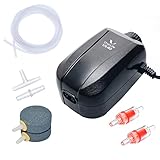
- Steady Output: Max Air Flow Rate: 64 GPH; Pressure: 0.016 MPa; Power: 4 W. Perfect for aeration in 10 - 100 gallon fresh water and marine aquariums.(The data is measured with experimental equipment and may deviate slightly from the actual data. The air volume may be insufficient due to the blocked air intake cotton. Please replace the cotton yourself if the air volume is insufficient.)
- Adjustable Air Flow: Feature a rotary knob to control the amount of air for dual outputs, allowing for your desired air flow to fully oxygenate your fish tank.
- Quiet Operation: The pump emits 25 dB sound under the “Low” mode and maximum 45 dB noise like the hum of a refrigerator under the highest air flow.
- 2 Air Stone Discs: Produce lots of dense medium bubbles bursting into the surface of water steadily. A great way to aerate your tanks and enliven the aquatic life.
- Pump Accessories: Include 2 air stones, 6.5-foot airline tubing, 2 check valves and 2 connectors. Complete accessories to build the basic aeration setup in your tank.
| Comparison | Typical size effect | What it means in an aquarium |
|---|---|---|
| Oxygen used by one whole fish | Usually increases with body mass | A large individual commonly adds more total oxygen demand than a small individual. |
| Oxygen used per gram | Often decreases as body mass rises | Small fish may have the greater demand relative to their own mass. |
| Opercular-beat frequency | Variable; not determined by size alone | Fast beats can reflect heat, exercise, low oxygen, high carbon dioxide or illness rather than small size. |
Across 69 teleost species, Andrew Clarke’s 1999 analysis found a mean body-mass scaling exponent of 0.79 (standard error 0.11) for resting oxygen consumption. In practical terms, this is sublinear scaling: doubling mass generally raises total resting oxygen use by less than twofold. The value is an average, not a formula for every tropical aquarium species.
Why the exponent is not fixed
Published standard-metabolic-rate exponents vary with species and conditions. A 2021 systematic review reported values from 0.64 for Nile tilapia at 25°C to 1.07 for Atlantic salmon at 20°C. Measurement protocol, life stage, acclimation, activity and water chemistry can all change the result. Species with accessory air breathing, ram ventilation or unusual gill structures may also depart from the pattern seen in typical teleosts.
Why body growth produces this pattern
Gill ventilation pushes water across the lamellae, where oxygen diffuses into the blood. Water contains less dissolved oxygen than air and is denser and more viscous, so moving enough water across the gills costs energy. As a fish grows, metabolic tissues and gill exchange surfaces do not increase in exactly the same proportion. The usual outcome is higher total demand but lower demand per unit mass.
Rank #2

- Steady Output: Max Air Flow Rate: 50 GPH; Pressure: 0.013 MPa; Power: 1.25 W. The pump supplies steady air flow with low power consumption. Work great for fish tanks or buckets up to 60 gallons.
- Adjustable Air Flow: There is a rotatable knob on the top to manually adjust the air volume. Greatly meet your desired air flow to keep fish or roots healthy.
- Quiet Operation: With 4 shockproof rubber feet to minimize vibration, the pump greatly reduces noise to less than 30 dB like a soft speaking voice. No disturbance to your daily life.
- Reliable Construction: The fish tank pump is well constructed with a sturdy ABS shell and a heavy-duty inner structure. Really lightweight and space-saving.
- Pump Accessories: Contain 6.5-foot 3/16" airline tubing (ID: 4 mm), 2 small air stone cylinders, 2 connectors (straight & T-shape) and 2 check valves. All build the basic aeration setup in your fish tank.
Gill respiratory surface area is commonly reported at about 0.1–0.4 m² per kilogram. That extensive surface lets fish match oxygen uptake to changing metabolic needs, but it does not make body size irrelevant: a large fish still has more total tissue to supply.
Temperature can outweigh the size effect
Tropical warmth raises biochemical reaction rates and resting metabolic demand. Clarke reported that a typical tropical fish at 30°C requires approximately six times as much oxygen for resting metabolism as a polar fish at 0°C. This is why size comparisons are meaningful only when temperature is held constant. A small fish in very warm water may use more oxygen per gram than a larger fish kept cooler, even if both are otherwise healthy.
How oxygen and carbon dioxide change visible breathing
Fish continuously adjust ventilation to metabolic demand and water chemistry. During hypoxia (low dissolved oxygen), many species hyperventilate by increasing respiratory frequency, ventilation amplitude, or both. Under hyperoxia, some reduce ventilation. Elevated carbon dioxide can also stimulate ventilation, while exercise and digestion increase oxygen demand.
Rank #3

- POWERFUL AERATOR PUMP & ENERGY CONSERVATION - AQQA fish tank air pump 3 watt equipped with a high-quality pump, the pump delivers stable output while conserving energy for optimal performance. Air volume for up to 80 gallon tank, the max pressure is 18Kpa and max air volume is 100GPH, can be easily connected to different type air stones, can be used for larger fish tanks, aquariums.
- NOISE REDUCTION ULTRA QUIET FUNCTION - The aquarium air pump features a sturdy double-layer structure with a built-in air pump and thickened casing, the bottom of the pump is designed with four soft rubber pads, which not only reduce noise, the max noise does not exceed 35dB but also prevent the pump from moving excessively during operation.
- DURABLE STAINLESS STEEL DUAL OUTLET DESIGN - The fish air pump designed with 2 stainless steel outlets, long service life, that can be used in multiple fish tanks or aquariums, making it suitable for both freshwater and seawater setups.
- ADJUSTABLE AIR FLOW SWITCH - The air pump aquarium is equipped with a knob on top, allowing you to easily adjust the air volume or switch without the need for frequent unplugging and plugging, making it more user-friendly.
- PACKAGE INCLUDED - 1 × Aquarium air pump with 5.91ft power cord; 2 × Air stones; 2 × 4.92ft Air tubes; 2 × Check Valves; 1 × User Manual. And you will get a 1-year after-sale product service and 7*24H lifetime customer service.
Ventilation itself has a measurable cost. A fish-gill review published by the American Physiological Society in 2003 estimated that routine gill ventilation can consume about 10% of oxygen uptake and may approach 70% during exercise. A rapid opercular rate is therefore both a response to demand and part of the energy cost of meeting it.
Does size determine survival in low oxygen?
No. Body size alone does not determine how well a fish can take up oxygen during hypoxia. A 2008 review by Claireaux and colleagues concluded that body size per se has little or no impact on hypoxic oxygen uptake because respiratory surface area generally matches metabolic rate across a wide range of sizes.
Recommended Free Tools
Nevertheless, small fish can become vulnerable quickly when oxygen is severely limited because their mass-specific metabolism is often higher. They may exhaust available oxygen relative to their body mass sooner, especially at high temperature or during activity. Species, gill morphology, acclimation and behavior remain decisive.
Rank #4
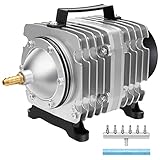
- HIGH PRESSURE, LARGE OUTPUT – This aquarium air pump delivers large output and high pressure of compressed air. Flow rate 600GPH, pressure 0.02Mpa, powered by a 18Watt electromagnetic motor.
- GREAT HEAT DISSIPATION - The housing of this air pump for aquariums is made of aluminum alloy with enlarged surface for the best heat dissipation. (Reminder – the air pump is highly recommended to be placed at a well-ventilated location. A cooling fan will help extend the life of the pump)
- EENRGY EFFICIENT, LONG LIFE – This air compressor is with lubricant free design. The high-quality cylinder and piston are made of wear-resistant materials to ensure the low consumption of power and long life.
- ACCESSORIES – Chrome coated metal air manifold. A 6-outlet manifold is provided for this pond aerator for easy access of oxygenation to anywhere you desire. The air output of each outlet is adjustable by simply turning the adjusting knob on the outlet.
- MULTIPLE APPLICATIONS – This commercial air pump is ideal for oxygenation of aquarium, pond, hydroponics, fish farm, and seafood restaurant, also great for compost tea brewing and air assist for laser cutting.
How to interpret fast breathing in a home aquarium
Do not diagnose a problem from fish size or beat count alone. Check the environmental causes first:
- Measure dissolved oxygen if possible, particularly before dawn when photosynthesis has stopped.
- Check temperature against the species’ accepted range; warmer water increases oxygen demand while holding less dissolved oxygen.
- Test for ammonia, nitrite and pH, since poor water quality can irritate gills or impair oxygen transport.
- Look for recent feeding, spawning, chasing, handling or other activity.
- Inspect whether several fish are breathing rapidly (suggesting a shared water problem) or only one (suggesting disease, injury or a gill-specific issue).
- Improve surface agitation and water movement with appropriate filtration or aeration, while avoiding a sudden temperature or chemistry change.
Persistent rapid breathing, gasping at the surface, loss of balance, clamped fins or unusual lethargy warrants prompt water testing and advice from an aquatic veterinarian or experienced fish-health professional.
How to compare fish fairly
For a meaningful size comparison, keep the following conditions consistent:
Free tools Windows power users keep installed
One-click scans. No signup required.
Best Value

- Ultra Quiet: Made of ABS thickening engineering plastics, super silent aquarium air pump. Soft rubber foot pads, further palliation for noise.
- Long Service Life: Manually adjustable air volume, won’t cause shakes and electric field fluctuation, much safer than electronic adjustment, lower failure rate.
- Aquarium Air Pump with 2 outlets, dual hose fish tank air pump, 3W air pump fit for fish tanks from 10 to 100 gallon.
- Unique Design: The air intake cotton is replaceable, it can filter the impurities in the air and extend the service life of the air pump, also come with 1 more replacement.
- Complete Accessories: Comes with everything you need, includes: Return Valve*2, Air Stone*2,Air Tube (2 x 4.9ft)*2, Suction Cup*2, Air Regulating Valve*2, T-Connector*1, Air Intake Cotton*1. Original quality, professional manufacturer.
- Use the same water temperature, salinity and dissolved-oxygen concentration.
- Compare fish at the same activity and feeding state; distinguish resting, routine and actively swimming measurements.
- Allow the fish the same acclimation period before measuring.
- Record body mass and life stage.
- Report both whole-animal oxygen consumption and oxygen consumption per gram.
- If counting opercular beats, state that frequency is an indirect proxy because ventilation amplitude and stroke volume may change.
These controls prevent a temperature, exercise or water-quality difference from being mistaken for a body-size effect.
What the size rule means for stocking
Plan oxygenation for the total biomass and the warmest expected water, not simply the number of fish. A large fish usually contributes more absolute oxygen demand, while a group of small fish can create substantial demand because their combined mass-specific metabolism is high. Stocking decisions must also account for species behavior, filtration, surface area, nighttime oxygen decline and emergency conditions such as power loss.
Quick Recap
Product prices and availability are accurate as of the date/time indicated and are subject to change. Any price and availability information displayed on Amazon at the time of purchase will apply.