As water warms within a fish’s tolerable range, its metabolism and oxygen demand generally rise. Yet warm water holds less dissolved oxygen than cool water, so a fish may need more oxygen just as less is available. The response varies by species and conditions, and it can change near a fish’s thermal limits.
What “respiration rate” means in fish
Respiration rate can mean either how quickly a fish consumes oxygen or how often it ventilates its gills, commonly observed as opercular (gill-cover) movements. These measures are related, but they are not interchangeable: oxygen consumption reflects metabolic demand, while ventilation frequency counts breathing movements.
Temperature is only one influence. Species, acclimation, activity, feeding, body size, life stage, health, stress and the dissolved oxygen in the water can all affect a fish’s oxygen use or gill ventilation.
Why warming can increase oxygen demand while reducing supply
Fish often use more oxygen as their metabolism speeds up
Fish are ectotherms: their body temperature is strongly influenced by the water around them. Within a tolerable range, warming tends to speed up biochemical and physiological processes. That can raise the energy required for maintenance and activity, and often increases oxygen consumption.
Recommended Free Tools
#1 Best Overall
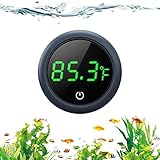
- HD LED Display: PAIZOO Aquarium Thermometer adopts LED screen to display temperature, LED can provide wide viewing angle and the color is saturated, it is easier to read the data no matter day or night. Green environmental protection and energy saving
- Cordless & Touch Design: Stick-on Induction Thermometer senses water temperature through probe, cordless design, no messy wires in the water, providing a clean and safe environment for fish.Touch the button to display the temperature, and the thermometer outside aquarium will enter the sleep state after 5s
- High Accurate Display: Tank Thermometer Aquarium just needs to tear off the adhesive and stick it below the water level on the outside of the tank. The thermometer for terrarium has a reading range of 0-140 °F and is accurate to 0.9 °F. Up to 5s refresh speed allows the naked eye to detect temperature changes more quickly
- Long Battery Life: The fish tank thermometer built-in 3V battery button, the battery is long-lasting. Mini design, easy to use. Digital thermometer is suitable for different water types such as fresh water, tap water, salt water, sea water, etc., to provide the most comfortable water environment for your beloved pets
- 100% Satisfied Customer Service: We provide 12-month warranty. In the event of any product quality defects within the warranty period, we will offer a free replacement without charge. PAIZOO customer service team operates 24/7 to deliver comprehensive, hassle-free support for an optimal user experience
Warm water holds less dissolved oxygen
The physical capacity of water to hold oxygen declines as temperature rises. University of Florida IFAS Extension gives saturation examples of 11.9 mg/L at 45°F and 7.4 mg/L at 90°F. These are oxygen concentrations at saturation, not measurements of what will necessarily be present in a particular pond or aquarium; actual dissolved oxygen depends on conditions such as aeration, photosynthesis and respiration.
When warming raises a fish’s oxygen demand while lowering the water’s oxygen availability, the two effects can combine to make warm conditions challenging. In ponds, oxygen can also fluctuate over the day: plants produce oxygen in daylight, while plants and animals consume it through respiration, and levels commonly fall at night.
Rank #2

- New digital aquarium thermometer: LED display fish tank thermometer with professional LCD visual effect, the fish tank and aquarium water temperature can be displayed clearly, despite the night light, and can be easily read. Mini compact body design is suitable for a variety of different types of fish tanks and aquariums, is a must have fish tank accessories.
- Safe wireless touch design: The digital fish tank thermometer comes with a touch power button, which can be easily awakened by clicking. The built-in high sensor probe measures the water temperature for fish tank, well-organized wire in the fish tank to protect the fish from being swallowed or electrocuted, providing a clean and safe living environment for the pet fish axolotl turtle.
- Simple installation: The tank thermometer does not need any installation tool to remove the adhesive on the back, stick it on the outside of the tank below the tank water level, and after standing for 5 minutes, it can accurately and real-time monitor the aquarium temperature change.
- Accurate data: tank thermometer aquarium measurement range of the tank thermometer is 0°C~60°C, the accuracy is 0.18°C, and the error is ±1 °C. This is suitable for axolotl tank, turtle thermometer, saltwater fish tank accessories, betta fish tank thermometer, etc..
- Long life battery: Thermometer for aquarium fish tank is powered by a CR2032 battery (included), and the battery lasts up to 12 months. The wireless aquarium digital thermometer will automatically enter the sleep mode after 5 seconds of no operation, extend the battery life, and be more environmentally friendly and energy saving.
Why the response differs among fish and temperatures
There is no single temperature-to-respiration rule or universal oxygen-consumption rate for all fish. The response depends on the species, the temperatures tested, whether fish were acclimated, their activity and health, and which measure a study used.
Stream fishes show species-specific patterns
Nathan Hartline’s study of five stream-fish species found that respiration increased with temperature in four species, while Cottus carolinae showed a declining trend. Oxygen regulation patterns also differed among the species. Lindsay Horne’s work on game and non-game fish likewise found that temperature effects on metabolism, critical oxygen levels and related regulation measures varied among species. Read Hartline’s study and Horne’s dissertation.
The Tool Desk
Outbyte PC Repair FREERepair Windows errors before they cause bigger problemsFix Now →Outbyte Driver Updater FREEFix the driver behind crashes, sound loss and screen glitchesFind Drivers →Rank #3

- Wide Application: Ideal for use in water or high moisture environment like aquarium terrarium, or vivarium, suitable for different water types such as fresh water, tap water, salty water, marine water and etc.
- Easy to Read: Comes with a large LCD display that is easy to read clearly.
- Easy to Setup: Submerge probe with suction cup can easily be set in water. (Submerge probe only, do not submerge thermometer in water) Press ''PWR'' for 3 seconds to power off.
- Free LR44: 1 PC LR44 button cell for each thermometer
- Wide Temperature Range: Measure -58°F to +158°F (-50°C to +70°C) with accuracy +/- 1°C
Tilapia illustrate the difference between standard and maximum metabolism
In a 2022 laboratory study of Nile tilapia, standard metabolic rate rose from 79.8 mg O₂ kg⁻¹ h⁻¹ at 18°C to 255.1 mg O₂ kg⁻¹ h⁻¹ at 38°C; the authors reported a Q10 of 1.79 for their experiment. Maximum metabolic rate did not keep rising throughout the tested range: it peaked at 373.8 mg O₂ kg⁻¹ h⁻¹ at 30°C and declined at higher temperatures. The authors estimated an absolute aerobic-scope optimum of 26°C for this species and experiment. These results describe Nile tilapia under the study conditions, not an ideal temperature or universal rate for fish generally. Read the Nile tilapia study.
Mahseer provide another species-specific example
In laboratory conditions, a study of mahseer (Tor tambroides) reported oxygen consumption of 1.55 ± 0.23 mL O₂ L⁻¹ h⁻¹ at 22°C and 5.5 ± 0.53 mL O₂ L⁻¹ h⁻¹ at 30°C. Those figures apply to the study’s species and conditions; they should not be treated as typical rates for other fish. Read the mahseer study.
Rank #4
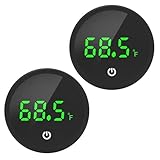
- New Digital Aquarium Thermometer: This new fish tank thermometer is equipped with an LED high-definition display and instant ℃/℉ switching (3-second response). It adopts an innovative circular buckle battery replacement design on the back, which takes care of your user experience in various aspects, meets the needs of different groups of people, and is an ideal for fish tank accessories.
- Safe wireless touch design: The digital fish tank thermometer comes with a touch power button, which can be easily awakened by clicking. The built-in high sensor probe measures the water temperature for fish tank, well-organized wire in the fish tank to protect the fish from being swallowed or electrocuted, providing a clean and safe living environment for the pet fish axolotl turtle.
- Simple installation: The tank thermometer does not need any installation tool to remove the adhesive on the back, stick it on the outside of the tank below the tank water level, and after standing for 5 minutes, it can accurately and real-time monitor the aquarium temperature change.
- Accurate data: tank thermometer aquarium measurement range of the tank thermometer is 0°C~60°C, the accuracy is 0.18°C, and the error is ±1 °C. This is suitable for axolotl tank, turtle thermometer, saltwater fish tank accessories, betta fish tank thermometer, etc..
- Long life battery: Thermometer for aquarium fish tank is powered by a CR2032 battery (included), and the battery lasts up to 12 months. The wireless aquarium digital thermometer will automatically enter the sleep mode after 5 seconds of no operation, extend the battery life, and be more environmentally friendly and energy saving.
What fish keepers and pond managers should monitor
Measure dissolved oxygen as well as water temperature. Temperature alone cannot tell you how much oxygen is actually available to fish, and surface behavior alone is not a reliable oxygen measurement. An electronic dissolved-oxygen meter measures oxygen in the water, not a fish’s respiration rate directly; chemical test kits are an alternative. IFAS identifies electronic meters as the most efficient option for pond monitoring.
For fish-production settings, IFAS recommends dissolved oxygen of at least 5 mg/L for optimum fish health. It also says most fish species are distressed at 2–4 mg/L and that mortality usually occurs below 2 mg/L. These are practical extension guidelines, not universal biological boundaries: sensitivity varies among species, and the effect of low oxygen depends partly on its depth and duration. See IFAS guidance on dissolved oxygen for fish production.
Quick Recap
Product prices and availability are accurate as of the date/time indicated and are subject to change. Any price and availability information displayed on Amazon at the time of purchase will apply.