Quick wins for a faster PC:
Scan for outdated or missing drivers - takes under a minuteDriver Scan →Clear out junk files and repair common Windows errorsFree Scan →Fix the driver behind crashes, sound loss and screen glitchesFind Drivers →A newly named fossil, Swaindelphys solastella, is the largest metatherian yet discovered from the Paleocene. Found in Big Bend National Park, Texas, it also extends the genus’s known range farther south and into younger rocks. The discovery does not establish the largest marsupial of all time or prove a particular migration route, but it gives paleontologists a new test case for how ancient geography shaped mammal distributions.
What was found in Texas?
Kristen Miller and K. Christopher Beard described Swaindelphys solastella in a 2025 paper in the Journal of Vertebrate Paleontology. The fossils come from the Tiffanian Ray’s Bonebed locality in the Black Peaks Formation at Big Bend National Park.
The animal is a metatherian—a member of the mammal group that includes living marsupials and their extinct relatives. “Possum” is a useful popular comparison, not the formal taxonomic name for this fossil species.
The University of Kansas release compares its overall size with a modern hedgehog. That is a qualitative comparison: the published sources do not provide a measured body mass, total length or other exact size figure.
Recommended Free Tools
#1 Best Overall
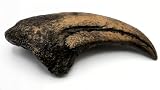
- Museum quality fossil cast replica from an acrocanthosaurus hand claw
- Claw is roughly 4.5 inches long
- Original was found at the Antlers Formation around the Oklahoma/Texas border
How large was it, exactly?
The scientific paper calls Swaindelphys the largest metatherian yet discovered from the Paleocene. A public-facing description calls it the largest marsupial by body size found so far in the North American Paleocene.
Those qualifiers matter. The evidence does not show that this species was the largest marsupial that ever lived worldwide, nor does it provide a precise weight or length. Its distinction is relative to the generally small metatherians known from that particular time and region.
How old is the Texas fossil?
The find belongs to the late Paleocene, broadly about 61–56 million years ago. News coverage often rounds the age to approximately 60 million years, but the study’s interval is the more informative geological framing. The Texas record is assigned to the middle Tiffanian, a North American mammalian age within that broader interval.
Rank #2
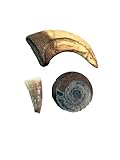
- Three-Item Fossil Set – Includes one Velociraptor claw replica, one Mosasaur tooth (B-grade), and one genuine small ammonite fossil
- Educational and Collectible – A great hands-on way to explore prehistoric life and paleontology
- Genuine Fossils Included – Both the Mosasaur tooth and ammonite are real fossil specimens
- Realistic Replica Claw – Velociraptor claw cast features high quality texture and curvature
- Ready for Display or Teaching – Great for collectors, educators, or science-themed gifts
What changed in the fossil’s known range?
Before the Texas discovery, reported Swaindelphys occurrences were known farther north, including southern Wyoming and the Four Corners region of New Mexico. The Big Bend material places the genus in west Texas near the international border.
| Question | Before the Texas record | After the Texas record |
|---|---|---|
| Geographic distribution | Known from southern Wyoming and the Four Corners region of New Mexico | Range extends south into west Texas at Big Bend |
| Stratigraphic distribution | Earlier reported Tiffanian occurrences | Range extends into the middle Tiffanian record described for the Texas material |
| Interpretive significance | Distribution appeared absent from some northern Paleocene assemblages | A southern occurrence provides another locality for testing why the pattern exists |
The authors note that Swaindelphys is conspicuously absent from some more northern Paleocene assemblages, although those areas have been sampled more thoroughly. A new southern specimen therefore changes the map without, by itself, explaining the absence.
What might the distribution reveal about ancient landscapes?
The researchers are investigating whether a prehistoric drainage divide helped separate mammal communities. The proposed divide would have stood between ancient drainage systems associated with the northernmost known occurrence at Swain Quarry, Wyoming, and the Texas locality.
Rank #3
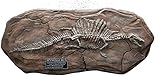
- Sold as a single fossils replica from the wonders of the wild Spinosaurus 1.0 Deluxe Edition Polyresin Statue Series featuring dinosaurs, ancient creatures and endangered species. A polyresin reproduction of the large animal skeleton, including the spurs of the torso compost, which is also derived from the scientific name.
- Product Size: Approx. 7.9 x 14.6 x 1.2 inches (20 x 37 x 3 cm). Weight: about 1.8kg
- Model Production: Scene Cooper / Planning Production: Explorer & Monster Shop
- Material: Plastic
This is a working hypothesis, not a demonstrated barrier. Several explanations remain possible:
- Paleodrainage: rivers and divides could have limited movement or separated habitats.
- Latitude: temperature, vegetation and seasonality could have restricted where the animals lived.
- Sampling and preservation: a patchy fossil record can make a species appear absent where it has not yet been found.
- Other ecological factors: food, competition or local environments could also have shaped the pattern.
Further fossils and geological work are needed to distinguish among these possibilities. The Texas specimen makes that question testable across a larger geographic and stratigraphic range.
What does it tell us about marsupial evolution?
The discovery improves the basic record needed to study early metatherian evolution: where these mammals lived, when they appear in the rocks and how their body sizes varied. Extending a genus’s range southward can reveal that an apparently northern distribution was partly an artifact of limited sampling.
Rank #4

- Replica Chirostenotes dinosaur claw – approx. 4.5 inches (11.43cm)
- Species: Chirostenotes pergracilis, Late Cretaceous (~76.5 million years ago), Alberta, Canada
- Realistic texture and anatomical accuracy – great for collectors, educators, and fossil enthusiasts
- Useful in paleontology education, museum displays, or as a unique prehistoric gift
- Display-ready fossil replica (stand not included)
It does not prove the origin of living marsupials, identify a direct ancestor or establish a migration route. The safest conclusion is that early metatherians occupied a broader and more complex Paleocene landscape than the earlier fossil map showed.
Independent reader supportYour contribution helps us test, update, and keep practical guides available for everyone.Why are early primates mentioned?
The same Paleocene ecosystems supported early primates. The University of Kansas release says that understanding possible landscape barriers for mammals such as Swaindelphys may provide collateral context for research on primate history.
That does not mean Swaindelphys was a primate or a primate ancestor. Its value is comparative: a better picture of ancient drainage systems and animal distributions can help researchers test whether similar geographic factors affected several mammal groups.
What’s actually slowing this PC down?
Pick the symptom - the matching free tool is one click away.
Best Value

- Feature: It is real, nature and authentic. Not fake or man-made.
- Size: It is variation 5cm - 8cm. Send by random.
- Note: Coz it is real fossil, each will be slightly different in shape, color, and size. Send by random.
- From: It is from the Hunan Province of China. Time: 450 million years ago silurian period.
- Gift: Memorable gift to friend, kids or family.
How was the material studied?
Fossils from Big Bend were collected by teams led by the late Judith Schiebout. Miller examined specimens held in collections at Louisiana State University and the University of Texas at Austin while preparing the species description.
Micro-computed tomography scans of all figured specimens were deposited in the open-access MorphoSource repository. Digital scans allow other researchers to inspect the illustrated material and evaluate anatomical interpretations without handling the original fossils.
What the discovery does—and does not—establish
- Established: Swaindelphys solastella is a new metatherian species from Big Bend’s Black Peaks Formation.
- Established: It is the largest metatherian yet reported from the Paleocene, with the public comparison limited to the North American Paleocene.
- Established: The Texas occurrence extends the genus’s geographic range and its reported biostratigraphic range.
- Not established: an all-time, worldwide “largest marsupial” record.
- Not established: a precise body weight or length.
- Not established: that a drainage divide, rather than latitude or another factor, caused the distribution pattern.
- Not established: a direct connection to primate ancestry.
Why this fossil matters
Swaindelphys solastella is important less because it was “giant” in an absolute sense than because it changes several boundaries at once: the southern limit of its genus, the known interval in which it lived and the range of body sizes represented among Paleocene metatherians. Those changes give researchers a stronger geographic framework for testing how terrain, climate and ecology structured mammal communities after the end-Cretaceous extinction.
Quick Recap
Product prices and availability are accurate as of the date/time indicated and are subject to change. Any price and availability information displayed on Amazon at the time of purchase will apply.




