Windows Errors? Fix Them Before They Spread
Repair common Windows errors and clear accumulated junk for a smoother, more stable PC - no reinstall needed.Free scan · no reinstallCrashes, No Sound, or Screen Glitches?
Random freezes, missing sound and display glitches usually trace back to one bad driver. Find and replace yours safely.Free scan · under a minuteFor most freshwater aquariums, the only routine chemical you must buy is a water conditioner (dechlorinator) that removes chlorine and chloramine from tap water. You also need a freshwater test kit for ammonia, nitrite, nitrate and pH. Bottled beneficial bacteria can help start a filter but are optional; pH, hardness, salt, medication and algae products belong in a problem-specific plan, not an automatic shopping list.
The essential supplies
Water conditioner for tap water
Municipal water may contain chlorine or chloramine, both of which can injure fish and damage the beneficial bacteria living in your filter. Use a conditioner labeled for freshwater aquariums whenever you add treated tap water, including during setup and every water change.
- Choose a product whose label explicitly covers chlorine and chloramine.
- Check whether it also treats heavy metals or states an ammonia-related function.
- Measure the amount of new water and dose exactly as directed on the current label.
- Add the conditioner to the replacement water before it enters the aquarium, unless the label gives different instructions.
Do not assume that letting water stand removes chloramine; ask your water utility which disinfectant it uses and check its latest water-quality report.
A test kit
Testing tells you whether the biological filter is processing fish waste and whether a water adjustment is actually needed. At minimum, test ammonia, nitrite, nitrate and pH. Add KH (carbonate hardness) and GH (general hardness) tests when your species requires particular hardness, your pH is unstable, or you use very soft or reverse-osmosis water.
Free tools Windows power users keep installed
One-click scans. No signup required.
#1 Best Overall

- Contains one (1) API TAP WATER CONDITIONER Aquarium Water Conditioner 16-Ounce Bottle
- Neutralizes chlorine, chloramines and other chemicals to make tap water safe for fish
- Prevents tap water chemicals from causing gill destruction, tissue irritation and fish death
- Super strength, high concentration formula
- Use when adding or changing water and when adding new fish to freshwater and saltwater aquariums
Liquid reagent kits generally provide more graduated readings, while strips are quicker and can cover several parameters at once. Whichever format you choose, make sure ammonia is included for a new aquarium; a multi-parameter strip may not include it.
What is optional during setup?
Bottled nitrifying bacteria
Products such as API QUICK START and Seachem Stability are marketed to seed or support the biofilter. They may be useful during setup or after filter disruption, but they do not prove that a tank is cycled. Continue running the filter and use ammonia, nitrite and nitrate results to decide when the aquarium can safely support fish.
Rank #2

- POWERFUL TREATMENT: Seachem Prime is a complete and concentrated conditioner for both freshwater and saltwater fish tanks, working hard to remove chlorine and chloramine.
- REMOVER: Seachem Prime immediately and permanently removes chlorine and chloramine, successfully allowing the bio filter to remove ammonia, nitrite, and nitrate while they are detoxified for 48 hours.
- DETOXIFIER: Seachem Prime effectively detoxifies ammonia, nitrite, and heavy metals found in the tap water at typical concentration levels, providing a ideal environment for your betta, tetra, or other fish.
- USE: Use 1 capful (5 mL) of Seachem Prime for each 200 L (50 US gallons) of new or replacement water. For best results, add Seachem Prime to new water first. For exceptionally high chloramine concentrations, a double dose may be used safely. For smaller volumes, use 2 drops per gallon.
- SAFETY: In case of an emergency, the 5x dose of Seachem Prime may be used for both ammonia and nitrite. Use a ½ dose if the water temperature is > 30°C (86°F) and chlorine or ammonia levels are low.
Ammonia-detoxifying products
Some conditioners, including products marketed as Prime or Safe, are described by their manufacturer as detoxifying ammonia or other toxic compounds. They can be useful as an emergency measure or where chloramine treatment leaves ammonia, but they do not replace biological filtration, testing or water changes. Follow the product’s stated duration and dosing limits rather than treating detoxification as a permanent solution.
Chemicals you should use only for a defined need
pH adjusters and buffers
“pH-up” and “pH-down” products can move a reading temporarily, but pH is tied to alkalinity and other water chemistry. Repeatedly forcing a number can create swings that stress fish and destabilize the biofilter. Test pH and KH first, then adjust only when the species’ requirements and your source water justify it. If a buffer is needed, use a product designed for the intended direction and make changes gradually.
Rank #3

- Contains one (1) API STRESS COAT Aquarium Water Conditioner 16-Ounce Bottle
- Makes tap water safe and protects fish with dual-action formula
- Removes chemicals from tap water that are harmful to fish
- Replaces fish’s protective coat damaged by handling or fish fighting with healing power of Aloe Vera extract
- Use when adding or changing water, when adding new fish and when fish are sick or injured
KH, GH and remineralization products
Hardness products are appropriate when test results show that the source water does not meet a species’ needs—for example, with very soft or reverse-osmosis water. They are not universal additives. Match the final KH and GH to the fish or invertebrates you keep, and make the same measured mixture for each water change.
Salt, medicines, algaecides and clarifiers
These are not standard freshwater setup chemicals. Salt can be unsuitable for some plants, fish and invertebrates; medication should target a diagnosed condition; and algaecides or clarifiers can mask an underlying lighting, nutrient or maintenance problem. Use them only with a species-appropriate husbandry plan and clear label directions.
Rank #4

- Contains one (1) API TAP WATER CONDITIONER Aquarium Water Conditioner 4-Ounce Bottle
- Neutralizes chlorine, chloramines and other chemicals to make tap water safe for fish
- Prevents tap water chemicals from causing gill destruction, tissue irritation and fish death
- Super strength, high concentration formula
- Use when adding or changing water and when adding new fish to freshwater and saltwater aquariums
A safe chemical sequence for a new aquarium
- Test the source water. Measure pH and, when relevant, KH and GH. Check your utility report for chlorine or chloramine.
- Condition every batch of tap water. Calculate the volume of replacement water, add the label dose, and mix before adding it to the tank.
- Run the filter and establish the nitrogen cycle. Beneficial bacteria convert ammonia to nitrite and then nitrate. A bottle may assist, but only test readings demonstrate progress.
- Monitor while cycling. Test ammonia, nitrite and nitrate regularly; weekly testing is a practical baseline, with extra ammonia checks in a newly started tank.
- Stock gradually and keep testing. New fish increase waste production, so verify that ammonia and nitrite remain controlled after each addition.
- Adjust hardness or pH only when justified. Make small, measured changes and avoid abrupt shifts in pH, temperature, KH or GH.
How to choose between products
| Product | Check before buying | Normal role |
|---|---|---|
| Water conditioner | Chlorine/chloramine coverage, any ammonia claim, dose per volume, freshwater compatibility and clear directions | Routine treatment of tap water |
| Test kit | Ammonia, nitrite, nitrate and pH; KH/GH if needed; liquid or strip format; reading range and resolution | Verify cycling and water conditions |
| Bottled bacteria | Startup versus maintenance use, freshwater compatibility, storage instructions and a way to verify results with tests | Optional biofilter support |
| pH or hardness product | Target range, effect on KH/GH, dosing method and species justification | Conditional correction of unsuitable water |
Common mistakes to avoid
- Adding untreated tap water because the water looks clear.
- Dosing conditioner for the aquarium’s full capacity when the label calls for the volume of new water.
- Calling a tank cycled because bottled bacteria were added, without ammonia and nitrite results.
- Chasing a “perfect” pH while ignoring KH, source-water chemistry and species tolerance.
- Adding several buffers or supplements at once, making it impossible to identify the cause of a change.
- Using salt, medication or algaecide as routine maintenance.
A practical first shopping list
For a typical tank filled with treated municipal water, buy:
- A freshwater conditioner that handles chlorine and chloramine.
- A test kit covering ammonia, nitrite, nitrate and pH.
- KH and GH tests if your fish, shrimp, plants or source water make hardness relevant.
- Bottled nitrifying bacteria only if you want an optional startup aid.
Keep the conditioner and test kit available for every water change and for diagnosing problems. Add other chemicals only after measurements and the needs of the animals give you a specific reason.
Quick Recap
Best Value
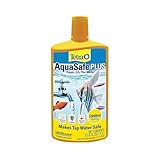
- FOR FRESHWATER AND MARINE AQUARIUMS: Tetra AquaSafe Plus works instantly to make tap water safe for fish.
- ADVANCED FORMULA: Neutralizes or removes harmful chlorine, chloramines and heavy metals.
- PROTECTS FISH: Enhances protective slime coat to help wounds heal.
- CLEAR AND HEALTHY WATER: With natural biopolymers and essential vitamins and minerals.
- WATER CONDITIONER: Use when setting up a new aquarium, with monthly partial water changes, or evaporation replacement.
Product prices and availability are accurate as of the date/time indicated and are subject to change. Any price and availability information displayed on Amazon at the time of purchase will apply.