Free tools Windows power users keep installed
One-click scans. No signup required.
In common fisheries life-stage terminology, a fish becomes a larva when it hatches. If it still has a yolk sac, it is a yolk-sac larva and may not yet feed on its own. Some classical embryology sources instead place the embryo-to-larva boundary at complete yolk absorption, so the answer depends on which staging convention is being used.
Is a newly hatched fish a larva?
Yes, under the hatching-based terminology used in fisheries staging. NOAA’s Alaska Fisheries Science Center defines the egg stage as ending at hatching and the yolk-sac stage as running from hatching until the yolk is completely absorbed. A hatchling with yolk remaining is therefore a larva, specifically a yolk-sac larva. NOAA’s life-history stage definitions also describe later larval stages by features such as fin development.



“Larva” does not mean a miniature adult or a fish that is already feeding independently. The hatchling may still rely on nutrients stored in its yolk sac.
Why do some sources place the boundary later?
Not every discipline uses the same boundary. In classical embryology terminology, the embryo stage may continue after hatching and end only when the yolk has been fully absorbed. By contrast, NOAA’s applied fisheries scheme and Eurostat’s fish-life-stage metadata treat hatching as the start of the larval period; Eurostat uses “fry” for a stage after yolk absorption. The Eurostat life-cycle metadata illustrates that labels can differ across frameworks.
The Tool Desk
Outbyte PC Repair FREERepair Windows errors before they cause bigger problemsFix Now →Outbyte Driver Updater FREEFix the driver behind crashes, sound loss and screen glitchesFind Drivers →| Staging convention | Boundary | What it calls a newly hatched fish with yolk |
|---|---|---|
| NOAA fisheries life-history staging | Egg stage ends at hatching; yolk-sac stage lasts until yolk absorption | Yolk-sac larva |
| Referenced bony-fish stage scheme | Yolk-sac larva lasts from hatching to yolk absorption; larval stage follows | Yolk-sac larva |
| Classical embryology terminology described in a textbook preview | Complete yolk absorption may mark the embryo-to-larva transition | May still be called an embryo |
| Eurostat fish-life-stage metadata | Eggs become larvae at hatching; fry follows yolk absorption | Larva |
For clarity, name the convention when comparing sources or describing a particular study. The SEAFDEC resource “Developmental Stages of Bony Fish” describes the hatching-to-yolk-absorption yolk-sac interval; a Wiley textbook preview discusses the classical embryology usage.
Hatching, yolk absorption and feeding are different milestones
These events should not be treated as one transition. A fish can hatch, remain a yolk-sac larva while it uses stored nutrients, absorb the yolk, begin feeding, and later develop into a juvenile at separate points in its development. NOAA defines the yolk-sac stage through complete yolk absorption and identifies the following preflexion stage separately.
Rank #2
Egg type also affects how developed a hatchling is. Some fish hatch while yolk remains; in some species with demersal eggs, yolk is absorbed inside the egg, so the fish emerges at a later larval stage. The FAO manual on warm-water fish propagation describes hatching as larvae emerging through the egg shell: The Artificial Propagation of Warm-Water Finfishes: A Manual for Extension.
Independent reader supportYour contribution helps us test, update, and keep practical guides available for everyone.A sea bass example shows why timing varies
For *Lates calcarifer* (Asian sea bass), an FAO culture manual reports hatching about 18 hours after fertilization at 28–30°C and salinity of 30–32 ppt. In that example, most yolk is absorbed about three days after hatching, when the mouth opens and feeding begins. These are species- and condition-specific timings, not a schedule for fish generally. FAO’s Training Manual: Biology and Culture of Sea Bass provides the example.
Recommended Free Tools
Quick Recap
Best Value
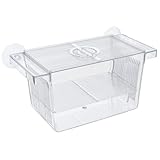
- Tiny Hatching Box: With inner size of 4.2" L x 2.7" W x 2.8" H, it protects newborn fry from being eaten or attacked. Suitable for feeding tiny fish or shrimp ONLY.
- Slotted Bottom Panel: It can effectively prevent soiling of the box by debris, food residues or excrement, and the slim slots in it keep the newborn fish from escaping.
- Floating Design: The balancing panel and 2 handles help keep the box floating on water, it can also be secured inside the tank with 2 suction cups. Space-saving during use.
- Acrylic Material: The highly transparent acrylic box allows you to watch the breeding process or fish fighting without any barriers, bringing you with endless enjoyment.
- Easy to Use: The incubator can be easily installed or disassembled for cleaning without any tool. And its side vents ensure optimum water flow, requiring no heater or air pump.
Rank #4
Product prices and availability are accurate as of the date/time indicated and are subject to change. Any price and availability information displayed on Amazon at the time of purchase will apply.




