A web-covered wall in Sulfur Cave, on the Albania–Greece border, holds an estimated 111,000-plus spiders. Guinness World Records recognizes it as the largest multi-species spider web, covering 106 m² (1,141 sq ft). The colony is remarkable not only for its size: two species, Tegenaria domestica and Prinerigone vagans, form one enormous connected web in a cave ecosystem powered by chemical energy rather than sunlight.
Where is Sulfur Cave, and when was the web discovered?
Sulfur Cave lies in the Vromoner Canyon region along the Albania–Greece border. Czech Speleological Society cavers brought the web to scientific attention in 2022. Researchers sampled spiders there in 2024, and the study documenting the community was published in Subterranean Biology on 17 October 2025.
The study, titled An extraordinary colonial spider community in Sulfur Cave (Albania/Greece) sustained by chemoautotrophy, describes an unusual concentration of spiders living in a shared web structure. The cavers’ 2022 discovery and the later scientific study are distinct milestones: the web was noticed first, then sampled and documented by researchers.
Is it the world’s largest spider web?
The most precise record claim is that Guinness World Records lists Sulfur Cave’s structure as the largest multi-species spider web. Guinness gives its web-covered wall area as 106 m² (1,141 sq ft). Some coverage calls it the world’s largest spider web, but that broader wording is less specific than the formal record category; it is safest to describe it as the largest multi-species web, or as a reported contender for the largest web overall.
#1 Best Overall

- 【Acrylic Reptile Terrarium】Our small reptile cage measures 7.87" x 4.72" x 4.33", perfect size for kinds of baby reptiles or other small animals, providing sufficient room for reptiles pets to move around.
- 【360 Degree View】Our large breeding tank is all-round transparent, it's convenient to observe your slithery friends in the box and feed them in time. The top is clam-shell design, easy to open and close.
- 【Easy to Install】Tear off the protective film on the surface at first and the acrylic tarantula enclosure requires a simple installation , the rubber bands do well in holding everything together. It's also easy to disassemble when not use for saving storage space.
- 【Perfect Design】This reptile breeding box tarantula enclosure is designed with ventilation holes on the two sides, providing the reptiles with fresh air. And the locking handle keeps your pet safe.
- 【Reptile Tank for Insects】Provide a perfect home and a warm habitat for your small reptiles, amphibians and invertebrates. Ideal for spiders, lizard, small turtles, snails, frogs, snakes, tarantulas, hermit crab or any other insects.
The 106 m² figure is the area covered by web on the wall, not the total area of Sulfur Cave. The structure is also not one single, smooth sheet: thousands of individual funnel-shaped webs combine into a vast patchwork.
How many spiders live in the giant web?
The colony is estimated at more than 111,000 spiders, not counted as an exact census of every individual. Guinness’s figures are about 69,000 Tegenaria domestica and more than 42,000 Prinerigone vagans. The FAO AGRIS abstract of the study likewise reports the two species and a combined community exceeding 111,000.
Rank #2

- Spider house package contains: 9.5 x 5.5 x 5.5 inches jumping spider enclosure, 2PCS spider climbing platform, 1PCS temperature and humidity detector, 1PCS jumping spider hide, 1PCS jumping spider water dispenser,6PCS glow-in-the-dark mushrooms, 1PCS bark, 1PCS turf, 2PCS simulated stones, 6PCS grass, 1PCS pavilion, 3PCS crystals, and some moss.
- Easy to observe:Our glass house is fully transparent, allowing you to easily observe and feed your spider inside. The top features a clamshell design for easy opening and closing.
- Easy installation:Remove the protective film from the surface first. The acrylic tarantula enclosure requires simple assembly, with rubber bands effectively securing everything together. It is also easy to disassemble when not in use, saving storage space.
- Perfect design:This insects enclosure habitat features ventilation holes on both sides, providing fresh air for reptiles.
- Jumping spider enclosure:Our jumping spider enclosure measures 9.5 x 5.5 x 5.5 inches, providing ample space for climbing and activity, ideal for your pet jumping spider.The package contains a temperature and humidity detector, with two LR44 batteries included inside the device.
Tegenaria domestica is the larger funnel-weaving species in the community; Prinerigone vagans is smaller. Their presence in the same extensive colonial web is the key biological novelty. The finding does not mean spiders have never lived near other spiders: it documents these two species together in a shared web formation on an extraordinary scale.
How do spiders survive in a sulfur cave?
The cave’s food web begins with sulfur-oxidizing microbes. They produce biofilms that support non-biting midges; the spiders then prey on the midges. Rather than relying on plants capturing sunlight as the starting point of the food chain, this system is sustained by chemical energy through chemoautotrophy.
Rank #3
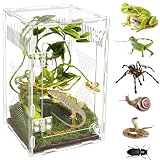
- Versatile Multi-Species Habitat: Designed for reptiles (leopard geckos, lizards,praying mantis), arachnids (jumping spiders, tarantulas), and amphibians (frogs), plus small critters like hermit crabs or praying mantises. 9.8*5.9*5.9inch accommodates most life stages
- 360° Crystal-Clear Acrylic Walls: This Reptile Terrarium offers unobstructed visibility to monitor pets like jumping spiders, tarantulas, or chameleons, with ultra-transparent, scratch-resistant acrylic that stays clear for a long time
- Easy Tool-Free Assembly: Effortlessly snap together this terrarium without screws or tools—perfect for beginners creating habitats for geckos, bearded dragons, or hermit crabs
- Keep Your Pet Secure: Precision-engineered 0.1inch ventilation gaps and a twist-lock door keep your pet secure, ideal for tiny pets like baby spiders, snails, or tree frogs
- Durable & Scratch-Resistant: Made with non-yellowing, high-grade acrylic, this enclosure resists scratches from claws or decor, ensuring a pristine reptile tank or spider terrarium
Researchers describe the joint web formation by these species as the first documented example of its kind. One proposed explanation for their coexistence is that pitch darkness may interfere with the larger funnel weaver’s hunting, reducing predation on the smaller species. That is an ecological interpretation reported alongside the study, not proof that darkness always prevents competition or that the same arrangement occurs elsewhere.
Independent reader supportYour contribution helps us test, update, and keep practical guides available for everyone.Why is this discovery unusual?
The headline number and area are striking, but the study’s ecological significance is more specific: two spider species not previously known to build a colonial web together occupy the same enormous connected structure. The cave also links that social arrangement to a food web based on sulfur-oxidizing microbes, rather than sunlight-driven plant growth.
Rank #4

- Moisture Retention - Moss is highly absorbent and retains moisture well, making it ideal for reptiles that tropical or require higher humidity levels environments. The sphagnum moss can allowing it to maintain moisture levels in the enclosure for an extended period, keep the humidity stable and prevents the substrate from drying out too quickly, provide natural and comfortable habitat for these reptiles
- Hiding Spots and Nesting Naterial - Reptile moss can be utilized as a substrate for reptiles that require hiding spots or nesting material. It provides a soft and natural surface for reptiles to burrow into or lay their eggs, promoting natural behaviors. Additionally, moss can aid in shedding, providing a moist surface for the reptiles to facilitate the shedding process
- Reptile Substrate - Moss can be used as a part of the substrate for snakes, turtle, frog and gecko, especially those that require higher humidity,it can provide insulation, providing a comfortable surface for reptiles to rest upon. peat moss cannot be used as a primary substrate. Snakes need a combination of mixed substrates such as some poplar shavings, and turtles, frogs, geckos and other reptiles need a combination of aquatic plants, rocks and other substrates such as sand or gravel
- Sphagnum Peat Moss Widely Used - Sphagnum moss for reptiles can not only be used as reptile bedding materials , can also be used as egg laying and incubation medium, substrate for the bottom of reptiles and amphibians feeding boxes with certain humidity. It can also be used as a nutrient for orchids, ferns, and succulents, sphagnum moss for plants,as well as for succulent modeling, filling hanging basket lines, and decorating wreaths
- Maintenance - Sphagnum moss for reptiles requires regular maintenance. It should be kept clean and moist, regularly replace the moss if necessary , but not overly wet, to avoid any health issues for your reptile
As study lead author István Urák, associate professor of biology at Sapientia Hungarian University of Transylvania, told Live Science: “The natural world still holds countless surprises for us.”
Quick Recap
Best Value
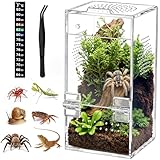
- 【Fresh Airflow Circulation】287 micro ventilation holes (0.06" diameter) are distributed across all 4 sides of this jumping spider habitat, with low intake vents drawing in cool air and high exhaust vents releasing warm, humid air. This layout maintains a steady bottom-to-top flow of fresh air inside the spider terrarium, effectively lowering humidity and preventing stale air buildup, while ensuring a stable microclimate for your reptile.
- 【No Assembly, No Mess】Skip the hassle of flat-packed cages! Unlike spliced designs that leak sand and water through panel gaps, this praying mantis enclosure arrives fully assembled with a sealed base to keep substrate and water securely inside. Four non-slip pads on the bottom provide extra stability—no sliding, no spills, just a clean, leak-free habitat from day one.
- 【Magnetic Side-Opening Door】This jumping spider enclosure features a strong yet easy-to-open magnetic side door, allowing you to feed or mist without disturbing your pet’s setup. The smart side-slide design avoids upper corners where spiders often build hammocks, keeping webbing intact. Perfect for a secure spider terrarium—no more worrying about pets sneaking out through a loose door.
- 【360-Degree Crystal-Clear View】Unlike dull, cloudy PP cages, this premium acrylic terrarium stays brilliantly clear—letting you watch your pet leap, hunt, and explore from every angle. Crafted from sturdy, scratch-resistant acrylic that won’t warp or leak, it’s a durable and pet-safe spider terrarium—perfect for nature lovers of all ages.
- 【Spacious 58% Larger Design】Our jumping spider enclosure kit measures 3.5 × 3.5 × 7 inches – 85.7 cubic inches of space! Compared to other 3×3×6-inch boxes (54 cubic inches), it provides 58% more space to create a cozy, enriched habitat your pet will love! (Enclosure ONLY, Plants and Animals NOT INCLUDED)
Sources
- Guinness World Records: “Largest multi-species spider web”
- FAO AGRIS: indexed abstract of “An extraordinary colonial spider community in Sulfur Cave (Albania/Greece) sustained by chemoautotrophy”
- Live Science: “World’s biggest spiderweb discovered inside ‘Sulfur Cave’ with 111,000 arachnids living in pitch black”
- George Washington University Media Relations: “Media Tip Sheet: World’s Largest Spider Web Discovered”
- Nature: “This is the world’s largest spider web — November’s best science images”
Product prices and availability are accurate as of the date/time indicated and are subject to change. Any price and availability information displayed on Amazon at the time of purchase will apply.
The Tool Desk
Outbyte PC Repair FREEClear out junk files and repair common Windows errorsFree Scan →Outbyte Driver Updater FREEFix the driver behind crashes, sound loss and screen glitchesFind Drivers →



