Most “banana slug” facts are really facts about the Pacific bananaslug, Ariolimax columbianus. Here are 10 that hold up—from its 10-inch maximum length to the surprising job its slime does in a coastal forest.
They may look like bright-yellow forest noodles, but banana slugs are specialized forest recyclers: they breathe through an opening on the side of the body, glide on a muscular foot, and turn fallen organic matter into nutrients. Most of the facts below are about the Pacific bananaslug, Ariolimax columbianus—the animal people usually mean in the Pacific Northwest when they say “banana slug.”
1. “Banana slug” is a familiar name, not a complete identification
The Pacific bananaslug is Ariolimax columbianus, as recognized by the U.S. Fish & Wildlife Service. “Banana slug” can be used more broadly for members of Ariolimax, so it is safest not to assume that every fact about one is true of every banana slug. Here, A. columbianus is the default.
2. They are creatures of damp Pacific-coast forests
Pacific bananaslugs occur in coastal temperate rainforests from central California to southeastern Alaska. Moisture is not a preference they can casually ignore: dry summer weather usually limits their activity to cool, damp nights and protected, humid spots. A rainy morning or the hours after a storm is when they are easiest to notice—on forest floors, logs, tree trunks, and trail edges. Muir Woods National Monument and Olympic National Park describe that moisture-dependent lifestyle.
#1 Best Overall

- Known for its heightened senses, this banana slug plush toy is ready to sniff out adventure with your child.
- Slink and slide into fun-filled play with this lifelike stuffed animal banana slug with a bright yellow pattern.
- Cuddles come naturally with this banana slug stuffed animal that is crafted with durable stitching for years of play.
- As the perfect birthday gift for kids or Christmas gift for kids, this banana slug animal plush is soft with pointy tentacles.
- Combining play with Earth-sustaining practices, The Petting Zoo is committed to providing little ones with cute and cuddly plush toys that are made from recycled water bottles.
3. A large one can approach a foot long
The Pacific bananaslug can reach up to 10 inches long, according to Muir Woods. That is a reported upper end, not the standard size of every slug on a walk. Still, it explains why an animal that initially looks like a yellow leaf or fallen fruit can become unexpectedly hard to miss. Source: National Park Service
4. Not all of them are banana yellow
Yellow is the classic look, often with dark spots, but it is not a rule. Olympic National Park reports animals ranging from bright to dark yellow, plus mixes of brown, black, white, and green. Color alone is therefore a poor reason to dismiss a large, smooth slug as “not a banana slug.” Source: Olympic National Park
Rank #2

- Meet Vinnie the Banana Slug Macaroon: a whimsical mashup of dragon fruit sweetness and forest critter charm, with a bright yellow “shell,” embroidered brown spots, and creamy fabric waves that echo movement
- Made with plush microfiber and silky polyester fill, Vinnie is irresistibly snuggly and resilient—ready for endless hugs.
- With a playful tuft of hair, expressive eyes, and a gleeful smiling face, Vinnie adds personality and fun to any collection.
- Surface-washable design provides peace of mind for parents—recommended for ages 24 months and up. Dimensions: 8 × 4 × 6 in
- Designed in Keene, New Hampshire, U.S.A. by Douglas Cuddle Toys, makers of lovable plush toys for over 60 years.
5. The “belly” is a muscular foot
A banana slug travels on one broad muscular underside, called a foot, over a layer of mucus. The combination lets it glide rather than walk on legs. Muir Woods puts its pace at about 6.5 inches per minute: enough to make progress across damp leaf litter, but not enough to hurry past a careful observer. Source: National Park Service
6. They have a one-lung “door” and four tentacles
Look at the right side of a Pacific bananaslug and you may spot its pneumostome, the small opening that admits air to its single lung. Its four tentacles also divide the work: the longer upper pair senses light and movement, while the shorter lower pair helps with touch and smell. At the front of the foot is the radula, a long, thin, tooth-bearing feeding ribbon used to work on food and taste it. Source: Muir Woods National Monument
Recommended Free Tools
Rank #3

- Bring a bright burst of color to your toddler toy collection with this yellow banana slug plush toy with outstretched tentacles.
- Slither into all-day play with this lifelike stuffed animal banana slug made with durable stitching and soft material.
- Slugs have heightened senses which is why this banana slug stuffed animal is the perfect one to have along on wildlife adventures.
- This small stuffed animal banana slug makes an ideal birthday gift for boys and girls or Christmas gift for kids.
- Combining play with Earth-sustaining practices, The Petting Zoo is committed to providing little ones with cute and cuddly plush toys that are made from recycled water bottles.
7. Slime is survival equipment, not just a gross-out feature
Mucus helps a slug glide and, crucially, slows water loss in an animal that is vulnerable to drying out. It can also contribute to defense: park sources note that it can deter predators. At the microscopic level, research on A. columbianus found that body-wall mucus is released from cellular material that forms the protective layer over the animal. Olympic National Park; mucus-granule study.
8. They are cleanup crews for the forest floor
Banana slugs eat detritus: decomposing plant and animal material, droppings, and other organic leftovers. As they digest and leave waste behind, nutrients move back through the forest ecosystem. In redwood country, that makes them a small but meaningful part of the nutrient cycle—not simply a conspicuous resident after rain. Source: Redwood National and State Parks
Rank #4
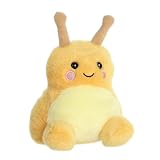
- This plush is approx. 4" x 5" x 4" in size.
- Made from high-quality materials for a soft, fluffy touch.
- Fits in the palm of your hand!
- Own the whole #palmpalsparty collection!
- Holds bean pellets suitable for all ages to ensure quality and stability.
9. Each one has male and female reproductive organs
Pacific bananaslugs are simultaneous hermaphrodites: each individual has both male and female reproductive organs. During mating, one or both partners may be fertilized. Olympic National Park describes eggs being laid in secluded places, with young emerging in roughly one to two months in that regional account. Source: Olympic National Park
Independent reader supportYour contribution helps us test, update, and keep practical guides available for everyone.10. The viral “they bite off their own penises” story is wrong
The real behavior is strange enough without the internet version. In some Ariolimax species, a rare post-mating event called apophally can occur when an everted penis cannot be retracted; one or both partners may bite the stuck organ. Scientific commentary specifically corrects the claim that banana slugs deliberately bite off their own penises to avoid a partner’s sperm. This is not a universal banana-slug behavior, and it is not the routine explanation for mating. Source: “Penis-biting slugs: wild claims and confusions”
Quick wins for a faster PC:
Clear out junk files and repair common Windows errorsFree Scan →Fix the driver behind crashes, sound loss and screen glitchesFind Drivers →Repair Windows errors before they cause bigger problemsFix Now →Best Value

- 【Size】about 10 inch
- 【Package】1 banana Slug Plush
- 【Material】The plush is made of soft pp cotton
- 【Safe】Everything is attached and sewn. There is nothing on the plush that could be dangerous to people
- 【Perfect Home Accent】Ideal for living rooms, bedrooms, offices
A small science update with big future value
In 2025, researchers published the first high-quality de novo genome assembly for the Pacific bananaslug: 401 scaffolds spanning 2.29 billion base pairs, with a 93.9% BUSCO completeness score. The practical takeaway is not a newly assigned conservation status. It is that researchers now have a much stronger reference for studying genetic variation, population structure, and how these forest specialists are connected across their range. Read the genome-assembly paper.
If you find one on a trail
Enjoy the sighting without making it an interaction. Watch your footing, leave the slug and its shelter where they are, and do not pick it up, kiss it, or lick it. Muir Woods advises visitors not to touch or kiss slugs; their sticky slime can numb lips. Source: Muir Woods National Monument
FAQ
Where do Pacific banana slugs live?
They live in moist Pacific-coast forests from California north through southeastern Alaska. They are easier to spot in damp weather and in cool, sheltered places.
How big can a Pacific banana slug get?
Muir Woods reports a maximum length of up to 10 inches; that is an upper limit, not a typical size.
Free tools Windows power users keep installed
One-click scans. No signup required.
Can you touch or kiss a banana slug?
No. Muir Woods advises visitors not to touch or kiss slugs, and their sticky slime can numb lips. Observe them without handling them.
The Bottom Line
Banana slugs are not just yellow curiosities: Pacific bananaslugs are moisture-dependent, mucus-powered recyclers that help keep coastal forests functioning.
Quick Recap
Product prices and availability are accurate as of the date/time indicated and are subject to change. Any price and availability information displayed on Amazon at the time of purchase will apply.




