Outdated Drivers Are Slowing You Down
One free scan finds every outdated or missing driver and matches the right update for your exact hardware.Free scan · exact hardware matchPC Slower Than It Used to Be?
A free scan shows the junk files, broken settings and background clutter dragging Windows down - then fixes them in one click.Free scan · Windows 10 & 11Jumping spiders are members of the spider family Salticidae—a worldwide group of compact, visually guided hunters known for sudden leaps, curious-looking movements, and elaborate courtship displays. The family is enormous: the World Spider Catalog listed 696 genera and 6,975 species in its record dated December 3, 2025, accessed August 10, 2026. That number will change as scientists describe new species and revise existing classifications.
What makes jumping spiders remarkable is not simply that they jump. Depending on the species, they can estimate distance from image blur, detect particular airborne sounds, use silk to stabilize a jump, choose detour routes around obstacles, specialize in blood-fed mosquitoes, imitate ants, communicate through vibrations, and enter a sleep-like state with REM-like eye movements. No single jumping spider does all of these things: Portia, Evarcha culicivora, Myrmarachne, Maratus, and other examples represent different branches of a highly diverse family.
How many eyes do jumping spiders have? They have eight: two large principal eyes that provide high-resolution vision and six smaller secondary eyes that help monitor movement and the surrounding environment.
1. They belong to the largest spider family on Earth
The phrase jumping spider sounds as though it describes one recognizable kind of spider. In reality, it describes an extraordinary radiation of species. Salticidae is currently the largest family of spiders by described species, with 696 genera and 6,975 species listed by the World Spider Catalog in its December 3, 2025 record, accessed August 10, 2026.
#1 Best Overall

- 【Acrylic Reptile Terrarium】Our small reptile cage measures 7.87" x 4.72" x 4.33", perfect size for kinds of baby reptiles or other small animals, providing sufficient room for reptiles pets to move around.
- 【360 Degree View】Our large breeding tank is all-round transparent, it's convenient to observe your slithery friends in the box and feed them in time. The top is clam-shell design, easy to open and close.
- 【Easy to Install】Tear off the protective film on the surface at first and the acrylic tarantula enclosure requires a simple installation , the rubber bands do well in holding everything together. It's also easy to disassemble when not use for saving storage space.
- 【Perfect Design】This reptile breeding box tarantula enclosure is designed with ventilation holes on the two sides, providing the reptiles with fresh air. And the locking handle keeps your pet safe.
- 【Reptile Tank for Insects】Provide a perfect home and a warm habitat for your small reptiles, amphibians and invertebrates. Ideal for spiders, lizard, small turtles, snails, frogs, snakes, tarantulas, hermit crab or any other insects.
Jumping spiders live on every continent except the extreme polar regions. They occur on leaves and tree bark, among rocks and grasses, and around buildings, windows, walls, and garden plants. Most are small, compact spiders that actively search for prey instead of waiting in a capture web. Many have conspicuously large forward-facing eyes, while others are hairy, metallic, brightly colored, or shaped to resemble something else entirely.
That diversity is why a behavior documented in one salticid should not automatically be treated as a family-wide rule. A house-dwelling Phidippus, an ant-mimicking Myrmarachne, and a web-hunting Portia may all be jumping spiders, but they can look and behave very differently.
2. Their eight eyes divide the visual workload—and can help measure depth
Two of a jumping spider’s eight eyes are much larger than the others. These principal eyes point forward and provide detailed vision. The six secondary eyes cover a wider field and are especially useful for detecting motion, noticing looming objects, and helping the spider orient toward something interesting.
The principal eyes are unusual even by spider standards. Movable retinal tubes allow the spider to redirect its gaze without rotating its entire body toward every target. In experiments on Hasarius adansoni, researchers found evidence that the spider could estimate the distance of an object from image defocus—the amount of blur in the image—rather than relying only on the binocular depth cues humans commonly use. A nearby object and a distant object produce different patterns of sharpness and blur, and the spider appears able to use that information when deciding whether prey is within jumping range.
Some salticids also have color-sensitive visual systems, and ultraviolet sensitivity has been documented in parts of the family. But vision varies among species, so it is safer to say that jumping spiders have exceptionally capable vision for their size—not that every species has identical color vision or the best eyesight of any animal.
Studies of the secondary eyes, including experiments involving looming objects, show why those smaller eyes matter. They can alert a spider to movement outside the narrow, high-resolution field of the principal eyes while the spider remains still and visually evaluates its surroundings. See the vision review, the study of secondary-eye responses, and the depth-perception study.
3. At least one species detects airborne sound without ears
A jumping spider does not have ears like a person, dog, or cricket. Nevertheless, experiments with the bold jumping spider, Phidippus audax, found that it can respond to certain low-frequency sounds traveling through the air.
In the study, spiders froze in response to an 80-Hz tone at approximately 65 decibels, including when the sound source was more than 3 meters away. Researchers also recorded sound-responsive neural units in the spider’s brain. The likely sensors are fine mechanosensory hairs that bend in response to tiny air movements.
That is a very different claim from saying that jumping spiders hear speech, understand music, or can follow spoken commands. The evidence concerns a tested species, a particular frequency and sound level, and a specific defensive or orienting response. The most accurate wording is that P. audax can detect particular airborne acoustic stimuli through mechanosensory structures. Read the primary acoustic-perception study.
Rank #2

- Spider house package contains: 9.5 x 5.5 x 5.5 inches jumping spider enclosure, 2PCS spider climbing platform, 1PCS temperature and humidity detector, 1PCS jumping spider hide, 1PCS jumping spider water dispenser,6PCS glow-in-the-dark mushrooms, 1PCS bark, 1PCS turf, 2PCS simulated stones, 6PCS grass, 1PCS pavilion, 3PCS crystals, and some moss.
- Easy to observe:Our glass house is fully transparent, allowing you to easily observe and feed your spider inside. The top features a clamshell design for easy opening and closing.
- Easy installation:Remove the protective film from the surface first. The acrylic tarantula enclosure requires simple assembly, with rubber bands effectively securing everything together. It is also easy to disassemble when not in use, saving storage space.
- Perfect design:This insects enclosure habitat features ventilation holes on both sides, providing fresh air for reptiles.
- Jumping spider enclosure:Our jumping spider enclosure measures 9.5 x 5.5 x 5.5 inches, providing ample space for climbing and activity, ideal for your pet jumping spider.The package contains a temperature and humidity detector, with two LR44 batteries included inside the device.
4. Their jumps use both muscle action and internal fluid pressure
Jumping spiders launch themselves with a rapid combination of leg movement and changes in internal hemolymph pressure. The familiar explanation that they simply pump fluid into their legs like a tiny hydraulic piston is too simple, however.
High-speed experiments on a regal jumping spider, Phidippus regius, concluded that leg muscles could supply the power needed for the jumps studied. Hydraulic augmentation may contribute, but it was not energetically essential in the tested individual. A 2025 study of peacock spiders likewise described jumping as a combination of muscular action and hydraulic pressure, while finding substantial differences between males and females in jump choreography and movement mechanics.
How far can a jumping spider jump? There is no single family-wide number. Distance depends on the species, the spider’s size and condition, the direction of the jump, and whether it is climbing, descending, escaping, or attacking prey. The P. regius research examined jumps involving tasks of roughly two to five body lengths and found different strategies for short, long, ascending, and descending movements. That is why claims that all jumping spiders routinely leap 50 body lengths should be treated with suspicion unless they identify the species and measurement method.
See the jump-biomechanics study and the 2025 peacock-spider biomechanics study.
5. Their silk works like a miniature flight-control system
Jumping spiders do not usually build the large prey-catching webs associated with orb-weaver spiders, but they use silk constantly. A spider may make a retreat, protect eggs, attach itself to a surface, or lay down a silk line before taking off.
That line is more than an emergency rope. During a jump, the dragline can help control body rotation, dissipate energy, and improve landing stability. In experiments with Hasarius adansoni, spiders that were able to produce a dragline landed with a more stable body orientation than spiders prevented from doing so. The silk helped reverse backward pitch and reduce landing speed.
The result is closer to a climber’s safety line combined with a miniature aircraft-control tether than to a simple parachute. The line remains attached while the spider is moving, helping shape the trajectory rather than merely catching the animal after a failed leap. Another study found that jumping spiders can produce high-performance silk rapidly in mid-jump, at approximately 500–700 millimeters per second in the experimental context.
Recommended Free Tools
So the accurate version of the common fact is: jumping spiders are active hunters that generally do not use capture webs, but they rely heavily on silk for safety, anchoring, shelter, reproduction, and movement control. Sources: dragline stabilization research, rapid silk-production research, and the National Park Service overview.
6. Portia spiders can choose detour routes to reach prey
The genus Portia contains some of the strongest examples of flexible decision-making in spiders. These salticids specialize in hunting other spiders, and reaching their prey may require navigating around leaves, gaps, or sections of web that block a direct route.
Rank #3
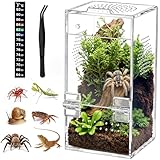
- 【Fresh Airflow Circulation】287 micro ventilation holes (0.06" diameter) are distributed across all 4 sides of this jumping spider habitat, with low intake vents drawing in cool air and high exhaust vents releasing warm, humid air. This layout maintains a steady bottom-to-top flow of fresh air inside the spider terrarium, effectively lowering humidity and preventing stale air buildup, while ensuring a stable microclimate for your reptile.
- 【No Assembly, No Mess】Skip the hassle of flat-packed cages! Unlike spliced designs that leak sand and water through panel gaps, this praying mantis enclosure arrives fully assembled with a sealed base to keep substrate and water securely inside. Four non-slip pads on the bottom provide extra stability—no sliding, no spills, just a clean, leak-free habitat from day one.
- 【Magnetic Side-Opening Door】This jumping spider enclosure features a strong yet easy-to-open magnetic side door, allowing you to feed or mist without disturbing your pet’s setup. The smart side-slide design avoids upper corners where spiders often build hammocks, keeping webbing intact. Perfect for a secure spider terrarium—no more worrying about pets sneaking out through a loose door.
- 【360-Degree Crystal-Clear View】Unlike dull, cloudy PP cages, this premium acrylic terrarium stays brilliantly clear—letting you watch your pet leap, hunt, and explore from every angle. Crafted from sturdy, scratch-resistant acrylic that won’t warp or leak, it’s a durable and pet-safe spider terrarium—perfect for nature lovers of all ages.
- 【Spacious 58% Larger Design】Our jumping spider enclosure kit measures 3.5 × 3.5 × 7 inches – 85.7 cubic inches of space! Compared to other 3×3×6-inch boxes (54 cubic inches), it provides 58% more space to create a cozy, enriched habitat your pet will love! (Enclosure ONLY, Plants and Animals NOT INCLUDED)
In experiments with Portia labiata, spiders visually inspected alternative routes and preferentially chose a route that remained passable. Researchers described the behavior in terms of scanning, intermediate goals, and decision-making during the detour. In separate experiments with Portia africana, spiders were more likely to take a direct route when it was available and to use a detour when the direct route was blocked. They did not make the detour simply to reach non-prey pieces of leaf.
Other work indicates that Portia can use specialized working memory while hunting. In plain English, the spider’s next movement can depend on what it has already seen and on whether a particular route is useful for reaching prey. That is why it is reasonable to describe Portia as showing sophisticated, visually guided decision-making.
Free tools Windows power users keep installed
One-click scans. No signup required.
It is not evidence that all jumping spiders have human-like intelligence, consciousness, language, or self-awareness. Portia is a specialized genus, and the experiments measured route choice and memory—not subjective thoughts. Explore the research on route selection, visual scanning, detour decisions, and working memory.
7. One species hunts mosquitoes that have already taken a blood meal
The East African jumping spider Evarcha culicivora is sometimes nicknamed a vampire spider. The nickname is dramatic but misleading: the spider does not drink blood and cannot pierce human skin like a mosquito. Instead, it preferentially attacks female mosquitoes that have recently fed on the blood of a vertebrate.
By eating the mosquito, the spider obtains nutrients that came indirectly from the blood meal. Experiments found that E. culicivora can distinguish preferred prey using visual and odor cues. It favored blood-fed female mosquitoes over non-mosquito prey, male mosquitoes, and females that had fed only on sugar. Research also suggests that the red color associated with a blood meal can help guide this preference.
This is a remarkable example of prey specialization, not a trait shared by all salticids. Most jumping spiders eat small arthropods opportunistically, while some species also consume nectar. Bagheera kiplingi is famous for a predominantly plant-based diet, although plant-eating is not typical of the entire family. Sources: research on E. culicivora and blood-fed mosquitoes, the blood-color cue study, research on nectar feeding, and the review of plant-eating spiders.
What’s actually slowing this PC down?
Pick the symptom - the matching free tool is one click away.
8. Some imitate ants—and pay for the disguise with poorer jumping performance
Several jumping spiders in the genus Myrmarachne look remarkably ant-like. Their narrow bodies, coloration, posture, and stop-start movements can all contribute to the resemblance. The evolutionary explanation is generally Batesian mimicry: a harmless spider may gain protection when predators mistake it for an ant that is dangerous, aggressive, or unpalatable.
The imitation has a cost. In a comparison of seven Myrmarachne species, the more ant-like species made shorter jumps and had lower prey-capture success than non-mimetic salticids. The slimmest mimics showed the greatest reductions in performance.
This is more than a visual trick. It is an example of an evolutionary trade-off: looking like an ant may reduce the chance of being eaten, but a narrower body and altered movement can make it harder to escape or catch prey. Studies of both ant mimicry and jumping performance and ant-like locomotion document the cost of the disguise.
Rank #4

- Spider house package contains: 3.15 x 3.15 x 6.3 inches jumping spider enclosure, 1 jumping spider hide, 1 drinking fountain, 1 jumping bridge, 2 artificial flowers decoration,1 flower decoration, 1 purple crystal decoration,1 climbing net, 1 turf,1 tweezers, some simulated crystal stones and some simulated moss.
- Easy to observe:Our glass house is fully transparent, allowing you to easily observe and feed your spider inside. Magnetic doors on the front prevent small pets from escaping and facilitate feeding.
- Easy installation:Remove the protective film from the surface first. Install all accessories in the jumping spider enclosure.Simple and convenient.
- Perfect design:This insects enclosure habitat features ventilation holes on both sides, providing fresh air for reptiles.
- Jumping spider enclosure:Our jumping spider enclosure measures 3.15 x 3.15 x 6.3 inches, providing ample space for climbing and activity, ideal for your pet jumping spider.
9. Their courtship combines color, choreography, and vibrations through the ground
A male jumping spider’s courtship display can look like a tiny dance show, but the female is receiving several kinds of information at once. Depending on the species, a male may wave his legs, raise an ornament, change his posture, expose bright colors, and send vibrations through the leaf, bark, or other surface beneath him.
In Habronattus dossenus, males whose vibratory signals were experimentally muted were less likely to mate, took longer to copulate, and experienced more precopulatory cannibalism than unmuted males. In Phidippus clarus, vibratory courtship signals—and especially signaling rate—were associated with mating success.
Peacock spiders in the genus Maratus add some of the most conspicuous visual decorations. Males can raise colorful abdominal flaps and ornamented legs while performing species-specific movements. Their courtship is multimodal: the famous visual display is only part of the communication system, with vibrations also traveling through the substrate.
Sexual cannibalism does occur in some jumping spiders and some mating contexts, but it is not accurate to say that a female always eats a male who performs a poor dance. Displays differ among species, and the outcome depends on the individuals and circumstances. See the studies of seismic signaling in Habronattus dossenus, Phidippus clarus vibration, and multimodal peacock-spider courtship.
Independent reader supportYour contribution helps us test, update, and keep practical guides available for everyone.10. At least one species enters an REM-sleep-like state
In a study of Evarcha arcuata, researchers observed periodic nighttime bouts of retinal movement accompanied by limb twitching and stereotyped leg curling. The retinal movements were visible in young spiderlings because their exoskeletons were temporarily translucent.
The Tool Desk
Outbyte PC Repair FREERepair Windows errors before they cause bigger problemsFix Now →Outbyte Driver Updater FREEFix the driver behind crashes, sound loss and screen glitchesFind Drivers →The researchers described this as an REM sleep-like state. That wording matters. The observations resemble some features of rapid-eye-movement sleep in vertebrates, but they do not prove that spiders dream or have a subjective experience like ours.
The same species has also been observed resting while suspended from silk lines at night. Hanging motionless from a thread may look like a miniature spider hammock, but it is best described as an unusual nocturnal resting behavior rather than evidence of human-like sleep habits. Read the REM-like behavior study and the research on suspended nocturnal rest.
What do jumping spiders eat?
Most jumping spiders are active predators of small arthropods, including flies, mosquitoes, other insects, and spiders. They usually stalk prey visually, turn toward it, approach within range, attach a dragline, and then leap. Specialized exceptions show how varied the family can be: Portia hunts other spiders, Evarcha culicivora targets blood-fed mosquitoes, and Bagheera kiplingi obtains much of its food from plant material.
Rare reports of larger salticids attacking small vertebrates such as frogs or lizards should not be used to suggest that ordinary jumping spiders routinely hunt them. Such events are unusual, species-specific observations rather than a standard salticid diet.
Do these 3 things before closing this tab:
1Repair Windows errors before they cause bigger problems2Scan for outdated or missing drivers - takes under a minute3Clear out junk files and repair common Windows errorsBest Value

- 【Tailor-Made Tiny Habitat】Spider terrarium small 3x3x6 inch size enclosure is specifically designed for jumping spiders, tarantulas, snail, mantis, lizard, and other small reptiles and amphibians, providing a safe and comfortable habitat
- 【Micro-Optimized Airflow System】Unlike other jumping spider enclosures,ours uses 264 Precision Micro-Vents (0.8mm) deliver 360° airflow while blocking fruit fly escapes—perfect humidity control for tropical habitats
- 【Magnetic Doors】Acrylic spider enclosure with magnet doors enable 1-second feeding access while military-grade prevent escapes. Handle your jumping spider or feed without anxiety
- 【Crystal-Clear 360° Theater Display】Optical-grade acrylic (98% light transmittance) transforms feeding time into a captivating show. Perfect for observing and interacting with your jumping spider or other small creatures
- 【No Assembly and Stackable Design】Portable jumping spider enclosure aquariums require no assembly and disassembly and are ready to use right out of the package, the unique stackable design allows for easy storage and customization, perfect for beginners and experienced pet owners
How to recognize a jumping spider
- Look for a compact body: many are short and stout compared with long-legged hunting spiders.
- Check the face: the two principal eyes are usually the most obvious feature, although some species disguise or reduce their visual prominence with hair or coloration.
- Watch the movement: they often turn to face a person or potential prey, pause, stalk, and make short, precise jumps.
- Do not rely on jumping alone: other spider families can jump too. The common name usually refers specifically to Salticidae.
- Expect silk, but not necessarily a web: a jumping spider may leave a visible dragline or build a silk retreat without constructing a prey-catching web.
FAQ
Are jumping spiders dangerous to people?
Usually not. Jumping spiders have fangs and venom, so they are venomous rather than poisonous, but their venom is generally not considered medically significant to humans. Bites are uncommon and are most likely when a spider is trapped, squeezed, or handled roughly. Give one space rather than picking it up.
Do not assume that an unexplained skin mark is a spider bite just because spiders are present. The UC Davis guidance and MedlinePlus information provide general medical context.
Do jumping spiders recognize individual people?
There is not enough evidence to claim that jumping spiders recognize particular humans or feel affection toward them. Their unusually strong vision and tendency to orient toward moving objects can make one appear to watch a person, but that behavior is better explained as visual attention or investigation unless a specific recognition study demonstrates otherwise.
Do jumping spiders spin webs?
Most jumping spiders are active hunters rather than capture-web builders like orb-weavers. They still use silk extensively: for draglines during jumps, retreats, egg protection, anchoring, and resting shelters. Saying that they do not use webs at all is therefore inaccurate.
Quick wins for a faster PC:
Fix the driver behind crashes, sound loss and screen glitchesFind Drivers →Repair Windows errors before they cause bigger problemsFix Now →Can jumping spiders really be trained?
In an experiment involving Phidippus regius, one individual—nicknamed Kim—was induced to make repeated jumps between experimental platforms. That is evidence that a spider’s jumping behavior can be shaped or controlled under laboratory conditions, not proof of dog-like obedience or a general ability to follow spoken commands. The study involved one individual out of four tested spiders, so it should not be generalized to the entire family.
See the primary jumping study for the experimental context.
Are all jumping spiders equally good jumpers?
No. Jumping ability varies with species, body shape, sex, age, condition, direction, and the task being performed. Ant mimics may jump less effectively because their narrow bodies favor resemblance over performance, while other salticids are better adapted for particular hunting or courtship movements. Avoid treating a single maximum-distance claim as typical for every salticid.
Do jumping spiders dream?
Researchers have observed an REM-sleep-like phase in Evarcha arcuata, including retinal movements, leg twitches, and curled limbs. That is fascinating evidence of a sleep state with some similarities to REM sleep, but it does not prove that the spiders dream or have human-like subjective experiences.
The Bottom Line
Jumping spiders are not simply tiny spiders that happen to leap. Across the family, natural selection has produced a remarkable toolkit of precise vision, flexible movement, silk-assisted control, specialized hunting, mimicry, vibration-based communication, and complex behavior. The most important caveat is also the most interesting one: these abilities are distributed among different species, so the family’s real superpower is its diversity.
Quick Recap
Product prices and availability are accurate as of the date/time indicated and are subject to change. Any price and availability information displayed on Amazon at the time of purchase will apply.




