The Tool Desk
Outbyte Driver Updater FREEScan for outdated or missing drivers - takes under a minuteDriver Scan →Outbyte PC Repair FREEClear out junk files and repair common Windows errorsFree Scan →Ocean animals range from transparent-headed fish to colonies that function as a single drifting organism. Some of the creatures below live in warm surface waters; others inhabit the deep sea, where sunlight fades and conditions change with depth. Their strange-looking features are not just curiosities: they help them find food, move, or survive.
First, what counts as the deep sea?
“Deep sea” is not one uniform habitat. Sunlight is gone to human eyes by around 650 feet (200 meters), according to Smithsonian Ocean; deeper zones bring different conditions. The animals here do not all live at the same depth—or even in deep water. Depths are given only where the cited source reports them.
As an Amazon Associate I earn from qualifying purchases.
Unusual bodies and ways of moving
1. Barreleye
The barreleye (Macropinna microstoma) has a transparent dome over its head and eyes that point upward to watch for prey. Its eyes can rotate forward when it feeds. Monterey Bay Aquarium reports that it usually lives at 2,000–2,600 feet (600–800 meters) and grows to about six inches (15 centimeters) long. Monterey Bay Aquarium’s barreleye profile explains this unusual arrangement.
2. Dumbo octopus
Members of the genus Grimpoteuthis are called dumbo octopuses for the fin-like structures above their eyes. They use those fins to swim and feed on small animals such as snails, worms, and bivalves. Smithsonian Ocean gives a typical depth range of 9,800–13,000 feet and describes them hovering above the seafloor. Smithsonian Ocean’s dumbo octopus profile has more.
#1 Best Overall

- 12-Piece Ocean Animal Set – Includes dolphin, sea turtle, seahorse, octopus, penguin, seal, whale, shark, clownfish, killer whale, crab, and whale shark for full undersea adventure.
- Realistic & Durable Designs – Hand-painted details bring each marine creature to life; crafted from non-toxic, BPA-free plastic, safe for kids ages 3+.
- Educational STEM Learning Toy – Boosts creativity and knowledge of marine biology; great for homeschooling, classrooms, or exploring ocean ecosystems.
- Versatile Play & Decor –These small ocean animal figures perfect as bath toys, cake toppers, party favors, or sensory bin fillers; also ideal for dioramas and aquarium displays.
- Gift-Ready Eco Box Packaging – Beetots ocean animal toys come in sturdy, eco-friendly packaging — easy to store, wrap, and gift for birthdays, holidays, and classroom rewards.
3. Gulper eel
The gulper eel, also called the pelican eel (Eurypharynx pelecanoides), has a pouch-like throat and stomach that can inflate to engulf prey, including squid, fish, or shrimp. NOAA reports it from tropical and temperate deep waters, from about 1,600 feet to almost 10,000 feet. Its oversized mouth is an adaptation for catching food in a habitat where meals may be sparse. NOAA’s ocean-critters explainer describes the eel.
4. Tripod fish
A tripod fish can pump fluid into its elongated fins, making them stiff enough to prop the fish up while it rests on the seafloor. It is a striking example of fins serving as supports, not just swimming tools. Smithsonian Ocean describes the adaptation in its deep-sea overview.
5. Giant isopod
Giant isopods (Bathynomus spp.) are crustaceans related to pillbugs, crabs, and shrimp. Smithsonian Ocean describes them as roughly 11–20 inches long and reports them from about 560 feet to nearly 7,000 feet. They scavenge, taking advantage of food that reaches the seafloor. The group is not a single species: Smithsonian quotes marine zoologist Angelika Brandt calling Bathynomus giganteus “the largest known isopod on Earth” and noting its role in deep-sea ecosystems. Smithsonian Ocean’s giant-isopod article provides the context.
6. Deep-sea tubeworm
The tubeworm Riftia pachyptila lives with chemosynthetic bacterial partners. Adults lack a digestive system, relying instead on their relationship with those bacteria. NOAA Ocean Exploration’s educational material describes this unusual arrangement; it is a reminder that some deep-sea life depends on chemical energy rather than sunlight. NOAA’s deep-sea Valentine’s Day explainer describes the partnership.
Rank #2

- Ocean animal toy, 46 Pack sea animal( no duplicated!!!) + 6 grass, beautifully detailed and made of 100% safety highest quality plastic material!
- Sea animal toy, approximately 2 inch, creature including Octopus,hippocampus, seahorse, jellyfish, turtle,clown fish, crab,shark Otter and etc
- Party favors, realistically detailed sea animal figurines inspire imaginative play and curiosity as learning toy, and makes the perfect novelty gift for boy girl,ages 3 year and up!
- Cake cupcake topper, Perfect to complete party decorations or used for school education project, Goodie Bag Prizes giveaway, or birthday, Valentines Day gift, Easter Eggs Stuffers, Pinatas Filler
- Bath toy, children love dropping ocean animal in the pool, water table, sand box, beach or bath tub and collecting them. Great for child to enjoy bathtub time!
Light, camouflage, and finding prey
7. Deep-sea anglerfish
In described deep-sea anglerfish examples, a glowing barbel can draw prey toward the mouth. Smithsonian Ocean says the light is produced by bacteria. Anglerfish is a broad common name, so this should not be treated as a description of every species called an anglerfish. Smithsonian Ocean’s deep-sea overview discusses the adaptation.
8. Dwarf lantern shark
The dwarf lantern shark has light-producing organs called photophores on its belly and fins. Their glow can help it blend against light filtering down from above; in darker water, it may also attract small prey. Smithsonian Ocean describes these possible roles but the cited material does not establish a species-specific range or size. Its shark overview explains the light-producing organs.
9. Viperfish
Viperfish are among the deep-sea animals Smithsonian Ocean identifies as using bioluminescence. In deep water, light can be useful for feeding or signaling, though those broad functions should not be mistaken for a detailed account of every viperfish species. Smithsonian Ocean’s deep-sea overview places them in this larger context.
10. Barreleye’s moving eyes
Beyond its transparent head, the barreleye has another useful adaptation: its eyes can shift from an upward-facing position to a forward-facing one. That lets it monitor the water above and then direct its gaze toward food. The behavior and usual depth are described by Monterey Bay Aquarium.
Rank #3
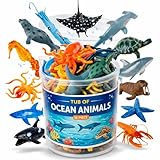
- OCEAN ANIMAL TOYS FOR KIDS: Give kids hours of screen-free fun with 16 large, realistic sea creature figures - sharks, dolphins, turtles, octopus & more - all stored in a reusable carry tub!
- REALISTIC SEA ANIMAL FIGURES KIDS LOVE: Every figure is highly detailed and true-to-life, sparking curiosity about marine life - parents love how educational these are without feeling like "learning!"
- IMAGINATIVE PLAY OCEAN TOYS: Watch creativity soar as kids invent their own underwater adventures with these colorful sea creature figures - hours of fun for boys and girls of all ages!
- VERSATILE OCEAN PARTY SUPPLIES & GIFTS: Perfect as birthday gifts, cake toppers, party favors, or classroom rewards - these ocean animal figures work great for any sea-themed celebration!
- REUSABLE STORAGE BUCKET PLAYSET: Comes in a sturdy reusable tub with a handle so all 16 sea animals stay organized and ready to go—toss it in the bath, pool bag, or backpack for fun anywhere!
Odd-looking hunters and scavengers
11. Cookie-cutter shark
The cookie-cutter shark (Isistius brasiliensis) is small but feeds by attaching to larger animals and removing a round plug of flesh. Smithsonian Ocean describes a brown collar that may act as a lure; its function is presented as a possibility, not a settled fact. Smithsonian Ocean’s shark coverage explains the feeding mark and the proposed lure.
12. Goblin shark
The goblin shark (Mitsukurina owstoni) has a long snout carrying sensory organs that detect electric fields. Its jaws can thrust forward to ambush prey. The combination helps explain why the shark’s appearance is more than a strange silhouette: its distinctive features are involved in sensing and feeding. See Smithsonian Ocean’s goblin-shark profile.
13. Giant squid
Giant squid (Architeuthis spp.) remain elusive deep-water animals. Much historical knowledge came from carcasses found after they surfaced, rather than from observing living squid in their habitat. Their story is a useful caution against treating dramatic size claims as settled when the evidence is limited. Smithsonian Ocean provides an overview in its giant-squid article.
Do these 3 things before closing this tab:
1Clear out junk files and repair common Windows errors2Fix the driver behind crashes, sound loss and screen glitches3Repair Windows errors before they cause bigger problems14. Hadal snailfish
The hadal snailfish (Pseudoliparis swirei) was formally described from around 27,000 feet. Smithsonian Ocean called it the deepest-living fish known in its account, while distinguishing it from a second fish observed at greater depth but not formally described in that report. That distinction matters: an observation and a formally described species are not the same thing. Smithsonian Ocean’s deep-sea overview discusses the fish.
Rank #4

- Sea creatures toys for kids,46 pack realistic ocean animals(no duplicated!!!),made of 100% safety non-toxic vinyl plastic
- Assorted ocean animals toys,approximately 2-4 inches,fits perfect for small fingers to hold and play
- What you see is what you get,small sea creatures with clear colors and realistic shapes.Suitable for school projects and educational purposes,which stimulate children's imagination and interest in sea animals world
- Sea creatures toys for kids,prefect for birthday gifts,Easter egg filler,party bag favors and Christmas gifts,decorating children’s desks and rooms,they love them so much
- Sea animals toys as cake cupcake toppers,summer beach under the sea party favors
15. Ghost shark
“Ghost shark” is a common name for chimaeras, cartilaginous fish related to sharks. Unlike sharks, chimaeras have one gill opening on each side. Reflective tissue behind their eyes can make them appear to glow. The name does not mean they are true sharks or supernatural creatures. Smithsonian Ocean explains these differences in its shark and chimaera coverage.
Independent reader supportYour contribution helps us test, update, and keep practical guides available for everyone.Colonies and animals with misleading names
16. Portuguese man o’ war
The Portuguese man o’ war (Physalia physalis) is not a true jellyfish. It is a siphonophore colony made of specialized zooids, with roles that include floating, capturing prey, feeding, and reproduction. NOAA says it drifts in warm tropical and subtropical waters. A single visible animal is therefore better understood as a coordinated colony than as one simple-bodied creature. NOAA’s ocean-critters explainer describes it.
17. Other siphonophores
Siphonophores are colonial hydrozoans: connected zooids specialize in different tasks. NOAA Ocean Exploration reported about 175 described species in 2023. Their delicate gelatinous bodies can break easily, which makes studying them difficult. This means the apparent simplicity of a floating strand can conceal a complex colony. NOAA Ocean Exploration’s marine-life page discusses their diversity.
18. Vampire squid
The vampire squid (Vampyroteuthis infernalis) lives in dark ocean depths; NOAA gives its range as 2,000–3,000 feet. Despite its name, it does not suck blood. Its webbed arms and a defense that releases bioluminescent mucus are more revealing than the horror-inspired name. NOAA also describes its lineage as extending back 165 million years in the fossil record. See NOAA’s ocean-critters explainer.
Best Value

- Ocean animal toys: 48 pieces realistic animal toys set contains 12 species of marine animals, including manta rays, chionoecetes, mantis shrimp, raninas, lionfish, eels, etc. These ocean figures will give your child a great trip in Ocean World
- Easy store: Realistic sea animal toys have a round, clear bucket that is round and does not hurt little hands. The bucket comes with a strong hand rope to make these ocean animal life figurines easy to store and carry outside
- Educational value: This small fish toy is suitable for school diorama projects and educational which teach about underwater creatures world, enhance animals vocabulary, and stimulate imaginations and the exploration of the ocean
- Safe play: The mini animal toy is made of great-quality plastic material, durable and safe. Their nicely painted and bright details make sea ocean animals vivid. The 2 to 2.2 inches is the perfect size for a little hand. Suitable for 3 years old and up to use
- Party favors: These sets also make good water table toys, bath toys, or toys for playing in the pool, beach or bathtub. It's not only as good as classroom prizes, but also under the sea party decorations, birthday, sensory bin, piñata gift for your little one
Small or unfamiliar animals that broaden the picture
19. Comb jelly
Comb jellies, or ctenophores, are not all deep-sea animals. NOAA Fisheries describes a new species discovered off Puerto Rico in 2015 and identified solely from high-definition video. That case shows how a camera can reveal animals scientists had not yet formally recognized, without implying that every comb jelly shares the same habitat or appearance. NOAA Fisheries’ deep-sea-creature feature covers the discovery.
20. Sea cucumber
Sea cucumbers occur in deep waters, too. In the deep sea, marine snow—particles of organic matter that sink from above—is an important food source for many animals. A sea cucumber is a less theatrical example than a glowing fish, but it belongs in a picture of deep-ocean life shaped by scarce food and darkness. Smithsonian Ocean discusses deep-sea ecology and marine snow in its deep-sea overview.
Why so many ocean animals remain unfamiliar
For many ocean species, scientists still lack a complete picture. NOAA Ocean Exploration estimated in 2023 that roughly two-thirds of ocean species, or possibly more, may remain undiscovered or not officially described. This is an estimate, not a census. Delicate animals can be hard to study, and many others live far below the surface. The NOAA Ocean Exploration marine-life page explains the scale of that uncertainty.
Quick wins for a faster PC:
Fix the driver behind crashes, sound loss and screen glitchesFind Drivers →Clear out junk files and repair common Windows errorsFree Scan →Unfamiliar does not mean dangerous. These animals’ striking features are adaptations to their own environments, and the examples here describe feeding, movement, light, or survival—not a threat to people.
Quick Recap
Product prices and availability are accurate as of the date/time indicated and are subject to change. Any price and availability information displayed on Amazon at the time of purchase will apply.




