What’s actually slowing this PC down?
Pick the symptom - the matching free tool is one click away.
The shark behind the 340-million-year-old fossil discovery in Mammoth Cave is Clavusodens mcginnisi, a newly identified species known from fossil teeth. It lived in a warm ancient sea; the cave passages formed millions of years later.
What shark was identified in Mammoth Cave?
The National Park Service announced Clavusodens mcginnisi on March 10, 2025, describing it as a new species of obruchevodid petalodont. The identification was based on small fossil teeth collected deep inside the Ste. Genevieve Formation—not on a complete shark skeleton. The park’s announcement says the teeth occur across the formation.
The teeth have flat crowns and long bases that superficially resemble old iron nails. That shape inspired the genus name; the species is commonly rendered “McGinnis’ nail tooth.” Its name honors David McGinnis, a retired National Park Service superintendent and naturalist whose career began at Mammoth Cave.
What the shark may have looked like and eaten
The park describes members of the Obruchevodidae as small, about 3–4 inches long, with chisel-like front teeth and crushing teeth farther back. Its interpretation is that this shark likely fed on crustaceans, worms, and small brachiopods on the seafloor. Small size may also have helped it avoid larger predators.
#1 Best Overall
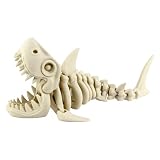
- Museum-Inspired Fossil Replica – Expertly 3D printed to capture the intricate skeletal structure and realistic proportions of prehistoric dinosaurs, creating a display-worthy piece for enthusiasts and fossil fans alike.
- Collector-Grade Display Quality – Designed with hobbyists and collectors in mind, this piece offers crisp detail and a professional finish that elevates any dinosaur or fossil collection.
- Durable & Lightweight Construction – Made from premium PLA material for a sturdy yet easy-to-handle structure, ensuring long-lasting enjoyment without the fragility of real fossils.
- Versatile Display Options – Ideal for showcasing on desks, bookshelves, display cases, or as part of themed décor in offices, libraries, or dedicated hobby rooms.
- A Unique Conversation Starter – Whether placed in a home, workspace, or collection room, this fossil replica is sure to spark curiosity and admiration from anyone who sees it.
Why is a 340-million-year-old shark fossil inside a cave?
The fossil is in ancient marine rock, not in a cave passage that existed when the shark lived. The Ste. Genevieve Formation dates to approximately 340 million years ago and consists of limestone and shale formed on a warm ocean reef floor. The shark lived and died in that marine environment; its remains were preserved in sediments that became rock.
Mammoth Cave developed much later. The U.S. Geological Survey explains that groundwater began interacting with the Girkin Limestone about 10 million years ago and that upper cave levels were fully formed by 3.2 million years ago. Those dates show why “340 million years old” refers to the fossil-bearing rocks and the shark’s time—not the age of the cave passages. USGS’s Mammoth Cave overview also describes the region’s Mississippian rocks as products of ancient seas that submerged this part of Kentucky.
Rank #2

- IT FROM XUQCAH MATERIAL AND FOIMOJSK PAR ENT AND Thurder LOVER
- Museum Quality Replica
- Please thoroughly read discription
What else has the park found in its ancient shark fossils?
Mammoth Cave National Park began its paleontological resource inventory in November 2019. The park’s findings point to a diverse assemblage of sharks and other fish, but the reported counts have different scopes and dates:
| Park report | Reported finding | Scope |
|---|---|---|
| 2025 species announcement | Over 70 species of sharks and other fish, including four new species | Ste. Genevieve geologic layer; National Park Service, 2025 |
| 2023 park overview | At least 40 species of sharks and their relatives, including six new species | Broader Mammoth Cave assemblage framing; National Park Service, 2023 |
These figures describe different reporting contexts, so they should not be added together or treated as conflicting counts of the same set. Shark fossils are often teeth or fin spines because shark skeletons are mostly cartilage, which is rarely preserved. The park also reports rare three-dimensional cartilage preservation and offers public 3D models of two partial cartilaginous skeletons.
Rank #3
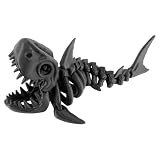
- Museum-Inspired Fossil Replica – Expertly 3D printed to capture the intricate skeletal structure and realistic proportions of prehistoric dinosaurs, creating a display-worthy piece for enthusiasts and fossil fans alike.
- Collector-Grade Display Quality – Designed with hobbyists and collectors in mind, this piece offers crisp detail and a professional finish that elevates any dinosaur or fossil collection.
- Durable & Lightweight Construction – Made from premium PLA material for a sturdy yet easy-to-handle structure, ensuring long-lasting enjoyment without the fragility of real fossils.
- Versatile Display Options – Ideal for showcasing on desks, bookshelves, display cases, or as part of themed décor in offices, libraries, or dedicated hobby rooms.
- A Unique Conversation Starter – Whether placed in a home, workspace, or collection room, this fossil replica is sure to spark curiosity and admiration from anyone who sees it.
Can visitors see the fossils on a cave tour?
Most of the fossils are in cave areas inaccessible on standard tours, so a tour is not a reliable way to see them in person. The park’s paleontology overview provides public 3D models and imagery as alternatives for exploring the finds.
Independent reader supportYour contribution helps us test, update, and keep practical guides available for everyone.Where can readers find the park’s inventory report?
The National Park Service report record cites Toomey, Tweet, and Santucci’s 2025 Mammoth Cave National Park: Paleontological resource inventory (public version), report number NPS/SR—2025/243. Its DOI is 10.36967/2308457. The park’s species announcement supplies the identification and discovery details discussed here.
Quick Recap
Best Value

- Museum Quality Replica
- 5.5 inches
- Please thoroughly read discription
Rank #4

- Museum-Inspired Fossil Replica – Expertly 3D printed to capture the intricate skeletal structure and realistic proportions of prehistoric dinosaurs, creating a display-worthy piece for enthusiasts and fossil fans alike.
- Collector-Grade Display Quality – Designed with hobbyists and collectors in mind, this piece offers crisp detail and a professional finish that elevates any dinosaur or fossil collection.
- Durable & Lightweight Construction – Made from premium PLA material for a sturdy yet easy-to-handle structure, ensuring long-lasting enjoyment without the fragility of real fossils.
- Versatile Display Options – Ideal for showcasing on desks, bookshelves, display cases, or as part of themed décor in offices, libraries, or dedicated hobby rooms.
- A Unique Conversation Starter – Whether placed in a home, workspace, or collection room, this fossil replica is sure to spark curiosity and admiration from anyone who sees it.
Product prices and availability are accurate as of the date/time indicated and are subject to change. Any price and availability information displayed on Amazon at the time of purchase will apply.




