Most horses eat forage—pasture grass, hay, or forage-based feeds—as the foundation of their diet. Many healthy horses need little or no grain; the right ration depends on the horse’s body condition, workload, age, health, and the quality of its forage. Keep clean water and salt available, change feed gradually, and ask a veterinarian or equine nutrition professional for help with individual needs.
The short answer: horses are forage-eating herbivores
Horses are adapted to eat fibrous plants. Pasture grass and hay provide most or all of the diet for many healthy horses, while concentrates are added when forage alone does not meet an individual horse’s needs. A horse’s requirements vary with body size, age, metabolism, body condition, workload, growth, pregnancy, lactation, health, and forage quality.
Forage is not interchangeable: hays can differ substantially in nutrient content. The University of Minnesota Extension recommends laboratory testing as the best way to determine hay quality. See its guidance on using hay in horse diets.
What belongs in a horse’s daily diet?
- Forage: Pasture, hay, and suitable forage-based feeds are the foundation for most horses.
- Water: Provide clean, fresh water continuously.
- Salt and minerals: Provide salt and choose mineral supplementation based on the whole ration and the horse’s needs.
- Concentrates: Grain and commercial feeds can supply extra energy or nutrients when forage does not meet an individual horse’s requirements. They are not automatically necessary.
- Treats: Suitable treats are optional extras, not a replacement for forage or a balanced ration.
The University of Minnesota Extension says forage should make up at least half of the daily ration and gives broad roughage guidance: at least 1% of body weight daily, about 2% in hay for most horses, and 2–2.5% when horses have free access to hay. These are general guidelines, not personalized prescriptions.
Windows Errors? Fix Them Before They Spread
Repair common Windows errors and clear accumulated junk for a smoother, more stable PC - no reinstall needed.Free scan · no reinstallOutdated Drivers Are Slowing You Down
One free scan finds every outdated or missing driver and matches the right update for your exact hardware.Free scan · exact hardware match#1 Best Overall

- HOLDS 1 BALE OF HAY - this 19x19x41" hay bag with 1.75" square openings holds approx. 1 bale of Timothy, Orchard, Alfalfa, or any other type of hay. Our hay bags were designed to minimize frustration and can be stuffed in seconds.
- EXCLUSIVE PATENTED 4-SIDED CONSTRUCTION - this hay bag features Derby Originals patented nylon web design that allows your horse to eat from any part of the hay bag. This design eliminates the risk of material rips and tears found in other hay bags.
- SUPER TOUGH BOTTOM DESIGN - our exclusive Super Tough Bottom is made of reinforced overlapping nylon webbing. This design allows for superior strength and durability while keeping your hay fresh and allowing dust and debris to exit the bag.
- IMPROVES DIGESTION - horses are designed to spend up to 18 hours a day grazing. Slow feeding allows you to replicate this natural behavior and is recommended by veterinarians to prevent gastric ulcers, colic, and boredom-related behavioral vices.
- ONE YEAR WARRANTY - this hay bag has a 1-year limited manufacturer's warranty offered by Derby Originals. This warranty covers manufacturing defects. Accidental damage or wear and tear is not covered. Contact the manufacturer for more information.
How much should a horse eat?
Start with body weight, forage quality, and the horse’s condition—not an unweighed scoop or flake. Hay and pasture differ in moisture and nutrients, so their as-fed weights are not directly comparable. The University of Minnesota Extension’s general guidance is that most horses should consume about 2% of body weight in hay daily, but individual needs vary. Use a forage analysis and professional advice when precision matters.
Monitor body condition and adjust the ration with care. Horses with metabolic disease, laminitis risk, poor dentition, difficulty maintaining weight, or other medical needs require an individualized plan. Do not impose severe forage restriction without veterinary guidance.
Pasture, hay, alfalfa, and other forage
Pasture grass
Pasture is forage, but its nutrient content varies. Introduce pasture or any new forage gradually rather than making an abrupt change. Horses with metabolic concerns or other specific needs may require controlled pasture access under veterinary guidance.
Grass hay and legume hay
Common grass hays include timothy, brome, orchard grass, Bermuda, and teff. Alfalfa and other legumes generally provide more protein, minerals, and vitamins than grass hay. Alfalfa can be useful for horses with higher protein or calcium needs, but no hay type is automatically right for every horse. Compare the hay’s quality and analysis with the horse’s needs.
Rank #2

- [Durable High-Strength Material and Knotless Design]: 5x5ft hay net features a sturdy knotless high-quality Polyester Fiber constructionthat which promise resist 0° and 100° resist strong sunshine snow rain conditions.
- [Protects Teeth and Reduces lnjuries]:Knotless design Round bale slow feed hay net smooth which promise protect your horse goat & cow teeth and gums, eliminating the risk of injury from traditional hay nets with knots
- [Slow Feeding & Non-Entanglement risks & Healthier Digestion]: 1.5" holes round bale hay netting reduces 80%-90% hay waste by slowing downfeeding, which promise avoid horse shoes boots or beakaway halters getting cauth in the netting metal parts for horses, goats, sheep cattle and active small group of animals.
- [Reduce Waste & Save Money]: Prevents large square hay from falling to the ground, reducing waste and saving money on hay.Round bale netting promise 1-2 year quality guarantee. with 24hours service on-line
- [Repair Accessories& Easy of use]: Package included 5x5x5 1.5" Slow feed round hay bales feeder Strong Packing bag. Wire bukle Netting Needle Shuttle 118 inch repair twine with repair net instruction; Cleaning and shaking out leftover hay is easy,hang or secure.
Forage alternatives
Soaked hay cubes or pellets can help some horses, including those with poor dentition. Certain forms may raise choke concerns and may need soaking. Commercial feeds are not interchangeable: read the label and follow its directions. A forage alternative is not automatically a complete feed.
How to choose and store hay
- Choose clean, good-quality hay suited to the horse and the local forage supply.
- Use a laboratory analysis when nutrient precision matters; appearance or hay type alone does not establish nutrient content.
- Discard moldy or spoiled hay and grain. Do not assume soaking makes moldy forage safe.
- Store feed to keep it dry and protected from contamination.
Do horses need grain?
No, not by default. Many horses meet their needs on good-quality forage. Grain or another concentrate may be appropriate for a horse that struggles to maintain weight, works hard, is pregnant or lactating, or cannot access adequate-quality forage. Consider the full ration and the horse’s needs before adding feed.
Measure concentrates and divide meals
Measure concentrates by weight and follow the feed tag because products differ in density and formulation. Merck Veterinary Manual advises that a horse should not receive more than 0.5% of its body weight in grain-based concentrate at one meal. For a 500-kg (1,100-lb) horse, Merck gives 2.5 kg (5.5 lb) as that upper limit. This is a maximum, not a recommended target. Large concentrate meals can increase digestive upset and laminitis risk; divide substantial amounts into smaller meals.
Make diet changes gradually over approximately 10–14 days to reduce digestive disruption. Read Merck’s feeding-practice guidance.
Recommended Free Tools
Rank #3
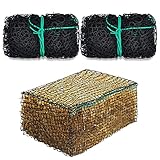
- Package Including: you will receive 2 pieces hay nets for horses, the size is about 47 x 20 x 20 inches, when the net is fully stretched, it can accommodate many hays, as well as smaller bags, which is the suitable size to meet your needs
- Quality Material: the hay net is made of polyethylene net, it is sturdy, lasting, wear resistant and not easy to break, it can also bind the bales firmly inside, and you don't need to worry about the bales falling
- Humanized Design: designed with the little hole, the hay horse feeder helps to prevent the horse from swallowing too much food or air while eating, and also slowing down eating to reduce stomach problems or indigestion
- Meaningful Ways to Apply: the small mesh of the square bale hay net can reduce hay spills and messes when the horses are eating, thus saving you time and effort and improving their overall digestibility at the same time
- Wide Applications: our large square bale hay net is suitable for barns, paddocks, trailers and so on, keeping the hay away from the barn floor or away from the dirt in the paddock, which helps keep the hay clean and arid so that reduce hay waste
Water, salt, minerals, and supplements
Keep fresh, clean water available at all times and provide salt. The appropriate mineral plan depends on the whole ration, including forage quality. A ration balancer is a concentrated source of protein, vitamins, and minerals that may help when forage supplies sufficient calories but leaves nutrient gaps. Do not add supplements automatically; follow product directions and consider the complete ration. See University of Minnesota Extension’s guidance on ration balancers.
What treats can horses eat?
Apples and carrots are common treats, but treats should be small extras. Prepare pieces appropriately to reduce choking risk, especially for horses that bolt food or have dental problems. Horses with metabolic concerns may need to avoid sugary or starchy treats; ask a veterinarian or equine nutrition professional if unsure.
UC Davis Center for Equine Health notes that rapid eating, inadequate water, dental disease, and other medical issues can contribute to choke, an obstruction of the esophagus that warrants veterinary attention. Prevention can include appropriately portioning treats, maintaining fresh water, regular oral examinations, and slowing fast eaters with suitable feeding arrangements. A slow-feed hay net may suit some horses, but equipment should be matched to the individual horse and setup. Read UC Davis’s choke guidance and University of Minnesota Extension’s slow-feed hay-net guidance.
Penn State Extension cautions that processed human foods can be high in sugar or starch and that horses with metabolic issues may need to avoid such treats. See Penn State’s treat guidance.
Rank #4

- NEW & IMPROVED HAY CHIX QUALITY – We've updated our production process and materials to address previous dye-transfer concerns while maintaining the same handmade fixed-knot construction and marine-grade UV-treated nylon that horse owners trust. This latest generation Hay Chix slow feed hay net delivers the durability, performance, and reliability you expect for everyday feeding.
- SUPPORTS NATURAL GRAZING & HEALTHIER DIGESTION – The 1 3/4" openings encourage smaller bites and slower eating to better mimic how horses naturally graze. This slow feed hay bag helps keep horses occupied between feedings while supporting digestive health and reducing boredom in the stall.
- MINIMIZE HAY WASTE BY UP TO 94% – University testing has shown Hay Chix slow feed hay nets for horses can reduce hay waste by up to 94% compared to feeding loose hay on the ground. Keep more hay in front of your horse, get more out of every bale, and spend less money replacing wasted hay.
- EASY TO FILL, EASY TO HANG, READY FOR THE BARN OR TRAILER – The patented Hay Chix Rope & Hoggle closure makes this hay bag for horses quick to fill and simple to hang in a stall, horse trailer, fence, or tree. A dependable horse hay bag that travels well for camping, trail riding, and horse shows.
- HANDMADE IN TEXAS, USA – Every Hay Chix hay net for horses is handcrafted using fixed knots that help maintain consistent hole size and feeding performance over time. Trusted by horse owners looking for a durable hay feeder that holds up season after season.
Safe feeding and individual needs
Use clean feed, discard moldy or spoiled hay and grain, and avoid abrupt diet changes. The right ration depends on age, body condition, workload, dental status, pasture, forage analysis, and health history. Local forage species and hay quality vary, so regional extension guidance can help.
| Horse or feeding situation | What to consider |
|---|---|
| Healthy horse maintaining condition | Good-quality forage may provide most or all of the diet; grain is not automatic. |
| Hard keeper or hard-working horse | Consider whether forage alone supplies enough energy and nutrients; select concentrates for a defined need. |
| Pregnant or lactating mare | Requirements may warrant additional nutrition and an individualized ration. |
| Poor dentition | Suitable soaked forage cubes or pellets may help; consider choke risk and feeding form. |
| Metabolic disease or laminitis risk | Use a veterinarian-directed plan for forage, pasture, and treats. |
| Horse that bolts feed | Appropriately portion food and consider suitable ways to slow eating. |
How to build a safe starting ration
- Assess the horse: Consider body condition, age, workload, dental status, and health history.
- Evaluate forage: Check quality and obtain a laboratory analysis when precision matters.
- Provide forage, water, and salt: Keep forage at the foundation and fresh water continuously available.
- Add concentrate only for a reason: Choose a product for the horse’s needs, weigh it, and follow its label.
- Transition gradually: Make diet changes over approximately 10–14 days.
- Monitor and adjust: Watch body condition, appetite, manure, and eating behavior; seek professional advice for medical or persistent concerns.
When a veterinarian or equine nutrition professional should help
Ask a veterinarian or equine nutrition professional for an individualized plan when a horse has metabolic disease, laminitis risk, poor dentition, difficulty maintaining weight, or another medical need. Seek veterinary attention for suspected choke, refusal to eat, signs of colic, suspected poisoning, or a sudden major change in health or eating behavior.
FAQ
What do horses eat most of the time?
Most horses’ diets are based on forage such as pasture grass and hay. Many healthy horses need little or no grain.
How much hay should a horse eat?
The University of Minnesota Extension says most horses should consume about 2% of body weight in hay daily, while emphasizing that these are broad guidelines. The right amount depends on the horse and the hay’s quality.
Do these 3 things before closing this tab:
1Scan for outdated or missing drivers - takes under a minute2Clear out junk files and repair common Windows errors3Fix the driver behind crashes, sound loss and screen glitchesBest Value

- Generous Capacity: This hay net is designed for square bales and is large enough to hold a hay bale measuring between 36x18x18 and 45x25x17 inches. Its generous capacity significantly extends feeding time, reducing the need for frequent refills and saving you time and effort
- Durable and Long Lasting: Crafted from premium PE material that is completely safe for animals. Hand-braided with 8 strands rope, its waterproof, abrasion-resistant, and anti-aging properties ensure lasting performance
- Slow Feeding Design: The super slow feed hay net with 1.6 inch mesh openings encourage horses to eat at a natural, slower pace. This not only aids digestion by mimicking their natural grazing behavior but also significantly reduces hay waste, helping to maintain a cleaner stall
- Easy Loading and Storage:The horse hay net with a drawstring design allows for quick and effortless hay loading. Simply pull the drawstring tight to secure the contents, ensuring a neat and tidy storage solution
- Multi Purpose: An ideal feeding solution for various settings like barns, paddocks, and trailers, helps maintain a tidy space. This hay feeder is a versatile choice for all your livestock, from horses and cattle to goats and sheep
Do horses need grain?
Not necessarily. Grain or another concentrate may be useful when forage does not meet an individual horse’s energy or nutrient needs, but it is not a default requirement.
Can horses eat apples and carrots?
They are common treats, but offer small, appropriately prepared portions. Be especially cautious with horses that bolt food, have dental problems, or have metabolic concerns.
How much grain can a horse eat at one meal?
Merck Veterinary Manual advises no more than 0.5% of body weight in grain-based concentrate at one meal. This is an upper limit, not a target; follow the feed label and divide substantial amounts into smaller meals.
What should I do if my horse chokes?
Choke is an esophageal obstruction and warrants veterinary attention. Contact a veterinarian promptly rather than trying to manage a suspected obstruction on your own.
The Tool Desk
Outbyte Driver Updater FREEScan for outdated or missing drivers - takes under a minuteDriver Scan →Outbyte PC Repair FREEClear out junk files and repair common Windows errorsFree Scan →Can a horse with metabolic problems have treats?
Some horses with metabolic issues need to avoid sugary or starchy treats. Ask the horse’s veterinarian or an equine nutrition professional about suitable choices.
The Bottom Line
Build most horses’ diets around clean, good-quality forage. Provide fresh water and salt, use concentrates only when the horse’s needs justify them, and keep treats small and appropriately prepared. Test hay when precision matters, change diets gradually, and seek individualized professional advice for medical concerns.
Quick Recap
Product prices and availability are accurate as of the date/time indicated and are subject to change. Any price and availability information displayed on Amazon at the time of purchase will apply.




