Quick wins for a faster PC:
Fix the driver behind crashes, sound loss and screen glitchesFind Drivers →Repair Windows errors before they cause bigger problemsFix Now →There is no single official list of Russian cat breeds, but ten cats are commonly described as Russian-associated. They include regional cats and breeds developed by Russian breeders, with varied coats, care needs, and registry recognition. This guide compares them and explains what to verify before choosing one.
Russia and surrounding regions are associated with forest cats, bobtails, curly-coated cats, reduced-coat breeds, and cats developed by breeders. “Russian-associated cat breeds” is a careful umbrella term, not a universally agreed registry category.
Registries do not classify every cat in the same way. For example, WCF describes the Neva Masquerade as a colorpoint variety of the Siberian, while FIFe lists the breeds separately. Recognition also varies for less widely covered breeds; check the current standard of the registry issuing a cat’s pedigree. The ten-breed overview is an editorial selection, not a claim of equal recognition.
Quick comparison of the 10 Russian-associated cat breeds
| Breed | Coat or appearance | Care and recognition |
|---|---|---|
| Russian Blue | Short, dense blue-gray coat with silver tipping; green eyes | Little coat grooming; widely established breed |
| Siberian | Powerful build; dense seasonal semi-long coat | Regular combing; broadly recognized |
| Neva Masquerade | Pointed Siberian-associated type, usually blue-eyed | Registry classification differs |
| Donskoy | Reduced coat, from hairless to partly coated | Skin-aware care and protection from environmental extremes |
| Peterbald | Coat types from hairless to fully coated; long, lean body | Care depends on coat type; not reliably hypoallergenic |
| Kurilian Bobtail | Short or semi-long coat; distinctive short, fluffy tail | Natural regional breed; regular brushing |
| Karelian Bobtail | Short- or longhaired bobtail | Recognition is registry-dependent; care varies by coat |
| Ural Rex | Short- or longhaired curly coat | Breed-specific English-language information is limited |
| Mekong Bobtail | Shorthaired, pointed, blue-eyed cat with kinked or curved tail | Russian-developed or associated; pointed appearance has Southeast Asian associations |
| Toybob | Compact cat with short kinked tail | “Small” does not mean teacup or guarantee a particular adult size |
1. Russian Blue
The Russian Blue has a short, dense blue-gray coat with silver tipping, green eyes, and a graceful, wedge-shaped appearance. It is often described as reserved around strangers and affectionate with familiar people, though an individual cat’s temperament can differ.
#1 Best Overall
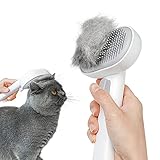
- 【Professional Cat Hair Brush】Perfect gift for pet owners, vets, and pet groomers. Using this cat brush for long haired cats on a regular basis can gently and effectively remove loose hair, tangles, knots, dander and trapped dirt. Suitable for short, medium or long, thick, thin or curly haired dogs/cats/rabbits, making your pets shiny and healthy.
- 【Skin-friendly Massage Needles】The mental pins on the cat brush with release button have round rubber tips on the ends. As a cat deshedding brush, it's perfect for shedding and massaging your pets without scratching your pet's skin, even the sensitive skin. After use, you can hang it with the silicone loop strap to protect the bent needle.
- 【Upgraded High Quality Material】The our long hair cat grooming brush made of durable 304 stainless steel and fine ABS material. Our wire bristles is 1.2 times as thick as bristles of other deshedding brush for cats. More sturdy and not easy to deform, can be used for a long time. 150° bent needles designed to penetrate deep into the coat are really easier to groom the undercoat well.
- 【One-click Cleaning Button】After brushing your pet, simply click the button. The shutter will pop out, separating the brushed hair from the metal needle, then wipe the hair off. The button of cat shedding brush on the handle saves time and energy when grooming and cleaning.
- 【SUPPORT · 365 Days】If the pet hair brush have any problems during use, we will provide you with replacement or 100% money back. And we have a professional customer service team and pet experts to provide you with the pre-sales and after-sales service. aumuca is always at your side.
Russian Blue care
The coat needs little grooming; the Cat Fanciers’ Association suggests combing two or three times monthly. Monitor food intake and provide interactive exercise, as the CFA notes an obesity risk. Routine dental care, nail care, parasite prevention, and veterinary checkups matter as they do for any cat. CFA’s Russian Blue profile provides breed-specific guidance.
2. Siberian
The Siberian is a powerful, medium-to-large cat associated with Siberia’s forests. It has a dense seasonal semi-long coat, and may take up to five years to reach full physical maturity, according to The International Cat Association (TICA). Siberians are often described as interactive and playful, but no breed description guarantees an individual personality.
Siberian care
TICA recommends combing or brushing a couple of times each week, more often during seasonal shedding. A grooming brush or stainless-steel comb can help, but choose tools to suit the individual cat’s coat and tolerance. TICA also recommends checking Siberians for hypertrophic cardiomyopathy; discuss appropriate veterinary screening with a veterinarian. This is a care consideration, not a claim that every Siberian develops the condition. TICA’s Siberian profile gives current breed guidance.
3. Neva Masquerade
The Neva Masquerade is a pointed-color Siberian-associated cat with a semi-long coat and usually blue eyes. Registry classification differs: WCF describes it as a colorpoint variety of the Siberian, while FIFe lists Neva Masquerade and Siberian separately. FIFe’s breed directory is one place to check its current listing.
What’s actually slowing this PC down?
Pick the symptom - the matching free tool is one click away.
Neva Masquerade care
Siberian coat care is a practical starting point: regular combing and extra attention during seasonal shedding. Adjust grooming to the individual cat rather than assuming every coat needs the same schedule.
Rank #2

- Cat brushes for long haired cats and short haired cats
- Soft Tip Bristles:Cat comb with soft tip bristles, helping to break up tangles and mats effectively,Your pet will enjoy the gentle massaging
- Soft Gel Handle:Super soft handle with anti-skid curved silicone gel, keeps your hand comfortable while grooming
- Self-Cleaning Button:Simply push the release button, and all the fur will come off the bristles, no more digging in between bristles to get the hair out
- Premium Material:The cat grooming brush is made of resistant and durable material, free of toxins and chemicals, healthy and easy to use
4. Donskoy
The Donskoy is a Russian reduced-coat breed associated with Rostov-on-Don. Its coat can range from hairless to bristly or partly coated, so cats may look different from one another.
Reduced-coat cats still need grooming and skin-aware care. TICA advises attention to skin and protection from sun exposure and temperature extremes. Ask a veterinarian about irritation or other skin concerns rather than treating them with grooming products. TICA’s Donskoy profile provides additional breed guidance.
5. Peterbald
The Peterbald is a Russian breed with coat types ranging from hairless to fully coated and a long, lean, muscular, Oriental-type body. It is distinct from the Donskoy, and its coat type affects its care needs.
Tailor grooming to the individual coat, and ask a veterinarian for advice about skin care when needed. Hairlessness does not make a cat allergy-safe: TICA states, “Hairless Peterbalds are not all hypoallergenic.” Cat allergies can involve saliva, coat, or dander, and reactions vary by person and individual cat. TICA’s Peterbald profile discusses the breed and care.
6. Kurilian Bobtail
The Kurilian Bobtail is a natural breed associated with the Kuril Islands, Sakhalin, and Kamchatka. It may be shorthaired or semi-longhaired, with a distinctive short, fluffy tail that varies from cat to cat.
Rank #3

- 【Easy Desheding】: Swihauk self cleaning dog brush for long haired dogs with release bottom helps effortlessly reduce shedding. A must have dog brush for short haired dogs, cat brush for indoor cats, cat brush for shedding, slicker brush for dogs.
- 【Safe Design】: Soft and protective plastic round head bristles creating a comfortable feeling while deshedding without hurting your pet. Ideal puppy brush for small dogs, dog brush for shedding and grooming.
- 【Sturdy & Durable】: Premium stainless steel metal and compact design make our product sturdy and durable for long term use.
- 【Ergonomic Design】: Press bottom for easy cleaning, high-quality & lightweight TPR handle make your grooming effortlessly.
- 【Effective to Remove Loose Fur】: Swihauk pet grooming brush is effective to remove loose fur, suitable for dogs, cat with long and short hair, perfect for your lovely pet like puppies, golden retriever, rabbit, kitten, bunny, yokie and more.
TICA says the coat generally does not tangle easily and recommends regular brushing. Choose grooming frequency and tools for the cat’s coat and shedding. TICA’s Kurilian Bobtail profile offers further information.
7. Karelian Bobtail
The Karelian Bobtail is distinct from the Kurilian Bobtail and has different regional and registry histories. Recognition is more registry-dependent, and coat-care needs vary between shorthaired and longhaired cats.
Do these 3 things before closing this tab:
1Clear out junk files and repair common Windows errors2Scan for outdated or missing drivers - takes under a minute3Repair Windows errors before they cause bigger problemsBefore choosing one, ask which organization registers the cat and how that organization’s current standard describes the breed. Ask breeders about the specific cat’s coat and line rather than relying on broad claims. WCF’s standards are one source for checking current registry material.
8. Ural Rex
The Ural Rex is a Russian-associated curly-coated breed shown in short- and longhaired forms. Reliable English-language information about its history, health, and temperament is more limited than for widely established breeds.
Ask about the individual cat’s coat, care needs, health records, and registering organization. Avoid treating claims about lifespan, disease risk, or guaranteed personality as established facts without reliable supporting information.
Rank #4

- WORLD’S #1 CAT HAIR BRUSH: Our cat grooming brush / cat shedding brush is the world's best patented pet grooming brush for cats, small dogs, and rabbits. It is the perfect cat deshedding brush, short hair cat brush, & cat brush for long haired cats.
- EASY AND FAST CLEANUP: SleekEZ Deshedding Grooming Tool is great for removing hair and fur from carpets, pet bedding, cat trees, and more! Our cat comb for shedding is also an amazing pet hair remover and cat fur remover / cat hair remover brush.
- ALL HAIR & FUR TYPES: It is the perfect cat comb for long haired cats and cat brush for short haired cats. SleekEZ works as a deshedding brush for cats, cat deshedding tool, undercoat brush for cats, cat fur brush, cat deshedder, & small dog brush.
- PAINLESS AND ENJOYABLE: SleekEZ serves as a versatile kitten brush, puppy brush for small dogs, & bunny brush / rabbit brush. It's the best pet hair brush on the market and is an absolute essential for cat shedding control!
- GREAT GIFT: SleekEZ makes the industry's leading cat combs for indoor cats & shedding brush cat hair. It is a must have for any cat grooming kit, cat essentials for indoor cats, & cat supplies. Also an amazing cat dander remover & cat undercoat brush
9. Mekong Bobtail
The Mekong Bobtail is a shorthaired, pointed cat with blue eyes and a kinked or curved short tail. It is more accurate to describe it as Russian-developed or Russian-associated than as an indigenous Russian forest cat; its pointed appearance has Southeast Asian associations.
For a less widely covered breed, check the current standard and recognition information from the relevant registry. WCF’s standards provide registry material to consult.
10. Toybob
The Toybob is a compact, small Russian-developed cat with a short kinked tail. Its recognition is not as uniform as that of more widely established breeds.
“Small” does not mean “teacup,” guarantee a particular adult weight, or establish that a cat is a healthy miniature. Prioritize the individual cat’s health, structure, and temperament, and check the registering organization’s current standard.
Independent reader supportYour contribution helps us test, update, and keep practical guides available for everyone.Which Russian-associated breed may suit you?
- For relatively little coat grooming: Consider the Russian Blue, whose short coat needs little grooming.
- For a dense, seasonal coat: A Siberian may suit you if you can provide regular combing and extra grooming during shedding.
- For a pointed, blue-eyed Siberian-associated cat: Consider the Neva Masquerade and check how your chosen registry classifies it.
- For a reduced-coat appearance: Compare Donskoy and Peterbald coat types, body shape, and skin-care needs; neither is guaranteed to be allergy-safe.
- For a natural regional bobtail: The Kurilian Bobtail is associated with the Kuril Islands, Sakhalin, and Kamchatka.
- For a less widely covered bobtail or curly-coated cat: Ask about registry recognition and the specific cat’s care needs.
Care checklist before bringing one home
- Confirm the individual cat’s coat type and grooming needs.
- Ask which registry recognizes the cat and whether its classification differs elsewhere.
- Review veterinary records, vaccination and parasite-control history, and any relevant health screening.
- Plan for routine veterinary, dental, and nail care regardless of coat type.
- For reduced-coat cats, ask a veterinarian about skin-aware care and protection from environmental extremes.
- For dense or semi-long coats, have suitable grooming tools ready and increase attention during shedding as needed.
- Do not choose a breed on assumptions of guaranteed hypoallergenic qualities, temperament, or adult size.
Are these all officially Russian cat breeds?
No. “Russian cat breeds” is not a single universally standardized category. Some cats are associated with Russian regions, while others were developed by breeders. Registry lists and classifications differ, including over whether the Neva Masquerade is a Siberian variety or a separately listed breed.
Recommended Free Tools
Best Value

- REMOVES LOOSE FUR & UNDERCOAT: The 5-inch EquiGroomer deshedding brush gently pulls loose hair and undercoat from cats and dogs without cutting healthy fur.
- PERFECT SIZE FOR CATS & SMALL DOGS: The compact 5-inch blade fits smaller pets and tight spots - face, legs and paws - for easy, precise grooming.
- WORKS ON SHORT & LONG HAIR: Rounded stainless-steel teeth glide through any coat, reducing shedding while keeping your pet calm and comfortable.
- LESS SHEDDING, LESS MESS: Regular use dramatically cuts loose hair on furniture, floors and clothes and leaves a softer, shinier coat.
- COMFORT-GRIP HANDLE: A lightweight, ergonomic handle gives you full control for quick, stress-free grooming sessions.
For a rare breed, verify the current rules and standard of the organization issuing the pedigree. This helps clarify recognition and the basis for a breeder’s claims.
FAQ
What are the Russian cat breeds?
There is no single official list. Russian-associated examples include the Russian Blue, Siberian, Neva Masquerade, Donskoy, Peterbald, Kurilian Bobtail, Karelian Bobtail, Ural Rex, Mekong Bobtail, and Toybob.
Are Russian cat breeds hypoallergenic?
Do not assume so. TICA says hairless Peterbalds are not all hypoallergenic, and individual exposure and reactions vary. No breed in this list should be described as universally allergy-safe.
What is the difference between a Neva Masquerade and a Siberian?
The Neva Masquerade is a pointed-color Siberian-associated cat. WCF describes it as a colorpoint variety of the Siberian, while FIFe lists the two separately; check the registry relevant to the pedigree.
Are Donskoy and Peterbald cats the same breed?
No. They are separate Russian-associated breeds. Both have variable coat presentations, but the Peterbald has a long, lean, Oriental-type body; care should be tailored to the individual cat’s coat.
How do you care for a hairless cat?
Use skin-aware care suited to the individual cat, protect it from environmental extremes, and ask a veterinarian about skin concerns. Hairlessness does not eliminate the need for routine veterinary and dental care.
Which Russian-associated cat breed is easiest to groom?
The Russian Blue has a short coat that needs little grooming. All cats still need routine care, and grooming needs vary by individual.
The Bottom Line
These ten Russian-associated cats differ in coat, appearance, care needs, and registry history. Choose based on the individual cat’s needs and verified health information, not assumptions about allergy-friendliness, guaranteed temperament, or miniature size.
The Tool Desk
Outbyte Driver Updater FREEScan for outdated or missing drivers - takes under a minuteDriver Scan →Outbyte PC Repair FREERepair Windows errors before they cause bigger problemsFix Now →Quick Recap
Product prices and availability are accurate as of the date/time indicated and are subject to change. Any price and availability information displayed on Amazon at the time of purchase will apply.




