There is no scientific proof that dogs can see ghosts. When a dog barks at “nothing,” it may be reacting to a faint sound, scent, or movement you have not noticed; that does not establish a paranormal cause. A sudden, persistent, or worsening behavior change can also have medical or behavioral explanations, so consult a veterinarian about concerning changes.
Why a dog’s behavior can look paranormal
Few things feel more convincing than a dog suddenly freezing, staring toward an empty corner, growling at a doorway, or barking at a patch of wall. Because dogs often notice things before their owners do, it is tempting to conclude that they are seeing a ghost.
The more evidence-based explanation is simpler: the dog may be detecting a real sound, smell, or movement that a human has missed. The behavior itself is real. No source reviewed establishes that dogs perceive ghosts, and anecdotes are not scientific evidence.
Science does not establish that every imaginable supernatural claim is impossible. The careful conclusion is that there is no scientific proof that dogs see spirits or have a validated paranormal “sixth sense.” Known sensory, learning, environmental, and medical explanations are better supported.
#1 Best Overall

- Heartbeat Toy for Medium Breeds: Plush comfort toy (12 x 8 in) sized for dogs 25-70 lbs; includes beating heart, 1 disposable heat pack, and 2 AAA batteries; also available in Junior for small breeds and Large for 70+ lb breeds
- Battery-Powered Heartbeat: Provides a rhythmic pulsing sensation designed to comfort puppies during rest, crate time, or overnight use; press button and place heart in belly pouch; batteries included; not a chew toy, remove heart before unsupervised play
- Calming Comfort for New Puppies: Designed to help your puppy settle during first nights home, crate training, and bedtime; rhythmic heartbeat and warmth create a soothing littermate-like presence; many owners use during travel, storms, and separation
- Heat Pack and Easy Care: Disposable heat pack inserts into belly pouch for up to 24 hours of warmth (single-use; replacement packs sold separately in 6-pack and 12-pack); plush toy is machine washable; remove heart unit and heat pack before washing
- Trusted by Over 1 Million Dog Owners: The original heartbeat comfort toy designed by SmartPetLove; used by breeders, shelters, and veterinary professionals; available in three sizes to fit every breed; batteries included and ready to use from day one
What your dog may notice that you cannot
1. Sounds outside the human hearing range
Dogs can hear some higher-pitched or fainter sounds from farther away than people can. When a dog alerts toward a ceiling, wall, doorway, or empty yard, the source might be ordinary but inaccessible to human ears.
Possible triggers include:
- Plumbing, heating, ventilation, or electrical appliances
- Rodents, insects, or other animals moving inside walls or ceilings
- Distant traffic, people, or animals outside
- Electronic tones or high-frequency noises from household devices
- Small changes in a building’s sounds that the dog has learned to recognize
A dog’s fixed stare may indicate the direction of a sound rather than the location of an apparition. Turn off appliances one at a time, check nearby walls and ceilings, and observe whether the reaction happens at a predictable time or during a particular household activity.
2. Odors and changes in airflow
Smell is an important way dogs investigate the world. They may respond to odor traces and chemical cues that people do not consciously notice. Detection dogs are trained to detect particular scents; this does not mean that every dog’s sensitivity is the same or that scent detection is evidence of a ghost.
A dog that repeatedly sniffs a doorway, stares into the air, or returns to one spot may be following:
- An animal scent entering through a gap, vent, or window
- Food, cleaning products, dampness, or another odor in the room
- A person’s or animal’s scent left on clothing, furniture, or flooring
- Airflow carrying a smell from another part of the building
A draft or change in air movement can also carry a scent. What looks like a dog watching an unseen presence could be the animal orienting toward a smell source.
Rank #2

- Plush Cat Toy: A cozy companion for kittens and cats—offers comfort during stressful transitions and helps ease separation anxiety
- Touch-Activated Purr: Gently squeeze or cuddle the cat pillow toy to trigger a calming purring sound that lasts 2 minutes
- Soft & Snuggly: Cozy fabric makes this interactive cat toy perfect for naps, kneading, and quiet snuggle time
- Easy to Clean: Simply remove the purr mechanism and machine wash the plush fabric shell; air dry fully before reassembling
- Play It Safe: No toy is indestructible. Do not leave toys with unsupervised pets. Remove and replace toy if worn or damaged. Contains 3 LR44 Alkaline replaceable button cell batteries
3. Movement and reflections in dim light
Dogs are not simply seeing the world in black and white. Their color vision and other visual abilities differ from ours, but canine visual processing is not fully understood and may vary among dogs. A peer-reviewed review by Byosiere and colleagues (2017) calls for more precise research on canine visual processing.
A small reflection, moving shadow, insect, curtain, branch, or animal outside may catch a dog’s attention even when a person sees nothing unusual. At night, headlights, television flicker, phone screens, and changing outdoor light can create movement or reflections across walls and floors.
To investigate, change the lighting and inspect the area from your dog’s eye level. Check windows, reflective surfaces, fans, hanging objects, and gaps under doors. If the reaction changes when the light or object changes, an ordinary visual trigger is more likely than a ghost.
Free tools Windows power users keep installed
One-click scans. No signup required.
4. Learned routines and associations
Dogs do not respond only to immediate sights and sounds. They learn patterns. A dog may become alert near a door because household routines predict that someone will arrive, or react in a room because previous sounds, smells, or experiences there have created an association.
For example, a dog that stares toward the hallway shortly before a family member comes home may have learned subtle cues: a distant vehicle, footsteps, a familiar scent, or a change in the household’s routine. The dog is not pretending to react, but the explanation does not need to involve anything paranormal.
Rank #3

- 【Anxiety Relief】WEOK heartbeat puppy toy which is a simulation of the true pulsing heartbeat enables the puppy to feel the comfort. It can help puppies and cats to relief the separation anxiety, loneliness, go through the tough time and adapt the new home or other complex environment. Important tips for heartbeat device: Press and hold the switch long enough, it works; Press and hold the switch long enough, it stops.
- 【Crate Training Toy & Sleep Aid Toy】When the time comes for crate training, cuddling with WEOK heartbeat buddy will help reduce negative behaviors, such as whining and barking,which means you will get more sleep at night. It is a good behavioral training aid toy which could comfort your puppies.
- 【Suitable for all kinds of dogs and cats】Whether an older rescue dog or a new puppy, the WEOK Heartbeat Puppy Toys help your special pup through the tough times with comforting calmness from a warm, cuddly friend with a heartbeat can ease their fears and offer general anxiety relief. This heartbeat stuffed animal helps your dog find the peace and relaxation they need.
- 【Best Gift for Pet & Comfort Toy for Puppy】The WEOK plush toy with heartbeat simulate is suitable for all puppies, small, medium, large dogs, cats, helps pets reduce anxiety, tension, loneliness, behavior training, insomnia aid, soothes dogs and more, and it is a great dog birthday or festival gift.
- 【Perfect buddy for our new puppy】The WEOK heart beat dog toy for puppy can help dogs not bark, howling and make noise when they are alone, with the company of heartbeat stuffed animal toy to make dogs adapt to their kennels or dog bed, reduce the dog's sticky behavior and sleep aid at night, let the dog sleep well.
Why anecdotes about haunted dogs feel persuasive
Stories about dogs reacting to a “ghost” often combine unusual behavior with an emotionally important detail. An owner may notice that a dog repeatedly pauses in one room and later learn that something significant happened there. That coincidence can feel like confirmation.
But an anecdote usually cannot answer the questions needed to establish cause:
Windows Errors? Fix Them Before They Spread
Repair common Windows errors and clear accumulated junk for a smoother, more stable PC - no reinstall needed.Free scan · no reinstallOutdated Drivers Are Slowing You Down
One free scan finds every outdated or missing driver and matches the right update for your exact hardware.Free scan · exact hardware match- Was the behavior recorded accurately and consistently?
- Were ordinary sounds, smells, reflections, drafts, and animals ruled out?
- Did the behavior occur when observers did not know the location’s history?
- Could independent observers reproduce the result?
- Was there a clearly defined “ghost” stimulus to detect?
Without controls and repeatable observations, a story shows that a dog behaved unusually—not that it perceived a spirit. No controlled experiment directly testing whether dogs perceive ghosts was identified in the research reviewed for this article.
Could staring or other unusual behavior be a health problem?
Yes. A sudden, persistent, worsening, or broader change in behavior should not automatically be attributed to a ghost. Cognitive dysfunction, anxiety, pain, and other disease can produce overlapping signs. In older dogs, cognitive changes may include disorientation, changes in social interaction or sleep, loss of house-training or learned behaviors, altered activity, and anxiety.
The American Animal Hospital Association (AAHA) reports that approximately 14–22.5% of dogs older than 8 years have age-related cognitive impairment. This is a population estimate, not a diagnosis or explanation for an individual dog’s behavior. Similar signs can have other causes, including pain, organ dysfunction, or intracranial disease. A veterinarian can take a history and perform an examination to assess possible causes.
Rank #4
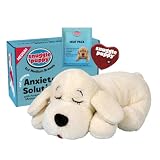
- Heartbeat Toy for Medium Breeds: Plush comfort toy (12 x 8 in) sized for dogs 25-70 lbs; includes beating heart, 1 disposable heat pack, and 2 AAA batteries; also available in Junior for small breeds and Large for 70+ lb breeds
- Battery-Powered Heartbeat: Provides a rhythmic pulsing sensation designed to comfort puppies during rest, crate time, or overnight use; press button and place heart in belly pouch; batteries included; not a chew toy, remove heart before unsupervised play
- Calming Comfort for New Puppies: Designed to help your puppy settle during first nights home, crate training, and bedtime; rhythmic heartbeat and warmth create a soothing littermate-like presence; many owners use during travel, storms, and separation
- Heat Pack and Easy Care: Disposable heat pack inserts into belly pouch for up to 24 hours of warmth (single-use; replacement packs sold separately in 6-pack and 12-pack); plush toy is machine washable; remove heart unit and heat pack before washing
- Trusted by Over 1 Million Dog Owners: The original heartbeat comfort toy designed by SmartPetLove; used by breeders, shelters, and veterinary professionals; available in three sizes to fit every breed; batteries included and ready to use from day one
For concerning changes, contact your veterinarian rather than trying to diagnose the cause from a description. Early recognition of cognitive dysfunction matters, and the appropriate assessment depends on the dog’s history and signs.
Keep useful observations
If an unusual episode happens, note what you observe and share it with your veterinarian. Include:
- The date and time
- How long the behavior lasted
- What happened immediately beforehand
- Whether the dog responded to its name or a familiar sound
- Any disorientation, sleep changes, house-training loss, anxiety, signs of pain, or other health changes
- Whether the dog seemed different afterward
If it is safe, a video may help your veterinarian understand what happened. Do not put yourself or your dog at risk to record an episode.
A practical checklist for a dog reacting to “nothing”
- Observe the immediate context. What changed just before the behavior—an appliance, odor, reflection, insect, animal outside, person approaching, or household routine?
- Check the location. Inspect windows, vents, walls, ceilings, floor-level gaps, reflective surfaces, and nearby appliances.
- Change one variable at a time. Turn off a device, alter the lighting, close a window, or move an object, then see whether the response changes.
- Look for patterns. Record when it happens, how long it lasts, and whether it is tied to a place, time, sound, smell, or activity.
- Watch for broader changes. Note disorientation, changes in sleep or social interaction, house-training loss, anxiety, pain, or other health changes.
- Get professional help when needed. Contact a veterinarian about new, ongoing, or worsening behavior changes. A qualified behavior professional may help with a nuisance-barking problem once health concerns have been considered.
What the evidence supports—and what it does not
| Possibility or claim | What the evidence supports |
|---|---|
| Faint sounds | Dogs may hear higher-pitched or fainter sounds from farther away than people can. |
| Odors | Dogs can respond to scents people do not consciously notice; detection dogs are trained for particular odors. |
| Movement in low light | Dogs may notice movement a person misses, but details of canine visual processing remain incompletely understood. |
| Health or behavior changes | Cognitive dysfunction, anxiety, pain, and other disease can produce overlapping signs; a veterinarian can assess concerning changes. |
| A reaction to an empty area confirms a haunting | Not established. The behavior alone does not identify its cause. |
| Dogs have a proven paranormal “sixth sense” | No scientific proof establishes that dogs perceive ghosts. |
So, can dogs really see ghosts?
There is no scientific proof that they can. Dogs may detect real details that humans miss, learn cues in their environment, or show behavior changes with medical or behavioral causes. None of those possibilities confirms a paranormal explanation.
The most responsible interpretation is not “my dog has confirmed a ghost,” but “my dog noticed something—or is experiencing something—that I need to identify.” That approach respects the dog’s behavior while avoiding an unsupported conclusion.
Quick wins for a faster PC:
Fix the driver behind crashes, sound loss and screen glitchesFind Drivers →Repair Windows errors before they cause bigger problemsFix Now →Scan for outdated or missing drivers - takes under a minuteDriver Scan →Best Value

- Realistic Heartbeat Simulation: Experience soothing comfort with a plush toy designed to mimic a real heartbeat, helping pets feel safe and calm during stressful moments
- Soft & Huggable Design: Made from ultra-soft, premium materials, this plush cat offers a cozy cuddle experience, making it an ideal bedtime companion for anxious pets
- Anxiety & Stress Relief: Perfect for pets dealing with separation anxiety, this toy provides a sense of security through its rhythmic heartbeat
- Easy-to-Use & Battery Operated: Insert the included batteries to activate the heartbeat mechanism; an automatic shut-off feature ensures energy efficiency and extended battery life
- Note: The heartbeat device that needs 2 AAA batteries (not included)
FAQ
Can dogs see spirits or ghosts at night?
No scientific proof shows that dogs can see spirits or ghosts. At night, a dog may notice movement, reflections, faint sounds, or odors that are difficult for people to detect.
Why does my dog bark at nothing?
“Nothing” to a person may still be a faint sound, scent, or movement to a dog. Consider the location, time, nearby people or animals, and household sounds. If the behavior is new, ongoing, or worsening, consult a veterinarian.
Why does my dog stare at an empty wall?
Possible explanations include sounds inside the wall, rodents or insects, odors, reflections, low-light movement, learned associations, or a health-related behavior change. If the staring is new or persistent, record what you observe and contact your veterinarian.
Can my dog see something I can’t?
Dogs may notice a sound, odor, or movement that you have missed. That is a plausible sensory explanation, not evidence that the unseen thing is a ghost.
What’s actually slowing this PC down?
Pick the symptom - the matching free tool is one click away.
When should I contact a veterinarian about unusual behavior?
Contact a veterinarian if the behavior is sudden, persistent, worsening, or part of a broader change such as disorientation, sleep or social changes, loss of house-training, anxiety, or signs of pain. A veterinarian can assess possible causes rather than relying on a paranormal interpretation.
The Bottom Line
Dogs can notice things people miss, but there is no scientific proof that they see ghosts. Check for sounds, smells, movement, and learned cues. If your dog’s behavior is new, persistent, worsening, or accompanied by other changes, consult a veterinarian.
Quick Recap
Product prices and availability are accurate as of the date/time indicated and are subject to change. Any price and availability information displayed on Amazon at the time of purchase will apply.




