Free tools Windows power users keep installed
One-click scans. No signup required.
Fish gills are the primary aquatic gas-exchange organs for most fish: they extract oxygen dissolved in water and release carbon dioxide into it. Water passes over thin, blood-rich surfaces called lamellae, where gases diffuse between water and blood. Gills also help regulate ions and acid-base balance and excrete nitrogenous waste.
Fish do not obtain oxygen by splitting water molecules. Instead, dissolved oxygen crosses a thin exchange surface into the blood. The anatomy and ventilation method vary among fish groups, but the basic exchange process is similar. Evans, Piermarini, and Choe’s review in Physiological Reviews describes the gill’s multiple physiological functions.
Where are a fish’s gills?
In most bony fish, the gills are located behind the head in chambers protected by an operculum, or gill cover. The operculum shields delicate gill tissue, and its movement helps move water across it.
Sharks do not have the same bony opercular cover: their gills open through exposed gill openings, and some sharks also have spiracles that can bring water toward the gills. Other fish groups can have distinct arrangements, so the covered-chamber description applies to typical bony fish, not every fish. The Western Australian Department of Primary Industries and Regional Development’s gill fact sheet describes common anatomy and ventilation differences.
#1 Best Overall

- Tiny but Enduring: Each air stone measures 0.6" D x 1" H and weighs 0.3 oz. Tiny but well-constructed for continual bubbling. Ideal for small fish tanks or aquariums.
- Medium Bubbles: The air stone cylinders produce a good amount of dense bubbles. A great way to increase oxygen solubility in your aquarium and enliven the aquatic lives.
- Model: ASC-025; Jetting volume: 0.8 L/min; Standard ID airline tubing: 3/16". Driven by even nano air pumps of 2 W - 4 W. Efficient bubble stone for long-time service.
- Reliable Material: The fish tank air stones are made of mineral material and sintered at a high temperature, it causes no effect to the health of your aquatics. Help keep your fish growing healthily.
- Easy to Use: Soak the airstone completely in water for 1 hour before use. Clean it regularly with a brush as it gets clogged after weeks or months of usage.
Many bony fish move water in through the mouth, over the gills, and out near the operculum. Coordinated mouth and operculum movements provide ventilation in many species. Some active swimmers rely more on forward movement to carry water across their gills.
What do fish gills look like inside?
A gill is a folded structure with parts that support and enlarge its exchange surface. In a typical bony fish, the sequence is gill arch, filament, and lamella:
| Part | What it does |
|---|---|
| Gill arches | Curved supports to which gill filaments attach; they also support gill rakers. |
| Gill rakers | Structures on the arches that help protect the gill area and are involved in handling particles in water; their form varies among fish. |
| Gill filaments | Projections that provide a large area for exchange and carry numerous lamellae. |
| Lamellae | Thin plates on the filaments that bring water and blood close together for gas exchange. |
| Operculum | The protective cover over the gills in most bony fish; its movement can help ventilate them. |
The exchange surface is thin and closely supplied with blood, allowing oxygen and carbon dioxide to diffuse between water and blood. For an accessible explanation of lamellae and countercurrent flow, see the American Museum of Natural History’s fish-gill resource.
How do gills help fish breathe?
Gills exchange gases by diffusion, the movement of a substance from an area of higher concentration toward an area of lower concentration:
Recommended Free Tools
Rank #2
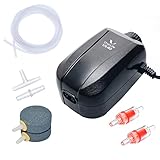
- Steady Output: Max Air Flow Rate: 64 GPH; Pressure: 0.016 MPa; Power: 4 W. Perfect for aeration in 10 - 100 gallon fresh water and marine aquariums.(The data is measured with experimental equipment and may deviate slightly from the actual data. The air volume may be insufficient due to the blocked air intake cotton. Please replace the cotton yourself if the air volume is insufficient.)
- Adjustable Air Flow: Feature a rotary knob to control the amount of air for dual outputs, allowing for your desired air flow to fully oxygenate your fish tank.
- Quiet Operation: The pump emits 25 dB sound under the “Low” mode and maximum 45 dB noise like the hum of a refrigerator under the highest air flow.
- 2 Air Stone Discs: Produce lots of dense medium bubbles bursting into the surface of water steadily. A great way to aerate your tanks and enliven the aquatic life.
- Pump Accessories: Include 2 air stones, 6.5-foot airline tubing, 2 check valves and 2 connectors. Complete accessories to build the basic aeration setup in your tank.
- Water carrying dissolved oxygen moves over the gill surfaces.
- Oxygen diffuses across the thin lamellar surface into nearby blood.
- Carbon dioxide diffuses from blood into the water.
- Ventilating water carries the carbon dioxide away.
Filaments and lamellae create extensive exchange area in a compact space. Their thin surfaces and close blood supply allow gases to cross efficiently. The physiological review by Evans, Piermarini, and Choe reports that oxygen-extraction efficiency varies across fish; there is no single percentage that applies to every fish or condition.
What is countercurrent exchange?
Countercurrent exchange means water and blood flow in opposite directions across the lamellae. This arrangement helps keep water with a higher oxygen concentration next to blood with a lower oxygen concentration along much of the exchange surface, allowing oxygen to continue diffusing into the blood.
If water and blood flowed in the same direction, their oxygen concentrations would tend to become similar sooner, reducing the gradient that drives diffusion. Countercurrent flow does not actively pump oxygen into the blood; it helps preserve conditions that support diffusion. The American Museum of Natural History and the Hawaiʻi Department of Land and Natural Resources’ marine-fishes resource explain this opposite-direction arrangement.
How do the gills connect to the fish’s heart?
In the typical fish circulatory pattern, blood follows a single main circuit:
Rank #3

- Widely applicable: suitable for small fish tanks and aquariums, helping extend the life of your nutrient solution
- Medium Bubbles: The air stone cylinders produce dense bubbles,tiny but steady, keep fish/ roots healthy and promote plant growth
- Air stone cylinder dimension: 0.55" D x 1.00" H;Fits for 3/ 16” standard airline tubing
- Quality and safe materials: made of safe, washable and non-toxic materia
- Note: soak the stone completely in water for 30 minutes before use; clean it with a brush after a period time of use
- Blood returning from the body enters the heart.
- The heart pumps oxygen-poor blood toward the gills.
- Blood passing through gill vessels receives oxygen and releases carbon dioxide.
- Oxygen-rich blood travels from the gills to the rest of the body.
- After delivering oxygen to the tissues, blood returns to the heart.
This differs from human circulation, in which blood returns from the lungs to the heart before being pumped to the body. In the typical fish pattern, blood travels from the heart to the gills and then onward to the body without first returning to the heart.
What else do fish gills do?
Gills are more than respiratory organs. Their large, thin surfaces are also important in ion and water regulation, acid-base balance, and the excretion of nitrogenous waste. These functions vary with the fish and its environment and work in coordination with other organs. Evans, Piermarini, and Choe’s review discusses these roles.
Why can many fish not survive out of water?
Many fish depend on water to support their delicate gill surfaces and keep them properly positioned and moist. In air, lamellae may collapse, stick together, or dry out, reducing the area available for gas exchange.
That is why many fish can suffocate on land even though air contains more oxygen than water: their gills are adapted to exchange gases while ventilated by water. Survival out of water varies by species and conditions, so no single time limit applies to all fish.
PC Slower Than It Used to Be?
A free scan shows the junk files, broken settings and background clutter dragging Windows down - then fixes them in one click.Free scan · Windows 10 & 11Crashes, No Sound, or Screen Glitches?
Random freezes, missing sound and display glitches usually trace back to one bad driver. Find and replace yours safely.Free scan · under a minuteRank #4

- Wenshall's air stone set is perfect for aquariums and hydroponics systems, providing essential oxygen to your plants and fish.
- Our set includes 4 pcs 1.6 inch air stones and 2 T-Splitters, so you can easily set up your system without any additional purchases.
- Made of high-quality silicon carbide, our air stones are safe for your fish and plants, promoting growth and a thriving environment.
- Soak the air stones in water for an hour before use and brush the surface every 2 weeks for optimal performance and longevity.
- dimension: 1.6" D x 0.6" H; Jetting volume: 2 L/min; Standard ID airline tubing: 3/16". Driven by even nano air pumps of 2 W - 4 W.
Do all fish use their gills in exactly the same way?
No. Gill-cover arrangement and ventilation differ among fish. Most bony fish have an operculum and many use mouth and operculum movements to ventilate their gills. Sharks have exposed gill openings rather than a bony opercular cover; some sharks use spiracles to bring water toward the gills, and some active swimmers move water across the gills as they swim.
Some fish also supplement gill breathing with accessory air-breathing structures. These adaptations differ by species; they do not change the basic explanation that gills are the principal aquatic gas-exchange organs for most fish.
Independent reader supportYour contribution helps us test, update, and keep practical guides available for everyone.Do fish “breathe water”?
“Fish breathe water” is convenient shorthand, but can be misleading. Fish do not use water itself as their oxygen source and do not normally inhale it into lungs. They move water across their gills and extract the oxygen gas dissolved in it.
A more precise description is: fish ventilate their gills with water and extract dissolved oxygen into their blood.
The Tool Desk
Outbyte Driver Updater FREEScan for outdated or missing drivers - takes under a minuteDriver Scan →Outbyte PC Repair FREEClear out junk files and repair common Windows errorsFree Scan →Best Value

- Air Stone Bar: Each airstone measures 4.5" L x 0.8" W x 0.5" T and weighs 1 oz. Well-constructed for continual bubbling. Ideal for small buckets, fish tanks or aquariums.
- Medium Bubbles: This air stone can produce a cascade of dense bubbles which form a rectangular bubble wall. Great for increasing oxygen solubility in your aquariums and enliven the aquatic lives.
- Steady Output: Jetting volume: 1.3 L/min; Recommended air pump power: > 2.5 W; Standard ID airline tubing: 3/16 inch. Efficient air bubbler for constant air diffusion.
- Reliable Material: The air bubblers are made of mineral material and wrapped in a green plastic base, it won't affect the health of your aquatics. Help keep your fish or roots growing healthily. ur fish or roots growing healthily.
- Easy to Use: Soak the air stone completely in water for 1 hour before use. Clean it regularly with a brush as it gets clogged after weeks or months of usage.
Why are gills effective respiratory organs?
Fish gills combine several features that support gas exchange:
- Large area: Filaments and lamellae create extensive exchange surfaces.
- Thin barrier: Gases cross a short distance between water and blood.
- Close blood supply: Blood flows near the water-facing exchange surface.
- Water flow: Ventilation brings dissolved oxygen to the gills and carries carbon dioxide away.
- Countercurrent arrangement: Opposing water and blood flows help maintain a gradient for diffusion.
FAQ
What do fish get from water through their gills?
Fish gills extract oxygen gas dissolved in water. They do not obtain oxygen by splitting water molecules.
What is countercurrent exchange in fish gills?
It is the opposite-direction flow of water and blood across the lamellae. This helps maintain a concentration gradient that supports oxygen diffusion into the blood.
Do all fish have an operculum?
No. Most bony fish have an operculum, while sharks have exposed gill openings rather than that bony cover. Gill arrangements vary among fish groups.
Do these 3 things before closing this tab:
1Clear out junk files and repair common Windows errors2Fix the driver behind crashes, sound loss and screen glitches3Repair Windows errors before they cause bigger problemsWhat other jobs do gills perform?
Besides gas exchange, gills help regulate ions and acid-base balance and excrete nitrogenous waste. The details vary among fish and environmental conditions.
Why do many fish suffocate out of water?
Many fish gills need water to keep their delicate exchange surfaces supported and moist. In air, the surfaces can collapse, stick together, or dry out, interfering with gas exchange.
The Bottom Line
Fish gills extract oxygen dissolved in water and release carbon dioxide through thin, blood-rich lamellae. Water and blood commonly flow in opposite directions across those surfaces, helping sustain diffusion. Gills also have important roles in ion regulation, acid-base balance, and waste excretion, and their arrangement and ventilation vary among fish groups.
Quick Recap
Product prices and availability are accurate as of the date/time indicated and are subject to change. Any price and availability information displayed on Amazon at the time of purchase will apply.




