The Tool Desk
Outbyte Driver Updater FREEFix the driver behind crashes, sound loss and screen glitchesFind Drivers →Outbyte PC Repair FREEClear out junk files and repair common Windows errorsFree Scan →Why do fish need scales? Fish need scales mainly because scales form a protective, flexible covering over the skin. Overlapping scales help shield the body from scrapes and attacks without creating a rigid shell, while their structure can influence water flow. A mucus coating adds lubrication, pathogen defense, and support for water-and-salt regulation.
That answer describes the most common function, not a rule that applies identically to every fish. Fish groups have evolved several kinds of scales, unusual coverings, reduced scales, and—in some species—little or no conventional scale coverage.
Key takeaways
- Fish scales primarily protect the skin and underlying tissues from abrasion, attacks, and mechanical injury.
- Overlapping scales provide flexible armor: they cover the body while allowing a fish to bend and swim.
- Fish scales are diverse and are not universal; sharks, rays, bony fish, and scale-reduced species have different coverings.
- Mucus is a separate protective layer that lubricates the body, helps regulate water and salt balance, and supports defense against pathogens.
- Scales can influence water flow, but they do not automatically make every fish faster.
- Seasonal growth marks on some scales can help estimate a fish’s age, although the method has important limitations.
Why do fish need scales?
Fish need scales mainly because scales form a protective, flexible covering over the skin. Overlapping scales help shield the body from scrapes and attacks without creating a rigid shell, while their structure can influence water flow. A mucus coating adds lubrication, pathogen defense, and support for water-and-salt regulation.
A fish scale is a dermal structure embedded in the skin, not a loose plate attached to the outside of the body. Neighboring scales overlap, creating a protective surface that can move as the fish bends. FishBase’s reference on scale diversity describes scales as structures associated with protection, coloration, and support, while noting that scales may be modified, reduced, or absent in some fish groups.
What’s actually slowing this PC down?
Pick the symptom - the matching free tool is one click away.
#1 Best Overall

- 4 in 1 Long Aquarium Tools Kits: The aquascape tools kit contains 1 x 10" aquarium scissors, 1 x 10.6" straight long tweezer, 1 x 10.6" curved feeding tongs, and 1 x 12.56" Aquarium substrate spatula. One set of terrarium supplies to help you better manage your aquarium and terrariums. This aquascaping tools are long and slender enough to easily use in any gallon fish tank, good as fish tank accessories. It suits both beginner and experienced people.
- Rust-proof and Stainless Steel Material: The 4pcs of aquarium supplies are made of high-quality stainless steel material, rustproof and corrosion-proof, sturdy, and long-lasting. With the protection of the rustproof coating, every tool has excellent corrosion resistance.
- Multi Functions and Applications: Ohtomber aquascape tools is ideal for all types of grooming, maintaining, and sorting out aquatic plants in water as an aquarium accessories. Aquarium scissors could help you trim the plant, furnish the aquarium landscape with driftwood cornerstones, sand, and aquarium algae scraper could be applied to scrap the algae and smooth out plant stratum substrate. Do use it to maintain a comfortable environment for fish in an aquarium tank now!
- Minimizing interference: Long aquascaping tools can prevent accidental injuries to Aquarium plants and damage to the environment. Long aquarium tweezer can adjust driftwood, and feed little reptiles instead of putting your hands into water. It is very effective in precise operation and avoiding getting your hands wet. Similarly, Long aquarium scissors are suited for small or thin water plants and help trim excess parts. It won't hurt the plant's cross-section.
- Maintenance tips: In order to extend tool life and keep performing well, we recommend that you rinse off the saltwater attached to the tools surface and then wipe up to keep dry.
How do scales protect a fish?
Scales protect fish by taking some of the mechanical damage that would otherwise reach the skin and tissues beneath it. A scale-covered body is better equipped to withstand contact with rocks, plants, other animals, and objects in the water. Scales can also make it more difficult for a predator’s teeth or claws to reach vulnerable tissue, although scales are not an impenetrable suit of armor.
Protection is not provided by scales alone. Fish skin, mucus, immune defenses, and the shape and thickness of the scales all contribute to the body’s defenses. A damaged or missing scale can expose the skin to injury, but the consequences vary with the fish species, the size and location of the damage, and the quality of the surrounding water.
Why are fish scales overlapping?
Fish scales overlap because overlapping plates combine coverage with flexibility. A rigid shell could protect a fish, but it would make the body difficult to bend during swimming. Overlapping scales can shift slightly against one another as the fish flexes, allowing the body to remain protected without becoming stiff.
The roof-shingle comparison is useful: each scale covers part of the scale behind it, and the complete arrangement forms a continuous surface. NOAA’s educational fish-scale activity also describes scales as overlapping like roof shingles and being covered by a slime layer. The comparison has a limit, however, because fish scales are embedded in living skin rather than pasted onto the surface.
Recommended Free Tools
Research on fish-scale structure shows why this arrangement is interesting beyond basic protection. The scale shape, thickness, overlap, and attachment can help distribute force and preserve mobility. A peer-reviewed review of bio-inspired protective scales examines how these features balance flexibility, strength, and resistance to damage.
Rank #2

- Contains one (1) API TAP WATER CONDITIONER Aquarium Water Conditioner 16-Ounce Bottle
- Neutralizes chlorine, chloramines and other chemicals to make tap water safe for fish
- Prevents tap water chemicals from causing gill destruction, tissue irritation and fish death
- Super strength, high concentration formula
- Use when adding or changing water and when adding new fish to freshwater and saltwater aquariums
Do scales help fish swim?
Scales can affect swimming by changing the thin layer of water that moves along a fish’s body, but scales do not automatically make every fish swim faster. The hydrodynamic effect depends on scale geometry, spacing, orientation, body region, swimming speed, body shape, and the mucus layer covering the surface.
Some scale structures may influence drag, turbulence, or the point at which water separates from the body. Shark denticles, for example, have been studied for their effects on fluid flow, and shark-skin structures have inspired research into engineered drag-reducing surfaces. A peer-reviewed study of fish hydrodynamics discusses how surface structures can affect flow around aquatic animals.
The claim that scales improve speed for all fish is incorrect. Some fast-swimming fish, including tuna and billfishes, have greatly reduced scales. In those animals, body shape, muscle, fins, skin texture, and swimming behavior may be more important to performance than extensive scale coverage. Scale effects are therefore species-specific rather than a universal speed advantage.
What are the main types of fish scales?
The four broad categories commonly used in introductory fish biology are placoid, cosmoid, ganoid, and elasmoid scales. Elasmoid scales include cycloid and ctenoid forms. These categories are useful for comparison, but they do not capture every modification or every unusual body covering found among fish.
| Scale type | Typical characteristics | Examples or associations | What to notice |
|---|---|---|---|
| Placoid | Pointed, tooth-like structures | Sharks and rays | They create rough skin and differ from the broad, overlapping scales of many bony fish. |
| Cosmoid | Older, highly mineralized form | Some lobe-finned and related fish groups | They represent an earlier scale design in fish evolution. |
| Ganoid | Hard, often rhomboid scales | Gars and related groups | The scales can provide a particularly tough external covering. |
| Elasmoid: cycloid | Flexible scales with smooth margins | Many bony fish | Smooth edges and overlapping construction support flexible movement. |
| Elasmoid: ctenoid | Flexible scales with comb-like margins | Many bony fish | The small tooth-like projections along the margin distinguish them from cycloid scales. |
FishBase’s scale glossary provides the terminology behind these categories. Scale size, texture, overlap, mineralization, and distribution can differ substantially even among related species, so a fish should not be identified from one general scale description alone.
Rank #3

- The aquarium brush made of high quality sponge, could remove the algae quickly and effectively, keep your fish tank a clean environment
- The brush handle made of premium plastic, sturdy and durable, with non-slip handle surface, make this clean work more easily
- Designed with a hole on the end of the handle, more convenient for you to hanging and store
- This algae scraper brush suitable for glass fish tank but not suitable for acrylic and plastic fish tank
- Dimension of sponge:3”x2.5”; Length of handle:12.5”
Do all fish have scales?
No, not all fish have scales, and “fish scales” do not all look or function alike. Some species have extensive overlapping scales, some have very small or modified scales, and some have little or no conventional scale coverage. FishBase’s overview of fish morphology records this diversity across fish groups.
Sharks and rays have placoid denticles, often called dermal denticles, rather than the typical flat overlapping scales seen on many bony fish. Their skin feels rough because the denticles are tooth-like and project from the surface. Other fish may have armor-like plates, thickened skin, or exposed areas with few scales. These are adaptations to different ecological pressures, not evidence that every fish requires the same kind of covering.
What is the difference between fish scales and slime?
Fish scales are embedded protective structures, while fish slime is a mucus coating spread over the skin and scales. The two layers work together but are not interchangeable. A fish can have scales without treating scales as its only defense, because mucus provides functions that hard tissue cannot provide.
- Lubrication: Mucus helps water move over the body and can reduce friction during movement.
- Barrier protection: Mucus forms a physical and chemical barrier against particles and disease-causing organisms.
- Osmoregulation: Mucus contributes to the regulation of water and dissolved salts across the skin.
- Surface coverage: Mucus fills and covers irregularities around overlapping scales.
The University of Florida’s fish-health guidance explains that mucus acts as a physical and chemical barrier, contributes to osmoregulation, and lubricates the fish. The guidance states: “Mucus also lubricates the fish, which aids movement through the water, saving energy.” Read the University of Florida explanation of mucus and fish disease for the broader role of the skin and mucus barrier.
Can you tell a fish’s age from its scales?
Scales can help scientists estimate the age of some fish because scales may develop concentric ridges or seasonal growth zones as they grow. Scientists may examine the rings, including winter zones or annuli, and compare the pattern with known growth cycles. The result is an estimate, not a guaranteed age reading.
Rank #4
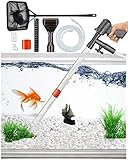
- Mufti-functional cleaning kit: Aquarium gravel vacuum cleaner kit is a mufti-functional aquarium cleaner that uses (adopts)the siphon design principle, which includes the aquarium, aquarium sand washing, algae scraping, fish excrement cleaning, aquarium residual debris, and aquarium water changing. Quick water change gives fish (provides)a clean and comfortable aquarium living environment.
- New safety design: new manual press design, no electricity required and silent while working. Fish tank cleaning tools uses a high-quality pressure resistant air bag, durable, super strong siphon pressure can quickly draw out the muddy water in the fish tank. The aquarium vacuum pipe has a filter net attached to the filter basket to block the blockage caused by the suction of gravel, while preventing your cute fish and the small gravel in the bathtub from being sucked out of the tank.
- Easy to install: This newly upgraded aquarium vacuum is easier to use than traditional fish tank vacuum. Simply hold the handle and press several times until you see water begin to flow out. You can also use a tube to agitate the gravel in the aquarium, causing fish manure, food debris, etc. to drain out of the aquarium with the current. The aquarium cleaning tools is securely attached to the aquarium so you can easily release your hands.
- A wide range of multi-combination accessories: aquarium cleaner vacuum crusher is suitable for different types and sizes of fish tanks, equipped with 2 water pipes and 1 joint, press pump, water flow clip, water pipe clip extended outlet hose, aquarium temperature stickers, fishing nets, plastic algae scraping plate, and detailed aquarium vacuum pump manual.
- Easy to use: The aquarium cleaning kit dust and water changer is hand-held, easy to use and operate, the aquarium cleaners can work stably and efficiently without electricity and without noise, which greatly saves your time and brings more convenience for fish tank cleaning.
The method is species-specific. Scales can erode, shed, or regenerate, and growth rings can become crowded near the edge of an older scale. NOAA Fisheries warns: “Scales are seldom used for ageing groundfish because the annuli tend to crowd together near the edge, which leads to underestimated ages.” The limitation is explained in NOAA Fisheries’ age-and-growth guidance.
Researchers may use other structures, such as otoliths or bones, when scales are unreliable for a particular species. Fish age is therefore determined by the species, the structure examined, the quality of the sample, and the reader’s interpretation—not simply by counting any visible rings.
How scientists examine fish scales
A basic educational activity can involve a fish scale, a microscope, forceps, and clean microscope slides. The scale is placed on the slide and examined for its shape, surface features, and growth marks. NOAA’s fish-scale age-determination activity lists these materials and demonstrates why magnification is useful.
For safe observation, use a legally obtained, clean specimen and avoid handling a live fish merely to remove a scale. A scale viewed under magnification can show structure, but a classroom observation does not automatically produce a reliable age estimate. The NOAA aging-fish activity provides additional educational context.
If you are setting up that activity, microscope slides for fish-scale observation are a practical supply to consider. Choose clean slides appropriate for the microscope and specimen-preparation method; the research supports the category, but current product quality, pricing, and availability should be checked before buying.
Quick wins for a faster PC:
Scan for outdated or missing drivers - takes under a minuteDriver Scan →Repair Windows errors before they cause bigger problemsFix Now →Best Value

- New digital aquarium thermometer: LED display fish tank thermometer with professional LCD visual effect, the fish tank and aquarium water temperature can be displayed clearly, despite the night light, and can be easily read. Mini compact body design is suitable for a variety of different types of fish tanks and aquariums, is a must have fish tank accessories.
- Safe wireless touch design: The digital fish tank thermometer comes with a touch power button, which can be easily awakened by clicking. The built-in high sensor probe measures the water temperature for fish tank, well-organized wire in the fish tank to protect the fish from being swallowed or electrocuted, providing a clean and safe living environment for the pet fish axolotl turtle.
- Simple installation: The tank thermometer does not need any installation tool to remove the adhesive on the back, stick it on the outside of the tank below the tank water level, and after standing for 5 minutes, it can accurately and real-time monitor the aquarium temperature change.
- Accurate data: tank thermometer aquarium measurement range of the tank thermometer is 0°C~60°C, the accuracy is 0.18°C, and the error is ±1 °C. This is suitable for axolotl tank, turtle thermometer, saltwater fish tank accessories, betta fish tank thermometer, etc..
- Long life battery: Thermometer for aquarium fish tank is powered by a CR2032 battery (included), and the battery lasts up to 12 months. The wireless aquarium digital thermometer will automatically enter the sleep mode after 5 seconds of no operation, extend the battery life, and be more environmentally friendly and energy saving.
Why do fish scales matter to engineers?
Fish scales matter to engineers because they demonstrate how a surface can be protective and flexible at the same time. Researchers study scale arrangements as inspiration for flexible armor, protective materials, robotics, and other engineered surfaces. Shark-skin structures have also influenced research into underwater drag reduction.
Biomimicry does not mean that an engineered surface copies every function of a fish scale. A material designed to reduce drag may not provide the same protection, flexibility, mucus interaction, or biological repair as a real fish covering. A review of bio-inspired underwater drag-reduction materials describes both the promise and the challenges of adapting aquatic-animal surfaces to technology.
What is the simplest explanation of fish scales?
Fish scales are flexible external armor. Their overlapping arrangement protects the skin while allowing the fish to bend, and their surface can interact with flowing water. Different fish have different scale types—or no conventional scales at all—while mucus supplies an additional layer of lubrication, disease defense, and water-and-salt regulation.
Frequently Asked Questions
Do all fish have scales?
No. Many fish have scales, but some species have reduced, modified, or absent scales. Sharks and rays have tooth-like placoid denticles rather than the typical overlapping scales found on many bony fish.
Free tools Windows power users keep installed
One-click scans. No signup required.
Do fish scales help fish swim faster?
Fish scales can influence water flow and drag, but they do not automatically make every fish faster. The effect depends on scale shape, arrangement, mucus, body shape, swimming speed, and species.
What is the difference between fish scales and slime?
Fish mucus, often called slime, is a separate coating from the scales. Mucus lubricates the body, forms a physical and chemical barrier against pathogens, and contributes to water-and-salt regulation.
Can you tell a fish’s age from its scales?
Scales can provide an approximate age estimate for some fish when seasonal growth marks or annuli are visible. The method is species-specific and can be inaccurate when scales erode, regenerate, or develop crowded rings.
The Bottom Line
Fish need scales mainly for protection, but scales are only one part of the fish’s body covering. Overlapping scales provide flexible armor, mucus adds lubrication and chemical defense, and scale shape may influence water flow. Because scale types and coverage vary widely, no single explanation applies equally to every fish.
Windows Errors? Fix Them Before They Spread
Repair common Windows errors and clear accumulated junk for a smoother, more stable PC - no reinstall needed.Free scan · no reinstallCrashes, No Sound, or Screen Glitches?
Random freezes, missing sound and display glitches usually trace back to one bad driver. Find and replace yours safely.Free scan · under a minuteQuick Recap
Product prices and availability are accurate as of the date/time indicated and are subject to change. Any price and availability information displayed on Amazon at the time of purchase will apply.




