Do these 3 things before closing this tab:
1Scan for outdated or missing drivers - takes under a minute2Clear out junk files and repair common Windows errors3Fix the driver behind crashes, sound loss and screen glitchesFossilized digestive contents can reveal what a particular dinosaur ate. In rare cases, the condition of prey remains also suggests that a predator died not long after its meal. But a fossil cannot provide an exact time of death: digestion and preservation make that inference indirect.
What can fossilized stomach contents reveal?
When plant fragments or prey remains are preserved inside a fossil’s digestive region, researchers can identify evidence of a meal rather than infer diet from teeth, jaws, or other anatomy alone. The evidence belongs first to the individual animal represented by that fossil. It does not automatically establish the usual diet of its species, or what it ate throughout its life.
Two examples show the distinction: the sauropod specimen Judy preserves evidence of a particular plant meal, while a fossil crocodyliform called Confractosuchus provides a clue about how long before death an animal may have eaten.
What was in the sauropod Judy’s last meal?
A study published in Current Biology on 9 June 2025 reported preserved gut contents in specimen AODF 0888, a Diamantinasaurus matildae nicknamed Judy. Curtin University describes Judy as about 95 million years old and 12 metres long—a subadult still growing when it died. [Curtin University, 10 June 2025]
The preserved material included pinnules and bracts from tall conifers, as well as leaves and fruiting bodies from smaller seed ferns and flowering plants. The authors interpret the range of plant types and heights as evidence that Judy browsed at multiple levels and fed as a generalist. They also support the interpretation that sauropods took in substantial plant material with limited oral processing. These findings describe this specimen and its preserved meal; they should not be treated as a fixed menu for every sauropod or every stage of life. [Current Biology study]
Can stomach contents tell when a dinosaur died?
Not precisely. Researchers may infer that an animal died relatively soon after eating if the meal remains show little digestion, but that conclusion depends on how digestion worked in the animal and how the fossil was preserved.
The Tool Desk
Outbyte Driver Updater FREEFix the driver behind crashes, sound loss and screen glitchesFind Drivers →Outbyte PC Repair FREERepair Windows errors before they cause bigger problemsFix Now →#1 Best Overall

- Resin Cast Replica
- 5.5 inches
The clue from Confractosuchus
A 2022 Gondwana Research study described Confractosuchus sauroktonos from Queensland’s Winton Formation. Its abdominal cavity contained remains attributed to a juvenile, non-iguanodontian ornithopod. The prey bones were partly articulated and showed no acid etching. The authors say those features indicate the carcass had not been significantly digested. [White et al., Gondwana Research, 2022]
From the remains’ condition, the authors infer that Confractosuchus died not long after eating. They do not give a precise interval. Whether its gut was highly acidic, as in living crocodilians, remains uncertain; the researchers say acidity cannot be separated from the short time the prey may have spent in the digestive tract as an explanation for the lack of alteration. The evidence supports a qualified timing inference, not a clock.
How do stomach contents differ from pellets and coprolites?
The terms refer to different kinds of evidence, and their location matters. A 2018 Scientific Reports article distinguishes material retained in the digestive tract from compacted material expelled from the mouth and feces expelled from the cloaca or anus. [Scientific Reports, 2018]
- Gut contents: food material remaining in the stomach or intestines.
- Gastric pellets: compacted indigestible material expelled from the mouth.
- Coprolites: fossilized feces, generally consisting of material after digestion and expelled from the cloaca or anus.
A fossilized meal inside the abdominal region is therefore not interchangeable with a pellet or coprolite. The latter can reveal feeding or digestion too, but they are different traces.
Rank #2
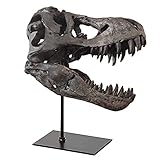
- 【Home Office Desktop Shelf Decor 】Dinosaur head sculptures skull model is hand cast from high-quality solid resin. The surface is made of antique craftsmanship, and the convincing colours and details make it look very realistic and eye-catching. Add some aesthetic to your room
- 【Supplement Your Collection】T-Rex is one of the most popular dinosaurs in the world. For dinosaur lovers or palaeontology lovers, the tyrannosaurus rex skull is a fantastic replica. It will also be a fun teaching tool for any child or teen
- 【Home Decor and Conversation Starter】A lifelike dinosaur skeleton decor. This impressive sculpture looks great on a table or bookshelf. It will be a great conversation starter and conversation piece for any family
- 【Suitable for Many Occasions】This Tyrannosaurus Rex skull replica comes with a metal base. There are 4 non-slip pads on the bottom of the stand to protect the surface of your furniture. It can be placed on various occasions such as office, hallway, TV cabinet, wine rack, living room, etc
- 【Perfect Christmas/Birthday Gift】10.2x 5.9x 11.8 inches.It only takes 2 minutes to complete the installation.Give it as a gift to children, adults, husbands, and friends, no one will refuse it
What do other fossil meals show?
Preserved abdominal contents are not limited to plant-eating sauropods or the timing case above. A 2012 PLOS ONE study documented abdominal contents in two large Early Cretaceous compsognathids, including a partial dromaeosaurid leg in the holotype of Sinosauropteryx gigas. That is evidence of prey inside a dinosaur fossil, but it is not the evidence for a time-since-meal inference described for Confractosuchus. [PLOS ONE, 2012] Independent reader supportYour contribution helps us test, update, and keep practical guides available for everyone.
How strong is the evidence?
The most reliable starting point is what the fossil physically preserves: plant structures, prey bones, their position, and any visible digestive alteration. Interpreting those traces requires further steps. Plant remains can identify a meal for one individual; prey that is partly articulated and unetched can support an inference of limited digestion. Neither type of evidence, by itself, settles an animal’s lifetime diet or an exact time of death.
Quick Recap
Rank #4

- IT FROM XUQCAH MATERIAL AND FOIMOJSK PAR ENT AND Thurder LOVER
- Museum Quality Replica
- Please thoroughly read discription
Rank #3

- Utahraptor was a large theropod dinosaur that lived during the Early Cretaceous period, known for its sharp claws and hunting abilities
- This replica is based on a real Utahraptor fossil discovered in Utah, accurately capturing the shape and detail of the original claw
- The Utahraptor’s curved claw was used for gripping and slashing, making it a key tool for hunting prey
- Cast in durable resin, this 5.5-inch replica offers museum-quality detail and texture
- Made in the USA, this fossil reproduction is perfect for collectors, educators, and dinosaur enthusiasts
- For diet: Judy’s identified plant remains support conclusions about her preserved meal and the authors’ interpretation of her browsing.
- For timing: the condition of the ornithopod remains in Confractosuchus suggests the predator died not long after feeding, but digestive physiology and preservation leave uncertainty.
Product prices and availability are accurate as of the date/time indicated and are subject to change. Any price and availability information displayed on Amazon at the time of purchase will apply.




