What’s actually slowing this PC down?
Pick the symptom - the matching free tool is one click away.
If your dog barks, lunges, or stiffens at dogs, people, or other triggers on walks, start by creating more distance—not by correcting the behavior. Work at a level where your dog can notice the trigger and remain relaxed, then pair that sight with something your dog values. Barking or lunging by itself does not prove that a dog intends to bite; the cause and risk depend on the dog and situation.
What leash reactivity means—and what it does not tell you
“Leash reactivity” describes an observable response such as barking, lunging, or becoming tense when a trigger appears during a walk. The trigger might be another dog, a person, or something else. Fear, frustration, discomfort, and other factors can contribute, so the label alone cannot identify the cause. The American Kennel Club recommends focusing on the behavior and context rather than treating “leash aggression” as a diagnosis. Read the AKC guide to leash aggression and its explanation of reactivity versus aggression.
Note what happens before and during an outburst: which trigger appeared, how far away it was, whether it was moving, where you were, and what your dog did before barking or lunging. Different triggers—or even the same trigger in different circumstances—may call for different management.
Start with safety and space
On everyday walks, prioritize preventing close, difficult encounters. Choose quieter routes or times when possible, cross the street, turn around, or move behind a visual barrier to give your dog room. Keep enough control of the leash to move away safely without pulling your dog toward the trigger. These choices reduce the chance of an outburst and can make later training easier; they do not, by themselves, change the dog’s underlying response. AVSAB describes this kind of prevention as management for fearful dogs: Staying Safe: Management for Fearful Dogs.
Quick wins for a faster PC:
Scan for outdated or missing drivers - takes under a minuteDriver Scan →Repair Windows errors before they cause bigger problemsFix Now →Fix the driver behind crashes, sound loss and screen glitchesFind Drivers →#1 Best Overall

- Helps Stop Pulling: Patented Martingale loop design puts gradual pressure on your dog’s shoulders to safely and effectively stop pulling; a front leash attachment helps you guide your dog
- Legacy Of Trust: Created by a veterinary behaviorist in 2004, the Easy Walk harness is loved and trusted by a million pet parents and trainers
- Comfortable Fit: Easy Walk harness has less coverage than other harnesses making it lightweight and very breathable
- No Gagging Or Choking: Rests across your dog’s chest instead of his throat to stop gagging and choking if he pulls
- Easy to Fit: Quick-snap shoulder straps and a different color belly strap make it simple to put the harness on your dog
A well-fitted front-clip harness may be one option for physical management, but it is not a treatment for the emotion behind reactivity. Check that equipment is comfortable and allows natural movement; there is no universally best product for every dog or plan.
Practice below your dog’s reaction threshold
For training, find a distance at which your dog can notice the trigger without barking, lunging, or appearing distressed. There is no single correct distance: it changes with the dog, trigger, movement, and setting. If your dog cannot comfortably watch, you are too close or the situation is too intense.
Rank #2

- 【FAST WEARING】NESTROAD dog vest harness is designed with 3 quick-release buckles (1 on the neck and 2 on the chest) which allows you to put it on from the side of the dog’s neck instead of the head. This way of dressing can reduce the dog's resistance effectively, helping you to put it on or take it off quickly
- 【EASY ADJUSTMENT】This no choke dog harness design with 4 fully adjustable straps (2 shoulder and 2 chest straps) which can be adjusted to the most fitting size, prevents the dog from breaking free while maintaining maximum comfort
- 【PREMIUM QUALITY】 Our dog harness and leash set the mainframe was reinforced with thick webbing. There's great padding at every pressure load point to protect your dog's skin, while a breathable air mesh keeps your dog comfortable
- 【SAFETY DETAILS】 Front and Rear Clip Design - One front clip for pull-free control or dog training and the other rear clip for casual walking or jogging. In addition, the reflective strip design allows your dog to walk freely at night and prevent collisions
- 【SELECTED ACCESSORIES】 Our no pull harness includes 1 professional dog leash & 1 retractable seatbelt & 1 storage strap, which makes walking dogs a pleasure. We provide several size harnesses for small dogs to large dogs, more details please refer to the sizing chart
- Set up a manageable view. Choose a quiet place with an exit and enough room to increase distance. A trusted helper and a predictable dog may make practice more controlled; do not use strangers or allow uncontrolled approaches.
- Pair noticing with a reward. When your dog sees the trigger, offer a high-value treat. Repeat while the trigger remains visible and your dog is still comfortable. The goal is for the trigger’s appearance to predict something good, not to make your dog stay near it.
- Change only a little at a time. If your dog remains relaxed across repetitions, you may gradually reduce the distance or make another small change in intensity. If your dog reacts or seems uneasy, increase distance, make the trigger less intense, or end the session.
- Keep practice short and controlled. Stop while your dog can still engage and recover. Repeated exposure at an overwhelming intensity can make the response worse rather than teach calmness.
The American Kennel Club outlines this reward-based approach in its guide to stopping leash lunging. For more detail on the learning process, VCA explains desensitization and counterconditioning.
Teach an alternative response away from triggers first
Choose a simple behavior your dog can do easily, such as looking toward you, touching your hand, or finding a treat you toss on the ground. Practice it in a calm place and reward it generously. Once your dog understands the behavior, try it with a trigger visible at a comfortable distance. If your dog cannot respond, do not insist: create more space and make the setup easier.
Rank #3
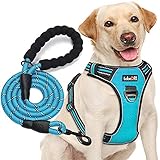
- 【 NO PULL & NO CHOKE 】tobeDRI dog harness featured with 2 strong metal delta shape-rings on front and back for leash attaching, front clip prevent pulling and back for relaxed walking. The 2 rings are sewn with durable thick nylon webbing and enforced box stitches and bartacks that preventing ripped off even pulling hardly. Pulling pressure is evenly distributed to the body to prevent choking
- 【 EASY TO USE AND LOCKING SECURITY 】The dog harness with simple design and quick snap buckles which make it easy to put on and take off. Locking feature on both snaps makes it more secure, 100% ensures no accidentally detachment. 4 easy size adjustors at neck and chest for easy adjusting to fit your dog perfectly, even with some room of growth. Perfect for daily walking, running, hiking, training, hunting, outdoor adventure and more!
- 【 DURABILITY 】Made of durable nylon webbing, enhanced high density nylon oxford, breathable mesh lining and strong accessories including buckle, size adjustors
- 【 EASY CLEANING 】Machine washable is easy for daily use. All metal accessories are rust-proof
- 【 REFLECTIVE 】Reflective stitching maintains high visibility at night for safety
Use reward-based training, not punishment
The American Veterinary Society of Animal Behavior states in its Humane Dog Training Position Statement (2021): “Based on current scientific evidence, AVSAB recommends that only reward-based training methods are used for all dog training, including the treatment of behavior problems.” AVSAB rejects aversive methods such as leash corrections, prong collars, choke chains, and electronic collars. Punishment does not address why the dog is reacting and may add distress to an already difficult encounter.
Independent reader supportYour contribution helps us test, update, and keep practical guides available for everyone.When to consult a veterinarian or behavior professional
Arrange a veterinary assessment if the behavior is new or changing, or if you notice other health concerns. Pain or another medical issue may contribute to a change in behavior; a veterinarian can assess whether that is relevant.
Rank #4

- 【No Pull & No Choke Design】: This harness simply goes through the dog's head, snaps on the belly and that's the end of it. Besides, the D-ring on the chest strap is used for no pull dog training and guiding direction, and the O-ring on the back is used for daily dog walking. The triangular design on both sides of this no pull harness helps to distribute the pulling force, so you don't have to worry about the dog choking when suddenly pulling.
- 【Soft Velvet Padded & Durable】: With soft thicken and wider fleece pads used beneath the strap of neck, back and handle atop, this dog harness could reduce friction from movement and protect the health of the dog's skin. It also uses superior nylon material to ensure long-lasting use.
- 【Leash Double Handle & Elastic Band】: You can use the top handle for casual dog walking, and the center handle for controlling the direction of the dog, easily guiding it through crowded areas and preventing storming in case of accidents. And the springy design of the leash really absorbs the pull from large strong dogs without tugging on your wrist and shoulder.
- 【Neck & Chest Adjustable】: SlowTon dog harness is equipped with adjustable loop for both neck and chest girth, and the quick-release buckle allows for quick donning. No matter what kind of breed and shape, it provides proper length after adjusting to fit your dog's neck and chest, which is perfectly designed for walking, jogging, running, hiking and training.
- 【Tangle-free Leash & Reflective】: The heavy-duty 360°swivel metal hook ensures no tangle. Plus, it has an elastic bungee and 2 padded handles, which is great for walking training of city dogs, or wandering off in country. Furthermore, its super bright reflective strips ensure a safe walk both day and night. And it comes with 2 hook and loop straps, a regular one Support Dog and the reflective one DO NOT PET.
Get help from a qualified, reward-based trainer or behavior consultant if you cannot keep encounters safe, your dog shows severe fear or aggression, training is not progressing, or your dog cannot remain comfortable enough to learn. For significant safety concerns or complex behavior, involve your veterinarian and ask whether a veterinary behaviorist is appropriate.
When choosing a professional, ask how they would prevent overwhelming exposures, manage distance, and teach an alternative behavior. Ask about their experience with leash reactivity, how they plan for safety, and whether they will coordinate with your veterinarian. Avoid anyone who relies on fear, pain, or physical force. AVSAB’s guide to choosing a trainer offers additional questions to consider.
Do these 3 things before closing this tab:
1Clear out junk files and repair common Windows errors2Scan for outdated or missing drivers - takes under a minute3Repair Windows errors before they cause bigger problemsBest Value

- 【No Pull & No Choke Design】: This harness simply goes through the dog's head, snaps on the belly and that's the end of it. Besides, the D-ring on the chest strap is used for no pull dog training and guiding direction, and the O-ring on the back is used for daily dog walking. The triangular design on both sides of this no pull harness helps to distribute the pulling force, so you don't have to worry about the dog choking when suddenly pulling.
- 【Soft Velvet Padded & Durable】: With soft thicken and wider fleece pads used beneath the strap of neck, back and handle atop, this dog harness could reduce friction from movement and protect the health of the dog's skin. It also uses superior nylon material to ensure long-lasting use.
- 【Leash Double Handle & Elastic Band】: You can use the top handle for casual dog walking, and the center handle for controlling the direction of the dog, easily guiding it through crowded areas and preventing storming in case of accidents. And the springy design of the leash really absorbs the pull from large strong dogs without tugging on your wrist and shoulder.
- 【Neck & Chest Adjustable】: SlowTon dog harness is equipped with adjustable loop for both neck and chest girth, and the quick-release buckle allows for quick donning. No matter what kind of breed and shape, it provides proper length after adjusting to fit your dog's neck and chest, which is perfectly designed for walking, jogging, running, hiking and training.
- 【Tangle-free Leash & Reflective】: The heavy-duty 360°swivel metal hook ensures no tangle. Plus, it has an elastic bungee and 2 padded handles, which is great for walking training of city dogs, or wandering off in country. Furthermore, its super bright reflective strips ensure a safe walk both day and night. And it comes with 2 hook and loop straps, a regular one Support Dog and the reflective one DO NOT PET.
If a muzzle is needed for safety, it should be introduced gradually and positively, with a design and fit suited to the individual dog. A muzzle is a management measure, not a substitute for safe handling, training, or professional guidance.
What progress can you expect?
There is no established universal success rate or timeline for a leash-reactivity protocol, and a general guide cannot predict an individual dog’s outcome. Progress depends on the dog, triggers, surroundings, safety needs, and the consistency of manageable practice. Track changes in the distance at which your dog can stay relaxed and recover, rather than expecting every walk to be trigger-free.
Quick Recap
Product prices and availability are accurate as of the date/time indicated and are subject to change. Any price and availability information displayed on Amazon at the time of purchase will apply.




