If your pet may have eaten rodenticide, contact a veterinarian or animal poison-control service immediately—even if your pet seems well. Keep the package or take a clear photo of its label, and report the active ingredient, the amount your pet may have eaten, and when exposure happened. Do not try to treat your pet at home.
What to do after possible exposure
- Call now. Contact your veterinarian or an animal poison-control service for case-specific instructions. Do not wait for symptoms to appear.
- Find the product information. Bring the package or a clear label photo. Share the active ingredient if it is listed, along with the product name.
- Describe the exposure. Tell the professional when it may have happened and how much bait may be missing. Give your pet’s species and weight, if known.
- Follow professional directions. Do not induce vomiting, give food, administer activated charcoal, or give vitamin K unless a veterinary professional specifically directs you to do so.
The Merck Veterinary Manual’s pet-owner rodenticide article says, “Early veterinary intervention in cases of ingestion provides the best chance for successful treatment.”
Why the active ingredient matters
Rodenticides are not a single type of poison. Their ingredients can affect the body in very different ways, so the right evaluation and treatment depend on the product and the individual exposure. Bait color, shape, or size cannot reliably identify what it contains; check the package label or ask the manufacturer for product information.
How common rodenticides can affect pets
The signs below are possible warning signs, not a way to diagnose which product was eaten. Some effects may be delayed, and a pet that looks normal can still need urgent assessment.
#1 Best Overall
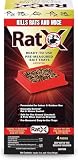
- RatX Ready Trays are your safe and effective solution to removing rats
- Perfect for use in homes, barnyards, industrial buildings, livestock areas, and more
- Easy to use - Just peel the tray and place wherever you spot rodent activity
- Provides the same power and effectiveness of RatX Pellets, with all the convenience of a traditional trap
- Formulated with naturally derived ingredients made in the USA
| Active ingredient | Main danger | Possible signs |
|---|---|---|
| Anticoagulants | Interference with blood clotting, which can lead to bleeding | Weakness or lethargy, pale gums, bruising, nosebleeds, difficulty breathing, blood in urine or stool, or blood in vomit. Signs can be delayed. |
| Bromethalin | Neurologic injury | Weakness, incoordination, tremors, altered behavior, seizures, or paralysis. |
| Cholecalciferol (vitamin D3) | Abnormally high calcium and phosphorus, with possible mineralization and soft-tissue damage, commonly involving the kidneys | Increased thirst and urination, loss of appetite, depression, or vomiting. |
| Zinc phosphide and other phosphides | Potentially rapid systemic illness; stomach acid can release phosphine gas, which is hazardous if inhaled | Vomiting, abdominal pain, breathing problems, cardiovascular collapse, or seizures. |
Anticoagulants: bleeding may take time to appear
A veterinarian may assess a suspected exposure using the history and blood-clotting tests. Vitamin K1 may be prescribed for appropriate anticoagulant exposures; it is not a universal antidote. Whether it is appropriate, how long it is needed, and what monitoring is required are decisions for the veterinarian.
Bromethalin: watch for neurologic changes
Bromethalin is a non-anticoagulant neurotoxicant. Its veterinary management is time-sensitive and differs from care for anticoagulant exposure, so do not assume that vitamin K or another treatment intended for a different ingredient will help.
Rank #2

- Death is delayed 4 to 5 days, so there's no bait shyness
- Kills warfarin resistant Norway rats
- Norway rats, roof rats and house mice may consume a lethal dose in a single night's feeding
Cholecalciferol: kidney and soft-tissue injury
Rodenticide-dose cholecalciferol can raise calcium and phosphorus levels and damage soft tissues, including the kidneys. Veterinary monitoring may continue after initial treatment because abnormalities and clinical effects can persist.
Phosphides: protect people from vomitus
If zinc phosphide exposure is possible, contact a veterinarian or poison-control service urgently and avoid contact with or inhalation near vomitus. Vomiting can release phosphine gas, which is hazardous to people. Merck Veterinary Manual professional guidance warns owners to take care around vomitus and describes transport with ventilation when phosphide exposure is suspected; get professional directions rather than attempting to induce vomiting or manage transport on your own.
Free tools Windows power users keep installed
One-click scans. No signup required.
Rank #3

- This is our safest bait station, and is resistant to tampering by children & dogs
- Compact design & low profile bait station helps reduce house mice problems
- Weather resistant, and can be used indoors or outdoors
- Can be used in tight places around the house
- Ideal for: attics, behind appliances, basements, garages and sheds
How to reduce the risk at home
- Follow the product label, including its placement and storage instructions.
- Store pesticides away from food and pet food, and place bait only where pets cannot reach it.
- Promptly remove dead rodents so pets cannot eat them.
- Ready-to-use bait stations can reduce access in relevant settings, but no station should be treated as fully pet-proof. A station does not treat an exposure or guarantee that a pet cannot reach bait.
The US Environmental Protection Agency provides guidance on ready-to-use bait stations and more protective stations for relevant settings. Keep the product label available and seek veterinary advice promptly if access is uncertain.
Quick Recap
Best Value

- Bait station to kill mice
- Weather resistant bait station
- Tamper proof bait station from children and dogs
- Includes 1 refillable bait station and refills
- Guaranteed to kill bait station
Rank #4

- RatX Pellets are your safe and effective solution for removing rats
- Perfect for use in homes, barnyards, industrial buildings, livestock areas, and more
- Easy to use - Just place pellets wherever you spot rodent activity
- Safe for use around people, pets, livestock, and non-target wildlife
- Formulated with naturally derived ingredients made in the USA
Product prices and availability are accurate as of the date/time indicated and are subject to change. Any price and availability information displayed on Amazon at the time of purchase will apply.




