Free tools Windows power users keep installed
One-click scans. No signup required.
Sometimes—but “bottled water” is not a single type of water, and no label alone shows that it suits every tropical fish tank. Test the water’s pH, general hardness (GH) and carbonate hardness (KH), compare it with the established aquarium and the needs of its fish, and avoid a sudden change in chemistry.
How to decide whether a water source is suitable
- Start with the livestock. Identify the fish species and check their water-chemistry needs. Account for plants and invertebrates too; suitability depends on the whole setup, not just the word “tropical.”
- Test the tank and candidate water. Compare pH, GH and KH in both. pH indicates acidity or basicity; GH reflects general mineral hardness; KH contributes buffering that helps resist rapid pH changes. A freshwater aquarium water test kit can help with these comparisons, but it does not certify every possible contaminant.
- Check treatment and source information. Read the bottle’s source and mineral details where available. For tap water, check local information about disinfectants and other known concerns, and use an aquarium water conditioner as directed when needed.
- Plan for the replacement water to match. Keep its chemistry and temperature reasonably close to the aquarium’s and make changes deliberately. Avoid chasing a particular pH with additives without species-specific guidance.
Aquarium Co-Op describes pH 6.5–8.0 for most freshwater fish, GH 4–8 dGH for most freshwater aquariums, and KH at or above 3 dKH for many freshwater aquariums. These are broad guidelines, not universal targets or a bottled-water specification; species and established tank conditions matter.
How the main water options compare
| Water source | Possible role | What to check | Important limitation |
|---|---|---|---|
| Bottled spring water | Tetra says it may be considered for a small aquarium. | Measure pH, GH and KH; check the source and mineral information; confirm the results fit the fish and tank. | That suggestion does not establish that every spring-water brand, tank size or species is suitable. |
| Bottled distilled or purified water | May be part of a controlled water-adjustment plan. | Check mineral content and plan any needed remineralization and buffering. | Do not assume it is ready to use as a complete replacement for aquarium water. |
| Conditioned tap water | Can be a practical option when local chemistry suits the aquarium. | Check pH, hardness, disinfectants and known local contaminants. Treat chlorine or chloramine as directed before use. | Tap-water quality varies; drinking-water safety does not establish aquarium suitability. |
| RO/DI water | Can provide a controllable starting point for changing hardness in selected setups. | Set the final mineral and buffer levels for the particular aquarium, then introduce changes gradually. | It requires a chemistry plan and testing; it is not a shortcut around them. |
There is no universal winner among these options, and the available guidance does not establish a bottled-water brand or label specification that guarantees aquarium suitability. Compare measured chemistry, compatibility with the existing tank, treatment needs, and whether you can obtain a consistent supply at the volume required.
Can spring water be used for tropical fish?
Possibly, if its measured chemistry fits the aquarium. Tetra mentions spring water as an option for a small aquarium, but that is not a blanket endorsement of bottled spring water. Mineral content and pH can differ between products, so test the specific water rather than relying on the category or label.
#1 Best Overall

- Contains one (1) API TAP WATER CONDITIONER Aquarium Water Conditioner 16-Ounce Bottle
- Neutralizes chlorine, chloramines and other chemicals to make tap water safe for fish
- Prevents tap water chemicals from causing gill destruction, tissue irritation and fish death
- Super strength, high concentration formula
- Use when adding or changing water and when adding new fish to freshwater and saltwater aquariums
Can you use distilled or purified water?
Not automatically as-is. Distilled and some purified waters have very low mineral content. Aquarium guidance treats RO/DI water as a tool for controlled changes to hardness and discusses mineral adjustment and gradual use. If using distilled or purified water, determine the minerals and buffering the particular tank needs before adding it.
Is bottled water better than tap water?
Not by default. Bottled water can have chemistry that does not suit the fish or match the established aquarium. Tap water can also have unsuitable chemistry or contain chlorine, chloramine or other local concerns, but testing and appropriate treatment can make some tap water suitable. Aqueon puts the distinction plainly: “While tap water is usually safe for humans, it can kill aquarium fish.” Its guidance emphasizes that local water differs and that testing and treatment matter.
Rank #2

- POWERFUL TREATMENT: Seachem Prime is a complete and concentrated conditioner for both freshwater and saltwater fish tanks, working hard to remove chlorine and chloramine.
- REMOVER: Seachem Prime immediately and permanently removes chlorine and chloramine, successfully allowing the bio filter to remove ammonia, nitrite, and nitrate while they are detoxified for 48 hours.
- DETOXIFIER: Seachem Prime effectively detoxifies ammonia, nitrite, and heavy metals found in the tap water at typical concentration levels, providing a ideal environment for your betta, tetra, or other fish.
- USE: Use 1 capful (5 mL) of Seachem Prime for each 200 L (50 US gallons) of new or replacement water. For best results, add Seachem Prime to new water first. For exceptionally high chloramine concentrations, a double dose may be used safely. For smaller volumes, use 2 drops per gallon.
- SAFETY: In case of an emergency, the 5x dose of Seachem Prime may be used for both ammonia and nitrite. Use a ½ dose if the water temperature is > 30°C (86°F) and chlorine or ammonia levels are low.
When assessing tap water, check local supply information and use a suitable test for any specific concern, such as metals, if needed. A general aquarium test kit may check pH and hardness, and some kits also test chlorine; it cannot be assumed to detect every local contaminant.
Independent reader supportYour contribution helps us test, update, and keep practical guides available for everyone.Keep changes gradual and consistent
Even a source with acceptable readings can be a poor choice if its chemistry differs substantially from the established tank. Stability and the fish’s needs matter more than trying to force every aquarium to one “ideal” pH. Use a repeatable source and compare replacement water with the tank before making changes. For unusual species, breeding setups or unexplained stress, seek species-specific aquarium or veterinary advice rather than experimenting with pH additives.
Quick Recap
Best Value
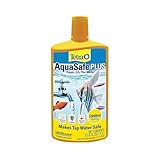
- FOR FRESHWATER AND MARINE AQUARIUMS: Tetra AquaSafe Plus works instantly to make tap water safe for fish.
- ADVANCED FORMULA: Neutralizes or removes harmful chlorine, chloramines and heavy metals.
- PROTECTS FISH: Enhances protective slime coat to help wounds heal.
- CLEAR AND HEALTHY WATER: With natural biopolymers and essential vitamins and minerals.
- WATER CONDITIONER: Use when setting up a new aquarium, with monthly partial water changes, or evaporation replacement.
Rank #4

- Contains one (1) API TAP WATER CONDITIONER Aquarium Water Conditioner 32-Ounce Bottle
- Neutralizes chlorine, chloramines and other chemicals to make tap water safe for fish
- Prevents tap water chemicals from causing gill destruction, tissue irritation and fish death
- Super strength, high concentration formula
- Use when adding or changing water and when adding new fish to freshwater and saltwater aquariums
Rank #3

- Contains one (1) API STRESS COAT Aquarium Water Conditioner 16-Ounce Bottle
- Makes tap water safe and protects fish with dual-action formula
- Removes chemicals from tap water that are harmful to fish
- Replaces fish’s protective coat damaged by handling or fish fighting with healing power of Aloe Vera extract
- Use when adding or changing water, when adding new fish and when fish are sick or injured
Product prices and availability are accurate as of the date/time indicated and are subject to change. Any price and availability information displayed on Amazon at the time of purchase will apply.




