Recommended Free Tools
To stock a tropical fish tank responsibly, first cycle it and confirm safe water readings, then choose fish whose adult size, water needs, behavior and social requirements suit the aquarium. There is no reliable universal number of fish per litre: the right stock depends on the tank’s dimensions, filtration and the needs of the particular species.
What to check before choosing fish
Write down the aquarium’s internal length, width and height, its volume, filter details, heater setting and current water-test results. A tank’s footprint matters as well as its volume: fish need room to swim and occupy different areas, and a tall tank is not necessarily a substitute for the floor space a species needs.
Minimum tank guidance is not a stocking formula. RSPCA UK advises an aquarium larger than 45 × 30 × 30 cm (about 40 L), while RSPCA Australia’s tropical-fish care guidance, updated May 1, 2024, lists 50 L as a minimum. These are general recommendations from different organizations, not proof that any particular fish combination will thrive in a tank of that size. Check species-specific needs before buying.
Build a species-first stocking plan
Research each candidate fish at adult size, not the smaller size it may be in a shop. Record its requirements before deciding how many species or individuals to keep together.
Quick wins for a faster PC:
Clear out junk files and repair common Windows errorsFree Scan →Scan for outdated or missing drivers - takes under a minuteDriver Scan →Repair Windows errors before they cause bigger problemsFix Now →#1 Best Overall

- FUN and REWARDING: Are you looking to buy an aquarium for your family, owning an aquarium can be a really fun rewarding experience while providing many wellness benefits.
- DAZZLING COLORS: Energy-efficient LED lighting with 7 dazzling color selections to brightly illuminate your fish; choose daylight white, blue, green, amber, aqua, purple, or red depending on the time of day or your viewing pleasure.
- COMPLETE FILTRATION: Powerful internal power filter cleans and purifies aquarium water at a flow rate of 45 gallon per hour, effectively removing fish waste and debris; uses Koller Products S replacement filter cartridges (AQ10FC-60), available on Amazon.
- IMPACT-RESISTANT CONSTRUCTION: Manufactured of impact-resistant plastic with crystal-clear clarity so good that most think it is made of glass, providing leak-proof confidence.
- BUILT-IN LIGHT TIMER: Set your LED light to come on at the same time every day, select light settings of 4 hours, 8 hours, or continuous On, easily with a flick of your finger.
| What to check | Why it matters |
|---|---|
| Adult size and tank footprint | A fish that outgrows the aquarium or lacks swimming space can become stressed; juvenile size is not a safe basis for planning. |
| Temperature and water hardness | Tankmates must be able to live in the same water conditions. Check the exact needs of each species and account for your local water. |
| Social needs | Many danios, tetras, rainbowfish, rasboras and catfishes are shoaling fish. RSPCA UK recommends groups of six or more for many such fish; check the needs of the particular species. |
| Temperament and behavior | Some fish are territorial or may fight, while others may nip fins or prey on smaller tankmates. Do not assume that a general “community fish” label guarantees compatibility. |
| Swimming zone and cover | Consider which aquarium depths fish use and whether shy or prey species need shelter. RSPCA UK recommends considering compatible fish that use different depths. |
| Diet and likely breeding | Confirm that you can provide each species’ appropriate food and consider whether breeding could increase the population beyond the tank’s capacity. |
RSPCA UK and RSPCA Australia both advise researching compatibility before purchase. If a pairing is uncertain, ask a knowledgeable aquarium retailer about the specific species rather than relying on a generic list. Male bettas are one example of fish that may fight with their own kind or other species, so do not assume they are suitable tankmates.
Cycle the aquarium before adding fish
A filter needs time to establish beneficial bacteria that process fish waste. Use fishless cycling: run the filter, follow a reliable cycling method, and test the water regularly rather than adding fish to an unprepared tank.
- Set up and run the aquarium filter before buying fish.
- During cycling, test the water every other day for ammonia and nitrite.
- Wait until ammonia and nitrite have risen and then returned to zero before adding fish. RSPCA UK says this takes at least two weeks by its guidance; RSPCA Australia describes biofilter establishment as typically taking four to six weeks. These timelines differ, so use test results—not elapsed time alone—to judge readiness.
Clear water does not show that the aquarium is safe. RSPCA UK’s aquarium guidance says ammonia and nitrite should be 0 mg/L. RSPCA Australia’s 2024 tropical-fish guidance gives general values for most tropical fish of ammonia below 0.1 ppm, nitrite below 0.2 ppm, nitrate below 50 ppm, pH 6.5–7.5 and temperature 24–26°C. These are broad guidance values, not universal targets; follow the requirements of the species you plan to keep. A freshwater aquarium water test kit that measures ammonia and nitrite is useful for cycling and routine checks.
Rank #2
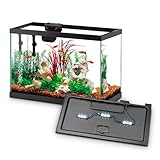
- PERFECT FOR BEGINNERS AND SEASONED AQUATIC HOBBYISTS: User-friendly setup designed for quick aquarium assembly and maintenance.
- COMPLETE STARTER KIT: Includes a 10-gallon glass rectangle aquarium, low profile hood with cool white LED lighting and feeding door, SmartClean filtration, EcoRenew cartridge, preset heater 50W, thermometer, fish net, premium fish food and a water conditioner.
- SIMPLE MAINTENANCE: SmartClean internal power filter provides quick and easy water changes to help improve water quality.
- IDEAL TEMPERATURE: Preset heater keeps your aquarium temperature at a constant 78 degrees, appropriate for most tropical fish.
- DURABLE GLASS CONSTRUCTION: Ensures clarity and durability, providing a safe environment for your fish. Made from high-quality materials for long-lasting use.
Match temperature and equipment to the fish
Use a thermostatic heater for tropical fish and check the water with a separate thermometer. RSPCA Australia gives 24–26°C as a general range for most tropical fish, but species differ. RSPCA UK, for example, lists guppies at 22–28°C and loaches at 18–26°C. Those examples are not interchangeable targets: select fish with overlapping temperature requirements and set the aquarium for their needs.
Biological filtration helps convert ammonia into less harmful compounds, and aeration supports both fish and the biofilter. Choose and maintain filtration for the aquarium and its intended inhabitants; do not treat a filter’s presence as a reason to exceed what the tank can support.
Independent reader supportYour contribution helps us test, update, and keep practical guides available for everyone.Add fish gradually and observe the tank
Once tests show the aquarium is ready, introduce fish in stages rather than adding a large number at once. RSPCA Australia cautions that the biofilter bacteria need time to adapt to increased waste. There is no single stocking order that suits every combination, so plan additions around species compatibility and monitor the water after each change.
Rank #3

- 🐠 ALL-IN-ONE AQUARIUM KIT, PACKED WITH VALUE - Comes complete with HD float 6 gallon glass tank, heater, hang on back filter with media, COB light, substrate sand, rocks, 5-in-1 cleaning tool set — just unpack, add water, and introduce your fish! The complete starter kit for instant aquatic enjoyment.
- 🔥 KEEPS TROPICAL & COLD-SENSITIVE FISH COMFORTABLE - Unlike most aquarium kits, ours comes with a reliable heater—essential for keeping delicate fish warm and healthy year-round.
- ✨ PREMIUM CRYSTAL-CLEAR GLASS FOR AN IMMERSIVE VIEW - Crafted from ultra-clear 5mm thick HD glass with 92% light transmittance, this tank offers a stunning, distortion-free view of your fish.
- 🌊 ADVANCED FILTRATION FOR CLEAN WATER - The included hang-on-back filter features both mechanical and biological filtration - sponge for debris and ceramic rings for impurities, harmful chemicals removal. This system keeps your tank water clean and clear, while enhancing oxygen exchange for healthier aquatic life.
- ⚠️ IMPORTANT SAFETY REMINDER - Do not bury the heater in sand or substrate. Keep at least 2 inches of clearance from the water surface. Always ensure the heater is fully submerged before plugging it in. Unplug the heater and let it cool for 10–20 minutes before removing it from the tank for cleaning or water changes.
- Check ammonia and nitrite after adding fish, and respond to any detectable rise before making further additions.
- Watch for persistent chasing, fin damage, hiding, loss of appetite or difficulty reaching food; these can indicate stress or a poor match.
- Keep a record of water readings, additions and maintenance so changes can be linked to a cause.
Maintain water quality, cover and feeding
RSPCA Australia recommends weekly partial water changes of 10–25%, with gravel cleaning and water conditioner for replacement tap water. Avoid over-cleaning the filter: preserve its beneficial bacteria, and do not rinse filter media in chlorinated tap water. Regular testing remains important because clean-looking water can still contain harmful waste.
Provide safe cover and decor suited to the fish. RSPCA Australia suggests about 50% plant cover as guidance; make sure decorations have no sharp edges or holes that could trap fish. Feed a diet appropriate to the species and avoid overfeeding. RSPCA Australia advises offering only what fish can eat in under two minutes, while RSPCA UK gives a two-to-five-minute feeding window and favors underfeeding over compromising water quality. Follow species-specific needs and remove uneaten food.
Free tools Windows power users keep installed
One-click scans. No signup required.
Before purchase, make sure you have a thermometer, a suitable thermostatic heater, an aquarium water test kit, a gravel siphon, water conditioner and appropriate filter media. These basics help you verify readiness, maintain the aquarium and respond to changes before they become a problem.
Quick Recap
Product prices and availability are accurate as of the date/time indicated and are subject to change. Any price and availability information displayed on Amazon at the time of purchase will apply.




