PC Slower Than It Used to Be?
A free scan shows the junk files, broken settings and background clutter dragging Windows down - then fixes them in one click.Free scan · Windows 10 & 11Outdated Drivers Are Slowing You Down
One free scan finds every outdated or missing driver and matches the right update for your exact hardware.Free scan · exact hardware matchA deaf dog or cat can live a safe, settled, and well-trained life. The care plan changes in three places: a veterinarian should confirm the hearing status before you assume anything, outdoor access must be controlled because the animal cannot hear approaching danger, and every cue has to move from voice to sight, touch, or vibration.
Start with a veterinary check, not a guess
Hearing loss in dogs and cats can be congenital (present from birth), age-related, or acquired after infection, injury, a blocked ear canal, loud noise, certain medications, or other disease. Merck Veterinary Manual’s reviews of deafness in animals, dogs, and cats describe this range of causes. Some acquired problems can be treated, and hearing may improve once an infection or obstruction is resolved. Congenital deafness in cats has no corrective treatment.
Do not write off sudden non-response as stubbornness or old age. A behavioral impression alone can miss one-sided hearing loss, so a pet that seems to hear most of the time may still be partly deaf.
Signs that warrant a visit now
- A new failure to respond to sounds the animal used to follow, especially if it came on suddenly
- Ear discharge, odor, redness, or swelling
- Persistent scratching or pawing at the ears
- A head tilt, circling, or unsteady balance
- Any other sign of illness
What the veterinarian may do
The veterinarian will examine the ears and look for underlying causes. For definitive assessment in appropriate cases, specialists use brainstem auditory evoked response (BAER) testing, which can establish hearing status in each ear and detect one-sided loss that is hard to notice at home. Cornell University College of Veterinary Medicine specifically advises owners not to probe a cat’s ear when infection signs are present. Do not try to clean out or inspect a painful ear yourself.
What’s actually slowing this PC down?
Pick the symptom - the matching free tool is one click away.
#1 Best Overall

- Patented Easy Control Harness distributes pressure evenly across your dog’s torso to prevent pulling and choking. Fully adjustable at the chest and neck, the harness provides a customized fit for the ultimate comfort and control of your dog breed.
- No-Pull Design includes a centralized back dog leash attachment as well as a chest leash O-ring that can also hold a dog tag. A top handle also lets you quickly grasp your dog and pick him up or pull him back.
- Quick-drying Neoprene is weather-resistant and breathable, perfect for water dogs in training or for working dogs who brave the elements every day. Reflective trim ensures high visibility to motorists in low-light or darkness conditions.
- Solid D-rings withstand pulling and tugging without spreading open, and twin dual-retention buckles make it easy to put the dog vest on and take it off without lifting your pet. Subdued black hardware adds a sleek, professional look for service dogs.
- Deaf Dog Reflective Removable Patches have the largest possible letters to be visible at night. Unlike an embroidered patch whose threads snag and break off easily, our patches are built to last. Hook-and-loop fasteners hold patches firmly in place.
The white-cat figure in context
Cornell University College of Veterinary Medicine cites a figure attributed to James Flanders, DVM, associate professor of surgery: about 80 percent of white cats with two blue eyes begin to show signs of deafness at about four days old. The page, accessed in October 2026, does not state a publication year. The figure describes that specific group of cats. It does not mean all white cats, or cats in general, are deaf.
Keep outdoor access safe for a pet that cannot hear danger
A deaf animal may not hear traffic, a neighbor’s dog, or a voice calling it back. Containment is the core safety measure, and the right setup depends on the species.
Rank #2
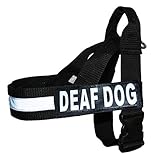
- Reflective Removable Patches on each side of Harness
- Reflective Strip on Front Chest Strap
- Handle on Top of Harness for extra control and training
- Stainless steel heavy duty D ring, Double-stitched to add strength for all activities
- 2 inch easy snap release buckle
| Situation | Deaf dog | Deaf cat |
|---|---|---|
| Recommended outdoor setup | A securely fenced yard, or a leash unless the dog has a reliable recall | Indoors, or outdoor time on a leash only |
| Door-dashing | Use a gate to keep the dog from slipping out, as American Animal Hospital Association (AAHA) guidance advises | Keep exits controlled so the cat cannot leave unsupervised |
| Main named hazard | Traffic and failure to respond to a voice recall | Not itemized separately in the sources cited; the guidance is containment |
A leash is a safety tool, not a hearing treatment. It keeps a deaf dog from reaching a road, but it does not make the dog hear you. Do not rely on an off-leash recall that has not been tested in controlled settings, especially near roads or other hazards.
Keep the routine predictable
- Feed, exercise, and toilet the animal at consistent times and in consistent places.
- Use safe containment or an enrichment area whenever the animal cannot be supervised.
- Keep the household’s training cues the same from one person to the next.
Approach so the pet is never startled
Startle responses are the most common way a deaf animal gets hurt or bites out of fright, so the approach matters as much as the cue. Cornell’s advice, from James Flanders, DVM, is direct:
Rank #3

- Patented Easy Control Harness distributes pressure evenly across your dog’s torso to prevent pulling and choking. Fully adjustable at the chest and neck, the harness provides a customized fit for the ultimate comfort and control of your dog breed.
- No-Pull Design includes a centralized back dog leash attachment as well as a chest leash O-ring that can also hold a dog tag. A top handle also lets you quickly grasp your dog and pick him up or pull him back.
- Quick-drying Neoprene is weather-resistant and breathable, perfect for water dogs in training or for working dogs who brave the elements every day. Reflective trim ensures high visibility to motorists in low-light or darkness conditions.
- Solid D-rings withstand pulling and tugging without spreading open, and twin dual-retention buckles make it easy to put the dog vest on and take it off without lifting your pet. Subdued black hardware adds a sleek, professional look for service dogs.
- Deaf Dog Reflective Removable Patches have the largest possible letters to be visible at night. Unlike an embroidered patch whose threads snag and break off easily, our patches are built to last. Hook-and-loop fasteners hold patches firmly in place.
“Avoid startling the animal. Never approach it from behind without signaling your presence. Clap your hands sharply or stomp on the floor. The vibrations will let the cat know that you’re nearby.”
- Move into the animal’s field of view before reaching toward it.
- If the animal is asleep or cannot see you, make a gentle vibration on the floor or the resting surface before touching it. For a sleeping or easily startled pet, keep the vibration soft rather than sharp.
- Explain the same approach to every visitor, child, and caregiver so the animal receives consistent signals.
Train a deaf dog with visual cues
Virginia Tech Veterinary Teaching Hospital quotes August O’Reilly, a veterinary licensed clinical social worker and experienced deaf dog owner: “Deaf dogs make wonderful companions. With a few adjustments, they can learn just as much and behave just as well as their hearing littermates.”
Rank #4

- Medium Vest harness adjustable fits neck size upto 40cm (15inch), chest size 48-72cm (19-28inch)
- Use the DEAF DOG range to show that this dog has limited/no hearing
- Now with extra front D ring for no pull option. Embroidered wording and high quality materials
- Colour coded with wording to PREVENT accidents or incidents in public, A Safer Place For All
- Available in buckle and semi-choke collars, leads, harnesses and coats in various sizes and ranges
Choose one clear signal for each behavior
Pick a visual signal for each behavior and keep it consistent across everyone who works with the dog. Make training signals distinct from incidental gestures, so the dog does not confuse “sit” with a hand movement you make while talking. Pair every signal with a reward.
Build attention and check-ins
Reward the dog for looking back at you and checking in. This becomes a useful habit when a voice cue is unavailable. Indoors, a light flick or a gentle floor vibration can attract attention without startling the dog.
Do these 3 things before closing this tab:
1Repair Windows errors before they cause bigger problems2Scan for outdated or missing drivers - takes under a minute3Clear out junk files and repair common Windows errorsBest Value

- High quality: Deaf dog patches are made of high quality PU leather and easy to clean and you can get 2pcs dog patches
- Reflective & Readable: White fluorescent word patches are easy to read at a distance in daylight and night glow effect can be brighter by strong light (For example:sun) at night
- Check the size before you buying: Our dog harness patch is (6.3*2 In), please measure the hook size of your dog’s harness first before you buying to make sure find the right size patches for your dog
- Stay Dog’s Harness In Place: Hook and loop fastener design make it easier to be attached on the vest or harness of dog
- Highly Recommended For Each Dog Owners:If people always pet your dog when you are out walking and practicing with my dog, these reflective dog patches will tell people NOT PET your dog
Practice recall where it is safe
Train recall in controlled, low-distraction settings first, then increase difficulty gradually. Keep the dog on a leash in any setting where a missed cue could put it near traffic.
Independent reader supportYour contribution helps us test, update, and keep practical guides available for everyone.Communicate with a deaf cat
For cats, use nonverbal signals consistently and reward the behavior you want. Every person in the household should use the same cues. VCA Animal Hospitals describes hand signals and sensory cues for deaf cats, along with elevated lookout places where a cat can watch activity and feel less likely to be surprised.
VCA also describes scent cues. Use any light, touch, or scent cue gently, and adjust it to the individual cat, since some cats tolerate a cue better than others.
Prepare the animal for veterinary visits
- Tell the clinic before the visit that the animal is deaf, so staff can approach and handle it with that in mind.
- Practice short, low-pressure sessions at home, touching the ears, paws, and body the way an exam would.
- Pair each session with high-value rewards and end on a success, not a struggle.
- Follow the veterinary team’s handling plan. Home practice supports that plan but does not replace it.
Virginia Tech’s guidance on exam-like sensations is a training suggestion. Gradual, reward-paired practice can help dogs become more comfortable with exam sensations over time.
Recommended Free Tools
Know when to ask for individual help
Dogs and cats differ in their outdoor needs, cue channels, and medical picture, but every individual is different. Seek veterinary advice for medical problems, behavior concerns, or any question about assistive equipment for an individual animal.
Quick Recap
Product prices and availability are accurate as of the date/time indicated and are subject to change. Any price and availability information displayed on Amazon at the time of purchase will apply.




