Do these 3 things before closing this tab:
1Clear out junk files and repair common Windows errors2Fix the driver behind crashes, sound loss and screen glitches3Repair Windows errors before they cause bigger problemsTo keep a cat occupied during veterinarian-directed crate rest, offer calm company and a short list of stationary activities that the treating veterinary team has approved, inside an enclosure that meets the cat’s basic needs and blocks the movements the vet has restricted. More stimulation is not better here. A toy or game that makes a cat leap, stretch, chase or scramble can undo the rest the crate is meant to protect.
Start with the vet’s limits, not a general enrichment list
Crate rest is a treatment instruction, not a default setting for a cat that needs a quiet week. Use it only when a veterinarian has prescribed or directed it. Strict post-surgical rest and general confinement are not interchangeable, and advice from routine crate-training articles cannot override a recovery plan.
Before you add any activity, get clear answers to these questions and write them down:
- Which movements are restricted, such as jumping, climbing, running or stretching, and for how long?
- How may the cat be handled, and may anyone lift it out of the enclosure for play or grooming?
- Is food-based enrichment allowed, and does it count toward the daily ration or conflict with a prescription or postoperative diet?
- What signs should prompt a phone call, and what should you do before the call?
Set up the enclosure around recovery needs
Choose a crate that fits the cat and the restriction
PDSA’s guidance on caring for a cat after surgery says cage rest should happen only when the veterinarian asks for it. It recommends a crate large enough to hold the cat’s bed, litter tray and food bowls, but not so large that the cat can run, jump or climb when those movements are meant to be avoided. The two goals pull in opposite directions, which is why the treating team should check the size against the cat’s actual restriction.
Free tools Windows power users keep installed
One-click scans. No signup required.
#1 Best Overall

- Interactive Level 2 Cat Puzzle Toy: 13" x 9.5" cat puzzle feeder that triggers hunting and foraging instincts. Level 2 adjustable difficulty for beginner to advanced cats.
- Indoor Cat Enrichment: Keeps indoor cats engaged, minimizes boredom, and delivers rewarding treat-finding play that supports daily stimulation.
- Level 2 Slow Feeder Puzzle: Holds 1/4 cup food or treats across 16 compartments. Promotes slower eating and positive feeding habits with adjustable challenge.
- Multiple Ways to Play (Level 2 Adjustable): Easy mode: treats in base compartments only. Hard mode: add treats into sliding cups via top holes so cats must push and move pieces to release rewards.
- Safe, Durable & Easy Clean: No removable parts. Made without BPA, PVC, lead, or phthalates. Wipes clean quickly for everyday use.
VCA Animal Hospitals gives a concrete sizing benchmark in its article “Crate Training and Confinement for Kittens and Cats,” co-authored by Ellen Lindell, VMD, DACVB, and Monique Feyrecilde, BA, LVT, VTS (Behavior):
“If the crate is used for sleeping or confinement, it should be large enough for the cat to comfortably lay on their side, stretched out, and have room for a small litter box.”
Rank #2

- Interactive Level 3 Cat Puzzle Toy: Cat puzzle feeder that triggers hunting and foraging instincts. Adjustable difficulty lets beginner cats start with an easier setup while advanced cats take on the full Level 3 challenge.
- Indoor Cat Enrichment: Keeps indoor cats engaged, minimizes boredom, and delivers rewarding treat-finding play that supports daily stimulation.
- Level 3 Slow Feeder Puzzle: Holds 1/4 cup food or treats across 14 base treat compartments plus 5 treat-filled pegs. Promotes slower eating and positive feeding habits with adjustable challenge.
- Adjustable Difficulty: Easier mode: place treats in base compartments and under spinning wheel, leave raindrops uncovered. Harder mode: also place treats inside pegs through top holes, cats must swivel the raindrops and slide the pegs to release rewards.
- Safe, Durable & Easy Clean: No removable parts. Made from a durable wood-and-plastic composite material; no BPA, PVC, or phthalates. Hand wash with warm soapy water and dry before refilling.
That benchmark describes a sleeping or confinement crate. It is a floor for comfort, not permission to add space the vet has not approved.
Place the essentials where the cat can reach them safely
The enclosure has to support four basics: a bed, a litter tray, food and water. PDSA’s guidance lists food and water access alongside the bed and litter, but it also tells caregivers to follow the treating team’s instructions on water access and mobility. If the cat needs to step over a bowl, use a low-sided tray or reach a litter box, ask the team whether that is acceptable before you settle on a layout.
The Tool Desk
Outbyte PC Repair FREEClear out junk files and repair common Windows errorsFree Scan →Outbyte Driver Updater FREEScan for outdated or missing drivers - takes under a minuteDriver Scan →Rank #3

- PUZZLE MASTER: Turn snack time into playtime with this cat food puzzle that challenges your furry friend's brain and keeps them entertained as they hunt for treats
- LEVEL UP: This cat puzzle features five different compartments and difficulty levels that keep clever companions challenged and coming back for more
- SLOW & STEADY: This puzzle feeder turns mealtime into a fun challenge, encouraging slower eating habits and helping manage your cat's weight naturally
- STAYS PUT: Non-slip rubber pads keep this food puzzle securely in place while your cat explores and searches for treats without chasing it across the floor
- EASY CARE: After your cat's adventure with this treat dispenser, cleanup is quick and easy with handwashing or top rack dishwasher placement
Keep the space quiet, dim and predictable
The 2022 ISFM/AAFP Cat Friendly Veterinary Environment Guidelines describe quiet periods and dim light or darkness as supportive of rest for hospitalized cats, and they identify hiding as a normal coping behavior. At home, the same principles apply if the setup stays safe and you can still check on the cat as needed. Do not pull a hiding cat out to play. Keep the crate in a low-traffic room, away from other pets and loud appliances, and cover part of it if the cat is startled by activity outside.
Enrichment that usually fits crate rest
The table below sorts common options by the conditions under which they generally fit a restricted cat. Every row assumes the veterinary team has not restricted that specific activity. Where the sources do not address a point, the table says so.
Rank #4
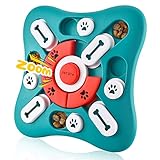
- 【PRODUCT SIZE】10 inch*10 inch*1.3 inch.
- 【3 WAYS TO PLAY, UPGRADE SLOW FEEDER】Our dog mental stimulation toys have a unique squeak button in the middle, which make it easier to attract the attention of dogs and cats. Three different difficulty designs and the 16-hole dog treat dispenser design maximize slow feeding time, even beyond 20 minutes.
- 【FUNNY STIMULATING TOYS】All kinds of dogs and cats love the puzzle game of Spin & Slide and the Seek & Hide with their smell sense and paw skills to find food. Combining circular orbit sliding game and linear orbit sliding game, smart dog and cat must move the slider correctly to get the food reward hidden in the maze.
- 【NON-REMOVABLE PARTS DOG PUZZLE】Our dog treat puzzle is made of non-toxic materials, very durable and suitable for pets to play for a long time. This dog toy has no removable parts because the design has built-in play parts that fold tightly and won't fall off easily.
- 【ANTI-SLIP & EASY TO CLEAN】: The four corners of the bottom are equipped with four anti-skid pads, which can be well fixed during the dog's slow food process; It is easy to clean, also dishwasher safe.
| Option | Generally fits when | Main caution |
|---|---|---|
| Sitting nearby, quiet company | The cat seeks it | Keep away from sore or restricted areas; some cats prefer to be left alone |
| Gentle stroking or grooming | The cat enjoys it; PDSA notes grooming is useful when a cone interferes with self-grooming | Avoid incision and sore areas |
| Familiar bedding or items | They fit inside the crate and match the care instructions | Choose washable items so you can keep the space clean |
| A small portion of usual food within easy reach | The team has approved the feeding plan | Counts toward the daily ration; follow postoperative or prescription-diet instructions |
| Stationary puzzle feeder | PDSA suggests one for some cats, and the cat can use it without prohibited movement | Needs veterinary approval if movement, appetite or diet is restricted; supervise anything the cat could chew apart or swallow |
| Food-stuffed toy | The toy can be used while the cat stays still | Check it for pieces that can break off; not covered by the sources for every diagnosis |
| Window view or moving images | Not stated in the sources for recovery | Remove the stimulus if it provokes jumping or scrambling |
| Wand toy, string or dangling toy | Only with a specific setup approved by the veterinary team | Do not leave unattended; risk of entanglement, swallowing and vigorous play |
Cornell University College of Veterinary Medicine’s “Safe toys and gifts” guidance emphasizes cognitive enrichment for cats and recommends asking a veterinarian about any concern with a potential toy. That check matters more during recovery than it does for a healthy cat.
Independent reader supportYour contribution helps us test, update, and keep practical guides available for everyone.Activities to avoid during crate rest
- Ordinary play sessions, including rolling puzzles, scattered-food searches and snuffle mats, which can provoke pawing, stretching and chasing.
- Wand toys left in reach, or any dangling object the cat can grab or chew.
- Unapproved exercise, such as letting the cat out of the crate to explore or run around.
- Leftover sedatives, human medication or any change to prescribed medication without a veterinary decision.
- Punishment for vocalizing or for trying to get out of the enclosure.
Signs that call for veterinary advice
VCA lists persistent vocalizing, drooling, attempts to escape and failure to settle as signs that warrant a veterinary consult about the cat’s comfort. The 2025 Ask A Vet guide on confinement and crate rest, written by Duncan Houston, adds persistent distress and changes such as appetite problems or new accidents in the enclosure. Call the treating team rather than trying to fix a recovery problem with extra activity or an unapproved change to care.
Optional items that fit the setup
- A crate or enclosure sized to the veterinary instructions and the cat’s needs. A universal size or model does not exist for every recovery.
- A litter tray that fits inside the enclosure with room for the cat to use it.
- Washable bedding that matches the care instructions.
- A stationary puzzle feeder, only with the approval and supervision described above.
Treat these as setup items, not as a substitute for the restrictions your veterinarian has set.
Quick Recap
Product prices and availability are accurate as of the date/time indicated and are subject to change. Any price and availability information displayed on Amazon at the time of purchase will apply.




