PC Slower Than It Used to Be?
A free scan shows the junk files, broken settings and background clutter dragging Windows down - then fixes them in one click.Free scan · Windows 10 & 11Crashes, No Sound, or Screen Glitches?
Random freezes, missing sound and display glitches usually trace back to one bad driver. Find and replace yours safely.Free scan · under a minuteSometimes, yes. Cats that are socially comfortable with each other may share one litter box without trouble. But one shared box is a weak default in a multi-cat home. The setup that works for most households is several boxes in separate, easy-to-reach places, so that no cat has to wait, pass a rival, or risk being cornered while it uses one.
The short answer
Cats can share a litter box when they are socially affiliated and at ease with one another. Shared use is not dependable, though, and it is not a sound starting point for a household with several cats. The guidance from the American Association of Feline Practitioners and the International Society of Feline Medicine (AAFP/ISFM) is that cats that are not socially affiliated should have separate litter stations, and that toileting sites should be placed in more than one location.
How many boxes to provide
The most widely repeated starting point is the “cats plus one” rule. For two cats, that means three boxes. The 2021 AAHA/AAFP Feline Life Stage Guidelines also offers a version based on social groups: one box per known social group, plus one additional box.
The “cats plus one” rule
Count every cat in the home, then add one box. A household of three cats starts with four boxes. The extra box matters because a single cat can monopolize a shared box, and a spare gives every cat a reliable alternative.
#1 Best Overall

- Spacious Top Entry: The Mimfam litter box features a generously sized top entrance measuring 16.33 inches by 15.35 inches. This design ensures that your cat can enter and exit freely without any restriction. It enhances your cat's comfort by offering a spacious and welcoming environment.
- Enhanced Safety Features:Mimfam AS11 automatic cat litter box, safety comes first. This model features a range of protective measures, including 4 pairs of infrared sensors and 3 hall sensors, is designed to halt its cleaning process as soon as it detects your cat inside, resuming only when your cat has safely exited.
- 10L Waste Capacity: The Mimfam litter box is equipped with a spacious 10L waste container, minimizing the need for frequent cleaning. Its large capacity is perfect for multi-cat households, allowing several cats to use the box without the need for constant maintenance. A single cat can go up to 10 days without manual scooping, saving you time and ensuring a cleaner home environment.
- Whisper-Quiet Functionality:The Mimfam automatic cat litter box operates at a mere 32dB, this low noise level ensures that your cat can use the litter box without being disturbed, providing a calm and peaceful environment. Whether it's day or night, the Mimfam AS11 guarantees your pet a quiet, stress-free space, while keeping your home serene and undisturbed.
- Hassle-Free Maintenance: Keeping your Mimfam litter box clean is simple with its removable waste bin and disposable liners. The generously sized waste container ensures quick disposal of cat waste, while the liners help effectively control odors.
The social-group version
If your cats clearly form separate groups, for example two friends who groom each other and a third cat that keeps to itself, count the groups rather than the individuals. Two groups would call for three boxes under this formulation. Each group should have its own usable resource and should not need to pass another group to reach it.
What the rule does not say
The AAFP/ISFM guidelines describe the cat-plus-one count as a historical rule of thumb, not an absolute requirement. Treat it as a practical starting setup. Social relationships, the number of accessible locations, the layout of your home, and what your cats actually do matter more than the arithmetic. Adding boxes also will not, on its own, resolve house-soiling that has a medical or behavioral cause.
Rank #2

- 1.[JUMBO SIZE & XL CAPACITY] Our kitty litter box (23.6"x15.7"x15.7") allows big cats to turn and dig freely. The large 80L capacity can hold cat litter up to 40L for deeper burying and less refilling—ideal for multi-cat households.
- 2.[HYGIENIC STAINLESS STEEL TRAY] This metal cat litter pan is non-porous, won't absorb odors. Its non-stick, scratch-resistant and easy clean surface leaves no residue, safe for cat's health. Sturdy & durable, our cat pan is built to last for years.
- 3.[3-IN-1 MODULAR & DOG PROOF DESIGN] Quick to assemble, 3 setup modes: fully enclosed litter box with lid,semi-covered,or open pan. Front entry top exit suits multi-cat needs. Lockable dog proof latch keeps curious dogs out,secures cat's privacy.
- 4.[ODOR CONTROL & LEAK PROOF] This enclosed litter box with high sides features a carbon filter pack for strong odor control. The tall walls and seamless overlap stop urine leakage and splashes—specially designed for high-sprayers and messy diggers.
- 5.[COMPLETE KIT & LESS TRACKING] Includes a step board for kittens or senior cats, a litter scoop with holder, a litter mat to catch scattered litter, 4 non‑slip pads for added stability. This all‑in‑one set keeps your home clean and tidy.
Where to put the boxes
Placement decides whether extra boxes help. A box that is hard to reach, or sits in a corner where a cat can be ambushed, is effectively unavailable to the cat that needs it.
- Use separate, quiet, accessible locations. Spread boxes around the home rather than grouping them side by side in one room.
- Keep boxes away from food and water. Most cats prefer not to toilet near where they eat or drink.
- Check escape routes. A cat should be able to approach, use, and leave a box without being trapped. Avoid placing a box in a dead-end alcove or behind a door that another cat can easily block.
- Watch for ambush points. A box in a narrow passage or beside a hiding spot can let one cat intercept another.
Multilevel homes
In a home with more than one floor, aim for at least one box on each floor. Cats that are upstairs at night should not have to go down a flight of stairs to toilet, and cats downstairs should not have to climb to reach a box.
Rank #3
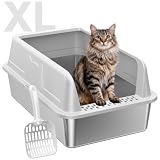
- Space:This spacious stainless steel litter box measures 22.95" L x 14.80" W x 10.04" H, offering ample room for cats or multi-cat homes. Ideal for cats for turning, digging, and comfortable use
- High-Sided Design:The 10.04" tall walls help prevent litter scatter and urine spills, keeping floors clean. A built-in anti-tracking step reduces mess, while the high sides create a private, comfortable space for your cat
- Odor-Resistant & Easy to Clean:This metal litter box resists odors and stains. The smooth, non-stick stainless steel surface lets litter slide off easily for quick cleaning, keeping your home fresh and hygienic
- Durable & Sturdy:Made of rust- and scratch-resistant stainless steel for long use. Secure clips lock walls to the base to prevent wobble or detaching—ideal for digging cats. Non-slip pads add stability and protect floors
- Includes Scoop:Comes with a sturdy litter scoop for easy cleaning. The ergonomic handle makes scooping effortless, and the matching scoop helps keep your litter area neat and organized.
Cats in different social groups
When groups do not mix comfortably, each group needs its own boxes in a location that group can reach without crossing into another group’s territory. Sharing a box across a group boundary is the arrangement most likely to create waiting, avoidance, and conflict.
Size, sides, and access
A box has to be big enough for a cat to turn around and squat comfortably. Sources use slightly different reference points:
Rank #4

- GREAT SIZE FOR LARGE CATS: Dimensions: 30"L x 20"W x 14"H
- XX-Large SIZE: Made for large and extra-large cat breeds like Maine Coons, Ragdolls, and Savannahs, this spacious litter box provides plenty of room for turning, digging, and stretching. It’s also a great choice for multi-cat households or older cats that need a little extra space.
- EASY CLEAN: Designed with a smooth interior and minimal crevices, this litter box is easy to wipe down and maintain vs leading stainless steel litter boxes. The high walls help contain spills and litter scatter, reducing daily mess and keeping your cat’s area cleaner with less effort.
- OPEN TOP: The open-top design encourages airflow and makes it easy to monitor your cat’s litter habits. It’s ideal for cats who dislike covered boxes and lets you know exactly when it’s time to scoop, helping maintain a fresher, cleaner space.
- HIGH-SIDED WALL: The XXL cat litter box features tall 14" walls with a 6.5" curved entrance that offers privacy while keeping litter and urine contained. Ideal for diggers and high-spraying cats, the elevated sides help prevent messes outside the box and reduce cleanup around your home.
- AAHA guidance: the box should be at least one and a half times the cat’s length, measured from nose to tail tip.
- Merck Veterinary Manual: the box should be at least one and a half times the cat’s length, measured from nose to the base of the tail.
Both measurements lead to a box that is larger than many people expect, so measure your largest cat before buying. Kittens, older cats, and cats with arthritis or other mobility problems may need a lower entry or lower sides. Think about these needs when choosing among box types. The useful comparison points are box size, entry height, whether the box is open or covered, and whether it can be placed in a separate accessible location. A large open box is a common choice that suits many cats, but no one design is required for every cat, and some cats avoid covered boxes.
Independent reader supportYour contribution helps us test, update, and keep practical guides available for everyone.Cleaning and litter preferences
A box that is dirty is a box that will be avoided. Cornell’s Feline Health Center advises removing waste daily when using clumping litter and cleaning the box with a gentle detergent. Merck also recommends daily scooping.
Do these 3 things before closing this tab:
1Repair Windows errors before they cause bigger problems2Fix the driver behind crashes, sound loss and screen glitches3Clear out junk files and repair common Windows errorsBest Value

- 1.[JUMBO SIZE & XL CAPACITY] Our kitty litter box (23.6"x15.7"x15.7") allows big cats to turn and dig freely. The large 80L capacity can hold cat litter up to 40L for deeper burying and less refilling—ideal for multi-cat households.
- 2.[HYGIENIC STAINLESS STEEL TRAY] This metal cat litter pan is non-porous, won't absorb odors. Its non-stick, scratch-resistant and easy clean surface leaves no residue, safe for cat's health. Sturdy & durable, our cat pan is built to last for years.
- 3.[3-IN-1 MODULAR & DOG PROOF DESIGN] Quick to assemble, 3 setup modes: fully enclosed litter box with lid,semi-covered,or open pan. Front entry top exit suits multi-cat needs. Lockable dog proof latch keeps curious dogs out,secures cat's privacy.
- 4.[ODOR CONTROL & LEAK PROOF] This enclosed litter box with high sides features a carbon filter pack for strong odor control. The tall walls and seamless overlap stop urine leakage and splashes—specially designed for high-sprayers and messy diggers.
- 5.[COMPLETE KIT & LESS TRACKING] Includes a step board for kittens or senior cats, a litter scoop with holder, 4 non-slip pads add stability. This all-in-one set keeps your home clean and tidy.
Cats also have preferences about litter texture, depth, and box location. A cat that refuses a box may be telling you something about the litter or the spot, not defying you. If you change litter, do it gradually and keep a familiar option available while the cat adjusts.
Signs the arrangement is failing
Watch for these patterns, which can appear in any multi-cat home:
- A cat waiting outside a box, or hovering nearby without using it
- A cat being chased, blocked, or ambushed while approaching or leaving a box
- A cat avoiding a particular box or the whole box area
- Urination or defecation beside a box, or elsewhere in the home
- A sudden change in how often a cat toilets, or in its posture while doing so
Several factors can drive these patterns: a soiled box, an inconvenient location, litter or box aversion, stress, competition between cats, and medical conditions. Adding and distributing boxes can improve access, but persistent problems call for investigation rather than punishment. Do not assume that soiling outside the box is deliberate misbehavior.
When to call a veterinarian
Arrange veterinary care for new or persistent house-soiling, because medical problems can change normal urination and defecation. Cornell’s Feline Health Center and the Merck Veterinary Manual both treat soiling as something to check medically rather than only behaviorally.
Free tools Windows power users keep installed
One-click scans. No signup required.
Seek prompt veterinary attention if a cat strains to urinate. Merck identifies straining as a possible life-threatening emergency, especially in male cats. This is the one situation in this article where waiting to see whether the problem resolves on its own is the wrong choice.
Quick Recap
Sources
- Cornell University College of Veterinary Medicine, Cornell Feline Health Center, Feline Behavior Problems: House Soiling
- American Animal Hospital Association, General Litter Box Considerations, 2021 AAHA/AAFP Feline Life Stage Guidelines
- American Association of Feline Practitioners and International Society of Feline Medicine, AAFP and ISFM Guidelines for Diagnosing and Solving House-Soiling Behavior in Cats
- Merck Veterinary Manual, Providing a Litter Box for a Cat
- Merck Veterinary Manual, Behavior Problems of Cats
“
Product prices and availability are accurate as of the date/time indicated and are subject to change. Any price and availability information displayed on Amazon at the time of purchase will apply.




