Free tools Windows power users keep installed
One-click scans. No signup required.
Diet-first management means running a supervised, exclusive diet trial as the first treatment step for a dog with chronic enteropathy or protein-losing enteropathy (PLE). The trial works as treatment and as a test: the dog’s response tells the veterinarian whether the diet is doing its job and what to try next. The right diet is not a universal product. It depends on the dog’s history, examination and test findings, the suspected mechanism of protein loss, nutritional status, and how the dog responds.
What “diet-first” means for chronic enteropathy and PLE
Chronic inflammatory enteropathy (CIE) is a category of long-term gastrointestinal disease. Protein-losing enteropathy describes gastrointestinal protein loss, and it can arise from several different mechanisms. Because PLE names a process rather than one disease, a diet cannot be chosen from the label alone.
The 2026 ACVIM-endorsed consensus statement and systematic review says dietary categories should be used first whenever possible. A diet trial is therefore the starting point, and additional treatment is added only when the diet alone does not bring remission. Diet trials sit inside a veterinary workup. Vomiting or diarrhea does not establish PLE on its own, and a diet should not replace investigation of the dog.
How a diet trial is run
- Agree the diet plan with your veterinarian first. The consensus says the diet should be selected according to diet history, gastrointestinal signs, and relevant physical examination and diagnostic findings. Ask which diet category fits the suspected mechanism and whether a low-fat diet is part of the plan.
- Feed only that diet, exclusively, for at least 2 weeks. Exclusive means nothing else goes in: no other food, table scraps, treats, chews, or flavored medications and supplements the veterinarian has not approved. Any unapproved item can make the result impossible to interpret, and switching before the 2 weeks are complete leaves the question unanswered.
- Score the dog at least weekly. Use a validated index such as CIBDAI (Canine Inflammatory Bowel Disease Activity Index) or CCECAI (Canine Chronic Enteropathy Clinical Activity Index). Keep the scoring method consistent from week to week so the scores can be compared.
- Judge the response on a 10 to 14 day timeline, with allowances. Clinical response typically appears within 10 to 14 days. Dogs with intermittent signs or concurrent dermatologic signs may need longer, so a slow response is not automatically a failed diet.
- If the first diet does not produce remission, move to a different category. The consensus says at least three trials using different diets should be considered if possible, ideally across multiple diet categories.
- If diet alone is not enough, add treatment rather than abandon the best diet. The consensus advises pursuing additional treatment while continuing the diet that reduced signs most.
Why PLE is not one condition
In a 2023 peer-reviewed nutrition review in Today’s Veterinary Practice, Angela Rollins and Maryanne Murphy identify mucosal injury, infectious disease, and lymphatic disease as major mechanisms of PLE. The mechanism that is suspected shapes how the diet question is approached.
#1 Best Overall

- Hill's Prescription Diet i/d Low Fat Digestive Care Chicken Flavor Canned Dog Food is specially formulated by Hill’s nutritionists and veterinarians to support dogs' digestive health.
- Helps settle digestive upsets for dogs that need a low fat formula.
- Helps improve digestion, nutrient absorption & lower blood fat levels.
- Low fat formula with highly digestible protein.
- Made with proprietary ActivBiome+ ingredient technology shown to rapidly activate beneficial gut bacteria and support a healthy GI microbiome balance.
Mucosal injury
Mucosal injury means damage to the intestinal lining. When food sensitivity could be contributing, the review says novel, hydrolyzed, or amino-acid protein sources may be considered.
Infectious disease
An infectious cause needs its own identification through veterinary testing. A diet trial should not be used to rule an infection in or out.
Lymphatic disease and intestinal lymphangiectasia
The review describes intestinal lymphangiectasia (IL) as a common PLE subset, and states that many dogs with PLE will have IL as a primary or secondary cause. Intestinal lymphatics transport much of the dietary fat a dog absorbs. Reducing dietary fat is therefore used in IL nutritional management to reduce lymphatic pressure.
Rank #2
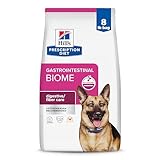
- Hill's Prescription Diet Gastrointestinal Biome Digestive/Fiber Care with Chicken Dry Dog food is specially formulated by Hill’s nutritionists and veterinarians to support your dog’s digestive health.
- Clinically shown to help firm loose stool in 24 hours and reduce risk of recurrence.
- Made with proprietary ActivBiome+ ingredient technology shown to rapidly activate beneficial gut bacteria and support a healthy GI microbiome balance.
- Unique blend of prebiotic fibers to promote regular bowel movements and help balance digestive function.
- High levels of omega-3 fatty acids (DHA & EPA)
Choosing a diet category
The 2026 consensus names the diet categories below. No single category suits every dog, so the table is a set of options to weigh with the veterinarian, not a ranking.
| Diet category | What it means | Points to weigh |
|---|---|---|
| Highly digestible | Formulated around ingredients that are easy to digest | Named in the consensus; fit depends on the dog’s signs and findings |
| Novel protein | A protein source the dog has not commonly eaten | Requires an accurate diet history to confirm what is truly new to the dog |
| Hydrolyzed protein | Proteins broken into small fragments | Considered when food sensitivity could contribute |
| Elemental protein | Amino-acid-based (elemental) formulas | Named in the consensus; weigh against diet history and nutritional status |
| Fiber-enriched | Higher fiber content | Named in the consensus; weigh against the dog’s signs and digestibility |
| Low to ultra-low fat | Reduced fat, graded in grams per 1000 kcal | Central when IL is suspected; see the fat section below |
| Home-prepared | A recipe formulated for the individual dog | Requires professional formulation and follow-up; see the home-prepared section below |
When comparing options, the consensus and review point to six questions:
- Fat content, especially when IL is suspected.
- Protein strategy (novel, hydrolyzed, or elemental) and the dog’s previous ingredient exposure.
- Digestibility and fiber profile.
- Whether the diet is complete and balanced for the intended duration.
- Palatability, and whether the household can keep feeding exclusively.
- Clinical response under veterinary follow-up.
For PLE, the review describes commercial low-fat hydrolyzed and novel-protein diets as possible first options. These are veterinarian-selected therapeutic dog foods. Choose the specific product and its fat level with your veterinarian, not from the package alone.
Rank #3

- Hill's Prescription Diet i/d Wet Adult Dog Food is specially formulated by Hill’s nutritionists and veterinarians to support dogs' digestive health.
- Nutrition clinically proven to help settle digestive upsets in adult dogs.
- Highly digestible formula to support easy nutrient absorption.
- Made with ActivBiome+ Digestion, a proprietary blend of prebiotic fibers shown to rapidly activate the gut microbiome to support digestive health and well-being.
- High levels of B vitamins and added electrolytes help replace lost nutrients from digestive upset.
Fat level when IL is suspected
The review sorts low-fat diets into three bands, measured in grams of fat per 1000 kcal of food. These are the review’s categories, not a prescription for any individual dog.
| Fat band | Fat per 1000 kcal |
|---|---|
| Ultra-low-fat | No more than 15 g |
| Conventional low-fat | 16 to 25 g |
| Moderately low-fat | More than 25 to 30 g (the review’s stated range) |
The review’s summary of PLE management reads:
“Many dogs with PLE will have IL as a primary or secondary etiology, and the best management is a low-fat diet.”
Special offer. See more information about Outbyte and uninstall instructions. Please review EULA and Privacy policy.
That statement describes management where IL is present. It does not mean every dog with PLE needs the same diet or the same fat restriction.
Rank #4

- Hill's Prescription Diet i/d Low Fat Digestive Care Chicken Flavor Dry Dog Food is specially formulated by Hill’s nutritionists and veterinarians to support your dog’s digestive health.
- Helps settle digestive upsets for dogs that need a low fat formula.
- Helps improve digestion and support easy nutrient absorption.
- Highly digestible, low fat formula.
- Made with proprietary ActivBiome+ ingredient technology clinically shown to rapidly activate beneficial gut bacteria and support a healthy GI microbiome balance.
The ultra-low-fat study in PLE
The review cites a retrospective study by Nagata and colleagues (2020) in which 23 of 27 dogs with PLE (85%) responded to an ultra-low-fat homemade diet. The median response time was 15 days, with a range of 6 to 32 days. Because the study was retrospective and used a homemade diet, these figures describe that group of dogs. They are not a guaranteed response rate for your dog.
Independent reader supportYour contribution helps us test, update, and keep practical guides available for everyone.What response rates do and do not tell you
The 2026 consensus reports that 38 to 89% of dogs with CIE are food-responsive. The width of that range means a single percentage cannot be applied to an individual dog. Response depends on the dog, the diet, and how consistently the trial is run.
A diet comparison summarized in the consensus
The consensus summarizes a study comparing a therapeutic GI diet with a soy-based hydrolyzed diet. The results are specific to that study and should not be read as a general ranking of products.
Recommended Free Tools
Best Value

- Hill's Prescription Diet i/d Wet Adult Dog Food is specially formulated by Hill’s nutritionists and veterinarians to support dogs' digestive health.
- Nutrition clinically proven to help settle digestive upsets in adult dogs.
- Highly digestible formula to support easy nutrient absorption.
- Made with ActivBiome+ Digestion, a proprietary blend of prebiotic fibers shown to rapidly activate the gut microbiome to support digestive health and well-being.
- High levels of B vitamins and added electrolytes help replace lost nutrients from digestive upset.
| Diet | Dogs studied | Short-term result | Long-term result |
|---|---|---|---|
| Therapeutic GI diet | 8 (6 reached remission) | Remission in 6 of 8 dogs (75%) | 17% long-term response (denominator not stated) |
| Soy-based hydrolyzed diet | Not stated | 67% short-term response | 79% long-term response |
A randomized, blinded trial of hydrolyzed fish diets
Simpson and colleagues (Journal of Veterinary Internal Medicine, 2023) ran a randomized, blinded, controlled trial comparing hydrolyzed fish diets, with and without added prebiotics, turmeric, and high cobalamin (vitamin B12), against a limited-ingredient maintenance diet. The population was dogs with chronic enteropathy, and it included dogs without PLE, so the trial does not isolate PLE. It also examined recovery and remission in PLE. This article does not quote those PLE-specific outcomes. The design is still useful because it shows how a hydrolyzed diet can be tested against a control diet under blinded conditions.
Staying on a diet that works
- A diet that induces remission should be continued for at least 12 weeks before any transition is attempted.
- Dogs with PLE may benefit from long-term continuation of an effective diet.
- Dietary non-compliance is associated with relapse risk in PLE, so keep the diet consistent, including treats and food shared by others in the home.
- The best time to transition away from a successful diet is not established for every case. Plan any change with the veterinarian rather than making it at the owner’s discretion.
Home-prepared diets
The review considers a home-prepared trial when commercial diets do not help. Home-prepared diets need professional nutritional formulation and follow-up for long-term use, and the review recommends involving a board-certified veterinary nutritionist.
Quick Recap
- Do not treat an internet recipe as nutritionally complete. A recipe that has not been formulated for your dog’s needs cannot be assumed to be complete.
- Ask the nutritionist how protein intake will account for intestinal losses, since the review notes that protein needs may be affected.
- Ask your veterinarian for a board-certified veterinary nutritionist referral, and keep scheduled follow-up in place for as long as the home-prepared diet is used.
Product prices and availability are accurate as of the date/time indicated and are subject to change. Any price and availability information displayed on Amazon at the time of purchase will apply.




