Quick wins for a faster PC:
Fix the driver behind crashes, sound loss and screen glitchesFind Drivers →Repair Windows errors before they cause bigger problemsFix Now →Scan for outdated or missing drivers - takes under a minuteDriver Scan →A roughly 99-million-year-old tail fragment preserved in amber gives scientists a rare three-dimensional view of feathers on a non-avian dinosaur. Its branching structure supports a specific idea about how feathers developed: fine branching elements may have appeared before a strong central shaft. The fossil is compelling evidence for that pattern, not proof of the entire history of feathers.
What did scientists find in the amber?
Lida Xing and colleagues described a fragment of a feathered tail in amber from Kachin State, Myanmar. The amber is estimated to be about 99 million years old, and the study was published on 19 December 2016. The specimen is a partial tail, not a complete dinosaur skeleton. PubMed’s study record and the Current Biology paper describe the find.
Vertebral outlines and the tail’s curvature, together with its plumage, led the researchers to identify it as a non-avian theropod and place it broadly within Coelurosauria. The fragment does not identify a named species, so it is not possible to say exactly which dinosaur it came from based on the evidence reported.
How did the researchers connect the feathers to a dinosaur?
The feathers are preserved attached to a tail fragment that includes vertebral outlines. That association is why the study could identify the source as a non-avian dinosaur rather than simply describe isolated feathers. The researchers’ broader placement within Coelurosauria is based on the fragment’s anatomy and plumage; it is not a species-level identification.
Free tools Windows power users keep installed
One-click scans. No signup required.
#1 Best Overall
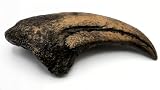
- Museum quality fossil cast replica from an acrocanthosaurus hand claw
- Claw is roughly 4.5 inches long
- Original was found at the Antlers Formation around the Oklahoma/Texas border
What does the fossil show about feather development?
The feathers have branching structures but lack a well-developed central shaft, called a rachis. The study’s authors interpreted this arrangement as supporting a “barbule-first” evolutionary pattern: components of feather structure developed before a robust central shaft. The finding makes the proposed sequence more concrete because the branching can be examined directly in a preserved feather. The paper’s highlighted findings describe the branching as support for that pattern; the University of Bristol announcement notes the lack of a well-developed rachis.
That is a focused claim about one aspect of feather structure. A single tail fragment cannot establish that every feather evolved through the same sequence, explain the original function of feathers, or settle the full history of feather evolution.
Rank #2

- Cast Replica Deinonychus Dinosaur Claw - 4 inches long
- Bonus Genuine Fossil Spinosaurus Dinosaur Tooth
- Claw Made In USA
Why is amber preservation useful—and what can it not show?
Amber can preserve delicate structures in three dimensions, including microscopic arrangements that may be difficult to read in a flattened fossil impression. Ryan McKellar, a paleontologist and co-author, described amber as preserving “tiny snapshots of ancient ecosystems” with microscopic details and labile tissues that can be difficult to study in other settings. The University of Bristol release attributes the statement to McKellar.
The Government of Saskatchewan announcement says synchrotron X-ray scanning revealed soft tissue thought to include muscle, ligaments, and skin, as well as trace ferrous iron. The announcement interprets the iron as indicating relics of hemoglobin; that interpretation does not mean intact blood, viable cells, or DNA were recovered. The provincial announcement calls the specimen a feathered tail of a non-avian dinosaur preserved in amber from about 99 million years ago.
Rank #3
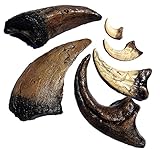
- Includes Six (6) Dinosaur Claw Fossil Replicas
- Sturdy fiberglass and resin
- Cast from original fossils
- Includes: T-Rex Toe claw, Velociraptor, Deinonychus, Allosaurus, Utahraptor, Camarasaurus
- Exclusive Collection from DINOSAURS ROCK
Amber’s fine detail does not make this a complete record of the animal. A tail fragment cannot reveal the dinosaur’s full anatomy, behavior, or species identity from the evidence described in the study and announcements.
Independent reader supportYour contribution helps us test, update, and keep practical guides available for everyone.How does an amber inclusion compare with a flattened fossil impression?
| Evidence type | What it can preserve well | What it can support | Main limitation here |
|---|---|---|---|
| Amber inclusion | Delicate microscopic detail, three-dimensional arrangement, and some labile tissues | Close examination of feather branching and surface plumage | The specimen is a fragment, not a complete animal |
| Flattened fossil impression | Broader outlines preserved in a rock slab | Visible shape and overall outlines of fossilized structures | May not retain the same three-dimensional detail as amber |
The comparison concerns preservation, not which evidence type is universally superior. In this case, amber offers unusually direct detail about feather structure, while the fragmentary nature of the inclusion limits what can be inferred about the whole dinosaur.
Quick Recap
Best Value
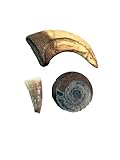
- Three-Item Fossil Set – Includes one Velociraptor claw replica, one Mosasaur tooth (B-grade), and one genuine small ammonite fossil
- Educational and Collectible – A great hands-on way to explore prehistoric life and paleontology
- Genuine Fossils Included – Both the Mosasaur tooth and ammonite are real fossil specimens
- Realistic Replica Claw – Velociraptor claw cast features high quality texture and curvature
- Ready for Display or Teaching – Great for collectors, educators, or science-themed gifts
Rank #4
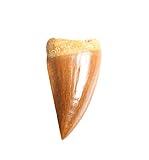
- Each Mosasaurus dinosaur tooth comes with a certificate of authenticity from Dey Designs that proves the tooth that you received was inspected and is real.
- These Mosasaurus teeth can date back up to 61 - 145 million years ago!
- Our real Mosasaurus tooth is the perfect gift for any dinosaur enthusiast.
- A thoughtful Mosasaurus toy for children to learn about dinosaurs, or to create a Mosasaurus necklace.
- Please note that these teeth are selected randomly and may vary in size and color, some may be bigger or smaller. As some are old they may contain slight cracks.
Product prices and availability are accurate as of the date/time indicated and are subject to change. Any price and availability information displayed on Amazon at the time of purchase will apply.




