There is no single aquarium fungus treatment proven best for every fish or tank. Cottony growth can be caused by water molds such as Saprolegnia, but it can also be a sign of damaged tissue or another disease. First check the fish and its water conditions; for a labeled treatment option, API lists PIMAFIX for freshwater and saltwater fish. Its directions are the manufacturer’s, not proof that it is the most effective remedy in every case.
What looks like fungus on a fish?
Water molds such as Saprolegnia can form grayish-white, cotton-like growth on a fish’s skin, fins, gills, or eyes. Some affected areas may look brown and matted. A fuzzy patch is a clue, not a diagnosis: other conditions, including bacterial disease such as columnaris, can produce lesions or patches that may be mistaken for fungus.
As an Amazon Associate I earn from qualifying purchases.
UF/IFAS explains that fungal spores are common in water but do not usually cause disease in healthy fish. Water molds may colonize tissue already damaged by parasites, bacterial infection, or handling injury. That means treating visible growth alone may miss the problem that allowed it to develop.
What to do before choosing a treatment
- Check water conditions and confirm they are appropriate for the species. Medication does not replace correcting poor water quality.
- Consider whether there may have been an injury, parasite, or bacterial illness behind the damaged tissue.
- Do not assume every pale patch, mouth lesion, or fuzzy-looking area is fungal disease.
- If the fish is declining quickly, growth is spreading, gills are affected, multiple fish are sick, or the diagnosis is uncertain, contact an aquatic veterinarian, fish-health professional, or diagnostic laboratory. Evaluation can include water-chemistry checks and microscopic examination of skin, gill, or fin tissue.
API PIMAFIX: a manufacturer-listed option
API describes PIMAFIX as an antifungal remedy for freshwater and saltwater fish and lists cottony growth and fungus on the fins, mouth, and body among the symptoms it addresses. Its product page gives the following directions. Confirm the current bottle label before use, since product directions and formulation may change.
#1 Best Overall
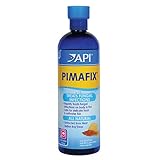
- Contains one (1) API PIMAFIX Antifungal Freshwater and Saltwater Fish Remedy 16-Ounce Bottle
- Rapidly and safely treats fungal infections on body and fins of fish
- Contains all-natural extract from West Indian Bay Trees to help with fungus and cottony growth
- Helps heal internal and external bacterial infections in freshwater, saltwater and reef aquariums
- Use daily for a week when treating infections
- Shake the bottle well.
- If possible, remove activated carbon.
- Add 5 mL per 10 US gallons (38 L) daily for seven days.
- After seven days, make a 25% water change. The manufacturer says to continue treatment if necessary.
- During treatment, the manufacturer recommends turning off a protein skimmer and UV sterilizer.
These are API’s published directions, not independent clinical evidence that PIMAFIX is superior or appropriate for every species, diagnosis, or aquarium setup.
Other treatments and why professional guidance matters
Veterinary and extension references mention formalin and potassium permanganate as possible treatments for fungal infections. Merck also discusses hydrogen peroxide for external saprolegniasis in the context of addressing environmental conditions and skin pathogens. These references do not establish a universal home-aquarium dosing protocol or a head-to-head ranking for ornamental fish. Do not turn them into unsupervised dosing instructions.
Rank #2

- Contains one (1) API PIMAFIX Antifungal Freshwater and Saltwater Fish Remedy 8-Ounce Bottle
- Rapidly and safely treats fungal infections on body and fins of fish
- Contains all-natural extract from West Indian Bay Trees to help with fungus and cottony growth
- Helps heal internal and external bacterial infections in freshwater, saltwater and reef aquariums
- Use daily for a week when treating infections
Kordon identifies Rid-Fungus as a product directed at external fungal infections. The available product information does not support a fair efficacy comparison with PIMAFIX, so neither can be called the best choice for all cases.
How to compare treatment options
Before selecting a product, match its label and intended use to the actual situation. Relevant factors include:
Quick Recap
Best Value

- For use in freshwater or marine aquaria.
- Easily absorbed through both skin and gills; ingestion not required.
- Does not adversely affect the filter bed and is easily removed with carbon.
- Safely and effectively treats several fungal, and bacterial fish diseases (dropsy, popeye, fin/tail rot, septicemia).
- When used in a medicated food mix, it is excellent for treating bacterial infections in tanks that contain invertebrates.
Rank #4

- Contains one (1) API LIQUID SUPER ICK CURE Freshwater and Saltwater Fish Medication 4-Ounce Bottle
- Treats "ich" white spot disease in fish and secondary bacterial fish infections
- Quickly kills ich parasite, typically within 24 hours of first dose
- Use only in freshwater and saltwater aquariums not with reef aquariums
- Dose every day for five days when symptoms first start occurring
Rank #3

- BOOST FISH HEALTH: Artemiss is an expellant; it provides a beneficial treatment against ailments including: dropsy, fungus, milky skin, mouth rot, fin/tail rot
- HOW IT WORKS: supports the immune system and stimulates and accelerates regeneration of damaged tissue until no trace of the wound remains; will not cause buildup of future resistance
- ACCEPTABLE TO USE: acceptable to care for all aquatic life; It is a great aid to use as a stress reducer when acclimating fish to a new environment
- HOW TO USE: Shake thoroughly prior to use and switch off UV sterilizer, protein skimmer or ozone generators; Keep filters operational; Add dosage to water; Best results will be achieved if product is used soon after problem is detected
- NOTE: This product is intended for use with all ornamental and aquarium fish only, and may not be used for fish intended for human consumption
- The suspected organism and whether the diagnosis is confirmed.
- Freshwater or marine setup, fish species, and species-specific sensitivity.
- Whether the aquarium contains live plants or invertebrates, and what filtration is in use.
- The active ingredient, label directions, and possible effects on biological filtration.
- Whether treatment requires quarantine or professional oversight.
- The strength of evidence: manufacturer claims and veterinary references are not the same as comparative trials showing one product works best.
Product prices and availability are accurate as of the date/time indicated and are subject to change. Any price and availability information displayed on Amazon at the time of purchase will apply.




