Windows Errors? Fix Them Before They Spread
Repair common Windows errors and clear accumulated junk for a smoother, more stable PC - no reinstall needed.Free scan · no reinstallOutdated Drivers Are Slowing You Down
One free scan finds every outdated or missing driver and matches the right update for your exact hardware.Free scan · exact hardware matchThe most effective indoor setup is a rotation, not a single “best” toy: use a food puzzle for problem-solving, a snuffle mat for scent-led searching, and a stuffable toy for licking or chewing. Add short scent hunts, trick-training sessions, and supervised play. Match every item to your dog’s size, swallowing risk, chewing style, food motivation, and ability to solve the task. Introduce new toys at an easy level, watch the first sessions, inspect them frequently, and remove anything damaged.
What keeps an energetic dog busy indoors?
Indoor enrichment works when it gives a dog an appropriate way to perform natural behaviors such as sniffing, seeking, foraging, chewing, licking, manipulating objects, and learning. A toy that occupies one dog for 20 minutes may frustrate another or be finished in two minutes. The useful question is not “Which toy is universally best?” but “Which activity fits this dog today, and how can I make it safe and achievable?”
As an Amazon Associate I earn from qualifying purchases.
Food puzzles turn part of a meal into a foraging or problem-solving task and can slow a fast eater. Snuffle and activity mats make the dog search with its nose. Stuffable toys can extend licking and chewing, especially when filled and frozen. A scavenger hunt, a new trick, or a brief interactive game adds variety without requiring another purchase. Rotate a few activities rather than leaving every toy available all the time.
American Hospital Association (AAHA) describes a dog’s sense of smell as about 10,000 to 100,000 times better than a human’s on its page updated July 14, 2026. That range is presented as general guidance rather than a cited study result, but it explains why a small indoor scent search can be mentally demanding even when the dog is not running.
#1 Best Overall

- [Treat Distribution] Our food dispenser has differently sized spheres at both ends. As dogs push the toy, it moves within a fixed area, allowing dogs to continuously chase and play with it. During movement, food is dispensed from the food holes on both sides of the toy.
- [Adjustable Switch] Each of the two spheres with a food dispensing switch, making it suitable for various sizes and types of pet dry food or snack. The switch can be adjusted according to the different sizes of dog food. It also allows control over the amount of food dispensed, extending or shortening the time it takes for pets to obtain food. It is more conducive to a healthy dog diet.
- [Increase Pet Intelligence] This dog treat puzzle toy combines intellectual training with food rewards. When pets push this toy, it will not only be to get delicious food, but it will also stimulate their intelligence and hunting instinct. This design not only meets the needs of pets but also encourages them to learn and grow in the game.
- [Prolonged Play] The dog enrichment toy is designed to limit the amount of treats your dog gets while encouraging more extended playtime. This is intended for effective playtime for dogs and is NOT a chewed toy. It is also dog boredom buster toys and best dog gift to keep them busy when dogs are left home alone, relief anxiety.
- [Attract Dogs' Attention] With barbell shaped design and bright color, the dog puzzle toy ball can attract your dog's attention, stimulate their curiosity and drive them crazy to roll it. Size: 6.1*3.44*3.44in/15.5*8.7*8.7cm.
Compare the main indoor toy types
| Activity | What the dog does | Food use | Best starting point | Care and supervision |
|---|---|---|---|---|
| Food puzzle or treat-dispensing toy | Pushes, rolls, lifts, or otherwise manipulates an object to release food | Use part of the normal meal or appropriate treats | An easy design that allows quick success | Watch first uses; check for cracks, loose pieces, and swallowing attempts |
| Snuffle or activity mat | Sniffs through fabric folds to find scattered food | Kibble or small, suitable treats | A shallow, easy-to-search mat with a small amount of food | Supervise dogs that chew or pull fabric; follow the maker’s washing instructions. Ohio State notes that many can be laundered. |
| Stuffable or freezable food toy | Licks, chews, and works food from a cavity | Part of a meal; suitable fillings can be frozen | A loosely packed, easy-to-empty filling | Choose a size and material that cannot be swallowed; inspect after every use |
| Scent hunt | Searches rooms or containers for hidden food | Use meal portions or a few treats | Visible or very easy hiding places | Count the food and prevent access to unsafe objects |
| Trick training or interactive play | Responds to cues, chases, retrieves, or plays tug under your direction | Optional small rewards | Short sessions with clear pauses | Stop if arousal escalates or the dog becomes frustrated |
Difficulty, durability, fit, cleaning, and supervision vary by individual dog and product. No category is automatically safe for every chewer, and no puzzle guarantees that every dog will enjoy it.
Food puzzle and treat-dispensing toys
Why choose one
A food puzzle makes the dog work for some of its food instead of consuming the entire portion from a bowl. The activity can provide mental exercise and may slow a dog that eats too quickly. The American Veterinary Society of Animal Behavior (AVSAB) describes food puzzles as useful enrichment while noting that more research is needed on their effects specifically in pet dogs. Treat-dispensing toys are therefore a practical tool, not a promise of a particular behavioral outcome.
How to set it up
- Measure the dog’s normal daily food before filling the toy. Reserve part of that amount rather than adding unlimited treats.
- Use the easiest opening or release setting. Food should come out after a few simple movements.
- Place the toy on a surface where it can be pushed without striking furniture or stairs.
- Stay nearby for the first sessions. Confirm that the dog manipulates the toy rather than biting off or swallowing pieces.
- Increase difficulty only after the dog succeeds calmly several times. If the dog gives up, paws frantically, vocalizes, or tries to destroy the toy, make it easier or stop.
What to look for when buying
- Size: The toy must be too large to swallow and suitable for the dog’s jaw and body size.
- Material and durability: Choose construction that matches the dog’s chewing style. “Indestructible” is not a reliable safety category.
- Food compatibility: Check whether ordinary kibble fits and whether the toy can be cleaned thoroughly.
- Difficulty: Look for a way to begin at an easy level. A puzzle that is too hard can create frustration; one that is solved instantly may not sustain interest.
- Inspection access: You should be able to see and clean the food-contact surfaces.
Snuffle and activity mats
How they differ from mechanical puzzles
A snuffle mat is primarily a scent-led search. Food is scattered among fabric strips or folds, and the dog uses its nose to locate each piece. Ohio State University’s Veterinary Medical Center identifies sniffing, seeking, and foraging as the central behaviors. This makes a mat a useful alternative for a dog that does not enjoy pushing or rolling a hard puzzle.
Do these 3 things before closing this tab:
1Fix the driver behind crashes, sound loss and screen glitches2Clear out junk files and repair common Windows errors3Scan for outdated or missing drivers - takes under a minuteSafe introduction
- Put the mat on a clear, non-slip area and let the dog inspect it without food first.
- Scatter a small amount of familiar kibble on top where it is immediately visible.
- Once the dog searches calmly, place pieces slightly deeper in the folds.
- End the session when the food is gone and store the mat if the dog is likely to chew it.
Many snuffle mats can be laundered, but care instructions differ. Follow the specific maker’s washing and drying directions, and do not return a mat that has torn fabric, detached parts, or embedded food that cannot be removed.
Who may need extra caution
Dogs that pull, shred, or ingest fabric need continuous supervision or a different enrichment format. A mat is not a safe unattended chew simply because it is marketed as an activity product. If the dog starts biting the strips instead of searching, remove it and choose a sturdier, non-fabric activity.
Rank #2

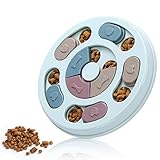
- 【PRODUCT SIZE】10 inch*10 inch*1.3 inch.
- 【3 WAYS TO PLAY, UPGRADE SLOW FEEDER】Our dog mental stimulation toys have a unique squeak button in the middle, which make it easier to attract the attention of dogs and cats. Three different difficulty designs and the 16-hole dog treat dispenser design maximize slow feeding time, even beyond 20 minutes.
- 【FUNNY STIMULATING TOYS】All kinds of dogs and cats love the puzzle game of Spin & Slide and the Seek & Hide with their smell sense and paw skills to find food. Combining circular orbit sliding game and linear orbit sliding game, smart dog and cat must move the slider correctly to get the food reward hidden in the maze.
- 【NON-REMOVABLE PARTS DOG PUZZLE】Our dog treat puzzle is made of non-toxic materials, very durable and suitable for pets to play for a long time. This dog toy has no removable parts because the design has built-in play parts that fold tightly and won't fall off easily.
- 【ANTI-SLIP & EASY TO CLEAN】: The four corners of the bottom are equipped with four anti-skid pads, which can be well fixed during the dog's slow food process; It is easy to clean, also dishwasher safe.
Stuffable and frozen food toys
Why freezing extends the activity
A suitable stuffable toy can turn a quick snack into a longer licking and chewing session. AAHA suggests freezing a filled food toy for indoor enrichment. Begin with a loose filling so the dog can empty it without excessive chewing; increase packing only if the dog remains relaxed and can finish safely.
Use the dog’s normal diet first
Use part of the regular meal whenever practical. Extra treats, spreads, or broth can add calories that are easy to overlook. If you add broth or another human-food ingredient, read the label carefully: AAHA specifically warns against unsafe ingredients such as onion and garlic. Do not assume that a food is appropriate merely because a small amount fits inside the toy.
The Tool Desk
Outbyte Driver Updater FREEFix the driver behind crashes, sound loss and screen glitchesFind Drivers →Outbyte PC Repair FREERepair Windows errors before they cause bigger problemsFix Now →Filling and freezing procedure
- Confirm that the toy is the correct size and has no cracks, sharp edges, or detachable pieces.
- Choose food the dog already tolerates. Reserve the amount from the daily ration.
- Fill loosely and offer it at room temperature for the first trial.
- Observe whether the dog licks and chews appropriately. Remove it if the dog bites off chunks or becomes frantic.
- For a longer session, freeze the same safe filling after the dog has demonstrated that it can use the toy without damaging it.
- Wash the toy according to its care instructions and dry it completely before the next use.
Low-cost enrichment to use alongside toys
Indoor scavenger hunts
AAHA recommends hiding treats around the home, beginning with easy locations and increasing the challenge as the dog learns. Start with food visible beside a table leg or just inside an open room. Later, place pieces behind a door that is already ajar or under the edge of a towel. Keep the dog out of the area while hiding food, then release it to search. Count every piece so none is left to spoil or attract another pet.
Trick training
Teach one new behavior at a time, such as touching a hand, going to a mat, or waiting briefly at a doorway. Use part of the dog’s meal for rewards when possible. Keep sessions short, provide breaks, and stop while the dog is still succeeding. Training is enrichment through communication and problem-solving; it does not require a complicated toy.
Interactive play
Short, supervised rounds of retrieving, tug, or chasing a toy can complement scent and food activities. Use clear start and stop cues, avoid games that encourage grabbing people or household objects, and pause if excitement becomes difficult to interrupt. Some toys increase arousal rather than calm a dog, so judge the dog’s response instead of assuming that any activity will settle it.
Rank #3

- 2 Levels in 1 Toy: start your pups off with a level 1 puzzle, add some treats in the base compartments and watch your dogs get their tasty reward by nudging the lids. For dogs who have mastered level 1, for added challenge in level 2, just put some treats in the top compartments, teach your dogs to press the top cover to dispense treats down into the base compartments and finally enjoy their reward
- Slow Feeder: The large capacity top transparent granary saves you the hassle to refill dog food frequently. The product can also be used as a slow feeder utensil for your dogs, which promotes healthy ingestion by slowing down eating speed by over 10x. Great for large and small dogs
- Not Easy to Tip Over: 4 non-slip rubber mats and weighted base hold the dog puzzle toy firmly in place when dogs eat and nudge and prevent the toy from tipping over
- We Prioritize Safety: the dog puzzle toys are designed with your pet’s health in mind, made of durable food-grade PP materials. Non-removeable parts make it safe and easy to clean. And you can give puzzles toy to your dog or directly out of the box, just no assembly!!
- Trains Dog’s Intelligence: interactive treat puzzle game challenges your puppies to get their reward of treats, works your dog's mind while reducing boredom and destructive behavior like chewing, digging and excessive barking. Size: 4.2 inch height
Rotate, do not overwhelm
AAHA suggests rotating toys in small groups every few days. Keep a few options available, store the rest, and reintroduce them later. Rotation preserves novelty while making it easier to notice damage, clean food toys, and identify which activity suits the dog.
Choose by the individual dog
| If your dog is… | Start with… | Adjust for… |
|---|---|---|
| Highly food-motivated and new to puzzles | An easy food puzzle or visible-kibble snuffle mat | Success rate; increase difficulty only after calm, repeated wins |
| A rapid eater | Part of a meal in a food puzzle or snuffle mat | Whether food releases steadily and the dog remains relaxed |
| More interested in sniffing than pushing | A scent hunt or snuffle mat | Fabric-chewing risk and mat cleanliness |
| A powerful chewer | A size-appropriate, durable food toy used under supervision | Any cracking, chunking, or attempt to swallow material |
| Easily frustrated | The simplest puzzle or an easy scent search | Shorter sessions, larger food rewards, and immediate success |
| Quickly bored by easy tasks | A rotation of puzzles, searches, training, and play | One change at a time so you can tell which difficulty is appropriate |
“Durable” is relative to the individual dog, not a permanent product property. A toy that survives one dog may fail quickly with another.
A step-by-step indoor enrichment routine
- Assess the dog first. Note body size, jaw size, chewing intensity, food allergies or dietary restrictions, eating speed, and whether the dog guards food.
- Select one activity. Choose sniffing, manipulating, licking, chewing, training, or interactive play based on the dog’s current need and ability.
- Use a measured food portion. Take food from the daily ration where possible. If adding ingredients, verify every label and avoid onion and garlic.
- Make the first attempt easy. Keep food visible, use a simple opening, or hide treats in obvious places.
- Supervise the entire first session. Look for calm engagement, successful problem-solving, and safe handling of the toy.
- Read the dog’s feedback. Continue if the dog searches or manipulates steadily. Simplify or stop if it freezes, vocalizes, abandons the task, or attacks the toy.
- Clean and inspect. Remove food residue, follow washing instructions, and check for tears, cracks, loose pieces, or sharp edges.
- Record what worked. A simple note of activity, duration, and response helps you build a useful rotation instead of buying randomly.
Food, calories, and household management
Enrichment food still counts as food. Measure the daily ration before dividing it among meals, puzzles, searches, and training. If the dog receives additional treats, reduce another portion as appropriate and ask a veterinarian for individualized feeding guidance when weight is a concern. The goal is to change how the dog works for food, not to add an unlimited stream of calories.
Search activities require a controlled environment. Close access to trash, medications, cleaning products, children’s toys, and other objects the dog might pick up while hunting. Use only food the dog can safely eat, and do not hide pieces where the dog must climb, squeeze behind appliances, or disturb another animal.
Toy safety: supervision, damage, and swallowing hazards
- Size: Select an item appropriate for the dog’s size and jaw. A small object can be swallowed even if it was sold for dogs.
- Material: Choose construction that will not readily fracture into swallowable pieces for that particular chewer.
- First use: Supervise every new enrichment item until you know how the dog handles it.
- Routine checks: Inspect after use for cracks, punctures, torn fabric, detached parts, and sharp edges.
- Removal: Discard a damaged toy rather than trimming off one visibly bad section and assuming the rest is safe.
- Symptoms: Choking, repeated gagging, vomiting, abdominal pain, unusual lethargy, or suspected ingestion requires prompt veterinary contact. Ohio State warns that swallowed pieces can cause choking or intestinal blockage.
AAHA, Ohio State, and VCA all emphasize size, durability, supervision, and damage checks. None supports describing a toy as universally safe or indestructible.
Rank #4
- 【Size】: L9.44" * W9.44"* H1.14" suitable for cats, puppies and small dogs.
- 【Interactive Dog Toys】This is a interactive puppy puzzle , which can easily become the closest companion and toy for your puppies and cats, and will release pressure for dogs. Find food by sliding parts to improve eating pleasure and IQ.
- 【Slow Feed Bowl】This encourages pets to eat at a slower speed, helps to slow down the feeding time to help the dog digest, and can provide your dog with a variety of healthy snacks.
- 【Slow Feede toys】 Use this educational game toy to exercise the dog’s brain, which will help meet the dog’s instinct needs, train the pet’s sense of smell, and let the dog enjoy feeding when using the nose or paw to move the slider, while providing spirit stimulate.
- 【Dog toys】No toy is indestructible. Do not leave toys with unsupervised pets. Remove and replace toy if damaged.
Food guarding and multi-pet homes
Food toys can create competition in homes with more than one pet. Give each dog its own activity in a separate room, behind a gate, or at a distance that prevents interference. Pick up finished toys before pets reunite if one dog approaches another’s food area.
Watch for stiff posture, hovering, hard staring, growling, snapping, rushing toward another pet, or attempts to steal a toy. Do not punish those warnings or reach into a guarded space. For known guarding, ask a veterinary behavior professional for an individualized plan; generic toy advice is not enough.
Troubleshoot the common failures
“My dog ignores the toy.”
Make the task easier and use a food the dog already values. Demonstrate by rolling or opening the toy once, then let the dog try. If interest remains low, switch from manipulation to sniffing, training, or interactive play. A lack of interest does not mean the dog needs a harder puzzle.
“My dog destroys the toy.”
Remove it immediately and inspect for missing pieces. The dog may need a different material, a larger size, a simpler activity, or continuous human interaction rather than an object left alone. Never call a product indestructible after one successful session.
Free tools Windows power users keep installed
One-click scans. No signup required.
“My dog becomes frantic.”
Stop the activity, reduce difficulty, and offer a calm break. Some dogs become more aroused by chasing or difficult food release. Try a slow scent search or a brief training exercise instead, and seek professional advice if distress or destructive behavior persists.
Best Value

- 【Product Size】10 inch*10 inch*1.2 inch.
- 【Interactive Dog Puzzle Toys 】This is a fun interactive puzzle toy,which can encourage and train your dogs or cats to seek foods by sliding the slider, helping pets to increase IQ by learning sequential steps and the challenging play.
- 【Squeaky Dog Toys】This dog puzzle toys is designed with a sounding device in the middle of the toy,which is to attract the pet's attention.Also,you would enjoy the fun of dog squeak puzzle toy with your pets, greatly improve relations with your pets and get fun during interactive dog games.
- 【Mental Excecise&Boredom Buster】Our memory training puzzle toy can keep smart dogs busy and engaged in more thinking and activities.Therefore,clot stimulation toys are great for reducing dogs’boredom,anxiety and destructive behaviors.
- 【Food-Safe PP Material】This dog treat puzzle is made with toxic-free, food-grade PP material. It is durable for interactive play and mental enrichment but not designed as a chew toy. Always supervise your pet during use.Easily washable with water or in the dishwasher.Note: No toy is indestructible. Remove and replace the toy if damaged.
“The puzzle is solved too quickly.”
First confirm that the dog is actually relaxed and not swallowing food rapidly. Then change one variable: use a slightly more complex opening, place food deeper in a safe mat, freeze a suitable filling, or rotate to another activity. Difficulty should extend engagement without creating frustration.
“The dog finishes the food but keeps searching.”
Check that the measured portion was complete and that no food remains in folds or cavities. End the session clearly, remove the toy, and transition to rest, training, or a non-food activity. Do not keep adding treats simply to prolong the search.
When toys are not enough
Enrichment can support a healthy routine, but it is not a complete treatment for serious behavior problems. AAHA’s behavior-management guidance notes that many dogs with behavioral problems are too distressed for simple environmental enrichment alone to have much effect. Persistent destructive behavior, separation-related distress, compulsive activity, aggression, guarding, or a sudden change in behavior warrants veterinary evaluation. A veterinarian can also help when dietary restrictions, weight management, dental pain, or gastrointestinal problems affect toy choice.
Quick wins for a faster PC:
Clear out junk files and repair common Windows errorsFree Scan →Scan for outdated or missing drivers - takes under a minuteDriver Scan →Repair Windows errors before they cause bigger problemsFix Now →The 2014 review by Heath and Wilson places enrichment in a broader veterinary context: the aim is to support species-typical behavior in the home or kennel, not merely to keep an animal occupied for a few minutes. A balanced indoor plan therefore combines safe food work, scent opportunities, learning, movement, rest, and appropriate social contact.
A practical rotation you can repeat
- Day 1: Use part of breakfast in an easy food puzzle; finish with a two-minute trick session.
- Day 2: Offer a supervised snuffle-mat search, then wash and dry the mat according to its instructions.
- Day 3: Give a suitable stuffable toy, first at room temperature and later frozen if the dog handled it safely.
- Day 4: Hide measured food in easy locations for a scavenger hunt and remove every remaining piece afterward.
- Day 5: Practice a new cue and add a short, structured retrieve or tug game.
- Day 6: Repeat the dog’s favorite safe activity at a slightly adjusted difficulty.
- Day 7: Inspect every toy, discard damaged items, clean food-contact surfaces, and choose the next small group for rotation.
This schedule is a framework, not a prescription. Alter the duration, food amount, and activity whenever the dog’s body condition, behavior, health, or household situation changes.
Quick Recap
Product prices and availability are accurate as of the date/time indicated and are subject to change. Any price and availability information displayed on Amazon at the time of purchase will apply.




