
Some links on this page are affiliate links: if you buy through them we may earn a commission, at no extra cost to you.
Short answer: a uniformly black cat is not one of the Siamese colors listed by the Cat Fanciers’ Association (CFA). What people often call a “black Siamese” is a seal-point Siamese: the face, ears, legs, paws and tail are deep seal brown, while the torso remains pale fawn to cream. The International Cat Association (TICA) uses a broader show description and accepts all colors and patterns in its pointed Siamese category. In either system, a color pattern alone cannot prove Siamese pedigree.
What people mean by “black Siamese”
The phrase can describe two visibly different cats. One is a genuinely solid-black cat, with pigment covering the body, legs, head and tail without a pale torso or sharply contrasting points. The other is a dark colorpoint cat whose extremities look almost black in photographs or dim light. That second cat may be a seal point, the darkest traditional Siamese color.


As an Amazon Associate I earn from qualifying purchases.
Quick wins for a faster PC:
Repair Windows errors before they cause bigger problemsFix Now →Fix the driver behind crashes, sound loss and screen glitchesFind Drivers →Clear out junk files and repair common Windows errorsFree Scan →Those are phenotype descriptions: they tell you what the coat looks like. “Siamese” as a registered breed identity is a lineage claim supported by a pedigree or registry record. A cat can inherit the Siamese-associated colorpoint pattern without descending from registered Siamese cats, because the same pattern occurs in other breeds and in mixed-breed cats.
Solid black and seal point are different coats
Use the pattern, not the darkest patch in a photograph, to separate the two.
Popular on Amazon

- Used Book in Good Condition
| Feature | Solid-black cat | Seal-point colorpoint cat |
|---|---|---|
| Overall pattern | Black pigment is distributed across the entire coat, including the trunk. | Dark pigment is concentrated in cooler “points”: mask, ears, legs, paws and tail. |
| Body color | Black or near-black from neck through torso and abdomen. | Pale fawn to cream on the warmer central body, with gradual shading possible as the cat matures. |
| Point shade | There is no separate point color because the coat is not colorpoint. | CFA describes the points as “deep seal brown.” In some lighting that brown appears black. |
| Face pattern | The head is the same basic solid color as the body. | A darker mask surrounds the eyes and muzzle and connects visually to the ears. |
| What it proves about breed | Nothing about Siamese ancestry by itself. | It indicates a colorpoint phenotype, not guaranteed Siamese pedigree. |
A useful visual test is to inspect the least-exposed areas rather than the darkest ones. Look at the chest, belly, inner legs and the hair close to the skin in bright, neutral light. A seal point generally has a lighter central body, even when its mask and tail look black. A truly solid-black cat does not have that point-to-body contrast.
Why seal points can look black
CFA lists four Siamese colors: seal point, chocolate point, blue point and lilac point. Seal is the deepest of those four. The registry’s concise description is “Points deep seal brown,” with the body described as pale fawn to cream. Indoor shadows, low-resolution images and the warm cast of household lighting can make deep brown read as black.
Windows Errors? Fix Them Before They Spread
Repair common Windows errors and clear accumulated junk for a smoother, more stable PC - no reinstall needed.Free scan · no reinstallOutdated Drivers Are Slowing You Down
One free scan finds every outdated or missing driver and matches the right update for your exact hardware.Free scan · exact hardware matchAge also changes the impression. Kittens are often born very pale because the colorpoint mechanism keeps much of the warm body light. As they grow, the cooler face, ears, legs and tail develop stronger pigment. Older cats can acquire more overall shading, especially if they spend time in cooler conditions, so an adult seal point may look substantially darker than a young one. Darker points still do not make the cat a solid-black phenotype.
Also popular on Amazon
How the Siamese colorpoint gene works
The Siamese-associated pattern is a form of colorpoint restriction. The UC Davis Veterinary Genetics Laboratory describes this trait as temperature-sensitive. In practical terms, pigment production is more strongly expressed in cooler parts of the body and reduced in warmer areas.
- Cooler extremities: the face, ears, paws, legs and tail are relatively cool, so they develop darker pigment.
- Warmer trunk: the chest, back and abdomen retain a lighter coat because pigment expression is restricted there.
- Temperature is not the only visible variable: age, coat condition, lighting and individual genetic background affect how strong the contrast appears.
This explains the familiar Siamese silhouette, but it does not create a unique breed fingerprint. The colorpoint trait can be present in cats without Siamese registration, and a cat with pointed markings should not be assigned a pedigree from appearance alone.
What the major registries say
Registry standards are not interchangeable. Always identify which organization’s rules you are discussing.
What’s actually slowing this PC down?
Pick the symptom - the matching free tool is one click away.
Also popular on Amazon
| Registry | Relevant color or pattern rule | How to interpret it |
|---|---|---|
| Cat Fanciers’ Association (CFA) | Its current Siamese page lists seal, chocolate, blue and lilac point. Solid black is not listed as a Siamese color. | Under this standard, a uniform black coat does not match the listed Siamese colors. A dark-looking cat may instead be a seal point if the body is pale and the points are deep seal brown. |
| The International Cat Association (TICA) | TICA states that all colors and patterns in the pointed category are accepted for Siamese show. | This is a broader show policy. It does not mean every black-looking pointed cat has Siamese pedigree, nor that every registry uses the same definition. |
These rules describe eligibility within particular registries. They are not universal biological laws and do not classify every household cat sold or described as “Siamese.” A breeder’s registration paperwork, not a marketplace label, determines whether a cat is documented as a pedigree Siamese.
Is your black cat Siamese? A practical identification process
- Check for a point pattern. In daylight, inspect the torso, neck and abdomen. If those areas are clearly lighter than the face, ears, legs and tail, you are looking at a colorpoint pattern rather than a solid-black coat.
- Compare the body with the points. Seal point means a pale fawn-to-cream body paired with very dark seal-brown points. Do not classify the cat from the mask or tail alone.
- Separate appearance from ancestry. A pointed phenotype can occur in mixed-breed cats and in breeds other than Siamese. Treat “Siamese-looking” as a description unless a pedigree or registry certificate supports the breed claim.
- Ask for documentation. For a cat represented as a registered Siamese, request the breeder’s pedigree and the issuing registry. Names, photographs or verbal assurances are not substitutes for lineage records.
- Use a genetics test only for the question it can answer. A veterinary genetics laboratory can test for relevant coat-color traits, including colorpoint restriction. That result can help establish whether the cat carries a genetic pattern; it cannot, by itself, prove registration or complete Siamese ancestry.
Why photographs and online listings cause confusion
Digital images compress subtle brown and cream tones into dark blocks. A seal-point mask photographed against a black background may appear to cover the entire head, while a warm indoor bulb can erase the contrast between seal brown and black. Long or dense fur can also hide the lighter base of the hair. Ask for several unfiltered photographs in natural light, including a full-body side view and the underside of the torso.
Terms used in advertisements are inconsistent. “Black Siamese,” “black-point Siamese” and “dark Siamese” may be informal descriptions rather than registry terminology. Before relying on any label, ask whether the seller means a solid-black coat, a seal-point pattern or simply a cat with a pointed appearance.
Also popular on Amazon
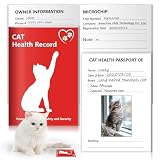
- 1.You’ll Get:When you choose our cat vaccines records tracker, you'll receive one notebook.This 12-page Kitty health journal has 8 dedicated pages for tracking your pup’s health, vet visits, and key details, with 4 blank pages at the end for jotting down extra notes, pet cat-related info, or anything else you want to record.
- 2.Ideal Size for Record Keeping:Each cat vaccine record book measures 5x3.5 inches folded; 5x7 inches unfolded, allowing for easy portability and storage.These handy health records notebook for cats with double sided printing, featuring enough space for all your pets important information,plus, it has dedicated spots for sticking on vaccine stickers and adding cute kitten photos.They offer a stylish and organized approach to pet health documentation, a must have addition to your pet supplies.
- 3.Premium Quality: The cat health record tracker’s cover features 300gsm coated paper with vibrant full-color printing and a protective laminate finish. Inside, 80gsm high-quality offset paper pages are durable and ink-resistant, ensuring no bleeding from pens or markers—so your records stay neat and easy to read.
- 4.Essential for cat owners: This kitten health record book is designed for vet clinics & owners. Track key health info (vaccines, exams, treatments) easily. When you’re away, pet sitters/family can quickly check medical history for seamless care. Kitten record book with photo, vital signs & ID sections, it helps in emergencies—even if your kitten gets lost.
- 5.Effortlessly Track Vaccinations and More:The cat canine health record booklets pages include:owner and cat information,medical history and hospitalizations,vaccination record and sticker,cat service providers,fecal examinations and de-worming,heartworm screening, prevention and treatment etc.This record keeping tool will ensure every important detail is accounted for and make this task easy, organized, and straightforward.Add this essential tool to your pet supplies for a happier, healthier pet.
What a color test can and cannot establish
Genetic testing is most useful when the question concerns an inherited trait. UC Davis provides information on testing for colorpoint restriction, and its feline resources explain the genetics behind coat-color patterns. A test can support the presence or absence of a relevant variant, subject to the laboratory’s stated methods and interpretation.
That information has clear limits:
- It does not create a pedigree where none exists.
- It does not establish that a cat is registered with CFA, TICA or another organization.
- It does not identify every ancestor or prove that a pointed cat is purebred.
- It should be interpreted with the cat’s visible pattern and available records, ideally with veterinary or laboratory guidance.
If you need certainty about breed status for showing, breeding or a contract, obtain registry documentation. If you need to understand why the coat is pointed, a color-genetics test addresses that narrower question.
Common questions that have straightforward answers
Can a Siamese cat be all black?
Under CFA’s listed Siamese colors, a solid-black coat is not included. A cat with very dark points may be a seal point, whose body should remain lighter. Other registries may use broader color and pattern policies, so the answer depends on the registry standard as well as the cat’s actual coat pattern.
Also popular on Amazon
Is a seal-point Siamese black?
No. Seal point is deep seal brown on the points with a pale fawn-to-cream body. The points can look black, but the pattern is not an all-black coat.
Does a pointed coat prove Siamese ancestry?
No. Colorpoint is a genetic pattern found beyond cats with Siamese pedigree. Breed identity requires lineage or registration evidence.
Recommended Free Tools
Why is my adult seal point darker than the kitten I adopted?
Colorpoint pigment commonly becomes more pronounced with age, and the cooler body regions darken more than the warmer trunk. Lighting, coat length and individual genetics also change the apparent contrast.
Bottom line for owners and adopters
If the entire cat is uniformly black, do not call the coat a CFA Siamese color. If the face, ears, legs and tail are dark but the torso is pale, “seal point” is the more precise description. Then handle breed as a separate question: verify pedigree or registry records, because coat appearance—even a classic pointed pattern—cannot establish Siamese lineage on its own.





Leave a Reply