
Some links on this page are affiliate links: if you buy through them we may earn a commission, at no extra cost to you.
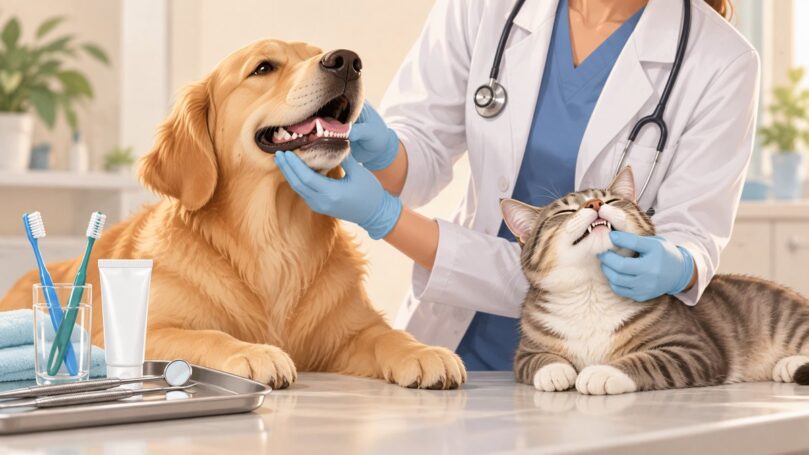
Dental disease in dogs and cats often develops where owners cannot see it. Plaque can trigger gum inflammation, infection and destruction of the bone and tissues anchoring teeth. A pet may keep eating normally while painful disease progresses below the gumline. Bad breath, brown buildup, red or bleeding gums, loose teeth or mouth pain warrant a veterinary examination, but a normal-looking mouth does not rule disease out.
Daily tooth brushing is the foundation of prevention. Veterinary examinations and, when indicated, an anesthetized procedure with dental radiographs are needed to find and treat disease under the gums. Diets, treats, chews and water additives carrying the Veterinary Oral Health Council (VOHC) Seal of Acceptance may supplement brushing; they do not diagnose or cure established periodontal disease.
As an Amazon Associate I earn from qualifying purchases.
What periodontal disease does to a pet’s mouth
The American Veterinary Dental College (AVDC) defines periodontal disease as destruction of the gums, bone and other structures that hold teeth in place, caused by bacterial infection. Plaque accumulates on tooth surfaces and can inflame the gums (gingivitis). If it is not controlled, infection can progress to periodontitis, damage the tissues around tooth roots and create abscesses.
The most important change is often hidden. The infection can extend beneath the gumline, where an owner cannot see it with a flashlight or a quick lift of the lip. As supporting bone is lost, teeth may become loose and painful. Advanced disease can require oral surgery and extraction. The AVDC describes periodontal disease as the most common clinical condition affecting adult pets and emphasizes that much of it is preventable.
Popular on Amazon
- DOG TOOTH BRUSHING KIT: Keep your dog's teeth and gums healthy with our dog toothbrush and toothpaste kit; our toothpaste is made with aloe, neem oil, grapefruit seed extract, baking soda, and enzymes to keep you dog's mouth fresh
- DOG DENTAL CARE MADE EASY: Our dog tooth paste gently cleans away plaque and tartar, serving as an effective dog breath freshener; rid your dog of bad breath and gift them a healthier mouth with our dog tooth brushing kit.
- TRIPLE HEAD TOOTHBRUSH: Our dog dental cleaning kit features a triple-sided dog tooth brush that cleans all sides of your dog's teeth at once, making tooth brushing faster and more efficient; no more struggling to clean those hard to reach back teeth
- NATURAL FLAVORS: Our toothpaste for dogs has natural flavors that your furry friend will love, making dog tooth brushing a more enjoyable experience even for the pickiest of pups, so you can keep their dog breath fresh without any fuss
- DENTAL KIT FOR DOGS OF ALL SIZES: Regular teeth cleaning supports your pet’s health. Use our dog toothbrush and toothpaste between vet visits to maintain oral hygiene, reduce plaque and tartar buildup, and keep your dog’s mouth fresh and healthy.
Oral bacteria can enter the bloodstream. The AKC Pet Insurance article reports that bacteria may travel to distant organs, particularly the heart, liver and kidneys. That is a possible complication, not an inevitable outcome for every dog or cat. The same article reports a World Small Animal Veterinary Association statistic: dogs with moderate to severe dental disease had a six-times-higher risk of endocarditis than dogs without that level of disease. This comparison does not prove that dental disease causes endocarditis in an individual dog.
Signs owners can notice—and signs they can miss
Arrange a veterinary appointment if you notice any of the following:
- Persistent or unusually strong bad breath
- Brown staining, tartar or visible buildup on teeth
- Red, swollen or bleeding gums
- Dropping food, chewing on one side, pawing at the mouth or reluctance to eat hard food
- Facial swelling, discharge, a loose tooth or obvious mouth pain
These signs deserve attention, but their absence is not reassurance. Pets commonly continue to eat despite significant dental pain, and the visible crowns of teeth can look acceptable while roots and supporting bone are diseased. A pet that appears comfortable still benefits from routine oral examinations.
Why bad breath matters
Foul breath is not simply a cosmetic issue. It can reflect bacterial plaque, gingivitis, periodontitis or an abscess. Breath odor alone cannot identify the location or severity of disease, so masking it with a flavored product does not replace an examination.
What visible tartar can—and cannot—tell you
Heavy calculus is a useful warning sign, but a small amount of visible buildup does not prove that the tissues beneath the gumline are healthy. Conversely, a pet with severe hidden disease may have little dramatic surface staining. Only a complete dental assessment can determine which teeth and roots are affected.
Also popular on Amazon

- Complete Pet Dental Kit – Includes 100g pet toothpaste, a 3-sided toothbrush, and a finger brush for easy cleaning as a dog tooth brushing kit. Designed for dogs and cats of all sizes, from puppies to seniors.
- Fresh Breath, Gentle Care – Vanilla-flavored formula helps freshen breath and is gentle on gums, making brushing a positive experience for pets during daily dental care.
- Effective Plaque & Tartar Control – Regular brushing with this kit helps reduce plaque buildup, fight tartar, and support long-term oral health for dogs and cats.
- Safe if Swallowed – Specially made for pets, this toothpaste is free from fluoride and foaming agents, so it’s safe if accidentally swallowed during brushing by puppies and cats.
- Vet-Recommended Routine – Consistent use of a pet tooth brushing kit supports healthier teeth and gums as a dog toothbrush and toothpaste routine, helping prevent costly vet visits and keeping your pet happy and active.
How periodontal disease progresses
| Problem | What is happening | What an owner may observe | Needed response |
|---|---|---|---|
| Gingivitis | Plaque irritates the gum margin. | Redness, swelling or bleeding when the mouth is handled; breath may worsen. | Schedule a veterinary assessment and establish daily plaque control. |
| Periodontitis | Infection destroys attachment tissues and bone below the gumline. | Bad breath, chewing changes, pain or few visible signs. | Veterinary dental examination, usually with radiographs to assess roots and bone. |
| Abscess or advanced attachment loss | Infection around a root or severe loss of support can make a tooth mobile and painful. | Facial swelling, discharge, a loose tooth, reluctance to eat or pronounced pain. | Prompt veterinary treatment; surgery or extraction may be necessary. |
The table describes a general pattern, not a reliable home staging system. Different teeth can be affected to different degrees, and only a veterinarian can determine the extent of disease.
Quick wins for a faster PC:
Repair Windows errors before they cause bigger problemsFix Now →Fix the driver behind crashes, sound loss and screen glitchesFind Drivers →Daily home care: the prevention foundation
The AVDC calls daily brushing the gold standard for preventing plaque and slowing periodontal disease. Brushing removes soft plaque before it mineralizes into calculus. It cannot remove established calculus under the gums or repair destroyed bone, so a pet with diagnosed disease still needs the treatment your veterinarian recommends.
A practical brushing routine
- Choose equipment for pets. Use a toothbrush designed for a dog or cat and a pet-safe toothpaste. Ask your veterinary team which brush size and technique fit your animal’s mouth.
- Introduce the routine gradually. Let your pet smell and taste the toothpaste, then briefly touch the lips and teeth. Reward calm cooperation rather than forcing the mouth open.
- Brush the outer surfaces first. Plaque commonly accumulates along the cheek side of the upper teeth. Lift the lip gently and use small strokes at the gumline.
- Build toward every day. A short daily session is more useful than an occasional long one. Stop if your pet shows pain, and arrange an examination rather than brushing through resistance.
- Keep monitoring. New bleeding, worsening odor, chewing changes or a loose tooth means home care should pause until a veterinarian checks the mouth.
Brushing is preventive care, not a substitute for professional treatment. The AKC article recommends regular brushing while also noting that even a strong home routine does not eliminate the need for veterinary assessment and dental work when indicated.
Where diets, treats, chews and water additives fit
The AVDC identifies dental diets, treats, chews and water additives that carry the VOHC Seal of Acceptance as products that can assist a preventive program. Check the current VOHC listing and confirm that a product is appropriate for your pet’s species, size and health. These products are supplementary; they do not replace brushing, examination, radiographs, professional cleaning or treatment of diagnosed disease.
What a comprehensive veterinary dental procedure involves
A complete procedure is more than scraping visible tartar. AVDC guidance describes several components:
What’s actually slowing this PC down?
Pick the symptom - the matching free tool is one click away.
Also popular on Amazon
- #1 BRAND CHOSEN BY VETERINARIANS: Proven effective and trusted for over 30 years, C.E.T. is the top recommended dental brand by veterinary professionals to reduce plaque & tartar buildup
- Dual-sided toothbrush designed specifically for canine mouths with soft bristles for comfortable brushing
- Long handle with reverse angle allows for easy use and soft bristles for comfortable brushing while the finger-brush slips over finger for ease of use and better control
- Great tasting poultry-flavored toothpaste is ideal for dogs and cats that quickly build up plaque and tartar
- Complete kit with everything pet owners need to start a program of regular oral hygiene for their dog or cat. Ideal to help acquaint dogs/cats and their owners with the tooth brushing experience
- An extraoral examination and an examination inside the mouth
- Full-mouth intraoral dental radiographs to evaluate roots, bone and areas hidden below the gumline
- Scaling and polishing above and below the gumline
- Treatment of disease discovered during the procedure, which may include surgery or extraction
Radiographs are important because the crown that you can see may represent only a small part of the problem. A tooth can look intact while its root or surrounding bone is compromised.
Veterinary cleaning versus anesthesia-free scraping
Anesthesia-free scraping is not an equivalent alternative to comprehensive veterinary dental care. The AVDC’s October 2023 position statement says it is not an effective prevention method or replacement because it cannot adequately inspect or clean below the gumline. Scraping can also leave a rough surface that allows plaque to accumulate again, while movement and stress make a thorough examination difficult.
| Feature | Comprehensive veterinary procedure | Anesthesia-free scraping |
|---|---|---|
| Access to hidden surfaces | Allows examination and cleaning below the gumline. | Primarily addresses visible tooth surfaces. |
| Radiographs | Full-mouth intraoral radiographs are part of AVDC-described comprehensive care. | Not a substitute for diagnostic dental radiography. |
| Ability to treat disease | Findings can be treated during the planned procedure, including extraction when necessary. | Does not provide comprehensive treatment for diseased roots, bone or painful teeth. |
| Role in prevention | Used with daily home care and periodic examinations when indicated. | AVDC says it is not effective prevention. |
Understanding anesthesia and reducing risk
It is reasonable to ask about anesthesia. Anesthetized care carries risk, and that risk is managed rather than denied. The AVDC says safety depends on assessing the animal’s health and size, using modern evaluation methods and continuously monitoring the patient. Anesthesia allows the team to protect the airway, take diagnostic radiographs, clean below the gumline and treat painful disease thoroughly.
The AVDC advises combining daily home care with periodic veterinary examinations and anesthesia-based scaling when indicated. Your veterinarian should decide whether a procedure is appropriate after considering age, medical conditions, medications, examination findings and test results.
Free tools Windows power users keep installed
One-click scans. No signup required.
Questions to ask before scheduling
AVDC client guidance suggests asking:
- Is pre-anesthesia laboratory testing recommended for this pet, and what will it evaluate?
- Who will monitor anesthesia, and which parameters will be monitored continuously?
- Are full-mouth dental radiographs standard for the procedure?
- Will local nerve blocks and pain medication be used when appropriate?
- How will the practice explain findings, obtain consent for additional treatment and discuss extractions or other procedures?
These questions help you understand the planned care; they do not replace individualized veterinary judgment.
Also popular on Amazon

- 🐶PROFESSIONAL PET TOOTH TOOL - 4 styles of dental cleaning care tools include dental probe, tartar scraper, sickle scaler and round plaque remover. easily clean the mouth of stubborn stains, food debris, remove plaque and tartar, keep your pet's breath fresher.
- 🐶CARE FOR PET DENTAL HEALTH - Our pet tooth cleaning kit is widely applicable, suitable for pets of different sizes and different breeds, such as cats, dogs, etc. you can confidently provide professional-level dental care for your pets, saving a lot of time and energy.
- 🐶EASY TO USE - This pet tooth dental pick oral hygiene tool is designed in different shapes, which allows easy and convenient access to different spots, with anti-slip handles to increase friction and stability in operation, you can easily solve the in the hard-to-reach areas of the mouth.
- 🐶HIGH QUALITY STAINLESS STEEL - The pets dental kit is made of food-grade high-quality stainless steel, which allows rust resistance, durability and safety, easy to clean and sterilize. Comes with a durable storage box to keep your pet's tooth cleaning tools clean and tidy.
- 🐶SATISFIED SERVICE - This pet oral care product is suitable for pet dogs and cats. We will provide worry-free warranty for all the comsumers if you have any issues with this product you could contact us for solutions, we will give you the best shopping experience without any worries!
How often should a dog or cat have a dental cleaning?
There is no safe universal interval. The right schedule depends on species, age, mouth shape, prior periodontal disease, home-care success, medical conditions and what your veterinarian finds on examination. The AKC article recommends that pets see a veterinarian at least once a year for general and dental health assessment. Some animals need professional procedures more often; others may go longer between procedures when daily plaque control is effective and examinations remain normal.
Do not wait for a bad smell or difficulty eating to book the next examination. A veterinarian can examine the mouth during routine preventive visits and recommend a procedure when visible findings or the pet’s history make it appropriate.
A simple decision plan for owners
- Inspect gently at home. Look for odor, red gums, staining, swelling or chewing changes without forcing the mouth open.
- Book an appointment for any concern. Seek prompt care for facial swelling, severe pain, bleeding, discharge, a loose tooth or refusal to eat.
- Ask what cannot be seen. Discuss whether dental radiographs and an anesthetized comprehensive procedure are indicated.
- Start or refine daily brushing. Introduce it gradually and stop if your pet appears painful.
- Use supplemental products selectively. Choose current VOHC-accepted options appropriate for your pet, but do not treat them as a cure.
- Keep the annual health visit. Ongoing examinations catch changes that home inspection can miss.
What pet insurance may cover
An AKC Pet Insurance article by Nell Ostermeier, DVM, CVA, FAAVA, published December 17, 2022, states that its Defender and DefenderPlus add-ons include wellness laboratory work and that teeth cleaning is available with DefenderPlus. Coverage is not guaranteed by that statement. Waiting periods, deductibles, coinsurance, benefit limits and exclusions may apply, and products and terms can vary by policy and location and may change over time.
Do these 3 things before closing this tab:
1Fix the driver behind crashes, sound loss and screen glitches2Repair Windows errors before they cause bigger problems3Scan for outdated or missing drivers - takes under a minuteBefore relying on insurance for a dental procedure, read the current policy documents for your pet and state or ask the insurer to confirm the applicable terms in writing. Insurance does not change the need for timely veterinary care.
When to call the veterinarian now
Make an appointment rather than monitoring at home if your pet has persistent bad breath, visible tartar, red or bleeding gums, mouth sensitivity or a change in chewing. Seek urgent veterinary advice for facial swelling, pus or other discharge, inability to eat or drink, uncontrolled bleeding or signs of severe pain. Because periodontal disease can be hidden, schedule regular examinations even when your dog or cat appears to have a normal appetite and clean-looking teeth.





Leave a Reply