What’s actually slowing this PC down?
Pick the symptom - the matching free tool is one click away.
Can all dogs swim? No. Some dogs paddle instinctively, but not every dog can keep its nose and mouth above water or swim safely for long. Flat-faced, stocky, short-legged, long-bodied, very lean, fearful, senior, injured, and mobility-limited dogs may struggle, while breed history is only one factor—not a guarantee of swimming ability.
Swimming can be enjoyable exercise, but a dog’s first lesson should be treated as a safety exercise rather than a test. The goal is calm, voluntary entry, a comfortable body position, short periods in the water, and a reliable return to land.
As an Amazon Associate I earn from qualifying purchases.
Key takeaways
- Dogs do not all swim naturally or safely; body shape, buoyancy, age, health, experience, and temperament affect swimming ability.
- Never throw, push, or drop a dog into water, because panic can cause drowning and create a lasting fear of water.
- Teach swimming in shallow, calm water with gradual exposure, positive reinforcement, close supervision, and a properly fitted dog life jacket.
- Every dog that enters a pool should learn the exact exit, while barriers or fencing should prevent unsupervised access.
- Natural water can contain currents, waves, salt, contaminated water, or toxic blue-green algae, so conditions must be checked before entry.
Can all dogs swim? No. Some dogs paddle instinctively, but not every dog can keep its nose and mouth above water or swim safely for long. Flat-faced, stocky, short-legged, long-bodied, very lean, fearful, senior, injured, and mobility-limited dogs may struggle, while breed history is only one factor—not a guarantee of swimming ability.
Can all dogs swim safely?
Can all dogs swim safely? No: dogs vary considerably in buoyancy, body position, coordination, confidence, and stamina. A dog may know how to paddle yet still become exhausted, panic in deep water, or fail to find a way out.
#1 Best Overall

- Dog Life Jacket: Maximum-buoyancy vest for large dogs (28–32" girth) of all swimming skill levels; supports without restricting movement; ideal for pool, lake, beach, or boat
- Secure, Easy Fit: Instant security with adjustable straps and quick-release buckles for easy on/off; see size chart and fitting video for guidance
- Durable & Lightweight: Ripstop material with thick foam padding and reinforced stitching for long-lasting comfort and strength
- Head Support & Rescue Handle: Front float helps support the head and neck; strong top safety handle for lifting and assisting your dog in an emergency
- High Visibility: Bright color with reflective accents for easily spotting your dog in low light and in all types of water, from pools to lakes
Retrievers and some water-working breeds may have physical traits and historical selection that make swimming easier. However, an individual retriever can still be frightened, inexperienced, injured, or overwhelmed by waves and currents. Conversely, a dog from a breed not associated with water may learn calmly in suitable conditions.
Body structure deserves particular attention. Flat-faced dogs may have difficulty keeping the head above water. Short-legged or long-bodied dogs may have to work harder to stay level, and very lean dogs may have less natural buoyancy. Michele Godlevski, a NADD Dock Diving Judge, Certified Professional Dog Trainer, and Certified Canine Behavior Consultant, explains that “There are also some breeds who have a weight distribution that would not make it possible for them to swim very well without a life vest.” Read the American Kennel Club’s guidance on whether all dogs can swim for additional breed and body-shape considerations.
Which dogs need extra caution around water?
Dogs need extra caution when their anatomy, health, age, or behavior makes floating, breathing, entering, or exiting difficult. Treat the following as reasons to use a life jacket, shorten the lesson, obtain veterinary advice, or avoid swimming until a professional has assessed the dog:
The Tool Desk
Outbyte PC Repair FREERepair Windows errors before they cause bigger problemsFix Now →Outbyte Driver Updater FREEFix the driver behind crashes, sound loss and screen glitchesFind Drivers →- Flat-faced dogs, including dogs with shortened muzzles, that may struggle to keep the airway clear.
- Stocky, short-legged, long-bodied, or very lean dogs whose body position or buoyancy may be unfavorable.
- Puppies that lack coordination, stamina, or experience.
- Senior dogs, dogs with arthritis or mobility limitations, and dogs recovering from injury or surgery.
- Dogs with heart, breathing, neurologic, or other health concerns.
- Fearful dogs or dogs that freeze, panic, repeatedly climb onto the handler, or cannot settle around water.
Ask a veterinarian before beginning a swimming program for a senior dog, a mobility-limited dog, a dog recovering from surgery or injury, or a dog with an underlying health condition. Swimming can be low-impact exercise, but it is not automatically suitable for every medical problem. Veterinary rehabilitation or structured canine swimming lessons may provide safer support for dogs that need a controlled progression. The American Kennel Club’s overview of canine hydrotherapy explains why rehabilitation swimming is a distinct, supervised activity rather than casual play.
What should a dog wear for a first swimming lesson?
A properly fitted dog life jacket is strongly advisable for a first lesson and particularly important for puppies, older dogs, weak swimmers, dogs with less favorable body structure, boating, paddleboarding, kayaking, currents, waves, open water, and unfamiliar locations. A life jacket helps provide flotation, but it does not make unsupervised swimming safe.
| Life-jacket feature | What to check | Why it matters |
|---|---|---|
| Fit | Use the manufacturer’s measurement chart; the jacket should be secure without restricting the shoulders or front legs. | A loose jacket can slip, while a tight one can interfere with movement and breathing. |
| Buoyancy | Check that the jacket supports the dog’s body and helps keep the head and airway clear. | Different body shapes need different levels of support. |
| Rescue handle | Choose a sturdy handle that allows an adult to lift or guide the dog if necessary. | A handle can help with an emergency recovery, but it is not a substitute for close supervision. |
| Shoulder mobility | Move the dog’s front legs and watch for rubbing or restriction before entering water. | Dogs need normal front-leg movement to paddle and maneuver. |
| Visibility | Prefer a clearly visible color and design, especially in open water. | Visibility helps the handler locate the dog more quickly. |
| Security | Check that the jacket cannot slip over the head or body when the dog is gently lifted by the handle. | An insecure jacket may shift during a struggle or rescue. |
Let the dog wear the jacket briefly on land first. Reward calm behavior and adjust it before the lesson. The American Kennel Club’s dog life-jacket fitting guidance emphasizes fit, mobility, and flotation rather than relying only on a breed label or a generic weight range.
How do you teach your dog to swim?
Teach a dog to swim through gradual exposure, voluntary entry, body support, short practice sessions, and repeated practice of the exit. Choose a shallow, calm, predictable location where you can stay within reach and help immediately.
Rank #2

- Dog Life Jacket: Maximum-buoyancy vest for medium dogs (21–27" girth) of all swimming skill levels; supports without restricting movement; ideal for pool, lake, beach, or boat
- Secure, Easy Fit: Instant security with adjustable straps and quick-release buckles for easy on/off; see size chart and fitting video for guidance
- Durable & Lightweight: Ripstop material with thick foam padding and reinforced stitching for long-lasting comfort and strength
- Head Support & Rescue Handle: Front float helps support the head and neck; strong top safety handle for lifting and assisting your dog in an emergency
- High Visibility: Bright color with reflective accents for easily spotting your dog in low light and in all types of water, from pools to lakes
1. Choose a controllable setting
A pool with gradual steps or a secure dog ramp is generally easier for a first lesson than rough ocean water, a river, or a lake with a steep or slippery bank. Identify the entry and the exit before the dog enters. Keep the life jacket, fresh drinking water, towels, and rewards ready.
2. Create a positive association on land
Let the dog sniff the water area and inspect the life jacket. Put the jacket on for a short period indoors or on dry ground, reward relaxed behavior, and remove it before the dog becomes uncomfortable. Do not use water, a life jacket, or a floating toy as punishment.
3. Let the dog enter voluntarily
Begin at the edge or in water shallow enough for the dog to stand. Walk in with the dog if practical, remain close, and let the dog investigate. A floating dog training toy or treat may encourage interest, but never use a reward to lure the dog beyond its comfort level.
Never throw, push, or drop a dog into water. Michele Godlevski warns, “Throwing a puppy or young dog in the water is not only a terrible idea, but it may, in fact, damage the dog’s courage about swimming for life.” The veterinary-reviewed PetMD swimming-training sequence likewise supports calm, gradual introduction rather than forced entry.
Do these 3 things before closing this tab:
1Repair Windows errors before they cause bigger problems2Fix the driver behind crashes, sound loss and screen glitches3Clear out junk files and repair common Windows errors4. Support the body without forcing it
Some inexperienced dogs paddle with the front legs while allowing the rear end to sink. If the dog remains calm, gently support the abdomen so the body becomes more horizontal and the hind legs can begin to work. Support the dog rather than restraining it, and reduce assistance only while the dog remains balanced and comfortable.
5. Keep the first swims brief
Guide the dog toward the same safe exit repeatedly, reward the return to land, and provide frequent rest breaks. Stop before exhaustion. Signs that a dog needs an immediate break include frantic splashing, a lowered head, difficulty keeping the nose or mouth clear, sudden weakness, or repeated attempts to climb onto the handler.
6. Increase difficulty one change at a time
Move to deeper water or a new environment only after the dog is calm and competent in shallow, controlled water. A dog that swims comfortably in a pool may not be ready for a lake, river, or ocean, where waves, currents, wildlife, boats, slippery banks, debris, and distractions change the risk.
Rank #3

- Unrestricted Movement: Designed with a ‘sports’ concept, the VIVAGLORY patented dog life vest opens up more around the neck and front chest. It doesn’t restrict your dog’s movement and avoids contact near the armpits and belly, preventing rubbing against your pup’s skin. Ideal for most breeds, especially those with broader or deeper chests, this dog swimming vest offers unmatched comfort during swimming and boating adventures
- Superior Buoyancy: This dog lifejacket features evenly distributed buoyancy with ultra-buoyant foam covering under the neck, top, and sides. Supporting your dog's entire body, this dog floating vest helps them doggy paddle confidently and easily in any water setting—perfect for both experienced swimmers and beginners, whether in pools, lakes, or at the beach
- Boosted Safety: Equipped with a sturdy handle and D-ring, this puppy life jacket allows for easy restraint and quick rescue if your puppy falls overboard or swims too far. Reflective strips and bright colors increase visibility, ensuring your doggy life jacket is easy to spot even in low-light conditions. The soft mesh belly band dries quickly for comfort, while adjustable straps with weight-bearing buckles guarantee a secure fit
- Built to Last: Made from ripstop Oxford material that passed the CA65 test, this dog lifevest is durable enough for swimming, boating, floating, and paddle boarding. Reinforced stitching and a comfortable lining ensure long-lasting performance. Whether it's your first trip or a frequent outing, this dog flotation vest is designed to handle repeated water adventures. NOTE: Always supervise your dog during water activities, even when wearing the dog lifejacket
- Universal Fit: The secure hook-and-loop fastening and adjustable buckled straps at the neck and belly of the dog swim vest provide a custom fit for your puppy. Putting the dog water vest on takes seconds. For best fit, measure the widest part of your dog’s ribcage and check the VIVAGLORY sizing chart
How do you teach a dog to get out of a pool?
Teach a dog to get out of a pool by repeatedly guiding the dog to the exact stairs, ramp, or shallow exit, rewarding the dog on land, and practicing while the dog is calm. A dog that can paddle is not necessarily able to locate or climb out.
- Choose one dog-usable exit and make it easy to see.
- With the dog wearing a properly fitted life jacket, enter or support the dog in shallow water.
- Turn the dog toward the exit before fatigue or panic develops.
- Help the dog place its front paws on the step or ramp, then reward the complete return to dry ground.
- Repeat short sessions until the dog seeks the exit reliably from different starting points.
A dog pool ramp can help when a pool lacks low, dog-usable steps, but the ramp must be securely installed and introduced through training. A ramp does not replace supervision, a pool barrier, or a life jacket during lessons. The PetMD pool-safety guidance also recommends preventing unsupervised access and teaching the dog how to leave.
Which swimming environment is safest for a dog?
A shallow, calm, supervised pool or other controlled setting is usually the easiest environment for a first lesson because the handler can predict the entry and exit. Every natural-water environment adds hazards that may not be visible from shore.
| Environment | Entry and exit | Main hazards | When to use extra caution |
|---|---|---|---|
| Controlled pool | Often predictable if gradual steps or a secure ramp are available. | Unsupervised falls, slippery sides, pool covers, chemicals, and drinking too much pool water. | Always use a barrier when no adult is actively supervising; practice the exit. |
| Lake or pond | May have steep, muddy, slippery, or unstable banks. | Blue-green algae, poor visibility, wildlife, debris, stagnant water, and difficult exits. | Check local warnings and avoid suspicious discoloration, scum, or posted cyanobacteria warnings. |
| River | Shore access may be difficult and currents can carry a dog away from the handler. | Current, undertow-like flow, submerged obstacles, changing water levels, and cold water. | Do not use moving water for an inexperienced dog or when you cannot remain close. |
| Ocean | Waves and changing surf can make entry and return unpredictable. | Rip currents, undertows, waves, sharp objects, marine animals, contaminated debris, and saltwater ingestion. | Provide fresh water and interrupt drinking or wave-chasing behavior. |
Check local warnings before allowing a dog into a lake, pond, river, or other natural water. Avoid green or blue-green scum, suspicious discoloration, stagnant water, and posted cyanobacteria warnings. Blue-green algae can cause severe neurologic or liver injury, and algae on the coat may later be swallowed during grooming. The ASPCA Animal Poison Control Center’s blue-green algae guidance explains the exposure risk.
Independent reader supportYour contribution helps us test, update, and keep practical guides available for everyone.Is ocean, lake, or pool water safe for dogs to drink?
Dogs should have fresh potable water available and should not be allowed to drink large amounts of ocean or pool water. Repeated ocean-water consumption can cause dangerous sodium elevation, while excessive pool-water consumption may cause stomach upset.
Keep pool chemicals securely stored. Undiluted chlorine, algicide, pool shock, and tablets can be corrosive and dangerous if swallowed. Contact a veterinarian promptly after suspected chemical ingestion. After every swim, rinse the dog with clean water to remove chlorine, salt, algae, and other contaminants, and dry the ears and coat appropriately, especially if the dog is prone to skin or ear problems. The ASPCA’s poolside safety guidance for pets covers pool water, chemicals, saltwater, and post-swim precautions.
What should you do if your dog is afraid of water?
If a dog is afraid of water, stop increasing the challenge and return to a distance where the dog can remain relaxed. Reward calm investigation on dry land or near a shallow edge, and end each session before fear becomes panic.
Rank #4
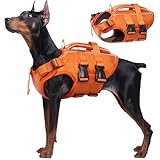
- 【Dog lifejacket Size】XS, S, M, L, XL, XXL fits most breeds furry friend,our size of dog life vest for swimming has been strictly measured. Chest girth is the key measurement, choose the smaller size if between two. Ideal for small dog life jacket, large dog life jacket, medium dog life jacket, and pet life jacket needs
- 【High Flotation Dog Swim Vest】This dog vest for swimming consist of ripstop Oxford & Polyester cloth, and high-density pearl cotton foam, which offers the dog swim vest great flotation support. Dog swimsuit gives dog additional safety and endurance in the water. Perfect as dog life vest for swimming, dog pool float, or dog swim vest for safe water fun
- 【Safe & Protective Dog life Vest】Dog swimming vest has a sturdy handle for quick rescue, which helps keep your pet safer in the water. The biggest role of the life safe vest is assist the dog to swim, reduce the amount of movement of the hind legs, helps reduce strain on the hind legs. Suitable for dog life vests for boating, dog life jackets for large breeds, and small dog life vest for swimming
- 【Adjustable Dog Swimming Vest】The dog life jackets belly and neck are designed with sturdy adjustable nylon straps and double-row quick-release buckles with hook & loop panels to provide double security for your dog. These designs make the dog water vest is easy to put on and take off. Works for dog swim vest, dog water vest, dog life vest with handle, and dog life jacket small or large
- 【Reflective Dog Safety Vest】 Kuoser dog flotation vest with bright colors and reflective strips can help you better notice your dog's position. Ideal for dog beach essentials, dog pool floats for small dogs, dog pool float for large dogs, and other outdoor water activities. Make swimming, boating, and pool time safer and more enjoyable for your furry friend
Do not force a fearful dog into water. If the dog freezes, panics, repeatedly tries to escape, cannot maintain a comfortable body position, or remains distressed despite gradual exposure, end the lesson. A reputable canine swim instructor, veterinary rehabilitation professional, or veterinarian can help determine whether structured instruction is appropriate.
When is a swimming emergency?
Stop the session and seek veterinary help for breathing difficulty, collapse, severe weakness, repeated vomiting, disorientation, tremors, seizures, or suspected exposure to toxic algae or pool chemicals. Rinse suspected algae from the coat with fresh water while contacting a veterinarian or animal poison-control service, and do not continue the lesson because the dog seems close to succeeding.
Quick wins for a faster PC:
Fix the driver behind crashes, sound loss and screen glitchesFind Drivers →Clear out junk files and repair common Windows errorsFree Scan →Swimming should remain a controlled activity, not a test of courage. The safest dog is one that enters voluntarily, wears appropriate flotation equipment, stays within immediate reach, takes frequent breaks, and can find a practiced exit.
Frequently Asked Questions
Can all dogs swim?
No. Dogs may paddle instinctively, but not every dog can keep its airway clear, stay buoyant, remain calm, or find an exit. Flat-faced, stocky, short-legged, long-bodied, very lean, elderly, mobility-limited, and fearful dogs may need extra precautions or may not be suitable for swimming.
Do dogs know how to swim naturally?
Never throw, push, or drop a dog into water. Forced entry can cause panic, increase drowning risk, and create a lasting fear of water. Introduce water gradually and allow voluntary entry instead.
How do I teach my dog to swim?
Use shallow, calm water, a properly fitted dog life jacket, positive reinforcement, close supervision, gentle body support, brief swims, and repeated practice of the same exit. Increase depth or change environments only after the dog is calm and competent.
Does my dog need a life jacket?
A life jacket is strongly advisable for first lessons, puppies, older dogs, weak swimmers, dogs with difficult body structure, boating, currents, waves, open water, and unfamiliar settings. A life jacket provides flotation but never replaces supervision.
How do I teach my dog to get out of the pool?
Teach the dog the exact stairs, ramp, or shallow exit by guiding the dog there repeatedly from calm, short swims and rewarding the complete return to dry land. Prevent unsupervised pool access with a secure barrier or fence.
The Bottom Line
Not every dog can swim safely, and no dog should be tested by being thrown into water. Start with shallow, calm water; use a properly fitted dog life jacket; support the dog without forcing it; practice the exit; supervise continuously; and avoid hazardous or contaminated water. Ask a veterinarian or qualified canine swimming professional for help when anatomy, age, health, mobility, or fear makes swimming uncertain.
Quick Recap
Product prices and availability are accurate as of the date/time indicated and are subject to change. Any price and availability information displayed on Amazon at the time of purchase will apply.
Free tools Windows power users keep installed
One-click scans. No signup required.




