Recommended Free Tools
Dog training apps may help, but the evidence so far shows associations, not proof. The most direct study, a 2025 analysis of the Zigzag puppy app, found that puppies whose owners completed more of the early lessons had lower reported severity of several behavior problems. A separate study of a wearable and app system found that owner-visible itch alerts went along with more veterinary visits and more treatment. Neither study shows that an app causes better behavior or better medical outcomes, and no alert is a diagnosis. This article separates what each study measured and how to use these tools sensibly.
Two different kinds of evidence
Claims about “training apps” and “better medical outcomes” usually blend two unrelated bodies of research. Keeping them apart avoids overstating either one.
| Question | Study | Design | What it supports | What it does not show |
|---|---|---|---|---|
| Does completing an app’s lessons relate to puppy behavior problems? | Rowland et al., Animals, February 2025 (Zigzag app) | Cross-sectional, observational | Higher early-lesson completion was associated with lower reported severity of several problems | Causation; results for adult dogs or other apps |
| Do owner-visible health alerts relate to care seeking? | Retrospective study of Whistle FIT, 2023 | Retrospective comparison of two 10-month periods | More alert-associated vet visits and earlier medication starts when owners could see alerts | Diagnostic accuracy; that alerts alone caused visits or treatment |
| Can structured digital data capture work in veterinary settings? | Braghetti et al., Frontiers in Veterinary Science, 2025 (PetsDataLab) | Proof-of-concept platform report | Feasibility of standardized behavioral and pain data collection | Anything about consumer training apps |
What the Zigzag puppy-app study found
The analyzed subset included 367 puppies: 194 with no training and 173 whose only training came from the app, with no formal classes or in-person training. The researchers modeled behavior-problem severity against completion of the first four app chapters, adjusting for age, sex, health, and where the puppy came from.
- Direction of effect: 19 of 21 odds-ratio point estimates favored lower severity as completion rose. The other two were marginally above one.
- Strongest signals: The authors reported reasonable evidence against “no association” for familiar aggression, house soiling, chewing, barking, escaping, and noise fear.
- No sign of harm: They found no good evidence that app use increased severity.
- Authors’ own caveats: Sample sizes were relatively small, confidence intervals were wide, and causal effects cannot be claimed. Their conclusion was that the associations are favorable and “suggest that further study is warranted.”
Two further points matter when weighing the result. First, the study was supported by Zigzag Petcare Services Ltd., the company behind the app. Second, completion itself may reflect an engaged, consistent owner, and statistical adjustment cannot fully remove that possibility. So the finding is best read as a promising signal for one puppy-focused app, not a general rule about apps.
#1 Best Overall

- New communication tool about you and your puppy.
- Pet Dog Training Clickers for Puppy, Cat, Potty, Bird, Horse, Pet, Trainer Training Tools, Behavior Aids
- Just press to mark desired behavior, then reward for faster learning.
- The spring wrist length : 16cm/6.3inches and can strength to 25cm/9.84inches.
- Package include : Black + Blue,each color 1 pcs.
What a health-monitoring app can and cannot do
The Whistle FIT study used records from 1,042 Banfield veterinary clinics in the United States over 20 months. Whistle FIT is an accelerometer paired with analytics and an app that, in the later period, could show owners increased-itching (pruritus) alerts. Researchers compared an earlier 10-month period, before owners could see alerts, with a later one in which they could.
- The odds of an “alert visit,” meaning a first veterinary visit within four weeks of an alert, were higher in the owner-visible period: odds ratio 1.6264 (95% CI 1.57–1.69, p < 0.0001).
- Among medications prescribed within four weeks after a pruritus alert, 53.3% fell in the later period versus 38.8% in the earlier one.
The sensible reading is that making a subtle change visible may help owners act sooner. Because this compares two time periods rather than randomizing owners, other changes over time could contribute. Itching is also a clinical sign, not a diagnosis; allergies, parasites, infections, and pain-related licking or chewing can all look similar to a sensor. An alert is a reason to call the clinic, not a reason to self-treat.
Rank #2

- ▼Come in 4 pack button clickers with wrist strap in 4 different colors:Black, Green, Orange, Yellow, each color 1 PCS
- ▼Can be used to train the dog basic obedience, small trick, and correct the bad behavior; Scientific method of training your pet safely and easily.
- ▼Stop barking and dog obdeience. Train your dog quiqly just by simply pressing the clicker and command.
- ▼Well constructed and durable, metal clicker will not rust or break.
- ▼Big button for easy clicking and loud sound. Easy to use in any position.
The PetsDataLab report is further removed from consumers. It describes a cloud-based, configurable platform that supports the Dog Pain Database with demographic, medical, pain-related, and video information. Fourteen veterinary professionals tested it and gave structured feedback. The authors conclude it shows potential to bridge research and practice through standardized, clinically compatible behavioral data collection, though external testers were less willing to use it in daily clinic life. That tells us about research infrastructure, not about whether a training app improves outcomes at home.
Why behavior and health belong in the same conversation
The American Veterinary Medical Association’s 2020 dog-bite prevention guidance makes the link directly. It states that how a dog feels, including pain, can affect behavior, and that “Dogs in pain are more likely to bite.” It advises consulting a veterinarian when fear or aggression seems unprovoked or potentially dangerous. In practice this means a new or worsening behavior problem is not automatically a training failure, and no lesson sequence should be asked to solve something that may have a medical cause.
Rank #3
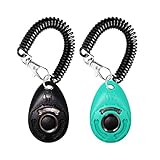
- EASY TO USE - Simple push button with distinct clicking sound.
- Comes with an elastic wrist band so you can leave it on your wrist or clip it to the leash or your pants.
- Not only train the dog but also the cat, bird, chicken, sheep a new behaviors like sit, fetch, roll over, lie down.
- For effective pet training ALWAYS reward with a treat after clicking.
- Can be used to train the dog basic obedience, small trick, and correct the bad behavior; Scientific method of training your pet safely and easily.
Does the training method matter?
The same AVMA document says: “The training method used can influence your dog’s behavior, and positive reinforcement training is recommended by veterinary behaviorists to produce the best results.”
A controlled 2020 study by China, Mills and Cooper in Frontiers in Veterinary Science adds some comparative data, though not about apps. It split 63 dogs with known off-lead behavior problems into three groups of 21, each receiving up to 150 minutes of training over five days. Trainers who focused primarily on positive reinforcement achieved significantly better responses to “Sit” and “Come” after one instruction than the e-collar group, and the authors found no evidence that e-collar training was necessary for its commonly cited purpose. The training period was short, so this supports asking what methods an app or trainer uses, not any claim about app outcomes.
Rank #4

- MANUAL AUDIBLE CLICKER: Produces an audible click when manually pressed. The clicker contains no electronics, batteries, remote-control functions, or Electronic Stimulation features.
- INDIVIDUAL RESPONSE TO SOUND MAY VARY: Dogs and other animals may respond differently to audible clicker sounds. Introduce the clicker gradually and discontinue use if the animal shows discomfort or fear.
- COMPACT HANDHELD DESIGN: Small finger-clicker design is intended to be carried and operated by the user. Review the product images and compact size before ordering to confirm it meets your expectations.
- 5-INCH VELCRO FINGER STRAP: Includes an approximately 5-inch adjustable Velcro strap designed to position the clicker on the user's finger or hand. The strap is worn by the user and is NOT intended to be worn by the pet.
- TEAL CLICKER ACCESSORY: Includes one Teal manual finger clicker and training instructions. Remote transmitter, receiver collar, batteries, and other training-system components are NOT included.
What about starting early?
A 2021 owner survey in Animals covered 641 qualifying owners and 1,023 dogs. Attending training by six months was associated with lower odds of aggressive (0.71), compulsive (0.64), destructive (0.60), and excessively barking (0.68) behavior later on. The reported odds of house soiling were higher (1.56). It is observational and not about apps, and the mixed result is a useful reminder that early training is not a blanket preventive.
How to get the most from a training app
- Do the lessons in sequence and consistently. Lesson completion was the exposure in the Zigzag study, so finishing the early chapters is the behavior with the best (still observational) support.
- Keep a short log. Note the date, the situation, what the dog did, and how long it lasted. This is especially useful for fear, house soiling, barking, or aggression, and it gives a veterinarian something concrete to work from.
- Record video of unusual behavior. Limping, scratching episodes, or sudden reactions often do not happen in the exam room.
- Choose reward-based instruction. This matches AVMA guidance. An optional clicker is one way some trainers mark rewarded moments, but the sources do not show one is required.
- Treat sudden changes as a health question first. New fear, aggression, restlessness, persistent itching, or signs of pain call for a veterinary visit, particularly if the behavior seems unprovoked.
- Bring in a professional for serious problems. Aggression that could injure someone is outside what an app can safely manage alone.
How to evaluate an app’s claims
No like-for-like trial comparing dog-training apps has been established, so choose using the evidence behind each product instead of marketing language.
Do these 3 things before closing this tab:
1Fix the driver behind crashes, sound loss and screen glitches2Clear out junk files and repair common Windows errors3Scan for outdated or missing drivers - takes under a minuteBest Value

- Stronger Bark Control with 3X Ultrasonic Emitters: Unlike single-emitter devices, our upgraded dog bark deterrent features three synchronized ultrasonic heads—delivering 3X the coverage to quickly stop barking, biting, and jumping behaviors. Ideal for anti barking training, safer than bark collar, more effective than a dog whistle, offers a humane, high-performance dog training solution
- 6-in-1 Safe & Humane Training Modes:Our dog bark deterrent device features dual ultrasonic frequencies (fixed 25kHz and variable 20-30kHz), combining 4 ultrasonic modes plus an audible beep and LED flashlight for versatile training. Whether for daily training or stubborn, persistent barking, this anti bark device adapts to different dogs providing effective bark control without causing pain or distress. Perfect for training at home or to stop neighbors dog bark that disturbs your peace
- 23 FT Extended Range & Night Safety: Bark Control Anytime, Anywhere: Stop barking and bad behavior from up to 23 feet away with our powerful dog bark deterrent device — perfect for your yard, neighbor’s yard, outdoor walks, and off-leash areas. Whether you're relaxing at home or out for a stroll, enjoy safe, long-distance control to correct disruptions quickly. The built-in LED flashlight adds safety for evening walks, and low-light training
- Fast Charge & Long Battery Life – Always Ready for Training:With a Type-C fast charging port, our dog bark deterrent device reaches a full charge in just 2 hours and provides up to 30 days of regular use on a single charge, along with 180 days of standby time. Whether you're correcting anti barking behavior or training your dog in public places, you’ll always be prepared for any situation. Forget the hassle of frequent charging and enjoy reliable, long-term barks no more support
- Ultra-Compact Design for Everyday Convenience:50% smaller than standard dog bark deterrent devices, our anti barking device is ultra-compact and lightweight, fitting effortlessly into your pocket, bag, or hand. Whether you're on daily walks, outdoor adventures, or dealing with unexpected situations in public places, this portable design helps you stop barking and encourage good behavior anywhere, anytime. Say goodbye to constant noise and enjoy a barks no more experience with your dog
| Check | What to look for |
|---|---|
| Evidence | Is there published, app-specific research? Is it observational or controlled, and who funded it? |
| Job performed | Teaching skills is different from monitoring or alerting. Do not expect one to do the other. |
| Professional involvement | Does a qualified trainer or veterinarian shape the content or review progress? |
| Method | Does it use reward-based training? |
| Data sharing | Can you export logs or alert history for your vet? |
| Claims | Restrained wording, with a clear statement that alerts are not diagnoses. |
| Practicalities | Cost, privacy terms, accessibility, and availability in your country change often, so confirm them directly with the provider. |
Be wary of any product promising guaranteed behavior change or replacing veterinary care. The research cited here supports neither.
Frequently Asked Questions
Is an app a substitute for puppy classes?
The Zigzag study compared app-only puppies with puppies that had no training. It did not compare the app with in-person classes, so it cannot say how the two stack up.
Do these findings apply to adult dogs?
Not directly. The Zigzag analysis was puppy-focused and tied to one app, and the Whistle FIT data came from a specific wearable and a US clinic network. Neither establishes the same results for other apps or age groups.
Quick Recap
Product prices and availability are accurate as of the date/time indicated and are subject to change. Any price and availability information displayed on Amazon at the time of purchase will apply.




