Free tools Windows power users keep installed
One-click scans. No signup required.
Yes, sometimes. An ear tip means a cat has been identified as having gone through Trap-Neuter-Return (TNR); it does not tell you whether the cat is friendly, has an owner, or can adjust to living indoors. A socialized cat with no located family may be a candidate for adoption or fostering after an ownership check and veterinary assessment. An unsocialized cat that is doing well outdoors is generally best left in its familiar home, with appropriate care.
What does an ear tip mean?
An ear tip is a visible identification mark used for cats who have been through TNR, a process that typically includes sterilization and vaccination. Alley Cat Allies says a veterinarian removes the distal quarter of the left ear while the cat is under anesthesia for spay or neuter surgery. For an adult cat, that is about 3/8 inch (1 cm); the mark is proportionally smaller in a kitten. The mark helps caregivers recognize cats who have already been treated and avoid unnecessary repeat trapping and surgery. It is not a temperament test or proof that a particular cat is ready for a home. Alley Cat Allies’ eartipping guidance explains the identification practice.
As an Amazon Associate I earn from qualifying purchases.
Alley Cat Allies puts it this way: “If you see a cat outdoors missing the tip of her left ear, she is eartipped.” The wording identifies the mark; it does not establish whether the cat is owned, socialized, or medically well. What To Do If You Find a Cat Outdoors.
How do you tell whether the cat may be comfortable indoors?
Focus on the cat’s behavior rather than its ear. A cat that approaches people, rubs against them, or permits touch may be socialized. Those signs can make adoption or fostering worth exploring, but they do not establish that the cat has no family or will immediately adapt to indoor life. A generally unsocialized community cat is usually not a suitable indoor-adoption candidate; if it is thriving outdoors, its familiar territory may be the better home. Alley Cat Allies’ outdoor-cat guidance distinguishes friendly cats from unsocialized community cats.
#1 Best Overall

- High Quality Materials:SZHLUX Live Animal Cage Trap use low carbon steel wire and medium frequency welding. In this way, the product surface is flat, the welding is firm, and it is not easy to solder off.Weather and rust resistant.
- Convenient Design: Our cat trap is foldable and can be easily loaded into the trunk of the car.It only takes 4 simple steps to set up,from nearly flat to assembled in seconds--no tools needed.
- Humane Live Animal Trap: Our raccoon trap use oblong support frame to secure the cage shape and use fixing clips to fix rear door,smoothed internal edges protect and prevent trapped animal being injured.All you need is some bait to catch and then release them back to the wild.
- User-friendly Design: The top cover guard board of the cage prevents people injured by the trapped animal's mistake.The connecting rod of the pedal mechanism is set inside the cage to prevent animals from touching the mechanism by mistake.A new tool has been designed to extend the safe distance when releasing the animal.
- Dimensions: Product Size: 32inch*10inch*12inch; Package Size: 38.2inch*11.8inch*3.15inch.Excellent choice when attempting to capture smaller animals such as stray cats, raccoons, squirrel, skunk, mole, groundhog, armadillo, rabbit and small dogs.
- Approachable or affectionate: Check for an owner and arrange a professional health assessment before deciding on adoption or fostering.
- Fearful or unsocialized: Do not assume the cat needs to be taken inside. Look for a caregiver and seek local TNR or rescue advice if support is needed.
- Behavior unclear: Ask a veterinarian, rescue, or TNR group to help evaluate the situation rather than trying to handle or trap the cat casually.
What should you do before adopting a friendly outdoor cat?
- Ask nearby residents whether the cat belongs to them. A friendly outdoor cat may have a family or regular caregiver.
- Have a veterinarian or rescue scan for a microchip. A scan can help locate an owner; it should be part of the ownership check, not a substitute for asking locally.
- Arrange a veterinary assessment. Ask about the cat’s health and any available medical history. An ear tip is a TNR signal, but you should not assume it confirms the individual cat’s vaccination history or current health.
- Consider fostering or adoption only if no family is found and you can provide for the cat. A veterinarian or rescue can help assess the cat and discuss suitable next steps.
These steps follow Alley Cat Allies’ guidance for friendly cats found outdoors. The guidance is general animal-welfare advice, not an examination of the particular cat you have found.
What if the cat is unsocialized or seems unwell?
If the cat is unsocialized but appears to be thriving
Leave the cat in its familiar outdoor home while you try to identify a caregiver. If no one is looking after it, ask a local rescue or TNR group how to provide appropriate care. Being ear-tipped is not, by itself, a reason to remove a community cat from its territory.
Rank #2

- HUMANE CAPTURE: This large live animal trap safely captures raccoons, cats, possums, and other small animals with a 1-door design that allows full entry before closing, reducing escape chances for effective pest control
- HEAVY-DUTY CONSTRUCTION: Built with galvanized wire mesh and solid steel door, this raccoon trap resists rust and corrosion while providing long-lasting durability for outdoor use in all weather conditions
- SAFETY FIRST: Features smooth internal edges to prevent animal injuries and protective handle guards for safe handling, making this humane animal trap ideal for both novice and experienced users in wildlife management
- PROFESSIONAL DESIGN: Engineered with a refined trip mechanism specifically calibrated for heavier animals like bobcats and coyotes, this live trap minimizes false triggers while ensuring reliable capture performance
- VERSATILE SOLUTION: Perfect as a feral cat trap, skunk trap, or armadillo trap, this large animal cage trap handles a wide range of pest control situations effectively for comprehensive wildlife management
If the cat appears ill, injured, distressed, or underweight
Contact a veterinarian, rescue, or local TNR group for direction. Avoid casually handling or trapping a fearful cat; people with local experience can advise on a safer response. Before taking an outdoor cat to a shelter, call to ask about that shelter’s community-cat policy and available TNR or other lifesaving programs. Practices and options vary locally. Alley Cat Allies’ TNR guidance discusses the process and the importance of local program support.
Where can you get local help?
A veterinarian, animal rescue, shelter, or TNR group can help you assess behavior, health, ownership, and available options. Alley Cat Allies’ Frequently Asked Questions describes its Feral Friends Network, which includes people who identify expertise in TNR, veterinary care, and fostering or adopting socialized cats. A referral does not guarantee that an individual helper is available, so contact local organizations directly and ask what they can offer.
Quick Recap
Best Value

- Safe & Humane Trapping – Designed with animal welfare in mind, this live trap safely captures animals without injury, making it ideal for humane relocation.
- Durable Galvanized Steel Build – Constructed from high-strength, rust-resistant steel for long-lasting performance in any weather condition.
- Reliable Trigger Mechanism – Features a highly sensitive trip plate and spring-loaded door to ensure fast and secure captures, every time.
- Spacious & Versatile Size – Accommodates a range of medium-sized animals including raccoons, groundhogs, armadillos, and stray cats.
- Simple Assembly– Folding to save space and easy assembly with no tools required—perfect for homeowners, farmers, or pest control professionals.
Rank #4

- Wide Application: As urban and wilderness ecosystems intertwine, animals may disturb your life. Our cat trap is a versatile solution for various animals, including cats, raccoons, rabbits, groundhogs, armadillos, and opossums. It effectively addresses issues such as farmland invasion, release, and harassment.
- Humanized Designs: We prioritize humane care with our raccoon trap. The L-shaped lever ensures the trap won't harm animals when triggered. The dense mesh prevents escapes and protects against external attacks or stolen food. Smooth wire edges prevent animals from panicking or biting the wire, ensuring their safety.
- Sturdy and Durable: Our animal trap is built to last. It is constructed with sturdy, thickened wires that withstand animal bites and impacts without deformation or cracking. The galvanized coating provides excellent corrosion resistance, ensuring stability and durability in all weather conditions.
- Simple and User-friendly: Our live trap is designed for your convenience. It comes pre-assembled, saving you from tedious setup steps. Just unfold the cage, secure the rear door, and connect the trap mechanism to start using it quickly. This saves time and effort, allowing you to engage in capture work promptly.
- Portable and Easy to Store: Our efficient groundhog trap is portable and easy to store. It features a convenient handle for easy mobility, with an extended design that prevents accidental injuries from animals. The collapsible design allows for easy storage, freeing up space when not in use.
Rank #3
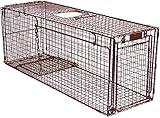
- Works for cats, skunks, rabbits, and other small animals
Product prices and availability are accurate as of the date/time indicated and are subject to change. Any price and availability information displayed on Amazon at the time of purchase will apply.




