If you are raising newborn puppies without their mother, do four things first: get them examined by a veterinarian, keep them warm without overheating them, feed a commercial puppy milk replacer (not cow’s or goat’s milk) with the puppy belly-down and head level, and weigh each puppy every day. Newborns can decline fast, so a cold, weak, non-suckling, struggling-to-breathe, dehydrated or unresponsive puppy is an emergency call to your vet, not something to watch overnight.
This guide is general education, not a substitute for an exam. It covers the first day, warmth, feeding, elimination, health monitoring, weaning and safe socialization.
What to do in the first hours
- Book a veterinary exam promptly. Best Friends Animal Society recommends an exam before an inexperienced caregiver starts raising orphans. This matters most if the litter was found abandoned, a puppy seems ill, or the puppies did not nurse soon after birth. Ask about feeding, weight checks, deworming and vaccines.
- Ask about colostrum. The Merck Veterinary Manual says intestinal absorption of antibodies (IgG) from the mother’s first milk generally ends by 24 hours after birth, and may begin within 4–8 hours. A puppy that missed nursing needs veterinary advice on immune protection.
- Look for a foster mother. A nursing dog is the best nutrition source when one is available and healthy. Otherwise you will use milk replacer.
- Start a log for each puppy. VCA Animal Hospitals recommends recording birth weight and daily weight for the first four weeks, then weekly from week five. Add food intake, urine and stool, activity and milestones. Mark puppies so you can tell them apart.
- Set up a clean, draft-free nest. Avoid loose, soft cloth that can trap a newborn; Best Friends warns about this.
How do I keep orphaned newborn puppies warm?
Newborn puppies cannot regulate body temperature well. Merck states: “Puppies and kittens lack thermoregulatory mechanisms until 4 weeks of age; thus, the ambient temperature must be high enough to facilitate maintenance of a body temperature of at least 97°F (36°C).” It also recommends 55%–65% environmental humidity.
Nest temperature targets
Best Friends gives these nesting-area targets. They are one source’s starting points, so confirm them with your vet and check with a thermometer placed at puppy level.
What’s actually slowing this PC down?
Pick the symptom - the matching free tool is one click away.
#1 Best Overall

- SQUEEZE BOTTLE - 60ml nursing bottle for newborn kittens and puppies, 2.1 ounce capacity, small animal feeding bottle is easy to squeeze and easy to control the amount of milk.
- SMALL ANIMAL FEEDER SET - 1ml for small nipples, 3ml, 5ml, 10ml for medium and large nipples, 60ml feeding bottles can be freely combined with (small, medium, large) nipples.
- 5 REPLACEABLE NIPPLES - Different sized nipples to meet the needs of small animal at every stage, the soft rubber-tipped nipple prevents scratching the gums of newborn kittens and puppies.
- 5ML BROWN FEEDER - The brown 5ml syringe is made of light-safe material to prevent photosynthesis of medication, use a separate dedicated feeder for better use when your pet is sick.
- NEWBORN KITTENS & PUPPIES GIFT - Suitable for newborn and not yet teething small animals, kittens, puppies, hamsters, chinchillas, squirrels, rabbits, etc. you will be a very gentle owner, take care of it, love it and grow with it.
| Puppy age | Nest temperature (Best Friends) |
|---|---|
| First 4–5 days | 85–90°F |
| Day 7–10 | About 80°F |
| End of week 4 | 70–75°F |
Heat sources and overheating
Newborns cannot crawl away from heat, so overheating is a real risk. Merck cautions that heating pads can burn neonates that cannot move off a hot surface, and describes overhead heat at a suitable distance as an option. Make sure the puppies can’t be stuck in a hot zone, and protect them from drafts.
If a puppy is cold
Chilling interferes with nursing and digestion. Merck advises rewarming a chilled neonate slowly over 30–60 minutes and not tube feeding until it is warm, because hypothermia can cause ileus, regurgitation and aspiration. Call your vet for any cold puppy rather than feeding it to “warm it up.”
Rank #2
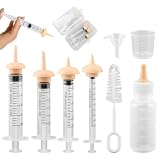
- One-Stop Scientific Feeding: Designed specifically for newborn kittens, puppies, and various small animals, this kit includes a 50ml professional feeding bottle, four precision syringes of different capacities (1ml, 3ml, 5ml, 10ml), four biomimetic nipples, as well as a funnel and measuring cup. From precise feeding immediately after birth to supplemental feeding during the transition period, this single kit meets all your care needs.
- Precise Measurement for Safe Feeding: Recognizing that newborn pets are extremely sensitive to feeding amounts, the kit includes four syringes of different sizes, each featuring clear, durable graduations. This allows you to control feeding with milliliter-level precision based on your pet’s weight and age, effectively preventing choking or digestive strain caused by overfeeding.
- Bio-Mimetic Nipples: Made from ultra-soft, food-grade silicone, these bio-mimetic nipples replicate the natural feel of a mother dog or cat’s mouth. They are bite-resistant and gentle on the mouth. Multiple nipple shapes are available to suit pets of different sizes and developmental stages, increasing the success rate of feeding.
- Easy to Clean, Comes with a Dedicated Storage Case: The included cleaning brush easily reaches the bottom of bottles and syringes, ensuring no milk residue remains. All accessories are neatly stored in a transparent storage jar/container, making it convenient for home storage and keeping your tools organized and ready to use—whether you’re traveling with your pet or on the go.
- Essential Professional Tools for Young Pets: Whether caring for orphaned puppies or kittens, administering medication to sick adult pets, or providing nutritional support for frail premature pets, this multifunctional kit offers the most professional support. The included measuring cup and funnel make the process of mixing formula more precise and spill-free, making it the ideal assistant for pet owners and animal rescuers.
What do I feed my orphaned puppy?
Use a commercial puppy milk replacer made for puppies. VCA says it is superior to cow’s milk and homemade mixtures, and its feeding guide notes cow’s and goat’s milk are inadequate, especially low in protein and fat. Esbilac is one product named in the sources as an example; follow whichever product your vet recommends and its label.
| Option | When it fits | Notes |
|---|---|---|
| Foster nursing mother | A healthy lactating dog is available and accepts the puppies | Preserves maternal milk; your vet should weigh health and disease considerations |
| Commercial puppy milk replacer | No foster mother | Follow label and vet guidance |
| Cow’s or goat’s milk | Not recommended | Inadequate substitute per VCA |
How often and how much should I feed the puppies?
Sources differ. VCA’s feeding article says every 2–4 hours in the first week, then every 4–6 hours until weaning. Best Friends says newborns commonly need feeding every 2–3 hours around the clock, and small or weak puppies may need more. No single interval suits every puppy, so settle on a schedule with your vet using accurate weights.
Rank #3

- ➤Biomimetic Nursing Design & Scientific Feeding: Features an anatomical nipple design that mimics natural nursing, combined with an airflow control system for precise milk flow to reduce choking risk. Clear 20ml measurement markings help owners feed scientifically. Suitable for puppies, kittens (specifically designed for kitten bottles), squirrels, rabbits, and other small pets aged 1-3 months
- ➤Anti-Choke Safety System: Exclusive flow restrictor + pressure balance technology automatically regulates milk flow, preventing choking or gas from rapid suckling. Leak-proof when inverted – feed upright without tilting for effortless operation
- ➤ Safe & Resilient Materials: Food-grade silicone sleeve provides grip and impact protection, extending lifespan. BPA-free & odorless for the safety of fragile newborns. ✓ Warning: "For toothless newborns only, Teething pets may damage the silicone nipple."
- ➤Ergonomic Upgrades: Features a non-slip silicone sleeve for secure grip, a bottle-shaped contour for comfortable palm-fit handling, and highly visible, laser-etched measurement markings with scratch-resistant coating to ensure long-lasting readability—all designed for effortless one-handed use during feeding
- ➤Multi-Scenario Use & Easy Cleaning: Detachable nipple and wide-mouth bottle enable quick cleaning/sterilization. ❄️"Recommend hand wash with warm water below 50°C (122°F)." Ideal as a kitten bottle feeding kit for homes, vet clinics, and shelters. Compact and portable for on-the-go or emergency use
VCA, with the Canadian Academy of Veterinary Nutrition (article copyright 2024), gives these general energy targets for formula:
| Age | Energy per 100 g body weight per day |
|---|---|
| Days 1–3 | 15 kcal |
| Days 4–6 | 20 kcal |
| After day 6 | Up to 25 kcal |
VCA also gives total fluid needs of 130–220 mL per kg per day, averaging about 180 mL/kg/day. Increase intake gradually through the first week and avoid overfeeding. Use the calorie density printed on your formula to convert these into millilitres, and check the math with your vet.
Rank #4

- Angled Design for Natural Feeding Position: 45 angled puppy bottles allow nursing pet babies to drink milk while lying down, which is the most natural way for pet babies to feed. The ergonomic design provides comfort during feeding sessions, and the puppy nipple can be used in conjunction with a syringe to accurately control the amount of milk consumed, especially useful for weak puppies requiring syringe feeding
- Three Silicone Nipple Sizes for All Ages: Three different sizes of pacifiers ensure that puppy feeders can be used from birth to weaning. The soft silicone nipple appeals to pet babies, and if the nipple's milk outlet needs adjustment, you can use scissors to widen the outlet for better flow
- Advanced Ventilation System for Safety: Features a bottle ventilation system similar to human baby bottles, eliminating the need for manual ventilation during feeding and reducing the probability of choking on milk, providing safety protection comparable to human baby feeding products
- Easy Disassembly and Cleaning: All accessories can be completely disassembled for thorough cleaning, making maintenance simple and ensuring hygienic feeding conditions for your pets
- Complete Feeding Kit Included: Product includes 1 bottle (350ml capacity), 1 medium size nipple, 2*M Sizes Nipple, 1*M+ Size Nipple,1 large size nipple, and 1 10ml syringe for comprehensive feeding solutions
How do I bottle-feed safely?
- Use a puppy nursing bottle and a nipple whose flow doesn’t let milk pour out freely.
- Warm the formula to roughly body temperature. VCA gives about 100°F (38°C) in one article and 95–100°F (35–37.8°C) in another. Don’t microwave it; Maddie’s Fund cautions against it.
- Hold the puppy belly-down with head level, like nursing from its mother. Never feed on its back.
- Let it suckle at its own pace. Never force-feed or allow rapid nursing, since fast flow risks aspiration.
- If the puppy won’t or can’t suckle, stop and call your vet. Tube feeding should be learned hands-on from a veterinary professional, not attempted from instructions online.
Keeping feeding equipment clean
VCA recommends cleaning and boiling bottles and nipples between uses, refrigerating prepared formula, and discarding formula left at room temperature after one hour. Best Friends says refrigerated prepared or opened formula should be discarded after 24 hours. If the product label is more specific, follow it. Wash your hands before handling puppies.
How do I get the puppy to urinate and defecate?
Young puppies need you to stimulate elimination, usually after each feeding. Use a warm, damp cloth or cotton ball on the genital and anal area, gently and without harsh rubbing. Sources vary on when it can stop: Best Friends says the first two weeks, VCA says until about three weeks. Ask your vet when your litter is ready to go on their own.
Quick wins for a faster PC:
Fix the driver behind crashes, sound loss and screen glitchesFind Drivers →Clear out junk files and repair common Windows errorsFree Scan →Scan for outdated or missing drivers - takes under a minuteDriver Scan →Best Value

- Products: 2 bottles (50 ml), 2 syringes (10 ml and 12 ml), 6 pacifiers (2 small straight pacifiers, 3 medium pacifiers, 1 large pacifier), 1 spoon with scale (10 ml), 1 measuring cup (27.5ml)
- Features: The content contained in the product can meet the feeding needs of cats and dogs, the size of the pacifier can be replaced with a bottle or syringe according to the situation; Two syringes and two bottles can also meet the needs of many people feeding multiple cats and dogs at the same time
- Syringe instructions: If the newborn kitten and dog can not drink their own milk, then we need to feed with a syringe, there are straight head and elbow syringe can choose, elbow design fits the mouth, feeding more convenient
- Note1:When feeding, always pay attention to the pet's feeding situation and observe the pet's sucking rhythm
- Note2: If your kitten or puppy has grown teeth, be careful not to be bitten by the kitten or puppy when using the pacifier, to avoid the risk of biting the pacifier and eating it by mistake
What should I monitor, and when is it an emergency?
Weigh each puppy daily and write it down. A puppy that fails to gain or loses weight needs veterinary advice. Watch for:
- Poor suckling or refusing feeds
- Lethargy, twitching or seizures
- Breathing difficulty, which needs urgent attention
- Dehydration, such as tacky gums
- Diarrhea or abnormal stool. Best Friends advises a vet call when diarrhea is severe, lasts beyond several feedings, or contains blood or parasites.
- Feeling cold or marked weakness
When and how do I wean orphaned puppies?
Around three weeks, begin offering water and gruel, guided by each puppy’s readiness. Make gruel by mixing growth-formulated puppy food with milk replacer, and thicken it gradually as puppies learn to lap. VCA says replacer should be the sole nutrition until 3–4 weeks and recommends a transition to solid food by 5–6 weeks; Best Friends says most puppies can eat dry puppy food by six weeks. Keep fresh water available and don’t remove formula abruptly.
How can I socialize orphaned puppies safely?
Keep socialization gentle and supervised. Best Friends suggests contact with friendly, fully vaccinated dogs and dog-friendly cats, carefully supervised visits with children, and ordinary exposure to people, objects, smells and household sounds such as a vacuum or television. Protect puppies from injury and from animals that might react badly.
Balance this against infection risk. In the earliest weeks, limit visitors and handling, wash hands, avoid visitors recently exposed to sick animals or animal facilities, and change clothes and shoes after contact with other dogs or shelter settings. Ask your vet how local disease risks and the puppies’ vaccine status should shape their exposure.
Outdated Drivers Are Slowing You Down
One free scan finds every outdated or missing driver and matches the right update for your exact hardware.Free scan · exact hardware matchPC Slower Than It Used to Be?
A free scan shows the junk files, broken settings and background clutter dragging Windows down - then fixes them in one click.Free scan · Windows 10 & 11Quick Recap
Product prices and availability are accurate as of the date/time indicated and are subject to change. Any price and availability information displayed on Amazon at the time of purchase will apply.




