
Free tools Windows power users keep installed
One-click scans. No signup required.
Some links on this page are affiliate links: if you buy through them we may earn a commission, at no extra cost to you.
The best medium-sized mixed-breed dog for your family is the individual dog whose temperament, energy, behavior history, likely adult size, coat and care needs fit your household. “Medium-sized” and a guessed breed mix are starting points, not guarantees of exercise needs or personality. Meet the dog, observe how it handles people and handling, verify its history and health records, and compare the match with your schedule, children, pets, home and budget before committing.
What makes a medium-sized mixed-breed dog a good family match?
Fit matters more than appearance or a breed label. The Centers for Disease Control and Prevention advises matching a dog’s attitude, temperament, size and activity level with your family. The RSPCA likewise notes that there is no single “best pet” for every family. A dog that is sociable and manageable in your home may be a better choice than a dog with a more appealing look or a label that sounds suitable.
As an Amazon Associate I earn from qualifying purchases.
Assess the whole household first. Write down who will provide walks, feeding, training, grooming and veterinary care; how long the dog will be alone; your travel pattern; children’s ages; existing pets; allergies; housing rules; and changes you expect in the next several years. A realistic description helps a shelter, rescue, breeder or veterinarian suggest an individual match instead of making a guess from a photo.
Use breed labels as clues, not predictions
When a dog’s ancestry is unknown, a shelter’s breed description may be an informed estimate rather than a verified pedigree. Woodgreen advises that breed labels are only part of the picture for adopted dogs. Give more weight to observed behavior, documented history, parent information when available and a professional assessment than to a guessed heritage.
Popular on Amazon

- COMFORT: the Ladoogo dog collar is padded with soft neoprene. Extremely comfortable and breathable. Care your dog neck
- DURABILITY and CONVENIENCE: Made of durable nylon webbing, strong quick release buckle and metal D ring. Easy to adjust and put on or take off. All metal accessories are strong and rust-proof. Machine washable. Easy care for daily use
- REFLECTIVITY: Highly reflective threads keep high visibility at night for safety
- BONUS DOG LEASH: A free 5ft dog leash is included. Featured with comfortable foam handle, strong climbing rope, and tangle-free hook
Remember that medium size is not an activity level
Size does not reliably predict how much exercise, training or space a dog needs. Veterinary guidance from the Merck Veterinary Manual and Virginia Tech Veterinary Teaching Hospital emphasizes that some smaller dogs are highly active while some larger dogs are calmer. A medium-sized dog can still need substantial daily movement and mental stimulation, or it may prefer a quieter routine; ask about the individual dog’s current behavior and recovery after activity.
How should I evaluate a candidate dog’s energy and temperament?
Look for a dog whose normal arousal level your family can support, not merely one that appears quiet during a short meeting. Ask the organization how the dog behaves across ordinary days, after exercise, around visitors and when left to settle. A useful assessment covers energy, confidence, sociability and response to gentle handling.
Energy and recovery
- Ask what activity the dog currently receives and how it behaves afterward. Does it relax, or remain restless and seek constant stimulation?
- Find out whether the dog enjoys walks, play, sniffing games, training or other enrichment. Your plan should include both physical activity and mental work.
- Ask whether the dog can settle indoors, sleep through normal household routines and cope with brief periods without attention.
Confidence and sociability
- Observe whether the dog is curious and able to recover after a new person, sound or room catches its attention.
- Ask how it responds to visitors, restraint, grooming, car travel, food handling and ordinary household noise.
- Distinguish a temporary shelter reaction from a persistent pattern. A qualified staff member who has seen the dog repeatedly can explain what is known and what remains uncertain.
Behavior history
Ask directly about fear, guarding, chasing, separation distress, destructive behavior, bite incidents and reactions to other animals. “No history known” is different from “no problem observed,” so plan management around the uncertainty. A dog with a known, manageable issue may still be suitable if your household can follow the required safety and training plan; a family without that capacity should choose another match.
How can I tell whether the dog is safe with children?
Children and dogs need teaching and constant adult supervision. The American Academy of Pediatrics warns that younger children may treat an animal like a toy; adults remain responsible for care and every interaction. A dog’s previous experience with children is important, but it does not remove the need for supervision in a new home.
Also popular on Amazon

- 【Size M】Dog Collar "M":Neck Fit 12.9"-21.6"(33-55cm),Width 3/4"(2cm) ;The Leash - Width 3/4"(2cm),Length 4FT. please measure your dog's neck girth refer to our size chart before ordering.Pls note that main photos are taken from L size.
- 【Fashion Design】 This bohemia floral tribal geometric American Flag Heart patterns collar will make your dog look more fashion and stylish while travelling and daily walking.
- 【Comfortable Wear】 Made of soft and lightweight polyester material, makes your dog feel relaxed and comfortable when wearing.Metal D-Rings provide a secure attachment point for your leash.
- 【DURABLE】 This dog collar is created by Polyester fiber which is strong and sturdy for pullers. The quick release plastic buckle is wear resistant , easy to on and off.
- 【GUARANTEED】If you have any quality problems, you can contact us at any time for after-sales service.
Ask about the dog’s actual experience
- How has the dog behaved around children of similar ages, sizes and activity levels?
- Has it lived with children, or only passed them on walks? What happened during noisy play, hugging, running or food-related situations?
- Are there any concerns about jumping, mouthing, fear, guarding toys or approaching a child’s food?
At a meeting, let the dog choose whether to approach. Keep greetings calm, avoid forced hugging or face-to-face contact and stop if the dog shows stress. Children should learn not to disturb a dog while it eats, sleeps or retreats, and every interaction should have an attentive adult present. If the dog’s history with children is unknown, treat that as a reason for extra management rather than as proof of safety or danger.
Can a medium-sized mixed-breed dog live with my other pets?
Compatibility depends on the individual dog’s behavior toward the particular species and on your ability to separate and supervise. Ask whether the dog has lived with dogs, cats or smaller animals, and whether its behavior was observed in a home or only in a controlled introduction.
Quick wins for a faster PC:
Clear out junk files and repair common Windows errorsFree Scan →Fix the driver behind crashes, sound loss and screen glitchesFind Drivers →Plan a careful introduction
- Tell the shelter or rescue about your existing pet’s age, temperament, health and routines before arranging a meeting.
- Where the organization permits and considers it safe, introduce the animals in a neutral, controlled setting with experienced handlers.
- Watch for loose, responsive body language and the ability to disengage, not just an initial friendly greeting.
- Use gates, separate rooms and individual feeding areas at home. Do not leave the animals together unsupervised until their behavior is consistently safe.
Chasing or intense fixation can be dangerous for cats and small pets even when a dog is friendly with people. If the organization cannot establish a history, ask a veterinarian or qualified behavior professional how to manage the uncertainty before adoption.
How predictable will a mixed-breed puppy’s adult size and activity be?
A mixed-breed puppy’s adult size and activity can be difficult to forecast, especially when parent information is unavailable. The Merck Veterinary Manual recommends using observed behavior, information about the parents when available and professional assessment rather than treating an estimate as a guarantee.
Also popular on Amazon

- COMFORT: the Ladoogo dog collar is padded with soft neoprene. Extremely comfortable and breathable. Care your dog neck
- DURABILITY and CONVENIENCE: Made of durable nylon webbing, strong quick release buckle and metal D ring. Easy to adjust and put on or take off. All metal accessories are strong and rust-proof. Machine washable. Easy care for daily use
- REFLECTIVITY: Highly reflective threads keep high visibility at night for safety
- BONUS DOG LEASH: A free 5ft dog leash is included. Featured with comfortable foam handle, strong climbing rope, and tangle-free hook
What to check before choosing a puppy
- Ask whether both parents are known and what their adult size, structure, temperament and health history are.
- Review the puppy’s growth and veterinary records and ask what the organization expects, while recognizing that an estimate can be wrong.
- Observe how the puppy responds to handling, novelty, recovery, play and rest. Early behavior is useful information, not a fixed adult personality.
- Consider whether every household member can safely manage a stronger or more active adult dog than expected.
If uncertainty about eventual size, strength or energy would create a housing or safety problem, an adult dog with an established body and routine may be the more predictable choice.
Should my family adopt an adult dog or get a puppy?
Choose a puppy only if your schedule supports intensive supervision and training. An adult may be more practical when you need a clearer picture of temperament, size and daily habits, although an adult still needs time to adjust and learn your routines.
What’s actually slowing this PC down?
Pick the symptom - the matching free tool is one click away.
| Consideration | Puppy | Adult dog |
|---|---|---|
| House-training | Frequent breaks, close supervision and a consistent routine are required. | May already be house-trained, but confirm the history and expect possible accidents during transition. |
| Socialization and training | Requires planned, positive exposure to people, handling, environments and basic skills. | May know household routines, yet may also arrive with established fears or habits that need careful change. |
| Size and strength | Adult size and activity may remain uncertain, particularly without parent information. | Current size, movement and energy are easier to evaluate. |
| Daily workload | Frequent feeding, toilet trips, supervision, chewing management and naps. | Often a more predictable schedule, but adjustment, exercise and training are still necessary. |
Neither age is automatically easier or safer. Match the workload to the time, experience and support your family can provide every day, including during illness, school changes or travel.
What coat and allergy factors should I consider?
Coat type affects shedding, brushing, grooming appointments, cleaning and comfort in your climate. Ask how often the individual dog needs brushing or professional grooming, whether it mats, and how it copes with heat, cold and wet weather. A medium-sized dog with a coat that needs frequent maintenance may be a poor fit for a family that cannot provide it.
Also popular on Amazon

- 【Premium Material】Tactical dog collars is made of 1000D high-quality nylon fabric,very durable,wear-resisting. Soft and comfortable padded inner won’t hurt dog’s fur and can protect dog’s neck well.
- 【Double Security】Buckle training dog collar adopt integrated collar,magic sticker and quick release metal clasp dual design.Adjustable dog collar easy to put on and take off,the metal clasp can be released quickly in case of emergency.
- 【Control Handle】Military Training Nylon Dog Collar has special control handle,can efficiently control your dog when training, patrol,hiking, jogging, hunting, camping, working, running, jumping, traveling, camping.fits lots of medium and large dogs like German Shepherd, Border Collie, Rottweiler, Great Dane, Doberman, Golden Retriever, Husky, Labrador, Alaskan Malamute,etc.
- 【Airtags case and Patches】DAGANXI tactical dog collar comes with 1*Airtag protective case and 2*patches. Airtags Case Cover can protects your Airtags from scratches and damage, when Airtags used to track your dog, this enables your dog to find its way home. tactical dog collar comes with two patches, On the back of collar, you can also put a name tag, ID badge, or any Velcro accessory to make your dog unique.
- 【Warm prompt】Please follow the size chart to measure your dog's neck carefully before you place the order to ensure the collar is fit well to your dog.There should be left 2 fingers gap between the collar and the dogs neck.
Do not rely on a “hypoallergenic” label. The American Academy of Pediatrics states that all dogs can trigger allergic symptoms regardless of shedding category. If allergies are significant, have the affected person spend time with the specific dog, discuss the situation with a clinician and make a household plan before adoption; no breed or mix can guarantee an allergy-free home.
What health records and costs should I verify?
The American Veterinary Medical Association cautions that unfulfilled expectations are a primary reason dogs are surrendered, so make an informed decision about lifelong care. Request vaccination, parasite-control, sterilization and veterinary records, along with the reason for rehoming and any diagnosed conditions or medication.
Crashes, No Sound, or Screen Glitches?
Random freezes, missing sound and display glitches usually trace back to one bad driver. Find and replace yours safely.Free scan · under a minuteWindows Errors? Fix Them Before They Spread
Repair common Windows errors and clear accumulated junk for a smoother, more stable PC - no reinstall needed.Free scan · no reinstallBuild a complete cost plan
- Food appropriate to the dog’s life stage and health needs.
- Routine examinations, vaccinations, parasite prevention and dental care.
- Training, grooming, licensing and identification requirements in your area.
- Housing equipment, replacement leads or collars, boarding or pet care during travel.
- Emergency veterinary treatment and any ongoing medication or special diet.
Prices and legal requirements vary by location, and emergency costs are unpredictable. Ask a local veterinary practice for current preventive-care recommendations and check your municipality’s licensing and identification rules before bringing the dog home.
Independent reader supportYour contribution helps us test, update, and keep practical guides available for everyone.What should I do before the dog arrives?
Prepare the environment and book veterinary care before adoption so the first days are orderly rather than improvised.
Also popular on Amazon
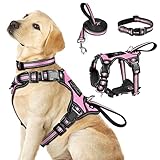
- 【3 in 1 Harness】 This WINSEE all-in-one set includes a reflective pet collar, a standard leash attachment, and a reflective no pull dog harness which makes the product one for all. Walk, play, jog, or ride, with the WINSEE 3 in 1 harness you'll always have your best friend by your side!
- 【Reflective Nylon】 - higher visibility of the 3 in 1 harness, collar, and control leash allows you and your dog to be seen on early morning or evening strolls.
- 【No pull & choke-free】WINSEE no pull dog harness featuring 2 sturdy D rings on the front/back range for attaching leash, a front clip that prevents pulling, and a back one for relaxed walking. The 2 D rings are reinforced on the extensional part which is not easily ripped off even by heavy pulling. Especially the metal buckle for a leash on the back give you more safety. Pulling pressure is evenly distributed to the body to prevent choking.
- 【Adjustable & customizable neck and chest girth fit】The fit of this pet harness can be completely customized for your pet using the slide adjusters on the chest and neck. Double stitching, lots of reinforcement stitching at high stress points, easy to fit and put on, and nicely padded for your dog's comfort.
- 【Perfect fit】 SMALL SIZE: Perfect for pets weighing 25-35 lbs., neck measurement 16-20.5 in; chest measurement 17-26 in, MEDIUM SIZE: perfect for pets weighing 35-50 lbs., neck measurement 17-24 in; chest measurement 18-31.5 in, LARGE SIZE: perfect for pets weighing 50-80 lbs., neck measurement 18-27 in; chest measurement 24-38 in; XL SIZE: perfect for pets weighing 80-140 lbs., neck measurement 21-33 in; chest measurement 24-49 in.
- Create a quiet sleeping area and a separate feeding place where children and other pets will not disturb the dog.
- Pet-proof rooms by securing food, medicines, chemicals, cords, rubbish and plants that could be harmful.
- Buy food and water bowls, an adjustable collar and leash, an identification tag and safe confinement equipment suited to the dog’s current size. Because a puppy’s adult size may be uncertain, choose an adjustable collar range and check the fit regularly.
- Agree on house rules, toilet routines, walking responsibilities and where the dog may rest before it arrives.
- Arrange a veterinary examination within a few days to a week after adoption. Bring all records, ask about preventive care and discuss any behavior or appetite changes.
How should I compare two or more candidate dogs?
Use the same questions for every dog and record evidence rather than relying on a first impression. A simple comparison exposes trade-offs that photographs and labels hide.
| Decision area | Questions to ask | What a good match looks like |
|---|---|---|
| Energy and exercise | What activity and enrichment does the dog need, and can our schedule provide it? | The dog’s normal activity fits your dependable daily routine. |
| Temperament and confidence | How does the dog respond to visitors, noise, handling and novelty? | Its responses and recovery are manageable for your household. |
| Children and pets | What is documented, and what is unknown? | You can supervise, separate and train to the level required. |
| Size and strength | Is adult size known, estimated from parents or uncertain? | Everyone can safely handle the dog at its current and likely adult size. |
| Coat and climate | What shedding, grooming and weather management are involved? | Care fits your time, budget and local conditions. |
| Age and workload | Can we provide puppy supervision or adult transition support? | The workload remains realistic during busy periods. |
| Health and records | Which preventive and medical records are available? | You understand known needs and have a post-arrival veterinary plan. |
| Total commitment | Can we fund routine, training, grooming, identification and emergencies? | The plan works for the dog’s entire life, not only the adoption day. |
What is the safest step-by-step selection process?
- Describe your household. Record schedules, exercise capacity, home restrictions, children, pets, allergies, travel and expected future changes.
- Give the organization the unedited facts. Ask a shelter, rescue, breeder or veterinarian to match on energy, confidence, behavior history and handling needs; keep breed labels secondary.
- Meet in person. Bring every household member and, where safe and permitted, existing pets. Observe recovery from novelty, response to handling, sociability and ability to settle.
- Verify history and records. Ask about rehoming, previous homes, children, animals, behavior concerns, vaccinations, parasite control, sterilization, parents and current medical needs.
- Compare age and uncertainty honestly. Decide whether your schedule can support puppy socialization and housetraining or whether an adult’s established size and routine are more suitable.
- Prepare and follow up. Set up the home, obtain identification and basic supplies, establish household rules and attend the early veterinary examination.
This process may lead you to decline a dog you like. That is a responsible outcome: the AVMA’s warning about unfulfilled expectations reflects the cost of choosing on impulse instead of matching the dog to the life you can actually provide.
Frequently Asked Questions
How long does it take a rescue dog to settle into a new home?
There is no universal timetable. Plan for an adjustment period in which the dog may eat, sleep, play or eliminate differently from its previous routine, and keep the first days predictable while you gather better information about its normal behavior.
What if the shelter cannot tell me the dog’s breed or background?
You can still make a sound decision by evaluating current behavior, handling tolerance, energy, health records and the organization’s observations over time. Treat unknown history as a management consideration and ask what introductions, supervision and professional support the shelter recommends.
Can I change my mind after meeting a dog?
Yes. A responsible shelter or rescue should let you explain why the match does not fit, rather than pressuring you to adopt. Declining before adoption is safer and kinder than returning a dog after preventable problems arise.
What identification should a newly adopted dog have?
Use an identification tag and comply with local licensing and identification rules; ask the veterinarian about permanent identification options during the first examination. Check that contact details remain current whenever your address or phone number changes.





Leave a Reply