The Tool Desk
Outbyte PC Repair FREERepair Windows errors before they cause bigger problemsFix Now →Outbyte Driver Updater FREEFix the driver behind crashes, sound loss and screen glitchesFind Drivers →The correct aquarium temperature depends on the fish, not on a universal “room temperature” setting. Most tropical freshwater community fish do well around 76–80°F (24.4–26.7°C), with 78°F (25.6°C) as a useful midpoint. Bettas generally need warmer water, while goldfish generally belong in the mid-60s to low-70s Fahrenheit. Some specialized equatorial fish require considerably warmer conditions.
Use these figures as starting points, then confirm the preferred range for every species in the aquarium. Just as important, keep the water stable: a tank that stays slightly away from the midpoint is often safer than one that repeatedly swings through the “correct” temperature.
Quick temperature guide
| Fish or aquarium type | Useful target range | Important qualification |
|---|---|---|
| Most tropical freshwater community fish | 76–80°F (24.4–26.7°C) | A broad starting range, not a requirement for every tropical species |
| Bettas | 76–85°F (24.4–29.4°C) | Usually need warmer, stable water than goldfish or other cold-water fish |
| Goldfish and other cold-water fish | About 65–72°F (18.3–22.2°C) | Variety matters; guidance may extend to about 75°F for goldfish |
| Common goldfish | Approximately 65–68°F (18.3–20°C) | Cooler than most tropical community fish |
| Fancy-tail goldfish | Approximately 65–72°F (18.3–22.2°C) | Use variety-specific guidance where available |
| Some equatorial or specialized fish, including discus and wild-caught angelfish | Approximately 84–88°F (28.9–31.1°C) | Check their care requirements instead of using a generic 78°F setting |
These ranges reflect guidance from Aqueon, Tetra, and PetMD. “Tropical fish” covers many species from different habitats, so a species’ documented preference should take priority over any general table.
Why aquarium temperature matters
Fish are ectotherms: their body temperature and much of their metabolic activity are strongly influenced by the surrounding water. Temperature affects appetite, digestion, activity, respiration, and the pace at which waste is produced and processed.
Recommended Free Tools
#1 Best Overall
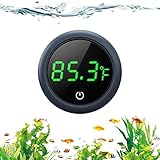
- HD LED Display: PAIZOO Aquarium Thermometer adopts LED screen to display temperature, LED can provide wide viewing angle and the color is saturated, it is easier to read the data no matter day or night. Green environmental protection and energy saving
- Cordless & Touch Design: Stick-on Induction Thermometer senses water temperature through probe, cordless design, no messy wires in the water, providing a clean and safe environment for fish.Touch the button to display the temperature, and the thermometer outside aquarium will enter the sleep state after 5s
- High Accurate Display: Tank Thermometer Aquarium just needs to tear off the adhesive and stick it below the water level on the outside of the tank. The thermometer for terrarium has a reading range of 0-140 °F and is accurate to 0.9 °F. Up to 5s refresh speed allows the naked eye to detect temperature changes more quickly
- Long Battery Life: The fish tank thermometer built-in 3V battery button, the battery is long-lasting. Mini design, easy to use. Digital thermometer is suitable for different water types such as fresh water, tap water, salt water, sea water, etc., to provide the most comfortable water environment for your beloved pets
- 100% Satisfied Customer Service: We provide 12-month warranty. In the event of any product quality defects within the warranty period, we will offer a free replacement without charge. PAIZOO customer service team operates 24/7 to deliver comprehensive, hassle-free support for an optimal user experience
That is why a betta should not automatically be kept at the same temperature as a goldfish, and why an equatorial species may need a different setup from a typical community tank. The goal is to provide a stable, appropriate environment for the particular fish.
Most tropical community tanks: 76–80°F
For many commonly kept tropical freshwater community fish, 76–80°F is a practical general target. Setting a heater to about 78°F often works as a starting point when the fish have overlapping requirements.
Do not treat 78°F as a universal aquarium rule. Some tropical fish prefer the cooler or warmer end of the range, and certain species have narrower requirements. Before stocking a tank, compare care guidance for the exact fish rather than relying only on the label “tropical.”
Bettas need reliably warm water
A betta aquarium is generally best maintained at 76–85°F. A cool room can leave an unheated betta tank below its preferred range, even when the water feels comfortable to a person.
Outdated Drivers Are Slowing You Down
One free scan finds every outdated or missing driver and matches the right update for your exact hardware.Free scan · exact hardware matchWindows Errors? Fix Them Before They Spread
Repair common Windows errors and clear accumulated junk for a smoother, more stable PC - no reinstall needed.Free scan · no reinstallChoose a target within the recommended range and keep it steady. A betta tank should not be managed like a goldfish aquarium, and a heater’s thermostat should not be assumed accurate without an independent temperature check.
Goldfish need cooler water
Goldfish are not tropical fish. General guidance places them around 65–72°F, although PetMD gives a broader upper limit near 75°F. Tetra distinguishes between common goldfish at roughly 65–68°F and fancy-tail goldfish at roughly 65–72°F.
The exact target depends on the variety and the fish’s needs. Avoid automatically setting a goldfish aquarium to 78–80°F. Warmer water holds less dissolved oxygen, which is especially relevant in a crowded or poorly aerated tank.
Specialized fish may need much warmer water
Some equatorial or specialist species require conditions well above the usual community-tank range. Aqueon gives approximately 84–88°F for discus, wild-caught angelfish, uaru, and certain other equatorial fish.
What’s actually slowing this PC down?
Pick the symptom - the matching free tool is one click away.
Rank #2

- New digital aquarium thermometer: LED display fish tank thermometer with professional LCD visual effect, the fish tank and aquarium water temperature can be displayed clearly, despite the night light, and can be easily read. Mini compact body design is suitable for a variety of different types of fish tanks and aquariums, is a must have fish tank accessories.
- Safe wireless touch design: The digital fish tank thermometer comes with a touch power button, which can be easily awakened by clicking. The built-in high sensor probe measures the water temperature for fish tank, well-organized wire in the fish tank to protect the fish from being swallowed or electrocuted, providing a clean and safe living environment for the pet fish axolotl turtle.
- Simple installation: The tank thermometer does not need any installation tool to remove the adhesive on the back, stick it on the outside of the tank below the tank water level, and after standing for 5 minutes, it can accurately and real-time monitor the aquarium temperature change.
- Accurate data: tank thermometer aquarium measurement range of the tank thermometer is 0°C~60°C, the accuracy is 0.18°C, and the error is ±1 °C. This is suitable for axolotl tank, turtle thermometer, saltwater fish tank accessories, betta fish tank thermometer, etc..
- Long life battery: Thermometer for aquarium fish tank is powered by a CR2032 battery (included), and the battery lasts up to 12 months. The wireless aquarium digital thermometer will automatically enter the sleep mode after 5 seconds of no operation, extend the battery life, and be more environmentally friendly and energy saving.
Consider temperature alongside water chemistry, oxygenation, tank size, filtration, stocking, and feeding. Use species-specific care guidance for a narrow or specialized range.
Stability is as important as the target number
Fish cannot move to a cooler or warmer part of a natural river or lake when aquarium conditions change. In a relatively small volume of water, room conditions, equipment, sunlight, and water changes can produce noticeable shifts.
Keep the tank in a stable location, away from:
- Direct sunlight or a bright window
- Exterior doors and drafts
- Fireplaces, radiators, and other heat sources
- Heating or air-conditioning vents
PetMD advises avoiding goldfish temperature fluctuations greater than approximately 2°F in 24 hours. The safest rate depends on species and circumstances, but avoid abrupt changes for all aquarium fish.
How to measure aquarium temperature accurately
A heater’s display or built-in thermostat is not a substitute for a separate thermometer. Tetra recommends checking aquarium temperature with a thermometer, and Fluval’s heater instructions advise verifying the set temperature with an accurate thermometer after the heater reaches its target.
Quick wins for a faster PC:
Clear out junk files and repair common Windows errorsFree Scan →Scan for outdated or missing drivers - takes under a minuteDriver Scan →Repair Windows errors before they cause bigger problemsFix Now →Place the thermometer where it is easy to read and represents the tank’s general water temperature. Do not place it directly against the heater, where it may read a localized hot spot.
Options include adhesive glass thermometers, submersible thermometers, digital aquarium thermometers, and wireless water-temperature monitors. Fluval’s Edge Thermometer reads 64–86°F, while its 2-in-1 digital thermometer is designed to measure both room and water temperature. These are model-specific examples, not evidence that one design is best for every aquarium.
Choosing and using a heater
A heater is usually necessary for tropical fish when the room is below the desired range or changes substantially during the day or night. Select a model rated for the aquarium’s volume, and consider ambient temperature, aquarium cover, room drafts, water circulation, and the manufacturer’s capacity guidance.
Aqueon advises choosing a heater designed for the tank size and ensuring circulation around it for even heat distribution. Tetra’s HT heaters are available for tanks from 2 to 55 gallons and use thermostatic control to maintain approximately 78°F; Fluval’s adjustable T-Series models have specific capacities and temperature settings. These specifications are model-specific and should not be generalized to every heater. Confirm the actual water temperature with a separate thermometer.
Do these 3 things before closing this tab:
1Clear out junk files and repair common Windows errors2Scan for outdated or missing drivers - takes under a minute3Repair Windows errors before they cause bigger problemsRank #3

- Wide Application: Ideal for use in water or high moisture environment like aquarium terrarium, or vivarium, suitable for different water types such as fresh water, tap water, salty water, marine water and etc.
- Easy to Read: Comes with a large LCD display that is easy to read clearly.
- Easy to Setup: Submerge probe with suction cup can easily be set in water. (Submerge probe only, do not submerge thermometer in water) Press ''PWR'' for 3 seconds to power off.
- Free LR44: 1 PC LR44 button cell for each thermometer
- Wide Temperature Range: Measure -58°F to +158°F (-50°C to +70°C) with accuracy +/- 1°C
Safety: Never run a submersible heater out of the water. Unplug it before removing it or performing maintenance, and allow it to cool as directed by its manufacturer. Fluval’s manual specifically warns against operating the heater out of water.
What to do if the tank is too hot
- Check the reading. Confirm the temperature with a reliable thermometer rather than reacting to a heater display alone.
- Find and remove the heat source. Check for direct sun, a room heat wave, a nearby vent, excessive lighting, or a malfunctioning heater.
- Increase surface movement or aeration. This may help during a heat event, especially if fish are breathing rapidly or gathering near the surface, but it does not replace correcting the temperature.
- Cool gradually. Aqueon recommends opening the lid slightly and directing a fan across the water surface to encourage evaporation. Monitor the water level.
- Consider a chiller only when appropriate. Sensitive cold-water systems or persistent heat problems may require one.
Do not dump ice or very cold water into the aquarium to force an abrupt temperature drop. Sudden cooling can stress fish. Warm water holds less dissolved oxygen than cool water, as described by the U.S. Geological Survey and the U.S. Environmental Protection Agency.
What to do if the tank is too cold
- Verify the low reading with a second thermometer if possible.
- Check whether the heater is unplugged, incorrectly sized, blocked from circulation, or malfunctioning.
- Check whether the room, window, vent, or draft is causing the drop.
- Raise the temperature gradually according to the species’ requirements rather than making a sudden adjustment.
- Monitor the tank after the change to ensure the heater cycles normally and does not overshoot.
Do not increase the heater setting repeatedly without checking the actual water temperature. A faulty thermostat can continue heating even when its dial appears to show an appropriate value.
Match replacement water before a water change
Replacement water should be conditioned and brought as close as practical to the aquarium’s existing temperature before it is added. This is particularly important when replacing a substantial volume of water.
Temperature matching reduces the chance of a sudden shock. PetMD recommends conditioned water at the same temperature for goldfish maintenance, and Aqueon gives the same general advice for aquarium water exchanges. Use a thermometer rather than relying on touch.
Independent reader supportYour contribution helps us test, update, and keep practical guides available for everyone.How to set temperature in a mixed-species tank
List the documented preferred ranges for every species and look for genuine overlap. If the ranges overlap, choose a stable point near the middle of the shared range rather than operating at an extreme edge.
If the ranges do not overlap, a compromise setting is not a good long-term solution. It may leave one species chronically too warm or another chronically too cold. Reconsider the stocking plan or provide separate systems designed for each group.
Also check compatibility beyond temperature. Fish that share a temperature range may still differ in adult size, temperament, water chemistry, diet, swimming space, and oxygen needs.
Rank #4
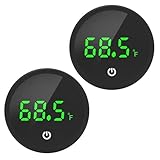
- New Digital Aquarium Thermometer: This new fish tank thermometer is equipped with an LED high-definition display and instant ℃/℉ switching (3-second response). It adopts an innovative circular buckle battery replacement design on the back, which takes care of your user experience in various aspects, meets the needs of different groups of people, and is an ideal for fish tank accessories.
- Safe wireless touch design: The digital fish tank thermometer comes with a touch power button, which can be easily awakened by clicking. The built-in high sensor probe measures the water temperature for fish tank, well-organized wire in the fish tank to protect the fish from being swallowed or electrocuted, providing a clean and safe living environment for the pet fish axolotl turtle.
- Simple installation: The tank thermometer does not need any installation tool to remove the adhesive on the back, stick it on the outside of the tank below the tank water level, and after standing for 5 minutes, it can accurately and real-time monitor the aquarium temperature change.
- Accurate data: tank thermometer aquarium measurement range of the tank thermometer is 0°C~60°C, the accuracy is 0.18°C, and the error is ±1 °C. This is suitable for axolotl tank, turtle thermometer, saltwater fish tank accessories, betta fish tank thermometer, etc..
- Long life battery: Thermometer for aquarium fish tank is powered by a CR2032 battery (included), and the battery lasts up to 12 months. The wireless aquarium digital thermometer will automatically enter the sleep mode after 5 seconds of no operation, extend the battery life, and be more environmentally friendly and energy saving.
Temperature troubleshooting checklist
- The reading changes several degrees: move the thermometer away from the heater, sunlight, or filter outlet, then compare it with a second thermometer.
- The heater never seems to shut off: check its rating, placement, thermostat, and actual water temperature. Unplug a suspect heater safely and follow the manufacturer’s guidance.
- Fish are gasping at the surface: check temperature and water quality, increase surface movement or aeration, and seek qualified help if the fish remain distressed.
- The tank is warm every afternoon: investigate sunlight, room temperature, lighting, and nearby heat sources.
- Temperature drops after maintenance: measure and match replacement water before the next water change, and check whether the heater was unplugged or removed correctly.
- There is no stable setting for all inhabitants: the aquarium may contain incompatible temperature requirements and should be restocked or divided rather than maintained at a harmful compromise.
Bottom line: choose the species’ range, then protect its stability
Use 76–80°F as a broad starting point for many tropical freshwater community aquariums, not as a universal rule. Bettas generally need 76–85°F; goldfish generally belong around the mid-60s to low-70s; and some specialized equatorial fish need about 84–88°F.
Check the water with an independent thermometer, select equipment for the actual aquarium and species, match water-change temperature, and correct overheating or chilling gradually. A stable, species-appropriate range is the goal—not a single number printed on a heater dial.
FAQ
Is 78°F good for every fish tank?
No. About 78°F is a useful midpoint for many tropical freshwater community fish, but bettas, goldfish, and specialized species have different requirements. Check each species’ preferred range and stock only fish with compatible needs.
Do goldfish need a heater?
Not usually if the aquarium remains within the variety’s preferred range. Goldfish generally prefer cooler water, around the mid-60s to low-70s Fahrenheit. A heater may be needed in an unusually cold room, but it should not automatically be set to a tropical temperature.
Can I cool an aquarium with ice?
Avoid adding ice or very cold water directly to the tank. Rapid cooling can stress fish. Remove the heat source, increase surface movement, use gradual evaporative cooling, and monitor the temperature and water level.
Does a heater’s thermostat make a separate thermometer unnecessary?
No. Heater thermostats and displays can be inaccurate or measure conditions near the heater. Use a separate thermometer in representative tank water and verify the temperature after the heater reaches its setting.
What temperature is dangerous for aquarium fish?
There is no single danger threshold for every species because tolerance and exposure time differ. Excessive heat increases metabolism and oxygen demand while reducing the oxygen water can hold. Aqueon notes that temperatures above 90°F can damage beneficial bacteria, but treat species-specific overheating or rapid changes seriously rather than relying on one universal threshold.
Quick Recap
Product prices and availability are accurate as of the date/time indicated and are subject to change. Any price and availability information displayed on Amazon at the time of purchase will apply.




