Correctly identified detritus worms are generally not harmful to fish: they feed on decaying material in aquarium substrate. A sudden increase is a reason to check for leftover food and accumulated debris, not proof that fish are sick or that water quality is unsafe. Because other aquatic worms can attach to or harm fish, identify an uncertain worm before treating the tank.
Are detritus worms harmful to fish?
Usually not, when the worms are correctly identified as detritus feeders. Petco describes them as eating decaying matter in substrate and says they are not harmful to fish: Petco’s guide to worms in fish tanks.

As an Amazon Associate I earn from qualifying purchases.
That reassurance does not apply to every small, pale, or threadlike worm. PetMD describes several kinds of aquatic worms, including leeches that attach to fish and other groups that may harm fish or invertebrates. If a worm is attached to an animal or fish seem unwell, do not assume it is a detritus worm based on color alone.
Windows Errors? Fix Them Before They Spread
Repair common Windows errors and clear accumulated junk for a smoother, more stable PC - no reinstall needed.Free scan · no reinstallOutdated Drivers Are Slowing You Down
One free scan finds every outdated or missing driver and matches the right update for your exact hardware.Free scan · exact hardware matchWhat do detritus worms mean for an aquarium?
Why they appear
Leftover food, fish waste, and rotting organic matter can settle on the bottom and collect in substrate, as Seachem explains in its planted-tank maintenance guidance. This material can provide food for detritus feeders. Overfeeding is also one contributor to aquarium water-quality problems; Aqueon’s fishkeeping guide notes that uneaten food can contribute to ammonia and nitrite increases.
#1 Best Overall

- APPLICATION: Use for issues caused by lice and anchor worms to keep your fish healthy: For best results, perform three applications one week apart, with water changes prior to each application
- OK FOR SCALELESS FISH: Acceptable for use with scaleless fish and other ornamental aquarium fish, reptiles, amphibians, and mollusks; Recommended for use with crustaceans
- WORKS BEST IN CONTROLLED TEMPERATURES: Intended for use in water above 40 degrees F and under 100 degrees F
- DIRECTIONS: Shake well before use; Dose at the rate of 1 fluid ounce per 300 gallons (1,136 L); Prior to the initial use, a partial water change of 20% is recommended
- NOTE: Not for use with fish or aquatic invertebrates intended for human consumption
A visible population is therefore a useful prompt to review feeding and cleaning. It is not, by itself, a water test: these sources establish no worm-count threshold that diagnoses unsafe conditions.
Potential benefits and drawbacks
- Possible benefit: Detritus worms feed on decaying substrate matter, according to Petco’s care guide.
- Possible drawback: A conspicuous population may be unpleasant to see and may coincide with excess food or debris. The practical response is to address that material, not to assume the worms are attacking fish.
- Identification risk: Mistaking another kind of worm for a harmless detritivore could delay appropriate care if fish are irritated, have attached worms, or appear ill.
How to tell when a worm needs closer attention
Notice where the worms are and what they are doing: are they associated with substrate debris, swimming freely, or attached to a fish or invertebrate? Location and behavior are more useful than color alone, but the sources cited here do not provide a complete visual key for every aquarium worm. If the organism does not fit the simple case of a substrate-associated detritus feeder, or if livestock show symptoms, seek qualified identification rather than guessing.
Rank #2
PetMD also cautions that treatments used against some worms can negatively affect helpful organisms in a marine system. That warning is specific to the marine-system context described in its article, not proof that every treatment harms every aquarium. It is a reason to identify the problem and choose care advice appropriate to the tank before using medication.
The Tool Desk
Outbyte Driver Updater FREEFix the driver behind crashes, sound loss and screen glitchesFind Drivers →Outbyte PC Repair FREEClear out junk files and repair common Windows errorsFree Scan →How to reduce detritus worms in the tank
- Check feeding. Reduce excess food so less is left to decay. Overfeeding can contribute to water-quality problems, according to Aqueon.
- Siphon accumulated debris. During routine water changes, use an aquarium siphon or gravel vacuum to remove detritus from the substrate. Seachem recommends siphoning detritus during water changes. This removes debris; it does not sterilize the aquarium or guarantee that every worm will disappear.
- Continue appropriate maintenance and observe the fish. If worms are attached to fish or fish appear unwell, seek qualified identification before treatment.
- Avoid broad deworming treatment based only on seeing small worms. A vague appearance is not a diagnosis, and PetMD notes potential effects on helpful organisms from treatments aimed at some worms in marine systems.
When should you get help?
- Worms appear attached to a fish or other animal.
- Fish show signs of illness or irritation.
- The organism is not clearly associated with substrate debris, or you cannot identify it confidently.
In these cases, get the worm identified and ask for aquarium-appropriate care advice before treating. PetMD’s overview explains why aquatic worms should not all be treated as the same problem: PetMD’s guide to worms in fish.
Quick Recap
Rank #4
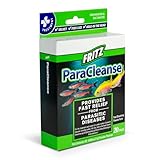
- Broad-Spectrum Parasite Treatment: Fritz ParaCleanse is expertly formulated to treat a wide range of parasitic diseases in aquarium fish, including velvet (Oodinium), hole-in-the-head disease (Hexamita & Spironucleus), fish lice, and gill & skin flukes (Dactylogyrus & Gyrodactylus), ensuring a healthy environment for your fish
- Safe for both freshwater and saltwater systems, this treatment does not, harm plants, invertebrates, or uninfected fish
- Dual Active Ingredients: Containing Metronidazole and Praziquantel, Fritz ParaCleanse is effective against a variety of common parasites in fish but also some internal bacterial infections
- User-Friendly Dosing: The pre-measured easy dosing packets simplifies the application process. Bulk jars are also available for larger systems
- Specific Treatment Indications: While highly effective against specific parasites, it is important to note that ParaCleanse does not treat Nematodes or Roundworms. For these, Fritz Expel-P is recommended
Rank #3

- Prevent nasty parasites from your Discus, Angel fish and other prized aquarium fish. It is harmless to most fresh water tropical fish.
- Flubendazole is the effective main active ingredient, and works differently to other Fluke treatments by gently starving the parasite; making this product perfectly safe for regular usage.
- Wormer Plus cleverly balances out its ingredients making very little (if any) difference to PH when using wormer plus.
- Safe to use on most tropical fish and salt water fish. Will not harm plants, or chemical filtration. Can be used in conjunction with other medications. No need to remove or unplug your UV sterilizer (just remove any activated carbon for full effect).
- Effective for use against Gill Flukes, Body Flukes, Parasites, Intestinal Helminths. Including Tapeworm, Nematodes (Roundworms), Planaria (Flatworms), Capillaria, Camallanus Nematodes, Metacercaria, Sanguinicola and Intestinal Protozoa. It is also an effective in eradicating pest snails from your tank.
Product prices and availability are accurate as of the date/time indicated and are subject to change. Any price and availability information displayed on Amazon at the time of purchase will apply.




