Free tools Windows power users keep installed
One-click scans. No signup required.
Cats can distinguish some familiar words—most clearly, their own names—and can learn associations between names and familiar cats. That is not the same as understanding sentences or human language broadly. Studies have measured cats’ attention and learned associations, not whether they grasp the full meaning of everyday conversation.
What does it mean when a cat “understands” a word?
A cat may learn that a particular sound predicts something important: their name may signal that a person is addressing them, while another familiar name may identify a cat in the household. Researchers describe abilities like these as discrimination and learned association. They are narrower claims than understanding a word’s dictionary meaning or following the structure of human sentences.


There is no published population-wide estimate of how many words cats understand. The evidence supports specific abilities under particular study conditions, not a universal word count or a claim that cats comprehend everything people say.
Can cats recognize their own names?
In a 2019 controlled study, Saito and colleagues tested whether household cats reacted differently to their own names than to general nouns and other cats’ names. Cats heard a series of familiar-sounding words before their own name; researchers looked for a change in observable behavior. Household cats discriminated their names from the other words, including when an unfamiliar person spoke them. That result makes recognition of the owner’s voice alone an incomplete explanation, although it does not establish how much meaning the cat attaches to the name. Read the 2019 study in Scientific Reports.
The Tool Desk
Outbyte Driver Updater FREEFix the driver behind crashes, sound loss and screen glitchesFind Drivers →Outbyte PC Repair FREERepair Windows errors before they cause bigger problemsFix Now →#1 Best Overall
The study’s measure was attention, such as ear or head orientation—not sentence comprehension, and not necessarily walking over or vocalizing. A cat that does not come when called may still have distinguished the sound. The authors described their findings as “the first experimental evidence showing cats’ ability to understand human verbal utterances.” In context, the experiment provides evidence that cats discriminate a salient learned utterance; it does not demonstrate human-like semantics or syntax.
Why household setting matters
In the same study, cats in ordinary households distinguished their own names from the names of cohabiting cats more successfully than cats living in a cat café. That contrast suggests that exposure and social setting matter when interpreting what a cat has learned; it does not mean every household cat knows every other cat’s name.
Can cats learn other cats’ names?
A 2022 experiment tested whether cats associate a familiar cat’s name with that cat’s face. In Experiment 1, 48 cats heard a familiar cat’s name and then saw a photograph. Household cats looked longer when the pictured cat did not match the name they had just heard, a pattern consistent with a learned name-face association. The café cats did not show the same pattern. The result supports the idea that some cats form these associations through everyday experience, without explicit training; it does not show that all cats know all the names in their home. Read the 2022 study in Scientific Reports.
What about names of people?
In that study, the result for matching a human family member’s name to a face was less clear. The authors noted that familiarity with the voice saying a name and the relationship between a person’s age and the time spent in the household complicate interpretation. The evidence therefore does not justify a broad claim that cats reliably know the names of their human family members. An author correction was recorded in 2023. See the 2023 correction.
Quick wins for a faster PC:
Repair Windows errors before they cause bigger problemsFix Now →Scan for outdated or missing drivers - takes under a minuteDriver Scan →Do cats understand what we are saying, or just our voices?
It is not an either-or question: cats can attend to both familiar sounds and who is speaking. Separate studies have found that cats distinguish an owner’s voice from strangers’ voices and can match a familiar owner’s voice with that person’s face. These findings show social recognition across voice and sight, but speaker recognition does not by itself prove that a cat knows the meaning of arbitrary words. Owner-voice recognition study (2013); Voice-and-face matching study (2019).
Researchers have also investigated whether indoor cats respond differently to cat-directed speech than to speech directed at adults. That question concerns attention and responsiveness to a style of speaking; it is not a direct test of word meaning. Study of cat-directed and human-directed speech (2022).
Quick Recap
Best Value
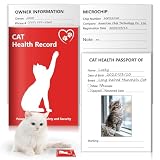
- 1.You’ll Get:When you choose our cat vaccines records tracker, you'll receive one notebook.This 12-page Kitty health journal has 8 dedicated pages for tracking your pup’s health, vet visits, and key details, with 4 blank pages at the end for jotting down extra notes, pet cat-related info, or anything else you want to record.
- 2.Ideal Size for Record Keeping:Each cat vaccine record book measures 5x3.5 inches folded; 5x7 inches unfolded, allowing for easy portability and storage.These handy health records notebook for cats with double sided printing, featuring enough space for all your pets important information,plus, it has dedicated spots for sticking on vaccine stickers and adding cute kitten photos.They offer a stylish and organized approach to pet health documentation, a must have addition to your pet supplies.
- 3.Premium Quality: The cat health record tracker’s cover features 300gsm coated paper with vibrant full-color printing and a protective laminate finish. Inside, 80gsm high-quality offset paper pages are durable and ink-resistant, ensuring no bleeding from pens or markers—so your records stay neat and easy to read.
- 4.Essential for cat owners: This kitten health record book is designed for vet clinics & owners. Track key health info (vaccines, exams, treatments) easily. When you’re away, pet sitters/family can quickly check medical history for seamless care. Kitten record book with photo, vital signs & ID sections, it helps in emergencies—even if your kitten gets lost.
- 5.Effortlessly Track Vaccinations and More:The cat canine health record booklets pages include:owner and cat information,medical history and hospitalizations,vaccination record and sticker,cat service providers,fecal examinations and de-worming,heartworm screening, prevention and treatment etc.This record keeping tool will ensure every important detail is accounted for and make this task easy, organized, and straightforward.Add this essential tool to your pet supplies for a happier, healthier pet.
Rank #4
How to interpret your cat’s response at home
- Notice the specific cue. A consistent ear turn, head movement, or look toward you when you say a name can be a sign that the sound has become familiar.
- Separate the word from the situation. A cat may react to a familiar speaker, tone, routine, or expected event as well as to the sound itself. One response cannot identify which cue mattered.
- Do not use “came when called” as the only test. The name study measured changes in attention, not obedience or approach. Not coming does not prove the cat failed to recognize the name.
- Avoid drawing conclusions from one missed response. The experiments establish group patterns under controlled conditions; an individual cat’s visible reaction, or lack of one, cannot reveal everything it has learned.
Product prices and availability are accurate as of the date/time indicated and are subject to change. Any price and availability information displayed on Amazon at the time of purchase will apply.




