Free tools Windows power users keep installed
One-click scans. No signup required.
Yes. Water temperature affects fish metabolism and appetite, so fish may eat more as conditions approach their species’ preferred range and less when water is too cold or too warm. There is no universal temperature cutoff or feeding schedule: the right response depends on the fish, its life stage, and the conditions in its aquarium or pond.
How water temperature affects feeding
Fish are ectotherms, meaning their body temperature is closely tied to the water around them. Temperature influences metabolism, oxygen demand, growth, and how much food a fish uses. As water warms toward a species’ favorable range, appetite may increase; outside that range, feeding can slow.
NSW Department of Primary Industries describes metabolic rate as doubling for every 10°C rise. Treat that as a broad generalization, not a formula for calculating a fish’s ration: appetite and feeding response remain species-specific. NSW DPI’s silver perch guidance also notes that warmer water holds less dissolved oxygen while fish oxygen demand rises. Temperature should therefore be considered alongside water quality.
Why there is no single feeding temperature
Fish species have different thermal ranges and preferred temperatures for growth and reproduction. Even within a species, size, life stage, feed type, natural food availability, and the setting can affect a suitable ration. FAO pond guidance says feeding frequency should be adapted to the species and reduced when water cools or rises above its optimum; it is not a universal schedule for aquarium fish.
#1 Best Overall
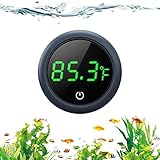
- HD LED Display: PAIZOO Aquarium Thermometer adopts LED screen to display temperature, LED can provide wide viewing angle and the color is saturated, it is easier to read the data no matter day or night. Green environmental protection and energy saving
- Cordless & Touch Design: Stick-on Induction Thermometer senses water temperature through probe, cordless design, no messy wires in the water, providing a clean and safe environment for fish.Touch the button to display the temperature, and the thermometer outside aquarium will enter the sleep state after 5s
- High Accurate Display: Tank Thermometer Aquarium just needs to tear off the adhesive and stick it below the water level on the outside of the tank. The thermometer for terrarium has a reading range of 0-140 °F and is accurate to 0.9 °F. Up to 5s refresh speed allows the naked eye to detect temperature changes more quickly
- Long Battery Life: The fish tank thermometer built-in 3V battery button, the battery is long-lasting. Mini design, easy to use. Digital thermometer is suitable for different water types such as fresh water, tap water, salt water, sea water, etc., to provide the most comfortable water environment for your beloved pets
- 100% Satisfied Customer Service: We provide 12-month warranty. In the event of any product quality defects within the warranty period, we will offer a free replacement without charge. PAIZOO customer service team operates 24/7 to deliver comprehensive, hassle-free support for an optimal user experience
For example, NSW DPI says silver perch may have greatly reduced appetite and activity below 10°C, and gives 23–28°C as their optimum growth range. These are silver-perch figures, not general thresholds for other fish.
Species-specific examples—not rules for every fish
| Fish or context | Temperature information | How to interpret it |
|---|---|---|
| Silver perch | Below 10°C, appetite and activity may be greatly reduced; optimum growth is 23–28°C. (NSW Department of Primary Industries; publication date not stated.) | Applies to silver perch, not all fish. See NSW DPI guidance. |
| Tilapia | Appetite and growth may decline below 20°C; feeding stops below 16°C; mortality can occur below 12°C. (Government of Ontario; publication date not stated.) | These figures apply to tilapia in the Ontario profile’s context. See Ontario’s tilapia profile. |
| Channel catfish in ponds | An FAO chapter gives a study-based example: above 26°C morning water temperature, two daily feedings were associated with maximum consumption and growth; at 22–26°C, once daily was optimal; below 20°C, alternate-day feeding resulted in the highest consumption. | This is a pond and channel-catfish example, not a prescription for other fish or home aquariums. See FAO pond guidance. |
How to decide whether to feed
- Identify the fish. Find guidance for the exact species and, where possible, its size or life stage. Do not apply silver-perch, tilapia, or channel-catfish figures to an unidentified fish.
- Measure the water temperature. Use the actual reading and compare it with a species-appropriate temperature range; do not rely on the room temperature or a generic “fish” threshold.
- Check appetite and conditions. Consider whether the fish is eating normally and whether water quality—especially dissolved oxygen—may be affecting feeding.
- Adjust cautiously. Follow species- and setting-specific husbandry guidance. Offer an appropriate amount and avoid leaving uneaten feed in the water.
Does cold water make fish eat less?
Often, yes, but the degree and temperature at which it happens vary by species. FAO guidance notes that low temperatures can reduce food intake, while the silver-perch and tilapia examples show how different the relevant temperatures can be. The sources do not establish one temperature below which all fish should stop feeding.
Rank #2

- New digital aquarium thermometer: LED display fish tank thermometer with professional LCD visual effect, the fish tank and aquarium water temperature can be displayed clearly, despite the night light, and can be easily read. Mini compact body design is suitable for a variety of different types of fish tanks and aquariums, is a must have fish tank accessories.
- Safe wireless touch design: The digital fish tank thermometer comes with a touch power button, which can be easily awakened by clicking. The built-in high sensor probe measures the water temperature for fish tank, well-organized wire in the fish tank to protect the fish from being swallowed or electrocuted, providing a clean and safe living environment for the pet fish axolotl turtle.
- Simple installation: The tank thermometer does not need any installation tool to remove the adhesive on the back, stick it on the outside of the tank below the tank water level, and after standing for 5 minutes, it can accurately and real-time monitor the aquarium temperature change.
- Accurate data: tank thermometer aquarium measurement range of the tank thermometer is 0°C~60°C, the accuracy is 0.18°C, and the error is ±1 °C. This is suitable for axolotl tank, turtle thermometer, saltwater fish tank accessories, betta fish tank thermometer, etc..
- Long life battery: Thermometer for aquarium fish tank is powered by a CR2032 battery (included), and the battery lasts up to 12 months. The wireless aquarium digital thermometer will automatically enter the sleep mode after 5 seconds of no operation, extend the battery life, and be more environmentally friendly and energy saving.
When should you feed fish in cold water?
Use the fish’s species-specific guidance rather than a calendar or a temperature borrowed from another species. In aquaculture, FAO advises reducing feeding frequency as water cools or exceeds the species’ optimum. For an aquarium or pond, do not assume that a farm feeding schedule applies; the fish, life stage, water quality, and available natural food all matter.
Quick Recap
Rank #4
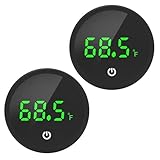
- New Digital Aquarium Thermometer: This new fish tank thermometer is equipped with an LED high-definition display and instant ℃/℉ switching (3-second response). It adopts an innovative circular buckle battery replacement design on the back, which takes care of your user experience in various aspects, meets the needs of different groups of people, and is an ideal for fish tank accessories.
- Safe wireless touch design: The digital fish tank thermometer comes with a touch power button, which can be easily awakened by clicking. The built-in high sensor probe measures the water temperature for fish tank, well-organized wire in the fish tank to protect the fish from being swallowed or electrocuted, providing a clean and safe living environment for the pet fish axolotl turtle.
- Simple installation: The tank thermometer does not need any installation tool to remove the adhesive on the back, stick it on the outside of the tank below the tank water level, and after standing for 5 minutes, it can accurately and real-time monitor the aquarium temperature change.
- Accurate data: tank thermometer aquarium measurement range of the tank thermometer is 0°C~60°C, the accuracy is 0.18°C, and the error is ±1 °C. This is suitable for axolotl tank, turtle thermometer, saltwater fish tank accessories, betta fish tank thermometer, etc..
- Long life battery: Thermometer for aquarium fish tank is powered by a CR2032 battery (included), and the battery lasts up to 12 months. The wireless aquarium digital thermometer will automatically enter the sleep mode after 5 seconds of no operation, extend the battery life, and be more environmentally friendly and energy saving.
Rank #3

- Wide Application: Ideal for use in water or high moisture environment like aquarium terrarium, or vivarium, suitable for different water types such as fresh water, tap water, salty water, marine water and etc.
- Easy to Read: Comes with a large LCD display that is easy to read clearly.
- Easy to Setup: Submerge probe with suction cup can easily be set in water. (Submerge probe only, do not submerge thermometer in water) Press ''PWR'' for 3 seconds to power off.
- Free LR44: 1 PC LR44 button cell for each thermometer
- Wide Temperature Range: Measure -58°F to +158°F (-50°C to +70°C) with accuracy +/- 1°C
Product prices and availability are accurate as of the date/time indicated and are subject to change. Any price and availability information displayed on Amazon at the time of purchase will apply.
Quick wins for a faster PC:
Clear out junk files and repair common Windows errorsFree Scan →Fix the driver behind crashes, sound loss and screen glitchesFind Drivers →



