
Outdated Drivers Are Slowing You Down
One free scan finds every outdated or missing driver and matches the right update for your exact hardware.Free scan · exact hardware matchWindows Errors? Fix Them Before They Spread
Repair common Windows errors and clear accumulated junk for a smoother, more stable PC - no reinstall needed.Free scan · no reinstallSome links on this page are affiliate links: if you buy through them we may earn a commission, at no extra cost to you.
Yes, a dog can share a home with a newborn, but only under continuous, active adult supervision. If the adult cannot watch closely enough to interrupt immediately, the dog and baby must be separated by a secure gate, closed door, crate or another physical barrier. Never put a dog in the baby’s cot or sleeping room, and never rely on a baby monitor or being somewhere else in the house as supervision.
Introduce the baby gradually: begin with scent, then use a quiet, leash-controlled meeting in which the dog may choose whether to approach. Reward calm behavior, stop at the first sign of stress or over-excitement, and keep the dog’s retreat, routines and access to an adult predictable. These rules reduce opportunities for bites, falls, choking, infection and breathing hazards, but they cannot guarantee a particular dog’s temperament.
As an Amazon Associate I earn from qualifying purchases.
What’s actually slowing this PC down?
Pick the symptom - the matching free tool is one click away.
Can my dog be around my newborn?
Usually, yes, when an adult is close enough to watch every interaction and intervene at once. The Health Service Executive advises, “Do not leave your baby or child alone with a pet,” while RSPCA Australia states, “Never leave your baby and dog together unsupervised!” Treat those statements as a practical rule, not as a suggestion based on whether your dog has always been friendly.
Infants cannot read canine signals, move away from a worried animal or control their hands. A dog can also react to crying, sudden movements, pain, illness, food, a valued toy or an unfamiliar handling style. Even a calm family dog may startle or guard a resource. Supervision therefore means watching the dog and baby continuously, staying near enough to block contact, and ending the interaction before either becomes distressed.
Popular on Amazon

- Auto-Close Baby Gate: Designed with an intelligent self-closing system, this dog gate automatically swings shut at angle under 90°, providing reliable protection against accidental openings
- Dual-Lock Safety: This baby gate for stairs features a secure dual-lock mechanism, ensuring curious children and pets stay safely contained while allowing adults to open it effortlessly with one hand. Parents can pass through the baby gates for doorways with ease even while carrying groceries or a baby
- Tool-Free Installation: The pressure-mounted dog gate indoor provides a secure hold while protecting your walls or furniture from damage, ideal for renters and hassle-free setups. The dog gates for doorways offer a quick, temporary solution that's both safe and convenient. The attached sticky pads are provided to keep the wall cups in place, so you don't need to drill
- Stroller-Friendly Baby Gate for Stairs: Features an anti-stumble pedal, ensuring a seamless transition between the pet gate and the floor. This design reduces the risk of tripping and allows strollers to roll through the child gate effortlessly, making the pressure mounted baby gate ideal for families with elderly members and young children
- Adjustable Pet Gate Indoor: With an adjustable width from 29 to 40 inches, the baby gate with door fits most standard doorways and stair openings, creating a safety environment for your little ones and furry friends while giving you peace of mind. Please measure the width of the openings you want to place the child gate before installation
General guidance cannot assess an individual dog. Medical problems, a history of aggression, predatory behavior, resource guarding, the baby’s mobility and the layout of your home all change the risk. Arrange veterinary or qualified behavior support when any of those factors are present.
What does active supervision require?
Active supervision is direct, uninterrupted attention by an adult who can physically intervene. It is not the same as being in the house, listening from another room or checking a camera.
The Tool Desk
Outbyte Driver Updater FREEFix the driver behind crashes, sound loss and screen glitchesFind Drivers →Outbyte PC Repair FREEClear out junk files and repair common Windows errorsFree Scan →- Keep the adult within immediate reach of the baby and dog during shared time.
- Put down the phone, avoid chores that divide attention and do not sleep during the interaction.
- Watch the dog’s face, posture, tail, movement and access to objects, not only the baby.
- End contact before the dog becomes tense, fixated, frantic or unable to respond to a cue.
- Use a barrier whenever the adult must cook, answer the door, use the bathroom, nap or attend to another child.
Decide in advance which adult is responsible. Passing the baby to another caregiver does not automatically transfer responsibility for the dog; say who is watching and when the dog will be separated.
Do I need a baby gate if I have a dog and a newborn?
A gate is one of the simplest ways to create separation, and it is useful even when your dog is gentle. Install it before the baby arrives so the dog learns the new boundary without associating the barrier only with losing access to the family.
| Management setup | When it works | Checks before relying on it |
|---|---|---|
| Baby or pet gate | Routine separation while an adult is occupied or the baby is sleeping | The gate is securely mounted, the dog cannot push through or climb it, and the baby cannot reach the dog through gaps. |
| Closed door | Keeping the dog out of a nursery or another no-access zone | The latch stays closed, adults know the rule, and the dog has water, ventilation and a comfortable area. |
| Crate | Short, planned periods when the dog is already comfortable resting there | The crate is a positive retreat, never a punishment, and the dog is not confined for longer than it can comfortably manage. |
| Leash with an adult | Brief introductions or movement through shared rooms | An adult holds the leash, keeps it loose enough to avoid adding tension and can increase distance immediately. |
| Unrestricted shared space | Only after repeated calm sessions and while an adult watches continuously | The dog remains responsive, has a retreat route and cannot reach the baby’s sleep space, food or high-value items. |
Judge any arrangement by five questions: Can an adult maintain direct supervision? Does the barrier prevent the dog reaching the baby? Does the dog have a comfortable retreat? Is the dog calm and responsive to cues? Is the baby’s sleep space completely pet-free? If one answer is no, change the setup rather than testing the limit.
Also popular on Amazon
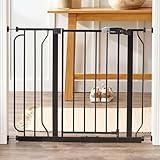
- ✅TESTED & TRUSTED BABY SAFETY GATE FOR OVER 30 YEARS: Parent-trusted safety gate certified by the Baby Safety Alliance.
- ❤️AMERICAN DESIGNED & FAMILY OWNED BABY GATE BRAND: Designed in the USA by parents, for parents. Regalo is a family-owned, US-based brand delivering trusted baby safety gates and child safety products for over 30 years.
- 🔒EXTRA WIDE BABY GATE FOR DOORWAYS & BOTTOM OF STAIRS: Expands to fit openings 29–38.5" wide and stands 30". Ideal for bottom of stairs, hallways, and doorways. FITS OPENINGS: 29–32" no extension, 35.5–38.5" with 6". DOES NOT FIT OPENINGS: 32–35.5".
- EASY SETUP WITH PRESSURE MOUNT DESIGN: ⚠️Install according to manufacturer’s instructions. ⚠️Wall cups must be used to keep the gate securely in place. ⚠️ To prevent falls, never use at the top of stairs.
- 🐾CHILD & PET SAFE | PUERTA DE SEGURIDAD PARA BEBÉS Y MASCOTAS: Walk-through safety gate designed for babies 6–24 months and small to medium pets. Features a secure safety locking system for parent convenience.
How should I prepare my dog before the baby arrives?
Preparation gives the dog predictable skills and a safe place to go before the household changes. Start early enough to practise in short, rewarding sessions.
Quick wins for a faster PC:
Clear out junk files and repair common Windows errorsFree Scan →Fix the driver behind crashes, sound loss and screen glitchesFind Drivers →Teach practical cues and a retreat
Build reliable sit, down, stay, wait, recall, leave-it and drop-it responses. Practise them around gradually increasing distractions, then reward the dog for returning attention to you. Teach a mat, bed or crate as a place to settle, and release the dog only when calm. A retreat should remain available without a child following the dog into it.
Introduce baby-related sights, sounds and smells
Pair low-volume recordings of crying with treats, increasing intensity only while the dog remains relaxed. Let the dog investigate prams, changing equipment and new furniture at its own pace. Before the first meeting, offer a blanket or item of clothing carrying the baby’s scent and reward calm investigation; do not push it toward the dog’s face.
Set boundaries and physical zones
Decide which rooms are dog-free, where the dog will eat and sleep, and where the retreat will be placed. Install gates and practise moving the dog behind them while you carry a doll, fold laundry or follow a bedtime routine. Keep cot and nursery rules consistent from the first day.
Protect normal routines
Keep walks, exercise, feeding and one-to-one attention as consistent as practical. If someone else will walk or feed the dog after birth, introduce that person beforehand. Food puzzles or a safe chew can support settling, but they do not replace supervision or separation.
Do these 3 things before closing this tab:
1Scan for outdated or missing drivers - takes under a minute2Repair Windows errors before they cause bigger problems3Fix the driver behind crashes, sound loss and screen glitchesAlso popular on Amazon

- [Worry-Free Safety]: Our expandable dog gate is great for doorways and blocking off other indoor spaces to keep your pet safe and secure. This durable puppy gate is made of strong, appealing fieldstone gray plastic with adorable paw print accents.
- [Convenient and Portable]: This gate for dogs is 23" tall, fits a variety of openings 26" - 40" wide. Please measure carefully: it will not work in a wider doorway. It is easy to take down and install - which means you can use it anywhere you need it!
- [Perfect for Modern Homes]: Our portable, adjustable pet gate features rubber bumpers that protect your walls and are positioned higher than other gates to accommodate up to 4" molding. It's an ideal indoor dog gate.
- [Easy and Comfortable to Use]: The sturdy, curved handle allows for a firm grip, which makes mounting and disassembling a breeze!
- [Proud USA-Owned Company]: Our rigorously tested gates & yards bring peace of mind to your family. We stand for the highest safety & quality standards while creating the ideal products for your furry friends. This item is proudly made in the USA!
Arrange health and behavior advice
Ask a veterinarian to investigate pain, illness, hearing or vision changes and any behavior concern before the baby comes home. A suitably qualified behaviorist can help with fear, guarding, predatory fixation or poor response to cues. Do not wait for a bite to seek advice.
How do I safely introduce my dog to my baby?
Keep the first meeting quiet, brief and optional for the dog. Have a second adult available so one person can hold the baby while the other handles the dog.
- Begin with scent. Present a baby blanket or clothing item and reward relaxed sniffing. If the dog avoids it, stares, stiffens or becomes frantic, put it away and try later from a greater distance.
- Choose a calm room. Remove food bowls, chews and toys that could trigger guarding. Put the dog on a leash and make sure the adult holding it can control the dog without pulling.
- Let the dog choose. Keep the leash loose and allow approach only if the dog decides to come closer. Do not carry the baby toward the dog, force a sniff or hold the dog in place. Praise quiet observation and a soft, relaxed body.
- Keep contact short. End the session while both are calm. If the dog licks its lips, yawns repeatedly, turns away, lowers its ears or tail, avoids eye contact, growls, snaps or fixates, calmly increase distance and place the dog behind a barrier.
- Build duration slowly. Repeat brief sessions on separate occasions. Increase time only after repeated relaxed responses. Off-leash contact is a later step, and only appropriate when the dog is very relaxed, responsive and still directly supervised.
After any separation, give the dog a quiet activity in its retreat rather than scolding. Punishment can make the baby predict unpleasant events and can suppress warning signals without removing the underlying fear.
What signs show that my dog is stressed around the baby?
Some dogs move away; others freeze or stay near the baby while showing subtle discomfort. A dog may not leave on its own, so the adult must create space.
Free tools Windows power users keep installed
One-click scans. No signup required.
| Signal | What it can mean | Adult response |
|---|---|---|
| Lip licking, yawning or repeated swallowing | The dog may be uncomfortable or trying to calm itself. | Pause the interaction, increase distance and invite the dog to its retreat. |
| Turning the head or body away, avoiding eye contact | The dog wants space and is disengaging. | Move the baby away; do not follow or coax the dog closer. |
| Lowered ears or tail, crouching, furrowed brow | Fear, uncertainty or rising arousal. | End contact and use a barrier; resume only with professional guidance if it repeats. |
| Stiff posture, hard stare, persistent fixation or inability to respond | The dog may be over-aroused or focused on the baby. | Do not touch the dog’s collar suddenly. Use distance, a calm cue if reliable, and secure separation. |
| Growling, snapping or showing teeth | A serious warning that the dog needs immediate space. | Separate without punishment and contact a veterinarian with behavior expertise or a qualified behaviorist. |
Never punish a growl. It is useful information that the dog is struggling; removing the warning can leave you with less notice before a bite.
Also popular on Amazon

- WORRY FREE SAFETY: Our expandable dog gate is great for doorways and blocking off other indoor spaces to keep your pet safe and secure. This durable puppy gate is made of strong, appealing light gray plastic with adorable paw print accents.
- CONVENIENT AND PORTABLE: This gate for dogs is 23" tall, fits a variety of openings 26" - 40" wide. Please measure carefully: it will not work in a wider doorway. It is easy to take down and install - which means you can use it anywhere you need it!
- PERFECT FOR MODERN HOMES: Our portable, adjustable pet gate features rubber bumpers that protect your walls and are positioned higher than other gates to accommodate up to 4" molding. It's an ideal indoor dog gate.
- EASY AND COMFORTABLE TO USE: The sturdy, curved handle allows for a firm grip, which makes mounting and disassembling a breeze!
- PROUDLY MADE IN THE USA: Our rigorously tested gates, yards & pens bring peace of mind to the entire family. We stand for the highest safety, quality and operational standards while creating the ideal collection of products for your furry friends. This item is proudly made in the USA!
Which places and interactions must stay off-limits?
Management is easiest when the rules apply every time, including when the baby is asleep.
- Sleep areas: Keep pets out of the cot, crib, bassinet and room where the baby sleeps. A sleeping infant must never share a sleep surface with a dog.
- Food and valued objects: Keep the baby away while the dog eats, sleeps, rests, is injured or has a chew, toy or other guarded item. Feed behind a closed door or gate.
- Rough handling: Do not allow hugging, kissing, riding, grabbing fur or ears, chasing, cornering or climbing on the dog. Teach gentle, adult-led contact as the child develops.
- Forced contact: Never hold the dog still for a photograph or push the baby toward its nose. The dog must be able to retreat.
- Uncontrolled access: Do not allow the dog to lick the baby’s face, pull at blankets or approach medical equipment without an adult managing distance.
As the child becomes mobile, supervision must continue. Crawling and grabbing can be more challenging for a dog than a quiet newborn, so reinforce gates and the dog’s retreat before that stage.
What should I do when I cannot supervise?
Separate first, then attend to the task. Put the dog behind a securely latched gate or closed door, in a suitable crate if crate-trained, or have another adult take responsibility for the dog. Confirm that the baby is in a safe sleep or care space and that the dog cannot reach the cot, food or toys.
Recommended Free Tools
Use the same plan for short absences, visitors, deliveries, bathing, cooking and nighttime. A monitor can help you hear a baby, but it does not make unsupervised dog access safe. If a barrier fails, the dog can open doors, or no adult can guarantee separation, change the room arrangement or obtain professional help before allowing shared time.
Independent reader supportYour contribution helps us test, update, and keep practical guides available for everyone.When should I call a veterinarian or behaviorist?
Seek prompt professional assessment for growling, snapping, biting, predatory fixation, repeated stress signals, resource guarding, sudden behavior change or any incident that makes you doubt your ability to separate dog and baby. A veterinarian can check for pain or illness and refer you to a qualified behavior professional. Until assessed, keep the dog and baby physically separated rather than attempting another introduction.
Also popular on Amazon

- ✅ TESTED & TRUSTED BABY SAFETY GATE FOR OVER 30 YEARS: Parent-trusted baby safety product certified by the Baby Safety Alliance. Designed to support everyday baby proofing and help keep babies and toddlers safe at home.
- ❤️AMERICAN DESIGNED & FAMILY OWNED BABY GATE BRAND: Designed in the USA by parents, for parents. Regalo delivers dependable baby gates and baby safety products trusted by families for over 30 years.
- 🔒EXTRA WIDE BABY GATE FOR DOORWAYS & BOTTOM OF STAIRS: Expands to fit openings 29–38.5" wide and stands 30" tall. Ideal for bottom of stairs, hallways, and wide openings. FITS OPENINGS: 29–32" no extension, 35.5–38.5" with 6". DOES NOT FIT OPENINGS: 32–35.5".
- EASY SETUP WITH PRESSURE MOUNT DESIGN: ⚠️Install according to manufacturer’s instructions. ⚠️Wall cups must be used to keep the gate securely in place. ⚠️ To prevent falls, never use at the top of stairs.
- 🐾 CHILD & PET SAFE | PUERTA DE SEGURIDAD PARA BEBÉS Y MASCOTAS: Walk-through safety gate designed for babies ⚠️6–24 months and small to medium pets. Features a secure safety locking system for parent convenience.
Bring a clear description of what happened, the distance between dog and baby, the dog’s body language, the presence of food or toys and what stopped the behavior. Do not arrange a “test” encounter to see whether the problem has gone away.
How can a household make supervised time predictable?
Use a written routine that every caregiver follows. Before bringing the baby into a room, remove high-value items, confirm the dog has a retreat route and decide which adult is watching. During the interaction, reward calm responses, keep the session short and separate at the first stop signal. Afterward, give the dog quiet rest and maintain its normal exercise and individual attention.
Review the plan whenever the baby reaches a new developmental stage, the dog becomes ill, visitors arrive or furniture changes. A setup that worked for a motionless newborn may not work once the child crawls toward a resting dog. Safety depends on management that changes with both individuals, not on a one-time introduction.
Common mistakes that increase risk
- Assuming a dog is safe because it has never bitten anyone.
- Leaving the baby and dog together while an adult sleeps, showers or uses a phone.
- Allowing the dog to enter the cot or nursery “just this once.”
- Ignoring lip licking, turning away or a lowered tail because there is no growl.
- Punishing a warning instead of creating distance.
- Taking away exercise, attention or the dog’s retreat immediately after birth.
- Letting a child approach the dog during eating, sleeping, illness or chewing.
- Moving to off-leash contact after one calm meeting rather than several relaxed sessions.
Frequently Asked Questions
Can a dog sleep in the same bedroom as a newborn?
The safest arrangement is for the dog to stay out of the room where the baby sleeps, including overnight. Use a closed door or secure gate and keep the baby’s cot or bassinet free of pets; nighttime monitoring does not replace physical separation.
Should I let my dog lick my baby?
Avoid face licking and do not allow the dog to pull at blankets or medical equipment. A newborn’s immune system and airway are vulnerable, and preventing close contact is simpler than trying to predict how the dog will react to sudden movement.
What if my dog refuses to approach the baby?
Do not coax, carry or lure the dog closer. Avoidance is information that the dog needs distance; continue neutral separation and ask a veterinarian or qualified behaviorist for a gradual plan if the response persists.
How should I prepare older children to live safely with the dog and baby?
Teach children never to enter the dog’s retreat, disturb eating or sleeping, or take away a chew. Adults remain responsible for supervision; children should not be assigned to watch a baby and dog together.





Leave a Reply