The Great Lakes and their tributaries support a diverse fish community, including 177 species—139 native and at least 34 non-native—according to the Great Lakes Fishery Commission. The fish people encounter and the fishing available depend on the lake, habitat, and local rules: commercial fisheries feature lake whitefish, walleye, yellow perch, and ciscoes, while recreational fishing also draws anglers to salmon, trout, muskellunge, and other species.
Which fish live in the Great Lakes?
The Great Lakes Fishery Commission describes 177 fish species in the lakes and their tributaries: 139 native species and at least 34 non-native fish species. These figures are from the Commission’s overview, which does not give them a publication year. Non-native does not automatically mean invasive or harmful; the Commission uses invasive for established non-native species that have negative ecosystem consequences.


The region’s fish communities include species that support commercial harvest, recreational fishing, or both. Those broad roles do not mean a species is abundant, catchable, or open to harvest at every location.
Commercial and recreational fish
- Commercial fishery: Lake whitefish, walleye, yellow perch, and ciscoes are identified by the Commission as foundational species.
- Recreational fishing: Salmon, trout, walleye, and muskellunge are among the fish that support angling.
The groups overlap: walleye, for example, are important in both contexts. The Commission’s overview is not a complete inventory of locally available targets or a forecast of current stocks.
Free tools Windows power users keep installed
One-click scans. No signup required.
#1 Best Overall
Where do fishing opportunities vary?
Fishing differs among lakes and locations because species use different habitats and local fisheries are managed by multiple jurisdictions. The following examples illustrate the range of opportunities; they are not a seasonal calendar or a guarantee of current availability.
| Area | Habitat or setting | Species highlighted | Fishery context |
|---|---|---|---|
| Lake Michigan, especially Green Bay | Nearshore | Yellow perch, walleye, smallmouth bass, pike, and panfish | Recreational opportunities described by the Great Lakes Fishery Commission |
| Lake Erie | Lake and connected habitats; the cited overview does not specify a fishing zone | Walleye, yellow perch, white bass, and lake whitefish; black bass, muskellunge, and rainbow trout are also listed among managed species | Species identified as intensively managed or otherwise managed; this is not a current catch forecast |
For current conditions and local fishing options, consult the responsible fisheries agency rather than assuming that a species listed for a lake is available, open, or plentiful where you plan to fish.
Why do habitats and connections matter?
Many Great Lakes fish rely on more than one aquatic habitat during their life cycle. Spawning, egg and fry survival, and growth at juvenile and adult stages can depend on suitable conditions across the lakes and their watersheds.
Walleye as an example
The Commission describes walleye as using tributary, nearshore, and offshore habitats to complete their life cycle. A change or barrier in one part of this connected system can matter beyond that single location, which is why habitat and fishery management are considered together.
How are Great Lakes fisheries managed?
Management is cooperative across U.S. and Canadian jurisdictions. Provincial, state, and tribal agencies work with support from Canadian and U.S. federal governments. The Great Lakes Fishery Commission coordinates fisheries research, controls invasive sea lamprey, and facilitates cooperative management among these agencies.
Shared work includes setting fish-community objectives, stocking predator fish, regulating harvest, and enforcing fishing regulations. Individual agencies implement management actions and establish rules. As a result, there is no single Great Lakes-wide season, size limit, bag limit, or license rule to apply everywhere.
What should anglers check before fishing?
- Identify the exact location and jurisdiction. A lake name alone may not be enough; rules can depend on the state, province, or tribal jurisdiction and the specific waters you plan to fish.
- Find the current rules from the responsible local fisheries authority. Confirm the season, size and harvest limits, license requirements, and any special waterbody rules before you go.
- Check fish-consumption advisories separately. Eating guidance is location- and fish-specific; do not treat a catch limit or a general Great Lakes guide as a consumption recommendation.
- Match your plan and tackle to the location and target. Nearshore, tributary, and offshore settings differ, as do target species. General fishing tackle is not one-size-fits-all; use current local guidance or advice from a knowledgeable local source.
How can invasive species affect fish?
Invasive species can affect fisheries through competition for food or habitat, predation, and broader disruption of food webs. Commission examples include sea lamprey, alewife, dreissenid mussels, round gobies, and spiny water flea. Their effects vary; these examples should not be taken to mean that all non-native fish or organisms are invasive or harmful.
Quick Recap
Best Value
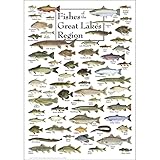
- "This stunning poster includes 106 fish species, both common and exotic, found in the Great Lakes and their tributaries"
- "Illustrations by Duane Raver, Ellen Edmundson, famed illustrator for the New York Conservation Dept."
- "Printed on #80 coated stock using fade resistant inks and the highest production values, it is truly museum quality and suitable for framing"
- Posters measures 19_ X 27_
- Shipped in a heavy-walled 2_ mailing tube with plastic endcaps
Product prices and availability are accurate as of the date/time indicated and are subject to change. Any price and availability information displayed on Amazon at the time of purchase will apply.




