Recommended Free Tools
Opercula pass water over the gills of stationary fish through a coordinated buccal-opercular pump: the mouth opens to draw water in, the mouth closes, and the opercula open as pressure changes drive water across the gills and out behind the gill covers. This mechanism lets typical bony fish breathe without forward swimming.
The operculum is therefore both a protective cover and a working part of the ventilation system. The explanation is most accurate for an operculate bony fish, not for every fish species.
As an Amazon Associate I earn from qualifying purchases.
Key takeaways
- A typical stationary bony fish ventilates its gills with a coordinated buccal-opercular pump rather than relying on forward swimming.
- During intake, the mouth opens while the opercular outlets are closed or restricted; during discharge, the mouth closes and the opercula open.
- Water normally travels one way—from the mouth, across the gills, and out through the openings behind the opercula.
- The operculum protects the gills and helps change pressure and volume inside the opercular cavity.
- Countercurrent flow between water and blood helps the gill lamellae extract dissolved oxygen.
How do opercula pass water over the gills of stationary fish?
Opercula pass water over the gills of stationary fish as part of a coordinated buccal-opercular pump. The fish opens its mouth and expands its buccal cavity to draw water in, then closes the mouth while the opercular covers open and the connected cavities contract. Pressure differences drive water across the gill filaments and lamellae before the water exits behind the opercula.
This mechanism applies most directly to a typical operculate bony fish, such as many familiar freshwater and marine fish. “Operculate” means that the gills are covered by a movable bony plate. The explanation should not be generalized to every fish: sharks and rays have exposed gill slits, while some fast-swimming fish depend substantially on forward motion to ventilate their gills.
#1 Best Overall

- Complete Anatomical Model - Includes a life-size model of a whole bass, with one side displaying the external coloration and the other side revealing detailed internal anatomical structures.
- Removable Internal Organs - Features removable swim bladder, intestines, and head, facilitating hands-on teaching and anatomical observation.
- Essential Teaching Tool - Features clear numbered labels and five-part structural markings for quick identification. Ideal for biology experiments in schools, laboratories, and home education settings.
- Includes Instructional Guide - Comes with a detailed product information card that explains the anatomical structures and provides key teaching points to support effective classroom instruction and self-directed learning.
- Suitable for Multiple Settings - Perfectly meets the needs of educators, students, medical professionals, home learners, and artists. Ideal for classroom instruction, science exhibitions, biology displays, and personal study.
What happens during the buccal-opercular pumping cycle?
The fish’s mouth, buccal cavity, opercular cavities, valves, body-wall structures, and respiratory muscles work together. The operculum is not an independent external pump that simply sucks water over the gills; the operculum is one moving part of a coupled pressure-and-valve system.
- Intake: The mouth opens and the buccal cavity expands. Water is drawn into the mouth and pharyngeal region. The opercular cavities also expand, helping establish the pressure pattern that maintains the respiratory flow.
- Sealing the front opening: The mouth closes after water enters. Closing the mouth helps prevent the newly inhaled water from escaping through the front of the fish.
- Discharge: The opercular openings open while the buccal and opercular cavities contract. The resulting pressure difference pushes and pulls water posteriorly across the gills.
- Exit: Water leaves through the openings behind the opercula. The usual route is therefore mouth → pharyngeal region → gills → opercular openings.
The University of Hawaiʻi’s explanation of fish structure and function describes the buccal pump as the mechanism fish use to move water over their gills when they are not swimming. In practical terms, the rhythmic opening and closing of a resting fish’s mouth and gill covers is visible evidence of active ventilation.
How do the buccal and opercular pumps work together?
The buccal pump contributes pressure from the mouth and buccal cavity, while the opercular pump contributes suction and outlet control from the opercular cavity. Their timing produces a more sustained flow through the gill chamber than either component would typically provide alone.
The Tool Desk
Outbyte Driver Updater FREEScan for outdated or missing drivers - takes under a minuteDriver Scan →Outbyte PC Repair FREEClear out junk files and repair common Windows errorsFree Scan →| Component | Main movement | Contribution to ventilation |
|---|---|---|
| Buccal pump | Buccal cavity expands and contracts | Draws water into the mouth and helps push water toward the gills |
| Opercular pump | Opercular cavity and cover move relative to the gill chamber | Helps pull water through the branchial cavity and controls the outlet |
| Coordinated pump | Mouth and opercular openings change state in sequence | Maintains generally one-way flow from mouth to gills to opercular openings |
The University of Tennessee’s respiratory-pump resource explains the alternating movements of the buccal and opercular cavities. The exact timing and relative contribution of pressure and suction vary among species, but the central principle is the same: changing cavity volume changes pressure and moves water through the branchial chamber.
Why can a fish breathe while remaining almost motionless?
A stationary fish cannot use forward swimming speed to ram fresh water through its mouth and across its gills. Active branchial ventilation solves that problem by repeatedly expanding and compressing internal cavities. The fish can remain nearly still while its mouth and opercula generate the water flow needed for gas exchange.
“Stationary” does not mean that the fish is physiologically inactive. Respiratory muscles continue to move the mouth, gill chamber, and opercular covers, even when the fins and body are not producing forward motion. The visible rhythm may become faster or stronger when oxygen demand rises, although the exact response depends on the species and circumstances.
Rank #2

- COMPLETE ANATOMICAL MODEL || Includes full-body carp model at natural size, with exterior coloring on one side and detailed internal anatomy on the other.
- REMOVABLE ORGANS || Features detachable air bladder, intestines, and testicles to support hands-on instructional use and examination.
- EDUCATIONAL || Illustrates both external morphology and internal systems including the skeleton, gills, and digestive structures.
- SUITABLE FOR CLASSROOM USE || Ideal for biology, zoology, comparative anatomy, and aquatic science studies at various educational levels.
- MOUNTED DISPLAY AND KEY CARD || Mounted on a base for stability and includes an English key card for easy identification of anatomical structures.
How does water move across the gills and become oxygenated?
Water crosses the gill filaments and their smaller lamellae, where dense networks of blood capillaries lie close to the respiratory surface. Dissolved oxygen diffuses from the water into the blood, while carbon dioxide diffuses from the blood into the water.
Water and blood flow in opposite directions across the lamellae. This countercurrent exchange arrangement helps preserve a difference in oxygen concentration along the respiratory surface, allowing oxygen uptake to continue as water travels across the gill. The University of Michigan’s fish respiratory-physiology resource describes the relationship between gill ventilation, lamellar exchange, and countercurrent flow.
The complete sequence is:
Buccal-opercular pumping → one-way water flow → water crossing the gill lamellae → oxygen entering blood and carbon dioxide leaving blood.
A physical fish gill anatomy model can be an optional classroom or study aid for visualizing the operculum, gill arches, filaments, lamellae, and direction of water flow. A model is not aquarium equipment and is not required for a fish to breathe; its value is that it makes internal structures and the pumping pathway easier to see.
How is stationary ventilation different from ram ventilation?
Stationary ventilation uses active movements of the mouth, opercula, and associated cavities, whereas ram ventilation uses forward swimming to force water through the mouth and across the gills. Some fish can shift toward ram ventilation as swimming speed increases, and some retain active pumping while swimming.
| Feature | Active branchial ventilation | Ram ventilation |
|---|---|---|
| Primary source of water movement | Mouth, opercula, cavities, valves, and respiratory muscles | Forward swimming and the resulting flow of water into the mouth |
| Can support a stationary fish? | Yes, in typical operculate bony fish | No; ram flow depends on forward movement |
| Role of the operculum | Contributes to pressure changes and controls the outlet | May be less central to generating flow when swimming supplies the water movement |
| Use among fish | Common in fish that ventilate while resting | Important or supplementary in some active swimmers |
The balance between the two strategies depends on species, body form, habitat, and activity level. The peer-reviewed discussion of active branchial and ram gill ventilation in fishes is useful for understanding why a single explanation should not be applied equally to resting fish, continuously swimming fish, sharks, rays, and other specialized forms.
Rank #3

- ✔ This model demonstrates the important internal organs of fish. From the gills to the digestive system, every aspect has been meticulously recreated for a comprehensive educational tool.
- ✔ Adult fish samples are anatomical reference, exquisite work, they can be divided into 3 parts, easy disassembly for In-depth study, facilitating a deeper understanding of their functions and relationships within the larger fish anatomy.
- ✔ This model demonstrates the important internal organs of the fish, such as the respiratory system, the circulatory system and the basic physiological structure of the fish.
- ✔ The full view of some iconic anatomy anatomical structures of the fish, which show in detail the major internal organ systems of fish, it is a rare commodity in teaching aquaculture.
- ✔ Very suitable for school teaching, learning, research and display can also be used as an important supplement for laboratory decorations.
What does the operculum do besides moving water?
The operculum has two closely connected jobs: protecting delicate respiratory tissues and helping ventilate them. As a bony plate, the operculum shields the gill filaments and gill chamber from physical damage. As a movable part of the respiratory pump, the operculum changes the volume and pressure of the opercular cavity and helps regulate the opening through which water leaves.
That dual function explains why the gill covers are so important in a resting fish. The covers are not merely lids over the gills. Their movement is mechanically linked to the pressure changes that keep water passing over the respiratory surface.
Does the operculum work the same way in every fish?
No. The buccal-opercular pump is the appropriate general model for a typical operculate bony fish, but fish respiratory systems vary. Some fish have gill covers and actively pump water at rest; some active swimmers use substantial ram ventilation; and sharks and rays have gill slits rather than a bony operculum.
Do these 3 things before closing this tab:
1Repair Windows errors before they cause bigger problems2Scan for outdated or missing drivers - takes under a minute3Clear out junk files and repair common Windows errorsThe comparative study of gill ventilation in marine teleosts published in the Journal of Experimental Biology illustrates why ventilation should be considered in relation to species and swimming condition. A statement about “fish” without the qualification “typical operculate bony fish” can therefore be misleading.
Independent reader supportYour contribution helps us test, update, and keep practical guides available for everyone.What should you look for when observing a resting fish?
A resting operculate bony fish commonly shows a repeating cycle of mouth movement and opercular movement. The observation supports active branchial ventilation, but the visible motion alone does not reveal the exact pressure contribution of each cavity or prove that every species uses precisely the same timing.
- Watch for rhythmic mouth opening and closing.
- Look for the opercular covers moving in a coordinated pattern.
- Think of the flow as entering at the mouth and leaving behind the opercula, rather than moving randomly in and out.
- Do not assume that a fish that swims continuously has the same dependence on active pumping as a fish resting in place.
The simplest accurate description is that a stationary bony fish actively pumps water: the buccal cavity helps draw and push water, the opercular cavity helps pull and discharge it, and the gills extract oxygen as the water passes over the lamellae.
Rank #4
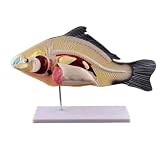
- Complete Anatomical Model - Includes a life-size model of a whole fishi, with one side displaying the external coloration and the other side revealing detailed internal anatomical structures
- Essential Teaching Tool - This model demonstrates the important internal organs of fish, such as the respiratory system, the circulatory system and the basic physiological structure of fish
- Removable Internal Organs - Adult fish specimens are an anatomical benchmark, an exquisite finish, can be divided into 3 parts.The aquatic anatomy is an important part of animal anatomy
- Premium Material - The model is made of high quality ecological PVC, purely hand painted, durable and long service life and comes with a sturdy base for display
- Wide Application - Very suitable for school education, learning, research display and can also be used as an important supplement for laboratory decorations, also is a rare product in the teaching of aquaculture
Frequently Asked Questions
How do fish breathe when they are not swimming?
A stationary bony fish breathes by actively expanding and contracting its buccal and opercular cavities. The mouth and opercula move in sequence to draw water in, drive it across the gills, and release it behind the opercular covers.
How does the operculum pump water over the gills?
The operculum helps ventilate the gills by changing the volume and pressure of the opercular cavity and controlling the outlet for water. The operculum also protects the gill filaments and gill chamber.
Which way does water flow through a fish’s gills?
Water normally moves from the mouth, across the gill filaments and lamellae, and out through the openings behind the opercula. Blood flows opposite to the water across the lamellae, supporting countercurrent oxygen exchange.
What is the difference between active branchial ventilation and ram ventilation?
Ram ventilation uses forward swimming to drive water through the mouth and across the gills, while active branchial ventilation uses movements of the mouth, opercula, and internal cavities. Some fish use both strategies depending on swimming speed and species.
The Bottom Line
A stationary operculate bony fish does not need forward swimming to ventilate its gills. The fish alternates mouth and opercular movements in a buccal-opercular pump: water enters through the mouth, passes one way across the gills, and exits through the opercular openings while countercurrent exchange transfers oxygen into the blood.
What’s actually slowing this PC down?
Pick the symptom - the matching free tool is one click away.
Quick Recap
Product prices and availability are accurate as of the date/time indicated and are subject to change. Any price and availability information displayed on Amazon at the time of purchase will apply.




