The Tool Desk
Outbyte Driver Updater FREEFix the driver behind crashes, sound loss and screen glitchesFind Drivers →Outbyte PC Repair FREERepair Windows errors before they cause bigger problemsFix Now →There is no single lifespan for turtles: it depends on the species, and published figures are not always measured the same way. The California Department of Fish and Wildlife says red-eared sliders may live up to 20 years in the wild and up to 40 years in captivity; the Smithsonian reports that eastern box turtles generally live 25–35 years, though some have survived beyond 100.
Sea turtles and tortoises have their own species-specific lifespans. NOAA Fisheries says loggerhead sea turtles can live 80 years or more, while the National Park Service gives a lifespan of 40–60 years for gopher tortoises.
Those figures are not interchangeable. Species, habitat, disease, predation, human activity, and the quality of captive care all affect how long an individual turtle lives. Published figures may describe a general range, an upper estimate, or exceptional longevity rather than a typical lifespan.
How long do different turtles live?
| Turtle or tortoise | Reported lifespan | What the number means |
|---|---|---|
| Red-eared sliders (pond sliders) | Up to 20 years in the wild; up to 40 years in captivity | Upper estimates reported by the California Department of Fish and Wildlife. |
| Eastern box turtles | Generally 25–35 years; some have survived beyond 100 years | The Smithsonian’s National Zoo and Conservation Biology Institute distinguishes the general range from exceptional longevity. |
| Loggerhead sea turtles | 80 years or more | A lifespan estimate reported by NOAA Fisheries. |
| Hawaiian green sea turtles | 70 years or more | NOAA Fisheries reports this estimate based on 52 years of research on nesting turtles. |
| Gopher tortoises | 40–60 years | A species-specific range reported by the National Park Service; it is not a lifespan range for all tortoises. |
“Turtle” is used here in the broad everyday sense for shelled reptiles, including aquatic turtles, box turtles, sea turtles, and tortoises. Tortoises are primarily land-dwelling, while many animals called turtles live in water or divide their time between water and land. Their different biology and habitats help explain why lifespan estimates vary so widely.
#1 Best Overall

- 【Complete Starter Kit for Small Reptiles】Package includes all accessories you need for a tank starter kit: 1*tank, 1*lamp+2*bulbs, 1*filter+2*filter plate, 1*PVC pipe, 1*sponge, 2*decorative plant, 1*cleaning brush, 1BAG rocks(240g), 1* manual. Save your time and trouble shopping for all parts separately!
- 【Compact Tank & Easy to Install】Tank size 15.4” x 10.6” x 7.1”. Maximum water level: 2.56’’. Perfect for small turtles, crabs and other small reptiles within 3.0’’. The installation is an easy job with our manual inside the pack!
- 【UVA/UVB Basking Lamp + 25W/35W Bulbs】Turtles need to bask in the sunshine everyday 1-2 hours for metabolism, mood regulation, breeding, etc. 25W/35W Bulbs provide best warmth within distance of 10’’ to 15’’. They’re perfect for this small tank, not too hot not too cold.
- 【3.5W Waterfall Filter + 3-Layer Filter Plates】 Our compact but powerful filter keeps water clean and provides shower for your pet. Please use the hook to hang the filter to stabilize it! Suitable for turtle or fish tanks of 1-15 gallons. [FILTER MOTOR MAINTENANCE] 1. Take out the motor and rinse to remove debris regularly. 2. Keep water level above the water inlet area to reduce noise and prevent dry burn!
- 【Easy to Use & Clean】Bottom drainage outlet and a PVC drain pipe are equipped to help you change water in no time. Four rubber foot stands are stable and anti-slip. There is an area to DIY your green planting as you like.
Do turtles really live 100 years?
Some do, but “turtles live 100 years” is too broad to be a useful general rule. The Smithsonian reports that eastern box turtles generally live 25–35 years, with some individuals surviving beyond 100 years. That century-plus figure is exceptional longevity, not the usual expectation.
There is also an important difference between a typical lifespan, a general range, and a maximum or exceptional age:
- Typical lifespan or general range describes what is reported for a species under ordinary conditions, where that information is available.
- Maximum or exceptional age refers to an unusually old individual or the upper edge of available evidence.
For example, the California Department of Fish and Wildlife reports up to 40 years in captivity for red-eared sliders; that does not mean every slider normally lives 40 years. Similarly, box turtles reported to survive beyond 100 years are exceptional, not representative of the general range.
Why do turtles live so long?
Turtles and tortoises generally grow slowly, mature later than many small animals, and can continue living for decades after reaching adulthood. Their hard shells offer protection from some predators, and adults of certain species have relatively low natural mortality compared with hatchlings.
Quick wins for a faster PC:
Repair Windows errors before they cause bigger problemsFix Now →Scan for outdated or missing drivers - takes under a minuteDriver Scan →Clear out junk files and repair common Windows errorsFree Scan →That does not mean turtles are invulnerable. Their early life can be extremely dangerous: eggs and hatchlings may be eaten by predators, and young turtles are vulnerable to dehydration, disease, habitat loss, and accidents. For long-lived species, the survival of established adults is especially important because replacing one mature turtle can take many years.
Species differences are decisive. A sea turtle, freshwater slider, terrestrial box turtle, and tortoise have different growth rates, diets, habitats, reproductive schedules, and threats. Those biological differences matter more than the generic label “turtle.”
Do wild turtles live longer than pet turtles?
There is no universal winner. Captive turtles may avoid major wild hazards such as predators, road traffic, fishing bycatch, food shortages, and some forms of habitat loss. They may also receive consistent food, controlled temperatures, and veterinary treatment.
Rank #2

- Complete Large Turtle Tank Kit: Create the perfect home for your pet with this large turtle tank starter kit—includes a spacious tank, secure acrylic walls, basking platform, UVB lamp, advanced filter, floating feeding ring, 3 plants, and hydroponic planters. The ultimate starter bundle.
- Healthy & Clean Turtle Habitat Kit: Support your turtle’s well-being with UVA-UVB lighting and a quiet low-water filter designed for aquatic turtles. This turtle terrarium keeps your water fresh and your pet active with a basking zone for proper heat absorption.
- Turtle Aquarium Kit with Natural Style: Turn your pet’s tank into a beautiful scene with included fake plants and real-plant hydroponic planters. This aquarium for turtles adds visual appeal and natural comfort, perfect for all turtle lovers and home setups.
- Easy Feeding & Drainage for Busy Owners: Smart design features like the floating feeding ring keep your turtle’s food in one place, while the drain hole makes water changes quick. Great for anyone wanting a baby turtle tank habitat kit that’s easy to manage.
- Built for Beginners & Turtle Pros: Whether you're starting fresh or upgrading, this turtle starter kit offers space, visibility, and thoughtful accessories. Durable acrylic gives 360° viewing with less weight than glass—ideal for baby turtles and growing red eared sliders.
On the other hand, captivity can create serious risks when the enclosure, water quality, lighting, diet, or temperature is wrong. A turtle kept in an unsuitable enclosure may develop preventable health problems. Captive lifespan figures can also be difficult to interpret because an animal’s age at acquisition may be unknown and reported ages are not always verifiable.
Wild lifespan estimates have the opposite problem: following one turtle for several decades is difficult, especially for ocean-ranging species. Researchers may use marking, recapture, growth, demographic, and population data rather than observing an animal continuously from hatching to death. As a result, a published lifespan may be an informed estimate rather than a precise birthday-to-death record.
Can you tell a turtle’s age by counting shell rings?
Not reliably in every turtle. Some young turtles and some species develop growth lines, or annuli, that can provide clues about age. However, growth is affected by food, temperature, health, season, and habitat. As a turtle ages, shell wear can erase or distort the lines, making them difficult to interpret.
Counting shell rings is therefore not an exact, universal aging method. A known hatch date is stronger evidence. For an older turtle, a long-term marking or ownership record may be more useful than attempting to count worn rings. Shell-ring counts should be treated as an estimate, not a guaranteed age.
What helps a pet turtle live a long, healthy life?
Good care supports health and welfare, but it cannot guarantee a particular lifespan. Requirements differ considerably between species, so identify the turtle before choosing equipment or changing its diet. Some turtles need special food and tanks, and some aquatic species grow large enough to require substantial swimming and basking space, according to the Indiana Department of Natural Resources.
Provide an adult-sized, species-appropriate enclosure
A hatchling’s current size is not a suitable basis for planning its entire home. The enclosure should accommodate the animal’s adult size, swimming or walking behavior, turning space, basking area, and safe retreat. Aquatic turtles need enough clean water to swim normally, while terrestrial species need appropriate land substrate and shelter.
Build a safe temperature gradient
Turtles regulate body temperature through their environment. A setup should normally provide a warmer basking zone and cooler areas so the turtle can move between temperatures rather than being held at one temperature throughout the enclosure. Exact temperatures depend on species and life stage; use a reliable thermometer and follow species-specific guidance or a reptile veterinarian’s advice.
Rank #3

- 【Durable & Shatter-Resistant PC Material】Medium-Sized Turtle Tank: 13.4”L x 8.8”W x 9.3”H. Made from high-quality polycarbonate (PC), this turtle tank is strong, impact-resistant, and safer than glass. Designed to be durable and long-lasting while maintaining crystal-clear visibility
- 【Complete Turtle Starter Kit – Ready to Use】Includes turtle tank, basking platform, dimmable heat lamp with 2 bulbs (25W & 50W), 3W low water filter, river rocks, artificial plants, hideout, and grass mat. Everything you need in one kit
- 【Dimmable Heat Lamp for Healthy Growth】The adjustable basking lamp provides proper warmth and lighting for turtles. Supports shell development and daily activity, with flexible brightness control
- 【Efficient Low Water Filtration System】Equipped with a 3W low water level filter, ideal for shallow setups. Keeps water clean, promotes circulation, and operates quietly for a stress-free environment
- 【Natural & Functional Habitat Design】Features a multi-level basking area for climbing, resting, and feeding. Decorated with natural-style accessories to create a comfortable and engaging environment for small turtles and aquatic pets
Use suitable UVB lighting where required
For many captive chelonians, UVB exposure supports vitamin D3 production and calcium regulation. Indoor aquatic-turtle setups commonly place UVB lighting over the basking area, alongside appropriate heat and access to a dry platform.
If you are shopping for a turtle UVB light, do not choose solely by wattage or appearance. Bulb type, UVB strength, distance from the basking surface, fixture design, coverage, screen obstruction, and replacement schedule all matter. Follow the manufacturer’s distance guidance and the needs of the species. A UVB lamp is part of appropriate husbandry for many turtles; it is not a device proven to add a fixed number of years to a turtle’s life.
Free tools Windows power users keep installed
One-click scans. No signup required.
Keep aquatic water clean
Poor water quality can contribute to chronic stress, skin and shell problems, eye irritation, and illness. Filtration, water changes, enclosure size, feeding practices, and the number of animals all affect maintenance needs. A filter alone does not make an overcrowded or undersized habitat safe.
Feed for the species, not the stereotype
Many aquatic turtles are omnivores, especially as adults, rather than strictly carnivorous. Commercial diets vary in nutritional quality, and a complete feeding plan may include species-appropriate pellets, vegetables, aquatic plants, or other foods depending on the turtle. Avoid major dietary changes without checking reliable species-specific guidance.
Prevent common accidents and obtain veterinary care
Use secure housing, prevent escapes, keep toxic materials away, and handle the turtle carefully. A reptile veterinarian can help with signs such as lethargy, loss of appetite, breathing difficulty, swollen eyes, soft or damaged shell areas, abnormal swimming, or unexplained weight loss. Early assessment is particularly valuable because reptiles may conceal illness until it is advanced.
Independent reader supportYour contribution helps us test, update, and keep practical guides available for everyone.What threatens turtles in the wild?
Wild turtles face different risks depending on species and location. Important threats include:
- loss, fragmentation, or degradation of wetlands, nesting beaches, rivers, and other habitat;
- road mortality during seasonal movements;
- predation of eggs and hatchlings;
- pollution and entanglement or accidental capture in fishing gear;
- disease and reduced food availability;
- illegal collection and the wildlife trade; and
- direct disturbance of nesting, basking, or overwintering sites.
Because many turtles mature slowly, losing breeding adults can have a disproportionate effect on a population. Protecting habitat and leaving wild turtles in the wild usually does more for conservation than removing them for private ownership. A turtle found crossing a road should be handled only when it can be done safely, moved in the direction it was already traveling, and never relocated far from its original area unless local wildlife authorities advise otherwise.
Rank #4
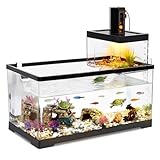
- 7.7 Gal Starter Habitat for Small Turtles: Measures 19.7" × 9.5" × 9.5". Designed for baby, juvenile, and small aquatic turtles, not adult or large turtles. Before ordering, check your turtle’s current shell length and compare it with the listed tank dimensions to ensure a proper fit.
- Double-Layer Space-Saving Design: Unlike submerged platforms that take up swimming space, the house-like upper platform sits above the tank edge to create more usable room. It provides turtles with a dedicated area to climb, explore, and bask while preserving lower water space for swimming.
- Secure House-Like Basking Area: The enclosed upper design gives turtles a dedicated space to climb, rest, explore, and bask. Its stable structure helps reduce the chance of turtles wandering off an exposed platform while keeping the basking area separate from the swimming space.
- Clear & Durable Polycarbonate Tank: Made from high-hardness polycarbonate with a thick, non-slip base for added stability. The clear construction provides a 360° view of your turtle and habitat, while the durable material helps resist everyday scratches, impacts, and yellowing for lasting use.
- Complete Turtle Tank Starter Kit: Includes 1 turtle tank, 1 basking platform, 1 hide cave, 1 car ornament, 1 stone pack, 6 plants, 2 basking lamps with bulbs, 1 filter, and 2 replacement filter plates—providing a colorful starter setup for small turtles and fish.
How long should you expect your turtle to live?
Start with the exact species and its origin rather than relying on a generic internet claim. A pet turtle may be a decades-long commitment. The California Department of Fish and Wildlife reports red-eared sliders may live up to 20 years in the wild and up to 40 years in captivity; the Smithsonian gives eastern box turtles a general range of 25–35 years, with exceptional individuals surviving beyond 100 years.
When the turtle’s species or age is uncertain, avoid promising a precise number. Ask a qualified reptile veterinarian, experienced herpetological organization, or wildlife authority for guidance. The best lifespan estimate is based on the animal’s species, captive history, and current health—not on shell-ring counting or the oldest turtle ever reported.
FAQ
How long do turtles live?
It depends on the species. The California Department of Fish and Wildlife reports up to 20 years in the wild and up to 40 years in captivity for red-eared sliders. The Smithsonian says eastern box turtles generally live 25–35 years, though some have survived beyond 100 years.
Recommended Free Tools
How long do sea turtles live?
It varies by species. NOAA Fisheries says loggerhead sea turtles can live 80 years or more, and Hawaiian green sea turtles can live 70 years or more.
Can you tell a turtle’s age by its shell rings?
No. Some species develop growth lines that may provide a rough clue, especially when young, but shell wear and variable growth make ring counting unreliable for many adult turtles. A known hatch date or long-term record is better evidence.
Do pet turtles need UVB light?
Many captive turtles require species-appropriate UVB exposure to support vitamin D3 production and calcium regulation. The correct bulb, strength, distance, fixture, and replacement schedule depend on the species and enclosure. UVB supports proper husbandry but does not guarantee a longer lifespan.
What affects how long a turtle lives?
A turtle’s lifespan depends on its species, habitat, food, temperature, water quality, disease risk, predation, and human-related hazards. Captive turtles may avoid predators and road mortality but can become ill if their enclosure, lighting, or diet is unsuitable.
PC Slower Than It Used to Be?
A free scan shows the junk files, broken settings and background clutter dragging Windows down - then fixes them in one click.Free scan · Windows 10 & 11Outdated Drivers Are Slowing You Down
One free scan finds every outdated or missing driver and matches the right update for your exact hardware.Free scan · exact hardware matchThe Bottom Line
Bottom line: Turtle lifespans vary widely by species, and published estimates are not all measured the same way. Red-eared sliders may live up to 20 years in the wild and up to 40 in captivity, eastern box turtles generally live 25–35 years but may exceptionally exceed 100, loggerheads can live 80 years or more, and gopher tortoises are reported at 40–60 years. Species-specific care supports health, but no setup guarantees a particular age.
Quick Recap
Product prices and availability are accurate as of the date/time indicated and are subject to change. Any price and availability information displayed on Amazon at the time of purchase will apply.




