Do these 3 things before closing this tab:
1Repair Windows errors before they cause bigger problems2Scan for outdated or missing drivers - takes under a minute3Clear out junk files and repair common Windows errorsThe broader evolutionary group that includes sturgeons and paddlefishes dates back roughly 200 million years in fossil-based accounts. But that is not the age of today’s sturgeon species: identifiable fossils from the sturgeon family are younger, dating to the Late Cretaceous. The key distinction is between the history of a lineage and the age of the living species descended from it.
What does “200 million years old” mean?
Sturgeons belong to Acipenseriformes, an order that also includes paddlefishes and extinct relatives. The Committee on the Status of Endangered Wildlife in Canada (COSEWIC) describes this broader order as having existed for at least 200 million years; a review of lake-sturgeon biology says its earliest members probably evolved in the Lower Jurassic, around that time. These figures describe the group’s deep history, not the first appearance of every living sturgeon species. (COSEWIC, 2012; lake-sturgeon review)
As an Amazon Associate I earn from qualifying purchases.
How old are sturgeon fossils?
Fossils identified as members of the sturgeon family, Acipenseridae, are younger than the roughly 200-million-year estimate for the broader order. The reviewed accounts place the oldest sturgeon-family fossils in the Upper or Late Cretaceous. A North American fossil review reports the earliest known North American sturgeon remains from the Santonian-to-Campanian Milk River Formation. The material is fragmentary, and nearly all the specimens examined could be identified only as Acipenseridae, without a definite genus or species. (lake-sturgeon review; Hilton and Grande, fossil review)
A fossil establishes that an organism lived by the time that fossil-bearing layer formed; it does not pinpoint the moment its lineage began. The fossil record is also incomplete, and the North American review is not a complete global census. So the oldest fossils found so far should not be treated as the exact birth date of sturgeons.
#1 Best Overall

- Comprehensive Fish Information: Includes size, weight, location, food quality, and coloring details for accurate species identification
- Easy-to-Use Fish Identification: Features visual illustrations for quickly identifying various freshwater fish, suitable for both beginners and experienced anglers
- 100% Waterproof Construction: Built with high-quality, weather-resistant materials to withstand the rigors of outdoor use, ensuring long-lasting reliability on every fishing trip
- Portable & Lightweight Design: Convenient, travel-friendly size fits in tackle boxes or fishing bags, allowing you to have it on hand whenever you need to identify a new species
- Versatile Gift Option: Suitable for beginners, seasoned fishermen, kids and scouts, and any outdoor enthusiasts looking to master fish identification
Why do some sources give a different age?
A 2020 phylogenetic study reported a Bayesian molecular-clock estimate of 318.0 million years for the origin of Acipenseriformes. This is a model-based estimate of lineage history, not a fossil occurrence. It answers a related question using a different kind of evidence, so it should not be combined with the fossil-based estimate of roughly 200 million years as though the two were dates for the same discovered event. (Shen et al., 2020)
Are sturgeons “living fossils”?
“Living fossil” is an informal shorthand for an old lineage whose features appear relatively conserved. It does not mean modern sturgeons have remained unchanged since the Jurassic, or that they are ancestors of modern bony fishes. NOAA Fisheries describes sturgeons as a specialized offshoot of ancestral Chondrosteans, rather than ancestors of modern bony fish. COSEWIC makes the distinction plainly: “The living sturgeons are the descendents of ancient fossil sturgeon, but they are not ancient in themselves.” (NOAA Fisheries, Green Sturgeon: Science; COSEWIC, 2012)
Rank #2

- Comprehensive Fish Information: Includes size, weight, location, water temperature, fishing methods, food quality, and coloring for each species
- Easy-to-Use Fish Identification: Features visual illustrations for quickly identifying various freshwater fish, suitable for both beginners and experienced anglers
- 100% Waterproof Construction: Built with high-quality, weather-resistant materials to withstand the rigors of outdoor use, ensuring long-lasting reliability on every fishing trip
- Portable & Lightweight Design: Convenient, travel-friendly size fits in tackle boxes or fishing bags, allowing you to have it on hand whenever you need to identify a new species
- Versatile Gift Option: Suitable for beginners, seasoned fishermen, kids and scouts, and any outdoor enthusiasts looking to master fish identification
There is evidence for slower molecular change in the group, but not for an absence of evolution. A 2002 comparative study tested 23 nuclear and mitochondrial loci or proteins. In 70 of 81 comparisons (86%), the acipenseriform sequences changed more slowly than the homologous teleost sequences examined. That percentage describes the comparisons in that study, not a universal measure of every sturgeon gene or trait. (Krieger et al., 2002)
Recommended Free Tools
Quick Recap
Best Value

- Includes Size, Weight, Location, Food Quality, And Coloring.
- Easy-to-Use Fish Identification: Features visual illustrations for quickly identifying various Pacific Ocean fish, perfect for both beginners and experienced anglers.
- 100% Waterproof: Built with high-quality, weather-resistant materials to withstand the rigors of outdoor use, ensuring long-lasting reliability on every fishing trip.
- Portable & Lightweight: Convenient, travel-friendly size fits in tackle boxes or fishing bags, allowing you to have it on hand whenever you need to identify a new species.
- Perfect Gift for All Anglers: Ideal for beginners, seasoned fishermen, kids and scouts, and any outdoor enthusiasts looking to master fish identification.
Rank #4
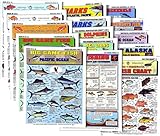
- Easy-to-Use Fish Identification: Features visual illustrations for quickly identifying various saltwater fish, suitable for both beginners and experienced anglers for inshore, offshore, and big game fishing
- 100% Waterproof Construction: Built with high-quality, weather-resistant materials to withstand the rigors of outdoor use, ensuring long-lasting reliability on every fishing trip
- Portable & Lightweight Design: Convenient, travel-friendly size fits in tackle boxes or fishing bags, allowing you to have it on hand whenever you need to identify a new species
- Comprehensive Gift Option: Suitable for beginners, seasoned fishermen, kids and scouts, and outdoor enthusiasts looking to master fish identification
- Extensive Species Coverage: Includes identification information for over 100 saltwater fish species across both Atlantic and Pacific regions with detailed full-color illustrations
Rank #3

- Easy-to-Use Fish Identification: Features visual illustrations for quickly identifying various freshwater fish, perfect for both beginners and experienced anglers.
- 100% Waterproof: Built with high-quality, weather-resistant materials to withstand the rigors of outdoor use, ensuring long-lasting reliability on every fishing trip.
- Portable & Lightweight: Convenient, travel-friendly size fits in tackle boxes or fishing bags, allowing you to have it on hand whenever you need to identify a new species.
- Perfect Gift for All Anglers: Ideal for beginners, seasoned fishermen, kids and scouts, and any outdoor enthusiasts looking to master fish identification.
How to read the different dates
| Date | What it refers to | Evidence and qualification |
|---|---|---|
| About 200 million years | The broader order Acipenseriformes, including sturgeons, paddlefishes and extinct relatives | Fossil-based summaries place the group’s history around this point; it is not a date for each living species. (COSEWIC, 2012; lake-sturgeon review) |
| Upper or Late Cretaceous | Oldest reviewed fossils attributed to the sturgeon family, Acipenseridae | Fossil occurrences; the North American material is fragmentary, and many specimens cannot be assigned to a genus or species. (lake-sturgeon review; Hilton and Grande, fossil review) |
| 318.0 million years | Estimated origin of Acipenseriformes | A Bayesian molecular-clock result reported in a 2020 study, not a fossil date. (Shen et al., 2020) |
Product prices and availability are accurate as of the date/time indicated and are subject to change. Any price and availability information displayed on Amazon at the time of purchase will apply.




