A healthy adult American Bulldog has a broad exercise guideline of one to two hours a day; PetMD’s general guidance for a dog described as a Pit Bull is at least 45 minutes to one hour daily. These are starting points, not prescriptions for every dog. Age, health, fitness and the individual dog’s breed or mix all matter. “Pit Bull” is also an umbrella label, so it does not identify one consistently defined breed with one uniform exercise requirement.
The figures are daily totals, not instructions to keep a dog running continuously. A suitable plan can combine walks, play, training and other activities, with the amount and intensity adjusted to the dog’s comfort and abilities. If a dog has a diagnosed condition, a veterinarian should help set the routine.
As an Amazon Associate I earn from qualifying purchases.
How the daily guidance compares
The cited recommendations give different ranges, and they refer to different kinds of dogs. PetMD’s American Bulldog guidance is specifically for a healthy adult. Its Pit Bull guidance applies to a broad category of breeds and mixes. Neither range is a measured study result or a guarantee that an individual dog needs exactly that amount.
| Dog described | General daily guidance | What the figure represents |
|---|---|---|
| Healthy adult American Bulldog | One to two hours | PetMD care guidance, on a page updated September 14, 2026. It is not an individual veterinary prescription. |
| Dog described as a Pit Bull | At least 45 minutes to one hour | PetMD’s broad category-level recommendation; the publication date is not visible in the cited page. It is not a measured study result. |
Do not add the figures together, treat the longer range as a target every dog must reach, or assume the difference means one category always needs more activity than the other. The recommendations are not a controlled comparison of equivalent populations. The American Bulldog figure is limited to healthy adults, while “Pit Bull” covers several breeds and mixes. Use the relevant range as an initial reference, then consider the dog in front of you.
#1 Best Overall
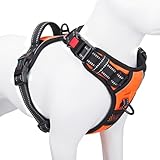
- [UPDATED VESION, EASY TO PUT ON & TAKE OFF] This dog harness has 3 buckles( One is on the neck with Lockable, two are on the chest), NO NEED go through dog’s head. This will let your dog loves to wear harness!
- [NO PULL WITH 2 HOOK LOOPS] There are 2 sturdy metal hook loops for leash attachment. If you use the front hook on the chest, it will reduce the pulling a lot and make going for a walk more enjoyable. As usual, most people like to use the back hook.
- [REFLECTIVE MATERIAL] The reflective material will be really nice when it gets dark. Also, your dog will be saw easily. This reflective material can make drivers have long time to react, which ensure your dog’s safety!
- [USEFUL & SOFT HANDLES] You will like this handle on the back,it is helpful in controlling dogs a bit closer to you when they are trying to lunge at something. Also, it is convenient to assist dogs into the car.
- [100% BEST CUSTOMER SERVICE] If any products quality really exits, a refund or replacement will be available.
Exercise needs vary by age, breed and health, as the American Kennel Club puts it. Fitness and individual temperament also affect how a dog handles a walk, game or structured activity. A particularly athletic adult may enjoy more varied work, while a less fit, recovering or easily fatigued dog may need a gentler interpretation of the same broad guidance.
What “Pit Bull” means for exercise advice
PetMD uses “Pit Bull” as a blanket term for several breeds and mixes, including American Staffordshire Terriers, American Bulldogs, Bull Terriers and Staffordshire Bull Terriers. A dog’s label alone therefore cannot establish its exact exercise needs. A mixed-breed dog may also have characteristics that do not match a generic category description.
This matters in the comparison: an American Bulldog is a named breed in the cited guidance, while “Pit Bull” describes a broader category. The American Kennel Club characterizes American Bulldogs as “a well-balanced athletic dog that demonstrate great strength, endurance, agility, and a friendly attitude.” It also notes their historical role as farm utility dogs. That background helps explain why regular activity is relevant, but it does not set a daily duration by itself.
Do these 3 things before closing this tab:
1Scan for outdated or missing drivers - takes under a minute2Clear out junk files and repair common Windows errors3Fix the driver behind crashes, sound loss and screen glitchesWhen someone asks how much exercise a “Pit Bull” needs, the most useful follow-up is what breeds are known or suspected to be in the dog, how old the dog is, and whether a veterinarian has identified a limitation. The 45-minutes-to-one-hour range should remain attributed to PetMD’s broad category-level advice rather than presented as a precise requirement for every dog carrying that label.
Rank #2

- Large Dog Harness - Recommended Breeds: Medium to Large Dogs, such as Siberian Husky, Labrador, German Shepherd, Akita, Chow Chow, Schnauzer Giant,American Pit Bull Terrier, etc. Please measure your dog's neck and check girth carefully before purchasing this present for your puppy. Make your puppy stand out with this Classic Black Harness!
- No Pull, No Choke - Our non-pulling dog harness is specially designed with 2 metal leash rings for safer dog walks. Use the chest attachment clip to stop your dog from pulling on walks, perfect for dog training or dogs who tend to pull. The back one is great for casual walks, jogging, hiking, etc
- Easy to Use - This hassle-free overhead harness is easy to put on and take off with its 2 fast-release buckles. Slide the harness over your dog's head, buckle it up, adjust the straps, and here you go! Grab the top handle for additional control. Lightweight and easy to clean
- Fully Adjustable - This adjustable harness features 4 easy adjusting straps around the body. You can use its 2 neck straps and 2 chest straps to create a perfect fit for your dog with some room of growth. No worries about slipping out or choking
- Safe and Comfortable - Your dog will enjoy the daily walk in this comfort dog harness! Made of sturdy polyester oxford and padded with soft cushion to protect your dog's skin. Breathable air mesh keeps your dog cool during outdoor activities. Super bright reflective strips ensure a safe walk both day and night
How to make the guidance useful for your dog
Start with the broad reference for the dog’s description, then adjust the plan for life stage, health and ability. A daily total need not mean one long, strenuous session. The cited sources name walks, play and structured activities as options; combining suitable activities gives you ways to make movement and interaction part of the day without assuming that all exercise must be hard running.
- Identify the right starting point. For a healthy adult American Bulldog, use PetMD’s one-to-two-hour range as a broad reference. For a dog described as a Pit Bull, use its 45-minutes-to-one-hour guidance as category-level advice.
- Account for age and health before treating the range as a target. Puppy activity depends on age and health status, and senior activity should be adapted to ability. A dog with a medical or mobility concern needs a plan informed by a veterinarian rather than a generic breed range.
- Divide activity into suitable portions. The total can be spread across walks, play, training or another appropriate structured activity. Splitting the day lets you vary the type of work and avoid interpreting the guideline as a demand for one uninterrupted effort.
- Choose activities the dog can do comfortably. Walks and play are practical options. Depending on the individual dog, the sources also describe fetch, agility, nose work, obedience, hiking, swimming and tug.
- Include mental engagement. Training, nose work and varied activities can provide mental stimulation alongside physical movement. AKC emphasizes that mental stimulation matters, particularly when planning short, varied activities for puppies.
- Review the plan rather than locking in a number. A routine that is appropriate at one age or fitness level may not remain appropriate after illness, injury, weight change or advancing age. If you are uncertain whether a duration or activity is suitable, ask your veterinarian to help set the plan.
This is a framework for applying general care advice, not a clinical exercise prescription. The cited sources do not establish a universal schedule of minutes per walk, a fixed number of sessions, or one formula that fits every dog.
Activities that can make up the routine
PetMD’s American Bulldog guidance includes long walks and play, as well as nose work, agility, obedience, hiking and swimming. Its Pit Bull guidance gives walks, fetch and agility as examples. Those lists offer choices, not a requirement to do every activity or to select the most intense option.
Recommended Free Tools
- Walks: A straightforward way to build regular movement into the day for either group. Adjust the route and duration to the dog’s ability. A properly fitted walking harness is an optional accessory that can support leash walks; none of the cited guidance requires a harness or endorses a particular model.
- Play and fetch: Interactive play can add movement and engagement. The cited Pit Bull guidance specifically names fetch; PetMD also lists play for American Bulldogs. Keep the form and pace appropriate for the individual dog instead of assuming every dog should perform repeated sprints.
- Training and nose work: Obedience and nose work are listed for American Bulldogs and can add mental engagement to a routine that would otherwise consist only of walking. Short, varied training also fits AKC’s emphasis on mental stimulation.
- Agility: Listed by PetMD for both categories. Whether it is appropriate depends on the individual dog’s condition and ability; the general recommendation is not a mandate to do high-impact work.
- Swimming or hiking: PetMD includes both among American Bulldog activity options. Choose an activity only if it suits the dog and can be done safely for that individual.
- Tug: PetMD lists tug as an option for American Bulldogs. It is one possible form of play, not a necessary exercise component.
A varied routine is useful because the sources describe more than one way to meet a dog’s activity needs. It also avoids interpreting the daily duration as a demand for uninterrupted, repetitive hard exercise. The evidence does not rank these activities or establish that one is best for either category. For a dog with a health concern, ask the veterinarian which of these options, if any, should be included.
Rank #3
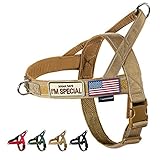
- [Premium No Pull Dog Harness] The wider soft padded inner is comfortable and friendly for dog's neck without dog's fur hurting. The back strap and chest strap inner is made of soft and breathable material that is comfortable for the dogs. And the front strap is better to prevent the dog from rushing forward. This design is maintain a long-time comfortable for walking,jogging,running,training,etc.
- [Reflective Strip] Reflective stitching along polyester webbing is not only add a sense of design to the safe for walking dog harness,but also increase a better visibility at dark under the light that it can keep the dog safe while walking.
- [Two Rings Design] The O-ring and D-ring is convenient and flexible to hang,they not only can connect well with dog leash,but also can hang ID tags,key,poop bag,etc.
- [Choose the Suitable Dog Harness] The no pull dog harness have FIVE sizes,XS is design 1 inch wide / S M L XL are design 1.5 inches wide for the small & medium and large dogs. PLEASE measure the size of the dog and refer the dimension chart to select the right one before buying.
- [Come with TWO Patches] There has a velcro area on the dog walking harness,and come with 2 patches, you can put the patches "MAMA SAY I'M SPECIAL" or the flag on the dog harness velcro area to make your dog unique.
How needs change for puppies and senior dogs
Puppies
PetMD says a puppy’s exercise depends on age and health status. AKC advises multiple short walks, play and training activities rather than treating a puppy like a healthy adult. Ask the veterinarian or breeder about an individual puppy’s plan, particularly if you are unsure how its developmental stage affects activity.
There is no supported universal “minutes per month of age” formula in the cited guidance. Avoid using such a rule as though it were established here; the relevant advice is to use short, varied activities and account for the puppy’s age and health. A puppy’s daily movement can therefore include brief walks, play and training spread through the day, with the exact amount determined for that puppy rather than copied from the adult table.
Senior dogs
Older dogs can still benefit from regular movement, but the duration and intensity should match their ability. AKC describes gentle activity such as walks, swimming and shorter play sessions. The practical aim is an age-appropriate routine, not automatically preserving an adult dog’s earlier duration or intensity.
Free tools Windows power users keep installed
One-click scans. No signup required.
Senior status alone does not mean stopping activity. It does mean that a veterinarian may need to help adjust the plan when mobility, heart or respiratory capacity changes. The general guidance supports daily movement adapted to ability, not a fixed senior-dog quota.
Rank #4

- Effective No-Pull Solution: The PetSafe Easy Walk Harness helps create pull-free walks by using a martingale loop design that applies gentle, gradual pressure to reduce lunging
- Designed for Comfort & Fit: Features adjustable comfort straps and a breathable harness design with less coverage, keeping dogs cool, secure, and comfortable on every walk
- Simple to Use & Trainer Recommended: Includes an easy color-coded fit and quick-snap shoulder buckles for fast on-and-off application, trusted by vets and trainers since 2004
- Global Mission, Local Care: With U.S. roots and worldwide reach, PetSafe delivers vet- and trainer-recommended solutions and exceptional customer support to create fields of joy for pets
- 25 Years of Trust: Since 1998, PetSafe has created safe, innovative, and trusted products that bring joy, enhance pet lives, and support the lifelong bond between pets and their families
When health or mobility changes the plan
Veterinary input is especially important when a dog has hip dysplasia or heart or respiratory issues. AKC recommends discussing an exercise routine with a veterinarian for these conditions. PetMD also notes that American Bulldogs can be prone to hip and elbow dysplasia, which is a reason to take an existing concern seriously—not a basis for assuming that every American Bulldog has a joint problem.
Do not try to solve a medical limitation by forcing the dog to complete a general time target. Ask the veterinarian which activities and amounts are suitable for that dog. The sources support individualizing exercise and seeking veterinary guidance; they do not support a claim that a particular plan prevents hip or elbow dysplasia.
Health status also changes how the daily range should be interpreted. A dog that is otherwise described as an adult may still need less activity while recovering or while a condition is being evaluated. Conversely, a veterinarian may clear a dog for regular movement but recommend a specific type or intensity. The breed label cannot answer those clinical questions.
What’s actually slowing this PC down?
Pick the symptom - the matching free tool is one click away.
Common mistakes when interpreting the numbers
- Treating a guideline as a quota: The PetMD ranges are general care recommendations, not individualized prescriptions or results from exercise studies.
- Assuming “Pit Bull” is one precise breed: The category includes several breeds and mixes, so its duration is necessarily broad.
- Applying adult guidance to every life stage: Puppy and senior activity needs should be adjusted, rather than automatically following the adult reference.
- Applying the American Bulldog range to an unhealthy dog: The one-to-two-hour figure is explicitly framed for a healthy adult and should not override a veterinary plan.
- Equating exercise with strenuous running: The sources include walks, play, training and other activities; they do not require all activity to be intense or continuous.
- Ignoring mental stimulation: Physical movement is only part of the routine; AKC identifies mental engagement as important, especially for puppies.
- Ignoring a known health condition: A general breed-care range does not replace veterinary advice for a dog with a medical or mobility concern.
- Assuming a product is required: A harness may be useful for a particular leash-walking setup, but the cited sources do not require one or recommend a specific model.
Sources and scope
The American Bulldog duration and activity examples come from PetMD’s American Bulldog article, shown as updated September 14, 2026 and naming veterinary reviewer Angela Beal, DVM, FFCP. The Pit Bull range and examples come from PetMD’s American Pit Bull Terrier article, which identifies Georgina Ushi, DVM, as its veterinary writer; the page’s publication date is not visible in the cited material. AKC provides the general guidance on breed characteristics, age, mental stimulation and consulting a veterinarian about health-related exercise concerns. These are general breed-care and life-stage recommendations, not an examination of an individual dog.
Best Value

- 【No Pull & No Choke Design】: This harness simply goes through the dog's head, snaps on the belly and that's the end of it. Besides, the D-ring on the chest strap is used for no pull dog training and guiding direction, and the O-ring on the back is used for daily dog walking. The triangular design on both sides of this no pull harness helps to distribute the pulling force, so you don't have to worry about the dog choking when suddenly pulling.
- 【Soft Velvet Padded & Durable】: With soft thicken and wider fleece pads used beneath the strap of neck, back and handle atop, this dog harness could reduce friction from movement and protect the health of the dog's skin. It also uses superior nylon material to ensure long-lasting use.
- 【Leash Double Handle & Elastic Band】: You can use the top handle for casual dog walking, and the center handle for controlling the direction of the dog, easily guiding it through crowded areas and preventing storming in case of accidents. And the springy design of the leash really absorbs the pull from large strong dogs without tugging on your wrist and shoulder.
- 【Neck & Chest Adjustable】: SlowTon dog harness is equipped with adjustable loop for both neck and chest girth, and the quick-release buckle allows for quick donning. No matter what kind of breed and shape, it provides proper length after adjusting to fit your dog's neck and chest, which is perfectly designed for walking, jogging, running, hiking and training.
- 【Tangle-free Leash & Reflective】: The heavy-duty 360°swivel metal hook ensures no tangle. Plus, it has an elastic bungee and 2 padded handles, which is great for walking training of city dogs, or wandering off in country. Furthermore, its super bright reflective strips ensure a safe walk both day and night. And it comes with 2 hook and loop straps, a regular one Support Dog and the reflective one DO NOT PET.
Frequently Asked Questions
How much exercise does a healthy adult American Bulldog need each day?
PetMD gives a broad guideline of one to two hours daily for a healthy adult American Bulldog. Divide that time among suitable walks, play, training or other activities, and adjust it for the individual dog’s fitness and health.
How much exercise does a Pit Bull need each day?
PetMD suggests at least 45 minutes to one hour daily for a dog described as a Pit Bull. Because “Pit Bull” is an umbrella label covering breeds and mixes, treat this as category-level guidance rather than an exact requirement for every dog.
Should a puppy follow the adult exercise range?
No. Puppy exercise depends on age and health. AKC recommends multiple short walks, play and training activities, and PetMD likewise says the plan should reflect the puppy’s individual status. The cited guidance does not establish a universal minutes-per-month formula.
The Tool Desk
Outbyte PC Repair FREEClear out junk files and repair common Windows errorsFree Scan →Outbyte Driver Updater FREEFix the driver behind crashes, sound loss and screen glitchesFind Drivers →What activities can count toward the daily total?
Walks and play are examples for both groups. PetMD also lists fetch and agility for Pit Bull dogs, and nose work, obedience, hiking, swimming and tug among American Bulldog options. Choose activities the individual dog can perform comfortably.
When should a veterinarian help set the exercise plan?
Ask for veterinary guidance when the dog has hip dysplasia, heart or respiratory issues, another mobility concern, or any condition that makes the general range uncertain. American Bulldogs can be prone to hip and elbow dysplasia, but that does not mean every dog has those problems.
The Bottom Line
Bottom line: Use one to two hours daily as PetMD’s broad reference for a healthy adult American Bulldog and at least 45 minutes to one hour for a dog described as a Pit Bull. Adjust the amount, intensity and activities for the dog’s age, health, fitness and actual breed mix, and involve a veterinarian when a medical or mobility concern is present.
Quick Recap
Product prices and availability are accurate as of the date/time indicated and are subject to change. Any price and availability information displayed on Amazon at the time of purchase will apply.
Quick wins for a faster PC:
Clear out junk files and repair common Windows errorsFree Scan →Fix the driver behind crashes, sound loss and screen glitchesFind Drivers →



