How often do you feed goldfish? Feed most healthy adult goldfish one small portion once a day, giving only what they can finish in about one to three minutes. Younger goldfish may need smaller, more frequent meals, while fancy goldfish may benefit from soaked or slow-sinking food if surface feeding causes air gulping.
The feeding schedule matters, but portion size matters more. Goldfish often continue begging after eating enough, so use observed eating time, leftover food, and aquarium water quality to adjust meals.
As an Amazon Associate I earn from qualifying purchases.
Key takeaways
- Most adult goldfish should start with one small feeding per day, although once or twice daily can work when portions and water quality are carefully managed.
- Feed only what the fish can finish in roughly one to three minutes; there is no universal number of flakes or pellets for every goldfish.
- Young goldfish may need more frequent meals as they grow, but each meal should remain small and water quality should be monitored closely.
- Uneaten food decomposes into waste, while persistent begging does not reliably show that a goldfish is hungry.
- Slow-sinking food may be useful for fancy goldfish that gulp air at the surface, but floating food is not automatically unsafe for every fish.
- A vacation feeder is a short-absence option that must be tested first; the Aqueon product guidance describes up to three days per block for five to six medium-sized fish.
How often do you feed goldfish?
Most adult goldfish should be fed one small portion once a day. Some care guidance allows feeding once or twice daily, but the more important rule is portion control: give only what the fish can finish within about one to three minutes, then remove leftovers.
Quick wins for a faster PC:
Scan for outdated or missing drivers - takes under a minuteDriver Scan →Repair Windows errors before they cause bigger problemsFix Now →The Ornamental Aquatic Trade Association’s 2022 goldfish care sheet states: “Goldfish should only be fed what they can eat within a few minutes, once a day.” That is a useful starting schedule for healthy adult goldfish in a normal home aquarium, not a universal promise that every fish, age, or setup needs exactly one meal.
#1 Best Overall

- Contains one (1) API GOLDFISH PELLETS Fish Food 7-Ounce Container
- Made with optimal protein sources and fiber to help promote healthy digestion
- Formulated for efficient use of nutrients resulting in less waste and less ammonia production for clean, clear water
- Yeast, garlic and vitamins C and E help support the immune system
- Feed up to twice a day the amount of food that your fish will consume within 3 minutes
Feeding once daily also makes it easier to observe the fish, check whether food remains, and notice changes in appetite or behavior. Feeding twice daily can be reasonable for some fish when each meal is smaller and the aquarium remains clean, but adding meals without reducing portions commonly creates overfeeding problems.
How much food should you give a goldfish?
Give a small amount that the goldfish can consume in approximately one to three minutes. The correct portion is not a fixed pinch, gram measurement, or pellet count because fish size, number of fish, age, food density, activity, tank conditions, and individual appetite all differ.
- Add a very small amount of goldfish-appropriate food.
- Watch the fish eat rather than walking away immediately.
- If the food disappears well before the short feeding window and the fish remain active, increase the next portion only modestly.
- If food is still present at the end of the window, reduce the next portion.
- Remove remaining food instead of allowing it to decompose in the aquarium.
Aqueon’s goldfish care guidance also emphasizes feeding an amount the fish can consume in a short period. The purpose of the time rule is to help you calibrate the portion for your particular fish, not to create a race or require feeding until the fish stops showing interest.
What’s actually slowing this PC down?
Pick the symptom - the matching free tool is one click away.
Can you overfeed a goldfish?
Yes, goldfish can be overfed, and persistent begging is not proof that another serving is needed. Goldfish are persistent feeders and may continue searching for food after they have eaten enough.
Excess food can remain on the substrate, break down, and contribute to toxic waste and poorer water quality. Overfeeding can therefore harm the aquarium even when the fish appear eager and healthy immediately after eating. If food is regularly left behind, reduce the next portion and review the aquarium’s maintenance and water-testing routine.
Rank #2

- Contains one (1) API BOTTOM FEEDER PELLETS WITH SQUID Fish Food 1.3-Ounce Container
- Includes optimal protein sources to support healthy fish and ideal growth
- Contains SQUID pellet, mussel, and seaweed for improved nutrition and great taste
- Formulated for easy digestion, leading to less toxic ammonia and cleaner, clearer water
- Feed as much as fish can consume in 30 minutes as bottom feeders have slower feeding habits
Do not respond to begging by adding an unplanned third or fourth meal. Use the observed eating time, the amount of uneaten food, and the condition of the water as better guides than the fish’s apparent enthusiasm.
Do young goldfish need a different feeding schedule?
Young goldfish may need more frequent meals as they grow, but the available care guidance does not establish one universal number of daily meals for every juvenile or fry setup.
For young fish, divide food into smaller portions rather than simply giving adult-sized servings more often. Watch growth, appetite, uneaten food, and water quality closely. Fry and juveniles can differ substantially in size, development, stocking density, and food requirements, so a precise schedule should be adapted to the specific setup rather than presented as a rule for every young goldfish.
PetMD’s goldfish care guidance distinguishes adult feeding from the needs of younger goldfish, noting that younger fish may need to be fed more often as they grow.
What should you feed a goldfish?
Use specialized goldfish flakes, granules, or pellets as the staple food. Goldfish are omnivores, and the Ornamental Aquatic Trade Association recommends specialized goldfish food because goldfish require more carbohydrates than some other fish species.
Rank #3
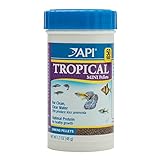
- Contains one (1) API TROPICAL MINI PELLETS Mini Sinking Pellets Fish Food 1.7-Ounce Container
- Contains key nutrients for a complete and balance diet for all tropical community fish
- Includes high-quality proteins, such as squid and shrimp, for optimal fish growth
- Formulated to help fish more readily use nutrients which means less waste and clean, clear water
- Feed twice a day to meet the requirements of small tropical fish
Food variety can include properly prepared live or frozen foods and suitable vegetable matter, provided additions are appropriate for aquarium use and do not replace sensible portion control. Introduce any new food in a small amount and remove leftovers.
Recommended Free Tools
Aqueon’s goldfish-food catalog lists flakes and granules among goldfish food formats, while OATA’s fancy-goldfish guidance discusses feeding choices alongside the special concerns of fancy varieties.
Should goldfish food float or sink?
Floating food is not automatically wrong, but slowly sinking or sinking food can be a better choice for some goldfish, especially fancy goldfish that gulp air while feeding at the surface.
OATA’s fancy-goldfish guidance states: “Some fancy goldfish can take in air when eating from the surface, causing them to temporarily lose buoyancy shortly after feeding.” If surface feeding appears to be associated with buoyancy problems, try briefly soaking flakes or choosing a slow-sinking format rather than forcing the fish to feed at the surface.
Aqueon advises briefly soaking flake food and avoiding floating pellets when surface feeding creates a buoyancy concern. That does not mean sinking food prevents swim-bladder disease or that every goldfish requires it. Common goldfish, comets, shubunkins, and fancy goldfish may all accept different formats, so observe how the individual fish eats.
Do these 3 things before closing this tab:
1Clear out junk files and repair common Windows errors2Fix the driver behind crashes, sound loss and screen glitches3Repair Windows errors before they cause bigger problemsRank #4

- Contains one (1) API TROPICAL PELLETS Sinking Pellets Fish Food 4.2-Ounce Container
- Contains key nutrients for a complete and balance diet for all tropical community fish
- Includes high-quality proteins, such as squid and shrimp, for optimal fish growth
- Formulated to help fish more readily use nutrients which means less waste and clean, clear water
- Feed twice a day to meet the requirements of tropical community fish
| Food or equipment | Sinking behavior | Portion control | Best use | Important caution |
|---|---|---|---|---|
| Flakes | Usually float at first; can be briefly soaked | Easy to break into a very small amount | Routine feeding when fish feed comfortably at the surface | Surface feeding may encourage air gulping in some fancy goldfish |
| Granules | Depends on the formulation | Usually easy to measure in small amounts | Routine feeding for many goldfish | Check whether the particular food floats or sinks |
| Slow-sinking goldfish food | Descends gradually | Can be portioned in small amounts | Fancy goldfish or fish that struggle with surface feeding | It is an option, not a mandatory treatment for buoyancy problems |
| Sinking pellets | Sinks | Often simple to count, but pellet size varies | Bottom-feeding or reduced surface feeding | Do not use a fixed pellet count as a universal portion |
| Vacation feeder | Releases food over time | Less direct control than hand feeding | Short absences after testing | Can overfeed or malfunction if not tested before the trip |
For owners comparing routine food formats, sinking goldfish pellets are a practical category to consider when a goldfish benefits from food that does not remain at the surface. Choose a food made for goldfish, check the pellet size, and keep the same one-to-three-minute portion rule; no brand or format removes the risk of overfeeding.
How do you establish a reliable goldfish feeding routine?
A reliable goldfish feeding routine uses a consistent time, observation, and gradual portion adjustments.
- Feed at a consistent time when you can watch the fish.
- Offer a very small portion of specialized goldfish food.
- Observe how quickly the fish consume the food.
- Increase the next portion only modestly if the food disappears substantially before the target window.
- Reduce the next portion if food remains.
- Remove leftovers and continue normal aquarium maintenance.
Feed individual fish according to the aquarium’s total demand rather than relying on a visual “pinch.” A tank with several fish may need more food overall than a tank with one fish, but the total should still be consumed promptly. Separate unusually slow or bullied fish if competition prevents them from eating, and avoid compensating by scattering excess food throughout the aquarium.
Independent reader supportYour contribution helps us test, update, and keep practical guides available for everyone.Can you use a vacation feeder for goldfish?
A vacation feeder can support a short absence, but it should not be treated as a set-and-forget replacement for tested care. Aqueon’s vacation-feeder product page describes feeding five to six medium-sized fish for up to three days per block. That stated capacity and duration apply to the described product and should not be generalized to every vacation feeder, fish, or aquarium.
The Tool Desk
Outbyte Driver Updater FREEFix the driver behind crashes, sound loss and screen glitchesFind Drivers →Outbyte PC Repair FREEClear out junk files and repair common Windows errorsFree Scan →Before leaving, test the feeder while you are still home. Check that the device dispenses the intended amount, does not dump its contents at once, remains secure, and does not leave excessive food in the tank. Do not overload it to cover a longer trip. Arrange a responsible human caregiver for longer absences, valuable or medically fragile fish, or any aquarium that needs daily observation.
Best Value

- Contains one (1) API POND FISH FOOD Pond Fish Food 11.5-Ounce Bag
- Superior pellet diet for all pond fish.
- High protein utilization helps fish produce less waste or ammonia, promoting clean and healthy water.
- Supports a healthy immune system, and help enhance color and growth.
- Feed 2 or 3 times a day, only as much as they will eat in 5-10 minutes.
Adult goldfish feeding schedule at a glance
| Situation | Starting approach | How to adjust | What to watch |
|---|---|---|---|
| Healthy adult goldfish | One small feeding daily | Use the one-to-three-minute rule | Uneaten food, appetite, and water quality |
| Adult fish fed twice daily | Split the daily amount into smaller meals | Do not double the total daily portion | Whether either meal remains uneaten |
| Young goldfish or juveniles | Potentially more frequent, smaller meals | Adapt to growth and the specific setup | Water quality and leftover food |
| Fancy goldfish with surface-related buoyancy concerns | Consider soaked flakes or slow-sinking food | Observe whether feeding behavior improves | Air gulping and recurring buoyancy problems |
| Owner away briefly | Use a tested feeder only if appropriate | Follow the device’s stated capacity | Dispensing accuracy and water quality |
Frequently Asked Questions
How many times a day should I feed my goldfish?
Most healthy adult goldfish should be fed one small portion once a day. Feeding twice daily can be reasonable if the total daily amount is divided into smaller meals and the fish finish each portion promptly without harming water quality.
Can you overfeed a goldfish?
Yes. Goldfish may keep begging after they have eaten enough, and excess food can decompose and contribute to toxic waste and poor water quality. Feed according to the one-to-three-minute observation window instead of begging behavior.
How much food should I give my goldfish?
Feed only what the goldfish can consume in roughly one to three minutes. No universal flake count, pellet count, pinch, or gram amount applies to every goldfish because fish size, age, number, food density, and aquarium conditions vary.
Windows Errors? Fix Them Before They Spread
Repair common Windows errors and clear accumulated junk for a smoother, more stable PC - no reinstall needed.Free scan · no reinstallCrashes, No Sound, or Screen Glitches?
Random freezes, missing sound and display glitches usually trace back to one bad driver. Find and replace yours safely.Free scan · under a minuteCan I use a vacation feeder for my goldfish?
A vacation feeder can be useful for a short absence if it is tested at home first. One Aqueon product describes up to three days per block for five to six medium-sized fish, but longer trips or fish with health problems require a human caregiver.
The Bottom Line
Start by feeding a healthy adult goldfish one small portion once daily. Adjust the amount—not automatically the frequency—so the fish finish it within about one to three minutes, remove leftovers, and consider slow-sinking food if a fancy goldfish has surface-air or buoyancy concerns.
Quick Recap
Product prices and availability are accurate as of the date/time indicated and are subject to change. Any price and availability information displayed on Amazon at the time of purchase will apply.




