
Some links on this page are affiliate links: if you buy through them we may earn a commission, at no extra cost to you.
A self-sustaining aquarium is not a sealed tank that can be ignored. It is a deliberately balanced, planted system in which plants, nitrifying microbes, filtration, light, and a modest livestock load reduce routine work while you continue to test water, feed animals, remove dead material, and respond to problems. Build the biological filter first, plant heavily, control light, stock conservatively, and treat observation as part of the system—not as an optional extra.
What “self-sustaining aquarium” really means
In practical freshwater fishkeeping, “self-sustaining” means lower-maintenance and biologically stable, not maintenance-free. Fish continually add waste through respiration and excretion, food adds more organic matter, and plants can only absorb nutrients while they are actively growing. A stable aquarium still depends on oxygen, water movement, an established microbial community, suitable lighting, and a keeper who notices changes early.
As an Amazon Associate I earn from qualifying purchases.
Free tools Windows power users keep installed
One-click scans. No signup required.
The phrase is sometimes used for a very different setup. The University of Florida IFAS describes an essentially self-cleaning aquarium for predaceous diving beetles: abundant plants and gravel can support nutrient uptake and decomposition without a filter. Its guidance also cautions that the approach is harder with fish because fish eat more, create more waste, and are more sensitive to waste accumulation. As the extension page puts it, “This amazing self-cleaning ecosystem is more challenging to accomplish with fish because they are more sensitive to the buildup of waste.” Read the complete, species-specific setup at UF/IFAS’s diving-beetle guidance; do not use it as a recipe for a stocked fish tank.
Aquarium aquaponics illustrates the same principle at a larger or more engineered scale. Plants take up nitrogen compounds, bacteria transform toxic waste, and circulation carries oxygenated water between the living parts of the system. Illinois Extension’s aquarium aquaponics example uses filters and bubblers to support circulation and root oxygen. That demonstrates how plant integration can help; it does not prove that an ordinary display aquarium will run unattended.
Popular on Amazon

- 【4 in 1 Aquascape Tools Kits】: Aquarium tank aquascape tools kits including 1*10.5" curved scissors, 1*10" straight tweezers, 1*10" curved tweezers, 1*12.5" sand spatula, one kit, multi-function.
- 【100% Anti-rust and Anti-corrosion】: Aquatic plant aquascape tool is made of high-quality stainless steel with the latest spray paint technology, not easy fade, anti-rust and anti-corrosion, durable.
- 【Don't Harm Plants】: Stainless steel aquarium tools suit for small or thin water plants, help trim excess parts, It won't hurt the plant's cross-section, more convenient than using a hand.
- 【Multi Functions】: Aquarium aquascape tools kits could help trim plant, furnishing aquarium landscape with cornerstone, sand, but also could clean the aquarium tank, remove the dirty things from the bottom of the aquarium.
- 【Please Note】: Because the product is a mini size part, children under the age of three are not suitable for use. It can be used with parents.
The seven steps to a thriving, lower-maintenance aquarium
1. Set a realistic goal before you buy equipment
Define success as predictable water quality and fewer emergency interventions. You should still expect to:
- Test ammonia, nitrite, nitrate, and pH while the tank matures and whenever stocking or feeding changes.
- Feed an amount your animals can consume without leaving persistent debris.
- Remove dead leaves, uneaten food, and visibly decaying material.
- Perform partial water changes when test results or animal condition indicate they are needed.
- Keep filters, heaters, lights, pumps, and air equipment operating reliably.
Plants and microbes distribute and process waste; they do not make waste disappear. If you want a truly closed system with no ongoing input, a fish aquarium is the wrong expectation. Fish need food, and their biological load rises as they grow. A low-bioload invertebrate habitat may tolerate a simpler design, but its requirements are species-specific and should not be generalized to fish.
Do these 3 things before closing this tab:
1Repair Windows errors before they cause bigger problems2Scan for outdated or missing drivers - takes under a minute3Clear out junk files and repair common Windows errors2. Choose enough volume and put the tank in a stable location
Choose a tank that can house every animal at its adult size, not the size sold at the shop. Larger water volumes generally dilute sudden changes and provide more margin for temperature or chemistry swings; OATA makes the same stability point in its planted-aquarium setup guidance. A larger aquarium costs more to start, occupies more space, and requires more water to move during maintenance, but its extra volume can make mistakes less abrupt. A small tank is not automatically easier simply because it contains less water.
Check the stand, floor, access to electrical outlets, and room to service the filter before filling. Position the aquarium away from direct sunlight, radiators and other heat sources, and strong draughts. Sunlight and unstable room temperatures can encourage algae or drive temperature changes that undermine the stability you are trying to create.
Plan the final layout before adding water. Leave clearance above the tank for maintenance, keep intake and outlet paths unobstructed, and make sure the chosen filter can turn over water through the intended media without forcing excessive current on the livestock.
3. Build the planted environment before adding livestock
Start with a substrate intended for planted aquariums or a compatible gravel-and-rooting arrangement. Select hardscape that is aquarium-safe, leaves swimming space, and does not trap large pockets of decomposing debris. Then plant before stocking so roots can establish while the tank is still quiet.
Also popular on Amazon

- Contains one (1) API FRESHWATER MASTER TEST KIT 800-Test Freshwater Aquarium Water Master Test Kit, including 7 bottles of testing solutions, 1 color card and 4 tubes with cap
- Helps monitor water quality and prevent invisible water problems that can be harmful to fish and cause fish loss
- Accurately monitors 5 most vital water parameters levels in freshwater aquariums: pH, high range pH, ammonia, nitrite, nitrate
- Designed for use in freshwater aquariums only
- Use for weekly monitoring and when water or fish problems appear
- Rinse substrate and hardscape according to the material’s instructions; do not use soap or household cleaners.
- Place the substrate deep enough for the plants you selected, with more depth where rooted species need it.
- Arrange rocks or wood so they are stable and cannot collapse onto animals or the glass.
- Fill slowly over a dish or plastic bag to avoid uprooting plants and clouding the water.
- Plant densely from the beginning, leaving room for growth and an unobstructed path around the filter intake.
- Remove damaged leaves and replant loose stems as the aquarium settles.
Heavy initial planting can help prevent algae from taking hold, but “heavy” does not mean every species belongs in every tank. Match plants to your actual light level, water chemistry, temperature, and available space. Fast-growing stems, floating plants, rosettes, mosses, and rhizome plants have different demands; there is no universal plant list that guarantees balance.
Keep dead leaves from accumulating. A plant that is melting after a change in conditions can release decaying material, so trim failing tissue while leaving healthy growth intact. Plant uptake is a living process: if growth stops, nutrient removal slows as well.
4. Control light instead of chasing algae
Use an aquarium light appropriate for the plants and put it on a timer so the photoperiod is consistent. OATA gives six to eight hours as a general starting span and notes that a ramped schedule can extend to about 10–12 hours. Treat those figures as starting guidance from that association, not a universal prescription: plant species, light intensity, room lighting, and nutrient availability all change the result.
- Begin at the shorter end of the suggested range if the tank is newly planted or algae is already appearing.
- Keep the aquarium out of direct sun so the timer, rather than daylight through a window, controls the total exposure.
- Change one variable at a time—duration, intensity, planting density, or feeding—so you can identify what helped.
- Clean algae from viewing panels and remove dying leaves instead of extending darkness indefinitely.
Added carbon dioxide is optional for many low-tech planted aquariums. OATA notes that many setups grow plants without injected CO₂, although some species struggle without it. If you add CO₂, treat it as another monitored system variable: dosing, diffusion, circulation, and animal behavior all matter. More equipment does not automatically create a more self-sustaining tank.
5. Mature the biological filter before fish arrive
Nitrifying bacteria convert toxic ammonia to nitrite and then to the less toxic nitrate. A new filter has little of this established community, so adding a full fish load immediately can expose animals to dangerous waste. Fishless cycling is the safer beginner route because you can establish bacteria without asking fish to survive the maturation phase.
- Set up the aquarium, substrate, plants, filter, heater (if required for the species), and aeration.
- Use a suitable water conditioner for the source water and start all circulation equipment.
- Add an ammonia source according to a fishless-cycling method and keep a written log of additions and test results.
- Test ammonia, nitrite, nitrate, and pH regularly while the bacteria establish. OATA describes dosing ammonia over several weeks and testing rather than declaring readiness after a fixed number of days.
- Wait for ammonia and nitrite to reach and remain at zero under the planned biological load, following the instructions for your test method.
- Carry out the partial water changes indicated by your results and the cycling instructions before introducing animals.
- Add the first livestock gradually, then continue testing as the new load reaches the filter.
A calendar alone cannot prove that a filter is mature. Temperature, pH, surface area in the media, ammonia dose, cleaning practices, and the test method all affect the timeline. UF/IFAS’s marine-aquarium project guide describes a three-to-four-week cycle in its saltwater context, but that is not a fixed freshwater promise; measured water results are the decision point. Read its saltwater-specific timeline at the UF/IFAS marine aquarium project guide.
Also popular on Amazon
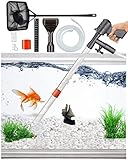
- Mufti-functional cleaning kit: Aquarium gravel vacuum cleaner kit is a mufti-functional aquarium cleaner that uses (adopts)the siphon design principle, which includes the aquarium, aquarium sand washing, algae scraping, fish excrement cleaning, aquarium residual debris, and aquarium water changing. Quick water change gives fish (provides)a clean and comfortable aquarium living environment.
- New safety design: new manual press design, no electricity required and silent while working. Fish tank cleaning tools uses a high-quality pressure resistant air bag, durable, super strong siphon pressure can quickly draw out the muddy water in the fish tank. The aquarium vacuum pipe has a filter net attached to the filter basket to block the blockage caused by the suction of gravel, while preventing your cute fish and the small gravel in the bathtub from being sucked out of the tank.
- Easy to install: This newly upgraded aquarium vacuum is easier to use than traditional fish tank vacuum. Simply hold the handle and press several times until you see water begin to flow out. You can also use a tube to agitate the gravel in the aquarium, causing fish manure, food debris, etc. to drain out of the aquarium with the current. The aquarium cleaning tools is securely attached to the aquarium so you can easily release your hands.
- A wide range of multi-combination accessories: aquarium cleaner vacuum crusher is suitable for different types and sizes of fish tanks, equipped with 2 water pipes and 1 joint, press pump, water flow clip, water pipe clip extended outlet hose, aquarium temperature stickers, fishing nets, plastic algae scraping plate, and detailed aquarium vacuum pump manual.
- Easy to use: The aquarium cleaning kit dust and water changer is hand-held, easy to use and operate, the aquarium cleaners can work stably and efficiently without electricity and without noise, which greatly saves your time and brings more convenience for fish tank cleaning.
When cleaning a mature filter, preserve its bacterial habitat. Rinsing biological media under untreated tap water can damage the community; use removed aquarium water or follow the media manufacturer’s instructions. Replace media only when it is physically failing, and avoid replacing every component at once.
6. Stock lightly, choose compatible animals, and add them slowly
Stocking is the largest controllable input in a fish aquarium. More animals mean more food, more excretion, greater oxygen demand, and less margin for a missed maintenance task. Calculate the adult size and behavior of every species, not the juvenile size at purchase. Consider territory, schooling needs, temperature, pH, flow, and whether any animal will uproot or consume the plants.
Windows Errors? Fix Them Before They Spread
Repair common Windows errors and clear accumulated junk for a smoother, more stable PC - no reinstall needed.Free scan · no reinstallCrashes, No Sound, or Screen Glitches?
Random freezes, missing sound and display glitches usually trace back to one bad driver. Find and replace yours safely.Free scan · under a minuteAdd a small first group only after the cycle is demonstrated by tests. Observe the readings and animal behavior before adding another group. If ammonia or nitrite rises, stop adding livestock, reduce feeding, increase aeration and circulation where appropriate, and perform the partial water changes required by the situation. Do not “solve” an overloaded tank by adding more animals that are advertised as cleaners; every animal contributes to the system’s total load.
The low-food, no-filter diving-beetle example from UF/IFAS is a specialized invertebrate design. Beetles may fly, so that guidance includes a cover and an above-water surface for climbing. Those details are relevant only when keeping that type of animal and do not establish that fish can be maintained without filtration.
7. Observe, test, and adjust before a small problem becomes a crash
Make monitoring routine rather than waiting for cloudy water or a dead fish. Keep a log with dates, test values, water changes, filter work, feeding changes, plant additions, and unusual behavior. The pattern is often more useful than a single number.
- Test results: Check ammonia, nitrite, nitrate, and pH during maturation and after changes in stocking, feeding, filtration, or plant mass.
- Animal behavior: Watch for gasping, hiding, clamped fins, loss of appetite, unusual aggression, or prolonged resting.
- Plant condition: Look for persistent melting, pinholes, pale new growth, excessive surface cover, or leaves blocking circulation.
- Equipment: Confirm that the filter outlet, intake, heater, air pump, and timer are working and that flow has not become restricted.
- Physical waste: Remove uneaten food, dead animals, and decaying leaves promptly.
Partial water changes remain part of responsible care. A planted, recirculating system may need them less often than a poorly planted or heavily stocked one, but plants do not remove every dissolved substance and do not correct every imbalance. Use test results, livestock condition, and the aquarium’s history to decide when intervention is needed.
Also popular on Amazon

- 【Novique Aquarium Cleaning Tool Kit】: Still hesitating over which tool to choose for perfectly cleaning your aquarium? Choose Novique now—one set of tools solves all your cleaning needs, providing a healthy living environment for your fish and aquatic plants. Featuring five different accessories, high toughness, sturdiness, and rust resistance, it offers secure installation and easy removal, plus a 19-inch anti-slip handle. With it, you'll enjoy crystal-clear underwater views every day.
- 【Multifunctional Aquarium Cleaning Tool】: Novique aquarium cleaning tool set includes five different accessories: a algae scraper for removing stubborn stains and algae from glass surfaces, a gravel rake for digging and leveling sand, a fish net for cleaning floating debris, a plant fork for removing and planting aquatic plants, and a sponge brush for cleaning glass.They're a great cleaning team—one set can tackle all kinds of aquarium problems, effortlessly giving your tank a fresh new look.
- 【High toughness & Sturdy & Rustproof】: Novique's high-toughness fiber operating rod has strong toughness, corrosion resistance, and tensile strength exceeding 1000 MPa, ensuring it will never break during use. All five accessories are crafted from high-strength ABS plastic, sturdy and durable, resistance to damage, and longer service life. The premium stainless steel algae scraper prevents rust and corrosion, effortlessly removing stubborn grime from glass surfaces.
- 【Secure Installation And Easy Removal】: Novique aquarium cleaning tools features a special snap-on design that securely attaches accessories to the handle, eliminating worries about them detaching during cleaning and reducing unnecessary hassle. Additionally, you can quickly swap out different cleaning heads in just minutes to adapt to various cleaning scenarios—making it incredibly convenient! All accessories share the same handle for easy storage, saving you valuable space.
- 【Deep Cleaning & Anti-Slip & One-Year Warranty】: Novique fish tank cleaner features a 19-inch-long handle that allows you to clean aquariums up to 1.77 feet deep without getting your hands wet. Equipped with a anti-slip handle, it enables vigorous scrubbing of stubborn stains on your aquarium without slipping, ensuring those tough marks are completely removed. We provide 24-hour professional after-sales service and a one-year warranty. For any product inquiries, feel free to contact us.
How the ecosystem components work together
| Component | What it contributes | What it cannot replace |
|---|---|---|
| Live plants | Take up some nitrogen compounds, provide habitat, and compete with algae when light and nutrients are balanced. | They cannot process unlimited waste or guarantee that water changes are unnecessary. |
| Nitrifying bacteria | Convert ammonia to nitrite and nitrite to nitrate on suitable surfaces in the filter and aquarium. | They do not remove the need to control the amount of food and livestock entering the system. |
| Mechanical and biological filtration | Moves water, captures solids, and provides surface area for microbes. | It cannot compensate indefinitely for overstocking, blocked flow, or neglected maintenance. |
| Lighting | Supplies energy for plant growth when duration and intensity suit the plants. | More hours or brighter light does not automatically mean healthier plants. |
| Aeration and circulation | Distribute oxygen and nutrients and prevent stagnant zones, including around plant roots. | They cannot make an immature filter safe for fish. |
| Keeper observation | Detects equipment failures, disease signs, deteriorating plants, and chemistry changes early. | It cannot be replaced by a “set-and-forget” label. |
University of Arizona Cooperative Extension’s July 2026 overview, Aquaponics Basics: How Fish, Plants, and Microbes Work Together, describes the balance among fish health, plant growth, and microbial activity. It also highlights solids removal, biofiltration, monitoring, aeration, reliable power, and the possibility that pump or oxygen failures can harm fish rapidly. A home aquarium is less engineered than a food-production aquaponics system, but the failure lesson transfers: circulation and oxygen are life-support equipment, not decorative accessories.
Choosing between common design options
| Choice | Advantages | Trade-offs and cautions |
|---|---|---|
| Larger tank | Typically more stable and gives more margin for parameter swings. | Higher startup cost, more floor space, heavier stand requirements, and more water to handle. |
| Smaller tank | Uses less space and less water during a change. | Conditions can shift more quickly; stocking and equipment choices must be especially conservative. |
| Low-tech planting | Fewer devices and simpler operation; many plants can grow without added CO₂. | Plant selection and growth rate are narrower, and some species may struggle. |
| CO₂-supported planting | Can expand the range or growth expectations of demanding plants. | Adds equipment, dosing decisions, and another variable to monitor for livestock safety. |
| Filtered fish aquarium | Appropriate for the higher food and waste load of fish when the filter is mature and sized correctly. | Requires cycling, testing, feeding control, maintenance, and dependable power. |
| No-filter beetle habitat | Can work for the specialized predaceous-diving-beetle setup described by UF/IFAS, with abundant plants and gravel. | Species-specific: beetles need a cover because they may fly and a surface above water to climb onto; do not generalize it to fish. |
University of Nevada, Reno Extension explains the broad aquaponic loop—fish waste, bacterial conversion, and plant uptake—in its 2015 article Grow Crops, Raise Fish With Aquaponics. Its crop-yield and water-use figures concern food production and should not be treated as performance guarantees for a small ornamental aquarium.
Independent reader supportYour contribution helps us test, update, and keep practical guides available for everyone.Troubleshooting a “self-sustaining” tank that is going wrong
Ammonia or nitrite is detectable
Stop adding livestock and reduce feeding while you investigate. Check that the filter is running, the intake is clear, and media has not been replaced or washed in a way that removed the bacterial community. Perform the partial water change appropriate to the measured result and livestock condition, then retest. A reading means the biological load currently exceeds processing capacity; adding more plants alone is not a reliable emergency response.
Algae is spreading
Check the timer, direct sunlight, feeding amount, plant density, and circulation. Shorten or moderate the photoperiod rather than making several changes at once, remove algae manually, and trim dying leaves. Algae control is a balance problem, not proof that the tank needs a chemical quick fix.
Quick wins for a faster PC:
Fix the driver behind crashes, sound loss and screen glitchesFind Drivers →Repair Windows errors before they cause bigger problemsFix Now →Scan for outdated or missing drivers - takes under a minuteDriver Scan →Fish are gasping or lethargic
Confirm that pumps, filters, heaters, and air equipment are operating and that the outlet is moving the surface. Test water immediately, look for temperature changes, and respond to ammonia or nitrite results with appropriate water changes. Treat a failed pump or oxygen supply as urgent: extension guidance warns that fish health can deteriorate quickly when circulation or aeration stops.
Plants are melting or failing to grow
Review whether the species matches the light, temperature, water conditions, and substrate. Remove decaying leaves, verify that the light timer is actually switching, and avoid increasing light or CO₂ blindly. Replant healthy portions and make one controlled adjustment at a time.
Also popular on Amazon

- GLASS AQUARIUM KIT: The starter kit includes one glass aquarium with a low-profile, hinged hood, an LED lighting system, an internal filter and filter cartridge, a water conditioner sample, a food sample and a setup and maintenance guide.
- LED LIGHTING: Energy-efficient LEDs give you a beautiful natural daylight effect.
- FILTRATION SYSTEM: The included Tetra Internal Filtration System features mechanical filtration to catch debris and chemical filtration with Ultra-Activated Carbon for removal of odors, discoloration and toxins.
- EASY SETUP: Aquarium kit includes items you need to create a healthy home for your fish*.
- SIZE: This 10-gallon glass aquarium measures 20 inches wide by 10 inches deep by 12 inches high.
The water is cloudy after setup
New substrate, disturbed material, or a bacterial bloom can cloud a young aquarium. Keep filtration and circulation running, avoid overfeeding, and continue the planned testing. Do not add fish simply to “balance” the appearance; biological maturity is demonstrated by stable test results, not clear water alone.
A maintenance rhythm that keeps the system stable
The exact schedule depends on livestock, plants, feeding, filter design, and test results, so use this as a checklist rather than a promise of fixed intervals.
The Tool Desk
Outbyte Driver Updater FREEScan for outdated or missing drivers - takes under a minuteDriver Scan →Outbyte PC Repair FREERepair Windows errors before they cause bigger problemsFix Now →- Each day: Verify that fish behave normally, equipment is running, and food is consumed without persistent leftovers.
- Several times a week in a new or changing tank: Test the parameters required by your cycling plan and record them.
- Weekly or as indicated by results: Inspect plants, remove dead material, clean viewing surfaces, and check that intakes and outlets are unobstructed.
- When tests or livestock condition call for it: Perform a partial water change using properly conditioned water matched as closely as practical to the aquarium’s temperature.
- At every equipment service: Confirm that the timer, heater, filter, air pump, and any CO₂ system restart correctly after cleaning.
Testing is an information tool, not a substitute for care. A test kit can show that ammonia is zero today; it cannot feed fish, remove a dead leaf, or restart a failed pump.
Questions people ask about self-sustaining aquariums
Can I make a fish tank with no filter?
Do not assume so. The no-filter example cited by UF/IFAS is for predaceous diving beetles in a specialized planted and gravel setup. Fish generally produce more waste and are more sensitive to its buildup, so a mature, appropriately sized filter is the safer design for a fish aquarium.
How long should I wait before adding fish?
Wait until testing shows that ammonia and nitrite reach and remain at zero under your cycling method and planned load. A calendar estimate is not enough; the timeline varies with temperature, pH, media, ammonia input, and other conditions.
Do live plants eliminate water changes?
No. Plants take up some nutrients and can slow accumulation, but they do not remove every dissolved substance or correct overfeeding, overstocking, or equipment failure. Continue testing and perform partial changes when the aquarium’s results and animals indicate they are needed.
Is CO₂ required for a self-sustaining planted aquarium?
No. Many low-tech setups grow plants without added CO₂, while some demanding species struggle without it. Choose plants for the light and conditions you can reliably provide; adding CO₂ increases equipment and monitoring requirements.
What is the most important purchase for cycling?
A reliable aquarium water test kit for ammonia, nitrite, nitrate, and pH lets you verify maturation and detect changes after stocking. Use the results to guide care; the kit does not replace filtration, aeration, water changes, or observation.
Can aquaponics principles make my ornamental tank self-sufficient?
They can inform a balanced design: microbes process waste, plants take up nutrients, and circulation supplies oxygen. But engineered aquaponics systems still require solids removal, biofiltration, monitoring, aeration, and dependable power. A planted home aquarium remains a managed ecosystem.





Leave a Reply