
Do these 3 things before closing this tab:
1Repair Windows errors before they cause bigger problems2Scan for outdated or missing drivers - takes under a minute3Clear out junk files and repair common Windows errorsSome links on this page are affiliate links: if you buy through them we may earn a commission, at no extra cost to you.
The right puppy name is short, distinctive, easy to pronounce, comfortable to call in public, and clearly different from training cues, household names, and other pets’ names. One or two syllables is a practical target, but sound clarity matters more than a strict syllable count. Build a broad list, test finalists aloud in real situations for a day or two, then teach the winner as a cue for attention using treats, praise, or a clicker. Keep the everyday call name separate from any formal registration name: they solve different problems.
What makes a puppy name “right”?
A call name is an attention cue you will use dozens of times a day. It should help your puppy orient toward you quickly, even when the environment is busy. The best choice balances six practical qualities:
As an Amazon Associate I earn from qualifying purchases.
- Clarity: You can say it quickly and the puppy can hear it in ordinary household noise.
- Cue distance: It does not resemble commands such as “sit,” “stay,” “stand,” “down,” “wait,” or “no.”
- Household separation: It sounds unlike the names of people and other animals who live with you.
- Public usability: You would be comfortable calling it at a veterinary clinic, training class, or busy park.
- Longevity: It still suits the dog after the puppy grows up.
- Emotional fit: It reflects something you genuinely like about the dog, your family, its heritage, or your interests.
Distinctiveness does not require an elaborate or unusual word. A familiar name with a clean sound is often more useful than a clever name that people mishear or cannot pronounce.
Should a puppy name be one or two syllables?
Usually, yes. One- and two-syllable names are quick to say, easy to repeat during training, and less likely to be shortened into a completely different sound. Two syllables also give you room to vary stress and intonation, which can help the puppy notice the word. Names ending in a vowel are commonly recommended because they can be projected clearly, but a vowel ending is not a guarantee of recognition.
Popular on Amazon

- New communication tool about you and your puppy.
- Pet Dog Training Clickers for Puppy, Cat, Potty, Bird, Horse, Pet, Trainer Training Tools, Behavior Aids
- Just press to mark desired behavior, then reward for faster learning.
- The spring wrist length : 16cm/6.3inches and can strength to 25cm/9.84inches.
- Package include : Black + Blue,each color 1 pcs.
Longer names can work if the household consistently uses a short call form. For example, a formal name might produce a two-syllable everyday name. Decide which version the puppy should learn and use that version consistently; switching among several nicknames slows the association during the first weeks.
Say each candidate at normal speed, in a cheerful voice, and as a recall. If its final sound disappears when you speak quickly, or if it becomes hard to distinguish outdoors, remove it from the list.
The Tool Desk
Outbyte PC Repair FREEClear out junk files and repair common Windows errorsFree Scan →Outbyte Driver Updater FREEFix the driver behind crashes, sound loss and screen glitchesFind Drivers →How do I keep a name from sounding like a command?
Read every finalist aloud beside the cues your puppy will hear most often. Avoid names that rhyme with or share the opening sound of “sit,” “stay,” “stand,” “down,” “wait,” and “no.” Tiny pronunciation differences that seem obvious to a person can be difficult for a dog to separate in fast speech.
| Check | What to ask | Why it matters |
|---|---|---|
| Training cues | Could the name be mistaken for “sit,” “stay,” “stand,” “down,” “wait,” or “no”? | A confused puppy may look for the wrong behavior or ignore both words. |
| People’s names | Does it sound like anyone who lives with you or visits frequently? | Dogs hear overlapping speech sounds, not the spelling on a page. |
| Other pets | Would the name be clear when both animals are called together? | Distinct first sounds make it easier to direct one animal at a time. |
| Emergency use | Can you shout it once without it blending into a command? | A clean, recognizable call is valuable when your puppy is moving away from you. |
Say the name and a command in alternating order: “Name, come,” “Name, sit,” and “Name, wait.” If the two words run together, choose a different name or change the command you plan to use before training begins.
How should I create a long list of puppy names?
Start with several sources rather than forcing an immediate decision. A broad list makes it easier to reject names that fail the sound or public-use tests.
Use the puppy’s observable traits
Color, markings, movement, size, and temperament can suggest names, but leave room for the adult dog. A name based on a tiny puppy’s current size may feel awkward when the dog is fully grown. Personality-based ideas are best treated as hypotheses until you have seen the puppy in different situations.
Also popular on Amazon

- ▼Come in 4 pack button clickers with wrist strap in 4 different colors:Black, Green, Orange, Yellow, each color 1 PCS
- ▼Can be used to train the dog basic obedience, small trick, and correct the bad behavior; Scientific method of training your pet safely and easily.
- ▼Stop barking and dog obdeience. Train your dog quiqly just by simply pressing the clicker and command.
- ▼Well constructed and durable, metal clicker will not rust or break.
- ▼Big button for easy clicking and loud sound. Easy to use in any position.
Explore heritage and interests
Breed history, a family hobby, a favorite place, food, music, books, or a cultural reference can provide meaningful options. Check pronunciation before adopting a word from another language, especially if you will need to call it quickly.
Use popularity lists carefully
Popular names can be appealing, but a common name may be shared by several dogs at a park or training class. The American Kennel Club’s 2025 examples include Luna, Bella, Daisy, Lucy, Ruby, Willow, Maggie, Penny, Nova, and Sadie for girls, and Max, Hank, Teddy, Cooper, Gus, Bear, Duke, Maverick, Charlie, and Finn for boys. These are inspiration from 2025, not a permanent ranking; popularity changes over time.
Try a name generator for variety
The American Kennel Club also offers a Dog Name Generator for less-obvious ideas. Treat generated suggestions as raw material: apply your own pronunciation, cue-distance, public-use, and longevity checks before choosing one.
How do I compare finalist names objectively?
Write five to ten finalists on paper and score each one before emotion takes over. A simple comparison exposes problems that are easy to miss when you are focused on how cute a name looks in writing.
What’s actually slowing this PC down?
Pick the symptom - the matching free tool is one click away.
| Criterion | Strong result | Warning sign |
|---|---|---|
| Clarity | Easy to pronounce at conversational speed and from across a room. | You must explain the pronunciation or repeat it to be understood. |
| Cue distance | Clearly unlike every routine command. | It rhymes with, starts like, or blends into a command. |
| Public usability | Comfortable to call at a clinic, class, or park. | It sounds threatening, embarrassing, insulting, or alarming when shouted. |
| Longevity | Fits both a young puppy and a mature dog. | It depends on a temporary size, trend, or behavior. |
| Distinctiveness | Stands out from local dogs and household names without being awkward. | It is so common that several dogs may respond. |
| Emotional fit | Has a meaning your household will still enjoy years from now. | You chose it only because it was fashionable for a week. |
Ask every household member to pronounce the finalists without seeing them written down. If people produce different sounds, the puppy will receive inconsistent input. Agree on one spelling and one everyday pronunciation before training starts.
How can I test a name before committing?
Use each finalist for a day or two as if it were already the dog’s name. This is more informative than repeating it silently or choosing from a list.
Also popular on Amazon
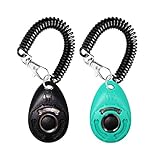
- EASY TO USE - Simple push button with distinct clicking sound.
- Comes with an elastic wrist band so you can leave it on your wrist or clip it to the leash or your pants.
- Not only train the dog but also the cat, bird, chicken, sheep a new behaviors like sit, fetch, roll over, lie down.
- For effective pet training ALWAYS reward with a treat after clicking.
- Can be used to train the dog basic obedience, small trick, and correct the bad behavior; Scientific method of training your pet safely and easily.
- Say it in three voices. Use a normal household voice, a happy voice, and a recall voice. The word should remain recognizable in all three.
- Call across a room. Check whether the ending is audible and whether the name blends with background speech.
- Try it outdoors. Wind, traffic, and distance reveal names that are too soft or easily confused.
- Use realistic phrases. Say “Name, come,” “Name, dinner,” and “Name, let’s go.” Notice whether the word is comfortable to repeat.
- Imagine public situations. Picture calling it at a veterinary clinic, dog-training class, boarding facility, or busy park.
- Check the adult version. Ask whether the name still fits a full-grown dog with the breed’s likely size and appearance.
Remove a candidate if it sounds alarming, offensive, embarrassing, or unclear in any of these settings. A name can be adorable in writing and impractical when shouted during an emergency.
How do I teach a puppy its new name?
Teach the name as a prediction of attention and good outcomes, not as a reprimand. Harriet Meyers, writing for the American Kennel Club, explains: “Your dog needs to learn that when you say their name, it means they should pay attention to you.”
Start in a quiet room
- Wait until the puppy is not looking at you but is calm and awake.
- Say the name once in a bright, happy tone. Do not repeat it rapidly.
- The instant the puppy turns toward you, mark the response with “yes” or a clicker.
- Give a small, soft treat, then add gentle praise or a brief game.
- Pause and repeat several times, keeping each session short.
A puppy-training clicker is optional; a consistent verbal marker works too. Small, soft puppy-training treats make it easy to reward promptly without interrupting the exercise.
Add distance and distractions gradually
Once the puppy reliably looks toward you in the quiet room, move a few steps away, then practice in another room. Add mild distractions only after the response is dependable. Outdoors, begin in a secure area and reduce the distance if the puppy stops responding.
Avoid common name-game errors
- Do not chant the name repeatedly; the puppy may learn that the word can be ignored.
- Do not shout the name after a missed response. Reduce the distraction or distance and try again.
- Do not use the name mainly before corrections, nail trimming, or other unpleasant events.
- Do not attach several nicknames until the primary name is reliable.
The aim is for the name to make the puppy turn toward you so you can give the next cue. It is not a substitute for “come” or another trained behavior.
Can I change my puppy’s name?
Yes. An early choice is not irreversible, and even an adult dog can learn a replacement name when it is consistently paired with positive experiences. Use the same procedure as the original name: say the new word once, mark the turn toward you, and reward immediately.
Recommended Free Tools
Also popular on Amazon

- ONE MANUAL AUDIBLE CLICK SOUND: Produces one audible click when manually pressed. This clicker does NOT provide multiple selectable sounds, electronic volume controls, batteries, remote functions, or Electronic Stimulation.
- REVIEW PHYSICAL SIZE BEFORE ORDERING: Customer size preferences may vary. Review the current product images and listed dimensions before purchase rather than relying on general descriptions such as small or compact.
- AUDIBLE CUE ONLY – RESPONSE MAY VARY: The clicker provides a manual sound cue and does not automatically give instructions to the animal. Individual dogs and other animals may respond differently. Introduce the sound gradually and discontinue use if fear or discomfort occurs.
- 5-INCH USER-WORN VELCRO STRAP: Includes an approximately 5-inch adjustable Velcro strap designed to position the clicker on the user's finger or hand. Review the strap configuration before purchase. The strap is NOT intended to be worn by the pet.
- TEAL CLICKER ACCESSORY ONLY: Includes one Teal manual finger clicker and training instructions. Remote transmitter, receiver collar, batteries, and other training-system components are NOT included.
For a gradual transition, pair the old and new words briefly—“OldName, NewName”—then reward attention. After several successful sessions, say only the new name. If the old name was associated with scolding, stop using it and build a fresh, positive association with the replacement.
Everyone in the household should use the same new word, pronunciation, and reward pattern. Inconsistent switching between old and new names can make either word less reliable.
Should the registered name and call name be different?
They can be, and separating them often makes both decisions easier. The call name is the short word used in daily life; a registered name is a formal record that may include a kennel name or longer wording.
For American Kennel Club registration, current rules include a 50-character limit counting spaces, apostrophes, and hyphens. Restrictions also apply to protected kennel names, titles, offensive terms, and certain descriptors, with additional rules for imported dogs and later name changes. Confirm the rules in force for your dog and registration type before submitting paperwork, because administrative requirements can change.
Choose the call name for speech and training first. Then design the formal name separately, making sure the two names do not create confusion in the household or at events.
Independent reader supportYour contribution helps us test, update, and keep practical guides available for everyone.What mistakes make a puppy name hard to live with?
- Choosing spelling over sound: A visually clever name is not useful if nobody agrees on how to say it.
- Using a command look-alike: Similar sounds can blur the line between the dog’s name and the behavior you want.
- Picking a temporary joke: Puppies become adult dogs; humor based on a current phase may age poorly.
- Ignoring public context: A name that feels funny at home may sound threatening or embarrassing in a clinic or park.
- Making it too common locally: Several dogs responding to one call creates avoidable confusion.
- Changing it casually: Frequent experimentation teaches the puppy that no single word reliably predicts attention.
- Using the name for punishment: This can weaken the positive association needed for a fast response.
When a problem appears, fix the cause rather than simply speaking louder: choose a clearer word, establish one pronunciation, reduce distractions during practice, and reinforce the response immediately.
Also popular on Amazon

- Stronger Bark Control with 3X Ultrasonic Emitters: Unlike single-emitter devices, our upgraded dog bark deterrent features three synchronized ultrasonic heads—delivering 3X the coverage to quickly stop barking, biting, and jumping behaviors. Ideal for anti barking training, safer than bark collar, more effective than a dog whistle, offers a humane, high-performance dog training solution
- 6-in-1 Safe & Humane Training Modes:Our dog bark deterrent device features dual ultrasonic frequencies (fixed 25kHz and variable 20-30kHz), combining 4 ultrasonic modes plus an audible beep and LED flashlight for versatile training. Whether for daily training or stubborn, persistent barking, this anti bark device adapts to different dogs providing effective bark control without causing pain or distress. Perfect for training at home or to stop neighbors dog bark that disturbs your peace
- 23 FT Extended Range & Night Safety: Bark Control Anytime, Anywhere: Stop barking and bad behavior from up to 23 feet away with our powerful dog bark deterrent device — perfect for your yard, neighbor’s yard, outdoor walks, and off-leash areas. Whether you're relaxing at home or out for a stroll, enjoy safe, long-distance control to correct disruptions quickly. The built-in LED flashlight adds safety for evening walks, and low-light training
- Fast Charge & Long Battery Life – Always Ready for Training:With a Type-C fast charging port, our dog bark deterrent device reaches a full charge in just 2 hours and provides up to 30 days of regular use on a single charge, along with 180 days of standby time. Whether you're correcting anti barking behavior or training your dog in public places, you’ll always be prepared for any situation. Forget the hassle of frequent charging and enjoy reliable, long-term barks no more support
- Ultra-Compact Design for Everyday Convenience:50% smaller than standard dog bark deterrent devices, our anti barking device is ultra-compact and lightweight, fitting effortlessly into your pocket, bag, or hand. Whether you're on daily walks, outdoor adventures, or dealing with unexpected situations in public places, this portable design helps you stop barking and encourage good behavior anywhere, anytime. Say goodbye to constant noise and enjoy a barks no more experience with your dog
What is the quickest decision process?
Use this checklist when you need to choose among a few good options:
- Write down at least ten ideas from personality, appearance, heritage, and household interests.
- Remove anything longer than two syllables unless you have a clear short call form.
- Cross out names resembling “sit,” “stay,” “stand,” “down,” “wait,” “no,” a person’s name, or another pet’s name.
- Say the survivors across a room, outdoors, and in a recall voice.
- Ask whether each one is comfortable at a veterinary clinic or busy park.
- Choose the finalist that still fits the expected adult dog.
- Use one consistent pronunciation and teach it with immediate positive reinforcement.
Stephanie Gibeault, MSc, CPDT, writing for the American Kennel Club, summarizes the public-use test this way: “A dog’s call name should be easy to say, easy to hear, and comfortable to use in public.”
Quick wins for a faster PC:
Scan for outdated or missing drivers - takes under a minuteDriver Scan →Clear out junk files and repair common Windows errorsFree Scan →Frequently Asked Questions
How long does it take a puppy to learn its name?
Many puppies begin turning toward a name after short, rewarding sessions, but reliability depends on age, distractions, motivation, and consistency. Practice in several easy locations before expecting the same response at a busy park.
Should I use my puppy’s name before every command?
Use the name to gain attention, then give the separate cue once the puppy looks at you. This keeps the name meaningful instead of turning it into background noise attached to every sentence.
Is it bad to give a puppy a human name?
No. A human name works if it is clearly different from the people’s names and routine commands in your household. Tell visitors the agreed pronunciation so the puppy hears one consistent sound.
What should I do if my puppy ignores its name outdoors?
Return to a quieter location or shorten the distance, reward every orienting response, and add distractions one at a time. Outdoor failure usually means the environment is more difficult than the puppy’s current training level, not that the name is permanently unusable.
Free tools Windows power users keep installed
One-click scans. No signup required.





Leave a Reply