To photograph fast-moving birds sharply, start with a shutter speed around 1/2500 to 1/3200 second or faster when light allows, use continuous autofocus, and set your exposure before the action begins. These are practical starting points, not guarantees: the best settings depend on the bird’s speed, available light, background, and camera.
Set exposure to freeze motion
Shutter speed is the main control for stopping a bird’s movement. Cornell Lab photographer Gerrit Vyn recommends 1/2500, 1/3200, or faster for birds in flight when light permits. Slower speeds may be necessary for slower birds or dim conditions, but expect fewer frames to be sharp. Nikon illustrates a bird photographed at 1/3200 second with sharp wings; that image is an example, not a controlled test.
A faster shutter lets in less light, so you may need a wider aperture or a higher ISO. Keep the aperture open enough to maintain your chosen shutter speed. If light allows, stopping down toward f/5.6 or f/8 can provide more depth of field across the bird’s head, body, and wings. These are examples from Vyn’s guidance, not requirements for every lens or camera.
For dedicated flight photography, Vyn recommends setting exposure in advance, often in manual mode. That can prevent a change from bright sky to dark foliage from unexpectedly changing your shutter speed or exposure.
What’s actually slowing this PC down?
Pick the symptom - the matching free tool is one click away.
#1 Best Overall

- Upgraded 28x Telephoto Lens – Wider View & Easier Framing: Designed for everyday users, this 28x telephoto lens delivers a wider field of view than most 28x lenses, making it easier to find and frame distant subjects. Whether you're at a concert, a sports game, or just exploring nature, you'll get crisp, high-resolution close-ups without the hassle of perfect alignment.
- Advanced Optical Performance with Reduced Edge Darkening: Features a breakthrough light path design for an ultra-wide view and excellent light intake. The field-of-view ring helps reduce edge darkening, so you get a cleaner image with fewer dark corners (results may vary by phone model). High resolution and true color reproduction significantly enhance your mobile photography.
- Stable Long-Distance Capture & Monocular Function: With 28x magnification, capture clear and steady shots of distant subjects. The lens can also be used as a monocular telescope for extended observation—perfect for birdwatching, wildlife, or scenic views.
- Wide Compatibility & Versatile Use: Perfect for sports events, concerts, bird watching, wildlife observation, and travel. Compatible with iPhone, Samsung, Huawei, Xiaomi, OPPO, Vivo, and most other smartphones.
- Portable & User-Friendly: Crafted with high-quality glass and a durable yet lightweight body. The universal clip attaches securely to your phone, and the compact design fits easily in a pocket or bag—ideal for travel and outdoor adventures.
Choose autofocus that can stay on the bird
Use continuous autofocus so the camera can keep adjusting focus as the bird moves. Choose a focus area according to how easily you can keep the bird under the active points and how much competing detail is behind it.
- Single point: Offers precise placement when the bird is large enough in the frame and you can hold the point on it.
- Wider area: Gives you more room to acquire a small or erratic bird, though it may be less selective against a busy background.
There is no universally best focus-area mode in the cited guidance. Names such as wide-area AF, auto-area AF, group, or zone refer to examples on particular camera systems; check your model’s manual for the equivalent options. A clean, distant background can make it easier for autofocus to distinguish the bird from its surroundings.
Rank #2

- 【36X Telephoto – Bring Distant Details Closer】Capture distant buildings, mountain scenery, and wildlife with your phone. This fixed-magnification 36X telephoto lens brings faraway details into view in a portable kit for travel, hiking, and outdoor photography
- 【Best at 100–500 ft – Made for Outdoor Viewing】Recommended for subjects approximately 100–500 ft away (30–150 m). Photograph perched birds, architectural details, or performers on a well-lit outdoor stage. Best for stationary or slow-moving subjects with a clear line of sight. Not suitable for fast-moving subjects; low-light venues are more challenging
- Use the Tripod for Steadier Shots】At 36X magnification, even small hand movements can cause visible shake. Use the included tripod, carefully align the lens with your phone’s main camera, and turn the focus ring until your subject looks sharp. A 3-second camera timer helps reduce movement when taking a photo
- 【Multi-Coated Glass & Aluminum Build】Multi-coated optical glass helps reduce unwanted reflections and flare, while the aluminum-alloy body offers a durable build for outdoor use. Image quality depends on lighting, distance, phone camera, and focusing accuracy
- 【Check Phone Width & Camera Alignment】The adjustable clip fits phones 2.6–3.7 in (66–95 mm) wide, including compatible iPhone, Samsung Galaxy, and Google Pixel models. If using a thick case, measure your phone’s total width with the case on to confirm it falls within this range. Width alone does not guarantee compatibility: the clip must also align the lens with your main camera. Remove the case if it prevents secure mounting or proper alignment
Prepare for the flight path
Choose a place where birds are likely to follow a predictable route and where the background separates them clearly. When conditions allow, put the sun and wind behind you. Birds often fly into the wind, which can slow their movement and make an approach more favorable.
If you can estimate the bird’s distance, prefocus near that range before it appears. This can make it easier to see and acquire the subject in the viewfinder and gives autofocus a closer starting point.
Rank #3
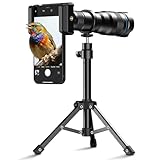
- 【36X Telephoto for Distant Subjects】Designed for long-range viewing, this 36X telephoto lens for iPhone and Android phones brings birds, wildlife, sporting action, and outdoor scenery closer in the frame. Compared with a 50X lens, its wider field of view makes subjects easier to locate and helps reduce visible dark edges
- 【Advanced Optics for Clearer Images】Multi-coated glass elements help reduce glare and distortion for sharper detail and more natural color. Use this iPhone telephoto lens to photograph graduation ceremonies, campus sports, wildlife, or distant views. Recommended shooting distance: approximately 30–200+ ft; not intended for close-up family photos
- 【Check Your Phone Size and Camera Alignment】This iPhone camera lens fits many phones measuring 2.6–3.7 in / 66–95 mm wide, including compatible iPhone, Samsung Galaxy, and Google Pixel models. Actual fit depends on the camera position, camera bump, and phone case. For best results, remove thick cases and align the lens directly over the phone’s main camera
- 【Minimize Dark Edges for a Fuller Screen】After attaching the zoom lens for iPhone, open the camera app and increase the phone’s digital zoom slightly—1.2X to 1.5X is recommended—to reduce the dark circular edges that may appear at 1X. Always align it with the main camera, not the ultra-wide lens. On supported iPhones, turn off Auto Macro if the flower icon appears
- 【Made for Sports, Graduation and Outdoor Adventures】Ideal for birdwatching, wildlife observation, fishing, camping, zoo visits, outdoor events, and sports from distant seats. The 36X lens offers a wider view, less vignetting, and easier subject tracking than higher-magnification options. Choose the T30X when image resolution is the priority; choose the 36X when easier framing and a wider field of view matter more
Track smoothly through the shot
Keep the bird in the viewfinder, follow it with your body, and continue panning after you press the shutter. Vyn’s advice is to “Follow with Your Whole Body”: turning your torso smoothly helps maintain the bird in the frame instead of relying only on your arms. Practice on common birds before attempting a difficult or brief encounter.
A tripod can help with deliberate composition or holding focus, but it can restrict movement when a bird changes direction. Hand-holding a shorter lens can make fast panning easier. The right choice depends on the lens’s weight, your comfort, and the bird’s path.
Rank #4

- ★ JINTU 420-800mm MF Super HD Telephoto lens, Solid Construction with full metal body, Small size 10.6 x 3.5 x 3.5 inch, lightweight 700g=1.8LB, easy to carry to anywhere.
- ★ Ultra high definition image quality from Japan, Multi coated low-dispersion glass. Free canon adapter supply. If your camera is Nikon, Pentax, Sony e mount cameras or other brand which can buy it from our store.
- ★ Compatible with Canon EOS Rebel T1i, T2i, T3, T3i, T4i, T5, T5i, T6, T7, T6i, T6s, T7i, SL1, SL2, 60D, 70D, 77D, 80D, 50D, 40D, 30D, 5D, 1D, 5D III, 5D IV, 5Ds, 6D, 7D, 7D Mark II etc SLR Digital Cameras.
- ★ Perfect for boyfriend or husband birthday gifts or photographyer. Best choice for small or distant subjects, ranging from birds and wildlife, through sports, to moon etc.
- ★ NOTE: This is a manual lens, NO auto focus, your camera will show "lens not attach", but not defect. pls switch to MF MODE in order to use this lens.
Review the frames and adjust
Check the head and primary feathers first. Blur in the primary feathers can be an early sign that the shutter speed was too slow; a sharply focused background with a soft bird may instead indicate missed focus. Nikon’s crane guidance specifically recommends looking at the primary feathers when assessing motion blur.
- If the bird’s feathers show motion blur, increase shutter speed if the light allows; compensate with aperture or ISO as needed.
- If focus lands behind or in front of the bird, adjust your tracking technique or focus-area size.
- If you are losing the bird while trying to use a single point, try a wider area; if autofocus is choosing background detail, try a smaller area or a cleaner background.
For more detailed flight-photography guidance, see Cornell Lab’s article by photographer Gerrit Vyn, excerpted from his book Photography Birds: Field Techniques and the Art of the Image. Other useful references include Nikon’s explanation of shutter speed, Nikon’s Sandhill Crane photography tips, and Audubon’s bird photography tips.
Quick wins for a faster PC:
Repair Windows errors before they cause bigger problemsFix Now →Scan for outdated or missing drivers - takes under a minuteDriver Scan →Clear out junk files and repair common Windows errorsFree Scan →Quick Recap
Best Value

- 【30X Telephoto with Manual Focus】Bring distant subjects closer with 30X magnification and fine-tune focus by rotating the focus ring. Capture clearer photos and videos of distant scenery, wildlife, athletes and other outdoor subjects
- 【HD Optics & Durable Aluminum-Alloy Build】Made with high-quality optical glass and an aluminum-alloy body for clear viewing and lasting durability. Multi-layer coated optics help enhance sharpness, reduce distortion and deliver vivid, true-to-life colors
- 【Tripod Included for Stable Shooting】The included aluminum-alloy tripod and fixing ring support hands-free use and help reduce blur in photos and videos caused by shaking, making long-distance shooting and observation more stable
- 【Two Ways to Use—Phone Lens or Monocular】Attach the lens to your smartphone for photos and videos, or add the silicone eyecup for direct viewing as a monocular. Ideal for camping, sporting events, moon watching, bird watching, fishing, hiking, golf, concerts and travel. Best shooting distance: 300 mm and beyond
- 【Wide Compatibility for Most Smartphones】The adjustable clip fits phones approximately 2.8–4.1 in / 71–105 mm wide, including many iPhone, Samsung Galaxy, Google Pixel and other smartphones. Works with single- or multi-camera phones; not for smaller iPhone Mini and SE series
Product prices and availability are accurate as of the date/time indicated and are subject to change. Any price and availability information displayed on Amazon at the time of purchase will apply.




