
Outdated Drivers Are Slowing You Down
One free scan finds every outdated or missing driver and matches the right update for your exact hardware.Free scan · exact hardware matchPC Slower Than It Used to Be?
A free scan shows the junk files, broken settings and background clutter dragging Windows down - then fixes them in one click.Free scan · Windows 10 & 11Some links on this page are affiliate links: if you buy through them we may earn a commission, at no extra cost to you.
The fastest way to earn an adopted cat’s affection is to stop trying to force affection. Give the cat a quiet base room, predictable care, safe hiding choices and control over every approach. Most cats become more social as they learn that your presence predicts food, play and calm rather than restraint. Some show clear trust within days; others need weeks or months. Your job is to make progress possible while watching appetite, litter use, body language and health.
What should I prepare before bringing an adopted cat home?
Set up one small, quiet room before the carrier arrives. A limited starting area lowers sensory overload, gives a frightened cat a defensible retreat and lets you monitor eating, drinking and litter habits. Keep the room available even after the cat begins exploring the rest of the home.
As an Amazon Associate I earn from qualifying purchases.
The Tool Desk
Outbyte PC Repair FREEClear out junk files and repair common Windows errorsFree Scan →Outbyte Driver Updater FREEScan for outdated or missing drivers - takes under a minuteDriver Scan →Use a complete safe-room checklist
- Food and water: Place them away from the litter box, with enough distance that the cat can eat without feeling cornered.
- Litter box: Keep it easy to reach and scoop it regularly so changes in urine or stool are visible.
- Hiding place: Offer a box, covered bed or other retreat that a person can reach if medical care is needed. Do not block the entrance or remove the hiding option.
- Bedding: Add a washable blanket or bed with familiar shelter scents if the adoption organization provides them.
- Scratching surface: A stable post or pad gives the cat an appropriate outlet for marking and stretching.
- Toys: Keep a few quiet toys available, plus an interactive wand for later play sessions.
- Hazard control: Close windows, secure cords, remove toxic or unsafe plants and block gaps where a cat could become trapped or unreachable.
- Access control: Close the door at first. Make sure other pets and busy visitors cannot enter unexpectedly.
A secure cat carrier is essential for the trip home, veterinary visits and emergencies. Leave it in the safe room with the door open once the cat arrives; it can become another voluntary retreat rather than a signal that a stressful trip is coming.
How should I handle the first day?
Bring the carrier into the prepared room, close the door and set it on the floor. Open the carrier door, then step back. The cat may remain inside for minutes or hours; that is a normal choice, not a failure to bond.
Popular on Amazon

- Pet Carrier: 17.5” L x 11” W x 11” H, Recommended max load of 16 lbs cats small dogs. Please do not choose your carrier based on weight--please reference your pet's length and height in selecting a pet carrier size.
- Fits for under-seat dimensions of most airlines. Every airline has a specific set of rules and regulations, please contact with airline before flying with your cats small dogs.
- Mesh windows for ventilation, top and side entry with locking zippers for safety. Carrying handles, adjustable shoulder strap which can also be used as seatbelt, and back strap can fasten the pet carrier to your luggage.
- Pet carrier comes with a removable base insert, which creates a solid surface for your pet to stand on, along with a removable & hand washable cozy fleece pet bed, which offers a cozy sleeping space for your traveling cats small dogs.
- "Toys for pets, of textile materials". Mostly used as a Toy of Fabric Pet Home for pets playing and relaxing.
- Keep the room quiet. Ask household members to avoid crowding the doorway, loud music, vacuuming and repeated checks.
- Allow an exit on the cat’s terms. Never tip, shake or reach into the carrier to pull the cat out.
- Offer essentials immediately. Food, water, litter and a retreat should be available even if the cat stays hidden.
- Give private time. A short, calm check is useful; prolonged hovering can make the cat feel watched.
- Record baseline observations. Note whether food is touched, water level changes, urine or stool appears and whether breathing looks normal.
Common transition behaviors include hiding, hissing, swatting, avoiding people, vocalizing, being active mainly at night, eating less and struggling to settle. PAWS identifies these as typical fear or adjustment signs. Treat them as information about stress, not as evidence that the cat dislikes you.
Why is my newly adopted cat hiding?
Hiding protects a cat from unfamiliar sights, sounds, smells and people. A small room with a reachable refuge is safer than forcing the cat into the open or giving a frightened newcomer the entire house immediately.
Recommended Free Tools
Do not drag the cat out for cuddling or photographs. Sit quietly in the room, keep your body turned slightly sideways and let the cat observe without pressure. If the cat eats, uses the litter box and explores while you are away, those quiet behaviors can represent meaningful progress even when you rarely see the cat.
Make a hiding place useful rather than dangerous
Choose a retreat that is enclosed enough to feel secure but accessible for cleaning and veterinary handling. Avoid inaccessible spaces behind appliances, inside walls or under heavy furniture. If the cat chooses a safe hiding spot, preserve it; add alternatives rather than removing the original refuge.
How can I interact during the first week?
Use brief, predictable visits. Sit at the cat’s level, speak softly and avoid direct staring. A slow blink followed by looking away can communicate non-threat. Rest a relaxed hand nearby instead of reaching over the cat’s head, and wait for the cat to close the distance.
Let body language set the stopping point
End an interaction when the cat turns away, flattens its ears, flicks or lashes its tail, crouches tightly, growls, hisses or swats. These are requests for space. Continuing after those signals teaches the cat that subtle warnings do not work and may lead to stronger defensive behavior.
Keep care events predictable
Feed at consistent times, refresh water on a routine and visit in a pattern the cat can anticipate. Predictability reduces the need to stay alert. Meals and treats can become positive associations with your presence, but leave the food and give distance if the cat will not eat while you are nearby.
Also popular on Amazon

- [PRODUCT DIMENSIONS] Pet travel carrier size : 17x11x11 inches, recommended up to 15 lb pets, it is suitable for large, medium cats and small dogs. Please don't choose your airline cat carrying case based on weight, please refer to your pet's length and height when choosing a pet carrier size.
- [AIRLINE APPROVED] This cat carrier is designed with airline approved, it can fit comfortably under most flight seats, we can take our pets wherever we want. Dog travel carrier offers two attachment loop handles that can be used as a dual harness or as a luggage strap for balanced carry and secure transport.
- [EXCELLENT MATERIAL] Collapsible cat carrier is made of polyester fabric, supported by a steel ring, washable, wear-resistant and durable. The three sides and the top of this pet carrier are nylon mesh, scratch-resistant and not easy to damage, it can not only check your pet in real time, but also ensure enough air circulation.
- [SAFE AND COMFORTABLE] Dog travel bag has metal zippers on the top and side entrances, durable and not easy to deform, it allows your pets to enter and exit easily. The cat carrying case is equipped with an anti-escape safety buckle, which can effectively prevent pets from accidentally falling. It is suitable for car rides and vet rides.
- [PORTABLE AND FOLDABLE] Pet travel carrier comes with a detachable and hand washable wool pet bed, it can provide a comfortable sleeping space for your traveling pet. The cat travel case comes with an adjustable shoulder strap and handle for easy portability. When not in use, you can fold it up for storage.
Use play without crowding
Move a wand toy across the floor or around a corner rather than waving it in the cat’s face. Let the cat choose whether to watch, chase or ignore it. Stop while the cat is still relaxed; ending on a comfortable note makes the next session easier to accept.
When should I let the cat explore more of the home?
Expand territory after the cat is eating and eliminating reliably, resting openly or exploring, and approaching the door or you without obvious distress. Open one additional room or hallway at a time, then keep the original safe room available as a retreat.
- Open a single route. Remove hazards and close doors to rooms that contain fragile objects, open windows or inaccessible gaps.
- Keep essentials reachable. The cat should not have to cross a busy area to reach water, litter or the safe room.
- Observe, do not escort. Allow voluntary exploration. Do not carry the cat around to “show” the house.
- Pause if stress rises. If the cat stops eating, hides continuously or becomes defensive, reduce access again and restore the quieter setup.
- Add space gradually. Repeat with another room only after the current area is being used comfortably.
Immediate whole-house access gives a confident cat more territory but can overwhelm a fearful one and makes food and litter monitoring harder. A small safe room is more controllable and reversible; gradual expansion preserves choice without flooding the cat with novelty.
Free tools Windows power users keep installed
One-click scans. No signup required.
How long does it take an adopted cat to trust me?
There is no reliable population-wide success rate or universal timetable for making a rescue cat affectionate. ASPCA guidance uses a planning framework of roughly the first three days as a nervous period, the next three weeks as decompression and settling, and the first three months as continued trust-building. San Francisco SPCA notes that some cats adjust in days or weeks, while others need months; when no other pets are present, one to two weeks may be enough for some cats to settle.
| Planning range | What may be happening | How to respond |
|---|---|---|
| First three days | Hiding, reduced appetite, nighttime activity or defensive signals are common. | Maintain the safe room, quiet visits and close health monitoring. |
| First three weeks | The cat may establish routines, explore more and begin accepting play or brief touch. | Keep schedules steady and expand space only when confidence is visible. |
| First three months | Trust can continue developing through repeated predictable experiences. | Respect individual limits; do not treat a slower pace as a behavioral failure. |
| Beyond three months | Some cats remain cautious or prefer proximity over handling. | Measure comfort and voluntary contact rather than expecting lap sitting. |
These are planning ranges, not promises. Age, previous handling, temperament, health, household noise and other pets can all alter the pace.
How do I make a cat more affectionate without forcing it?
Build a pattern in which approaching you reliably produces something the cat values: a meal, a treat, a calm play session or a comfortable place to rest. Affection is more durable when the cat can initiate and end contact.
Reward voluntary proximity
Place a treat near you, then farther away as the cat becomes comfortable. You can quietly drop a treat when the cat enters the room, looks toward you or settles nearby. Avoid luring the cat into a position where you then restrain it.
What’s actually slowing this PC down?
Pick the symptom - the matching free tool is one click away.
Also popular on Amazon

- High Quality Design:Sturdy steel cage structure and wooden support board maintain good spatial stability and shape. Breathable mesh windows on four sides,which can ensure good air circulation and views,make pets have a comfortable and safe travel.It can also be easy for you to check on your pets.There is a front pocket to store pet toys,treats,etc.
- Dimension and Weight:Made of durable tear-resistant fabric.Four easy entrances for pets. Dimensions: 17 inch x 11 inch x 11 inch (L*W*H), suitable for pets up to 16 lbs.Please don't choose your carrier based on weight only,consider your pet's length and height when choosing a carrier.
- Airline Approved & Safty:Can be placed under the seats of most airplanes(Four non-slip feet on the bottom to prevent movement), and comfortably on the seat next to you in a car or bus.It has a adjustable shoulder strap.Can also be fastened to the car seat with a safety belt or shoulder strap to keep your pet safe.
- Easy to Clean :You can clean the stains and dirt on the surface with a soft cloth.Soft mat inside the pet carrier is removable and washable.You can take it out and wash it easily to solve all stains.
- Easy to Collapsible & Lightweight:When not in use,fold it into a flat,space saving and easy to store.Only 2.2lbs,it's easier to carry around.It can also used as a toy of pet house,allowing pets to play in a safe space to relax and rest.
Touch only where it is welcomed
Many cats accept cheek or chin rubs before they tolerate strokes along the body. Offer one or two gentle touches, pause and watch the response. A cat that leans back into your hand is inviting more; a cat that freezes, turns away or moves off has answered no.
Respect different forms of affection
Trust may appear as following you, rubbing against your legs, sitting beside you, sleeping nearby, playing in your presence or requesting a brief touch. A cat that never chooses a lap can still be strongly bonded. San Francisco SPCA’s practical message is that cats ask for affection when they want it; your role is to notice and honor that request.
What body-language signals show growing trust?
Look for a pattern over several days rather than judging one interaction. Relaxed muscles, normal grooming, regular appetite and exploratory behavior matter as much as cuddling.
| Signal | Likely meaning in context | Your response |
|---|---|---|
| Approaches or follows you | Interest and increasing confidence | Stay calm; reward proximity without grabbing. |
| Rubs against legs or arms | Social contact and scent exchange | Offer a brief cheek or chin touch if the cat remains relaxed. |
| Sits or sleeps nearby | Comfort with your presence | Let the cat rest undisturbed. |
| Relaxed play | Enough security to engage | Use interactive play and stop before fatigue or frustration. |
| Ears back, tail twitching, growling or hissing | Discomfort, fear or overstimulation | Stop, increase distance and provide the retreat. |
Association of Shelter Veterinarians guidance emphasizes ongoing observation and adjustment of handling plans. In practice, every interaction is a small feedback loop: offer a low-pressure choice, read the response and change the plan when the response says the demand is too high.
How should I introduce a newly adopted cat to another cat?
Keep the newcomer separate while it settles and receives a veterinary check. Introductions should move from scent to sight to brief supervised contact, and the process should be slowed whenever either cat shows sustained stress.
- Separate first. Give each cat its own food, water, litter and retreat resources.
- Exchange scents. Swap bedding or use separate cloths to transfer cheek scent, without forcing either cat to approach the item.
- Allow controlled visual contact. Use a secure barrier or a partially opened door so the cats can see one another without direct access.
- Pair sight with good events. Offer meals, treats or play at a distance where both cats remain able to eat and relax.
- Try short supervised meetings. Provide multiple escape routes and end the session before chasing, cornering or prolonged staring occurs.
- Increase duration gradually. Keep resources distributed so one cat cannot guard every essential location.
San Francisco SPCA gives a seven-to-ten-day settling and veterinary-check guideline before resident-cat introductions, but that is a planning guide, not permission to rush a fearful or ill cat.
How can I introduce the cat to a dog?
Prevent chasing from the first meeting. Keep the dog controlled, give the cat an elevated or enclosed escape route and maintain a dog-inaccessible safe area at all times.
Also popular on Amazon
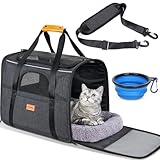
- 【 Spacious & Comfortable Cat Carrier 】The large cat carrier provides ample space for your feline friend to move, turn, and stretch during travel. Measuring 17.3 x 12.2 x 13.4 inches, it is wider and taller than most cat carriers, ensuring your pet feels comfortable and at ease while on the go.
- 【Balanced Mesh Design】Unlike other cat carrier hard, our cat carrier soft strikes the perfect balance with 40% mesh surface area. This ensures your pet can observe the surroundings and breathe easily while feeling safe and secure at the same time. The cat carrier large is suitable for pets in all kinds of situations.
- 【Built-in Dual-Sided Cushion】The detachable pad offers two distinct comforts: a cool side for summer and a super-soft, warm side for winter. You can easily flip it to match the season, providing the perfect temperature for your pet in any weather.
- 【Includes Foldable Bowl】Designed for on-the-go use, our foldable bowl carries 410g of food or 20oz of water. After use, simply collapse it and attach it directly to your pet's collar or leash, perfect for keeping your pet fueled and hydrated anywhere.
- 【Safe & Durable】Safety is our top priority, and the pet carrier for cat is equipped with a secure buckle to prevent your pet from escaping. The cat carrier soft is made of reinforced snow silk fabric and hard mesh material, ensuring durability and preventing any tearing during long-distance travel.
Begin with separation and scent exchange, then allow the dog to see the cat from a distance while calm. Reward the dog for looking away and responding to you. Increase proximity only when the dog can remain relaxed and the cat can retreat; never hold the cat in front of the dog or allow a cornering encounter.
Quick wins for a faster PC:
Clear out junk files and repair common Windows errorsFree Scan →Scan for outdated or missing drivers - takes under a minuteDriver Scan →What should children do around a newly adopted cat?
Teach children that hiding, flattened ears, tail twitching, growling and hissing mean “stop and give space.” Adults should supervise every interaction, especially during the first weeks.
- Let the cat approach rather than carrying it to a child.
- Use quiet voices and slow movements.
- Do not chase, pull a tail, hug, wake or block the cat’s retreat.
- Invite children to toss treats or move a wand toy while an adult controls the pace.
- Keep the safe room off-limits when the cat is resting there.
When should I call a veterinarian or the adoption organization?
Arrange veterinary care shortly after adoption, even when the cat appears healthy. Contact a veterinarian promptly for breathing difficulty, marked lethargy, weakness, repeated vomiting, persistent diarrhea, dehydration, pain or other signs of illness; illness can look like “shyness” in a new home.
PAWS advises contacting its foster team if a cat does not eat for more than two days or has persistent diarrhea. That organization-specific threshold is not a universal substitute for veterinary advice: a kitten, senior cat or cat with a known condition may need attention sooner. If you are unsure whether reduced appetite is stress or illness, call rather than waiting for the cat to become affectionate.
Which supplies genuinely help a cat feel secure?
Supplies support the plan; none can guarantee affection. Choose items that increase safety, choice or environmental control.
| Supply | Useful role | Selection and setup principle |
|---|---|---|
| Cat carrier | Safe transport and an always-available retreat | Use a secure model and leave it open in the safe room after arrival. |
| Covered hide or bed | Privacy and recovery from stimulation | Keep it reachable; provide more than one option as territory expands. |
| Scratching post or pad | Stretching, marking and stress outlet | Use a stable surface near resting or traffic areas. |
| Interactive wand toy | Distance play and positive association | Move it away from the cat and let the cat choose whether to engage. |
| Food and water dishes | Reliable access to essentials | Keep water and food away from litter and place them where the cat is not cornered. |
What should I do if progress seems to stop?
First check for a change in health, noise, visitors, household schedule, litter location or conflict with another animal. Return to the last setup in which the cat ate, rested and used the litter box comfortably, then make one change at a time.
- The cat hides all day: confirm that food, water and litter are close, keep visits brief and avoid reaching into the refuge.
- The cat accepts food but avoids touch: continue meals and play without touching; proximity is progress.
- The cat becomes defensive during petting: shorten contact, switch to cheek or chin touches and stop at the earliest warning signal.
- The cat stops eating or develops illness signs: contact a veterinarian or the adoption organization rather than treating it as a training problem.
- Conflict starts with another pet: separate immediately and return to scent work and barrier-based visual contact.
PAWS captures the pacing principle simply: you cannot go too slowly, but you can go too fast. A reversible step that preserves the cat’s choices is usually safer than a dramatic interaction intended to speed up bonding.
Also popular on Amazon
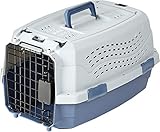
- Hard sided pet carrier with 2 doors for front and top entry; suitable for cat or extra-small dog breeds, such as chihuahuas and toy poodles (up to 11 pounds)
- Durable plastic construction with steel wire front door; screws keep the top and bottom sections securely connected
- Top door can swing open to the left or right for easy access and convenience
- Plenty of ventilation on sides, top, and back of the carrier
- Note: Be sure to measure the size of the pet when choosing carrier size
How can I tell whether the cat is becoming safer, even without cuddling?
Track ordinary behavior rather than waiting for lap sitting. A useful weekly note includes appetite, litter use, sleep location, time spent exploring, willingness to play, distance tolerated and whether the cat initiates contact. Improvement may be a cat eating while you remain in the room, resting outside the hide, walking toward the door or recovering faster after a noise.
Continue offering the safe room, predictable care and voluntary choices as the relationship develops. Affection is the outcome of repeated security, not a behavior that can be demanded on a schedule.
Frequently Asked Questions
Should I sleep in the room with my newly adopted cat?
Only if you can do so quietly and without blocking the cat’s routes to food, litter or hiding places. A short, calm visit is enough; some cats settle better when the room is left private overnight.
Is it normal for a rescue cat to be active only at night?
Yes, nocturnal exploration is a common transition behavior because the home is quieter and feels less threatening. Keep essentials available, avoid waking or chasing the cat, and watch the overall trend in eating, elimination and confidence.
Can I use catnip to make my new cat friendlier?
Catnip affects individual cats unpredictably and is not a substitute for a safe setup or gradual interaction. Introduce it only after the cat is eating and settling, and remove it if play becomes frantic or defensive.
What if my cat never becomes a lap cat?
Temperament and past experience influence preferred contact. A cat that chooses to sleep nearby, follow you, play or request brief rubs may be securely bonded without enjoying being held.
Do these 3 things before closing this tab:
1Repair Windows errors before they cause bigger problems2Fix the driver behind crashes, sound loss and screen glitches3Clear out junk files and repair common Windows errors




Leave a Reply