What’s actually slowing this PC down?
Pick the symptom - the matching free tool is one click away.
Help a newly adopted dog settle in by making the first days calm, predictable and low-pressure. Start with a leash-guided bathroom break, a small dog-proof area and a quiet retreat; let the dog explore and approach people at their own pace. Adjustment varies by dog: the familiar “3-3-3 rule” is a rough set of milestones, not a deadline.
Before your dog comes home
Prepare the space and agree on the routine before arrival, so the dog is not met with a busy household and changing expectations. Decide who will handle meals, bathroom breaks, walks and supervision, and where the dog can rest and sleep.
- Dog-proof the areas the dog can access. Put away food, household chemicals and anything the dog could chew or swallow.
- Set up a quiet retreat in a dog-proof room or gated area. A crate can also work if the dog is comfortable with it and it is introduced positively.
- Have practical essentials ready: a leash, collar and ID tag, bowls, a bed and the dog’s appropriate food. A gate or crate is optional; choose based on the dog and your home rather than assuming every dog needs confinement.
- Keep adoption medical records, medication details and any follow-up instructions together.
What to do on the first day
- Go to the bathroom area first. Keep the dog on leash and allow time to sniff without rushing or pulling them along.
- Offer a short, limited tour. Let the dog explore only the areas they can safely access. There is no need to show them the whole house at once.
- Make the home quiet. Speak gently, keep activity low and give the dog a chance to retreat. Ask household members to avoid crowding or reaching for the dog.
- Let the dog choose contact. Sit nearby if that helps, but do not coax, corner or pull a hiding dog from a secure place.
Skip optional outings and limit visitors during the early adjustment period. A dog that hides or eats less than usual may be reacting to a major change. Monitor eating, drinking and bathroom habits; contact a veterinarian if refusal to eat or drink continues beyond a day or two.
Build a calm, predictable routine
Regular cues help a dog learn what to expect in a new home. Keep meals, toilet breaks, walks, play and rest on a steady rhythm. Avoid packing the first days with new people, places and activities; add normal household experiences gradually as the dog becomes more comfortable.
Recommended Free Tools
#1 Best Overall

- IDEAL FOR 21-40 LB DOGS: Measures 30.5 x 19.25 x 21.5 inches - perfect for French Bulldogs, Welsh Terriers, Dachshunds & similar breeds. For dogs near 40 lbs, consider sizing up to our 36-inch model so they have plenty of room to get comfortable.
- WE DON'T CUT CORNERS, WE PERFECT THEM: Precision welding, rounded corner clips & slide-bolt latch with Paw Block mitigate snags, cuts & escapes. With rigorous safety testing, iCrate provides peace of mind knowing your dog is safe while you're away.
- DURABLE CONSTRUCTION: Sturdy metal wire design with a protective black e-coat finish, the iCrate resists rust and everyday wear. Complete with leak-proof tray, rubber feet, carry handle, and tool-free assembly, it's ready for years of use.
- SUPPORTS CRATE TRAINING: A divider panel lets the crate grow with your dog, from puppy kennel to full-size crate. Large openings and low thresholds ease the crate training process and help your dog feel more at home.
- LIFE GOES BETTER WITH PETS: A family-owned business based in Indiana, MidWest Homes for Pets brings over 100 years of pet product expertise and a commitment to quality, rigorous safety testing, and excellent US-based customer service.
Make bathroom breaks frequent and rewarding
Take the dog out on leash often, especially after meals, naps and play. When they eliminate outdoors, reward them calmly. Even a dog who was house-trained before adoption may have accidents while learning a new layout and routine. Clean accidents without punishment; scolding can make the dog more anxious and does not show them where to go instead.
Keep an eye on everyday changes
Notice whether the dog is eating, drinking and toileting, and whether they can rest between activities. These observations can help you spot a change that merits veterinary advice without interpreting every quiet or cautious moment as a problem.
Rank #2

- Designed for the "graduation moment", when your dog is crate-trained and ready to move out of the wire cage and into the living room. This ECOFLEX Dog Crate replaces a wire crate AND your end table in one piece. Guests won't know it's a kennel. Your dog will love it. Available in Black, Brown, Antique White, and Grey, four sizes from Small (up to 20 lbs) to X-Large (up to 100 lbs).
- Right-size your crate: Small (up to 20 lbs) · Medium (up to 50 lbs) · Large (up to 80 lbs) · X-Large (up to 100 lbs). Size for your dog's adult length and weight, the ECOFLEX Dog Crate is built as a permanent piece of furniture, not a collapsible crate. The flat top surface holds a lamp, a drink, or your remote and wipes clean with a damp cloth.
- Important: this crate is designed for calm, crate-trained adult dogs. It is not chew-proof, not suitable for puppies still in training, and not recommended for dogs with separation anxiety or escape behaviors. If your dog chews furniture or rattles wire crates, complete wire crate training first, then upgrade to the ECOFLEX Dog Crate. Dogs already comfortable in a crate will feel completely at home here.
- ECOFLEX composite outlasts wood and cleans like plastic, wipe the interior and exterior with a damp cloth, no scrubbing, no odor retention. The color is embedded in the ECOFLEX material, not a surface coating, it won't fade, chip, or peel. Stainless steel spindles and latches (double latch on Large and XL) won't rust or corrode. Backed by a 10-year manufacturer warranty.
- Assembles in under 30 minutes with no tools required, all hardware included. Once assembled, ECOFLEX Dog Crate is a solid, permanent fixture designed to stay in place as furniture. Available in four colors engineered to coordinate with real home décor: Espresso Black for dark wood and traditional rooms, Grey for modern interiors, Brown for warm and earthy tones, and Antique White for farmhouse or coastal spaces.
Give the dog a safe retreat and room to choose
A safe space should be comfortable and available when the dog wants it, not used as punishment. A quiet room, gated area or positively introduced crate can serve this purpose. Let the dog leave and return freely where practical, and do not force them into a space or leave them confined for long periods as a settling strategy.
If you use a crate
Introduce it gradually: leave the door open, make the area inviting and let the dog investigate. Treats or toys can encourage voluntary exploration. If the dog shows distress around confinement, use a room or gate instead and ask a veterinarian or qualified trainer for guidance. Feeding in a crate is not suitable for every dog.
Rank #3
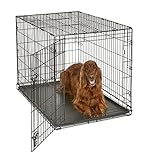
- IDEAL FOR 71-90 LB DOGS: Measures 42.5 x 28.5 x 30.5 inches - great for Australian Shepherds, Boxers, Golden Retrievers & similar breeds. Divider panel not included, so select based on adult size. Dogs near 90 lbs should consider our 48-inch model.
- WE DON'T CUT CORNERS, WE PERFECT THEM: Precision welding, rounded corner clips & slide-bolt latch with Paw Block mitigate cuts & escapes. With rigorous safety testing, New World provides peace of mind knowing your dog is safe while you're away.
- DURABLE CONSTRUCTION: Sturdy metal wire design with a protective black e-coat finish, the New World resists rust and everyday wear. Complete with leak-proof tray, rubber feet, carry handle, and tool-free assembly, it's ready for years of use.
- SUPPORTS CRATE TRAINING: Open wire design provides visibility and ventilation to help reduce anxiety. Large openings and low thresholds ease the crate training process and help your dog feel more at home.
- LIFE GOES BETTER WITH PETS: A family-owned business based in Indiana, MidWest Homes for Pets brings over 100 years of pet product expertise and a commitment to quality, rigorous safety testing, and excellent US-based customer service.
Offer low-pressure enrichment
Food-dispensing toys and snuffle mats may give a dog a quiet activity. Choose items suited to the dog’s size and chewing style, use dog-safe food and supervise as appropriate. Remove an item if the dog chews off or swallows pieces that could be unsafe.
Introduce children and resident pets gradually
Keep early introductions short, controlled and positive. Do not require the new dog to greet or play with anyone. Supervise children closely, and never leave a child alone with a dog, even if the dog has previously been comfortable around children.
Rank #4
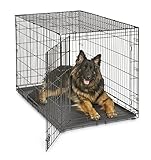
- IDEAL FOR 90-110 LB DOGS: Measures 48.5 x 30.25 x 32 inches - perfect for German Shepherds, Collies, Huskies & similar breeds. Divider panel not included, so select based on adult size. Dogs near 110 lbs should consider our 54-inch drop-pin model.
- WE DON'T CUT CORNERS, WE PERFECT THEM: Precision welding, rounded corner clips & slide-bolt latch with Paw Block mitigate cuts & escapes. With rigorous safety testing, New World provides peace of mind knowing your dog is safe while you're away.
- DURABLE CONSTRUCTION: Sturdy metal wire design with a protective black e-coat finish, the New World resists rust and everyday wear. Complete with leak-proof tray, rubber feet, carry handle, and tool-free assembly, it's ready for years of use.
- SUPPORTS CRATE TRAINING: Open wire design provides visibility and ventilation to help reduce anxiety. Large openings and low thresholds ease the crate training process and help your dog feel more at home.
- LIFE GOES BETTER WITH PETS: A family-owned business based in Indiana, MidWest Homes for Pets brings over 100 years of pet product expertise and a commitment to quality, rigorous safety testing, and excellent US-based customer service.
Meeting another dog
For a dog-to-dog introduction, AAHA recommends neutral territory, loose leashes and brief positive interactions. Feed dogs separately, and wait several weeks before allowing them to spend time together unsupervised. Give each dog space to disengage rather than expecting them to sort out every interaction themselves.
Meeting a cat
Use barriers to manage early encounters and preserve the cat’s access to high places and escape routes. Do not carry a cat toward the dog or allow the dog to chase. Keep the animals separated when you cannot supervise them.
The Tool Desk
Outbyte PC Repair FREERepair Windows errors before they cause bigger problemsFix Now →Outbyte Driver Updater FREEScan for outdated or missing drivers - takes under a minuteDriver Scan →Best Value

- IDEAL FOR 71-90 LB DOGS: Measures 42.5 x 28.5 x 30.5 inches - perfect for Australian Shepherds, Boxers, Golden Retrievers & similar breeds. For dogs near 90 lbs, consider sizing up to our 48-inch model so they have plenty of room to get comfortable.
- WE DON'T CUT CORNERS, WE PERFECT THEM: Precision welding, rounded corner clips & slide-bolt latch with Paw Block mitigate snags, cuts & escapes. With rigorous safety testing, iCrate provides peace of mind knowing your dog is safe while you're away.
- DURABLE CONSTRUCTION: Sturdy metal wire design with a protective black e-coat finish, the iCrate resists rust and everyday wear. Complete with leak-proof tray, rubber feet, carry handle, and tool-free assembly, it's ready for years of use.
- SUPPORTS CRATE TRAINING: A divider panel lets the crate grow with your dog, from puppy kennel to full-size crate. Large openings and low thresholds ease the crate training process and help your dog feel more at home.
- LIFE GOES BETTER WITH PETS: A family-owned business based in Indiana, MidWest Homes for Pets brings over 100 years of pet product expertise and a commitment to quality, rigorous safety testing, and excellent US-based customer service.
How long does it take a rescue dog to adjust?
There is no reliable deadline: the decompression period differs from dog to dog and may range from several days to a few weeks, according to Wisconsin Humane Society guidance. The “3-3-3 rule” is a rule of thumb, not a scientific timetable or promise that every dog will behave a particular way on schedule. AAHA describes three days, three weeks and three months as useful milestones for thinking about transition; the American Kennel Club also discusses those stages as general expectations.
Use the milestones as a reminder to be patient, not as a test. A dog may initially seem unusually quiet and show more of their behavior as they become comfortable. Keep responding to the individual dog in front of you rather than assuming that reaching a date means the adjustment is complete.
Arrange veterinary and behavior support
AAHA recommends taking a newly adopted dog to a veterinarian within one week to establish a health plan and identify possible medical or behavior concerns. Bring the available adoption and medication records. Contact the veterinarian sooner if you are worried about the dog’s health, or if reduced eating or drinking lasts beyond a day or two.
If the dog remains unable to settle or shows concerning behavior, discuss it with a veterinarian and a qualified canine behavior professional. New behaviors can emerge as a dog grows more comfortable; treat them as information about what support the dog needs, not as proof the adoption has failed. Positive-reinforcement group classes, private lessons and behavior consultations are possible support options; choose help suited to the dog’s needs and your circumstances.
Quick Recap
Product prices and availability are accurate as of the date/time indicated and are subject to change. Any price and availability information displayed on Amazon at the time of purchase will apply.




